This encyclopedia entry consolidates supplier-published data on marine ballast water treatment systems into a single procurement-oriented reference. Material is drawn from manufacturer datasheets, product listings, and component specifications that describe capacities ranging from 30 m3/h to 6,000 m3/h, package dimensions, power consumption, and certification status. The objective is to provide engineering, naval architecture, and shipowner audiences with a vendor-grounded baseline for evaluating equipment against the requirements of IMO BWM Convention type approval and the parallel United States Coast Guard approval framework.
Where datasheets disagree, the entry records the range rather than selecting a single number. The chapter on specifications includes a consolidated table that attributes each row to the originating vendor, since the available sources do not support a single industry-wide range and the technology mix varies by supplier. Standards clauses, market share figures, and compliance deadlines not present in the supplied sources are deliberately omitted.
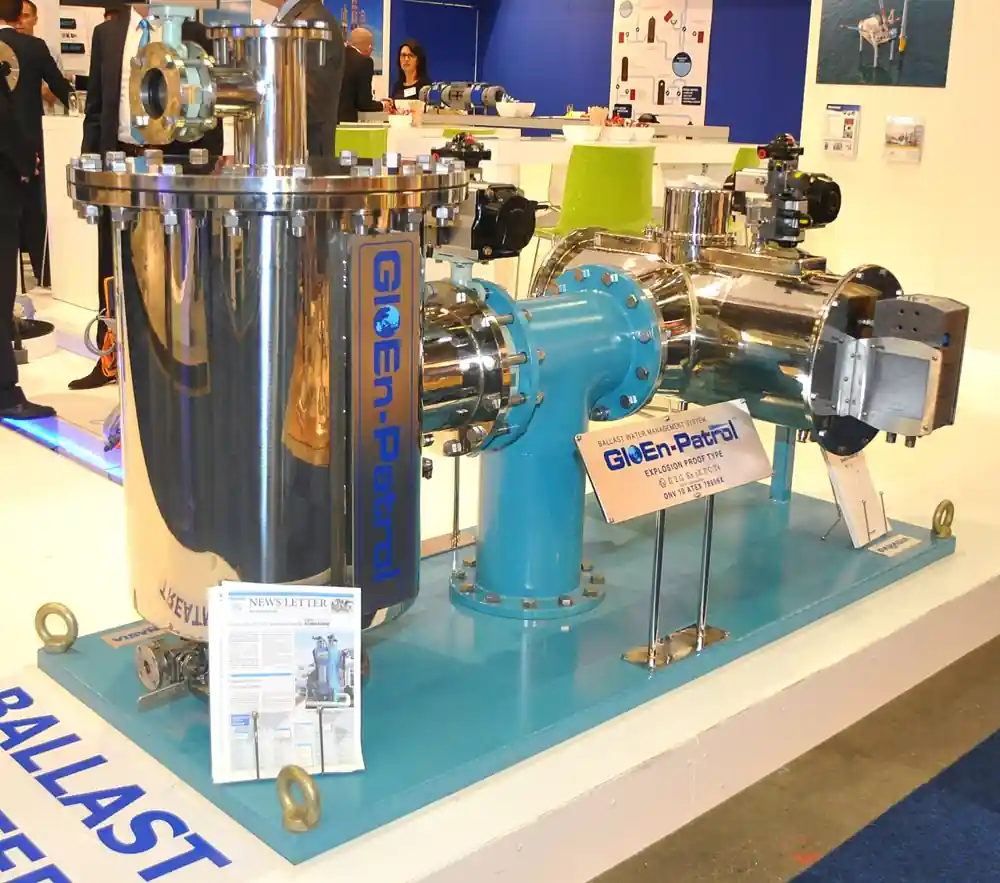
A ballast water treatment system, designated BWTS or BWMS, is the integrated machinery installed aboard commercial ships to neutralize or remove invasive aquatic organisms carried in ballast tanks. The systems documented in current supplier literature are predominantly built around two-stage architectures combining automatic backwash filtration with either medium-pressure ultraviolet irradiation, advanced oxidation, or electrochlorination. Compliance is anchored to the International Maritime Organization Convention for the Control and Management of Ships' Ballast Water and Sediments, the IMO D-2 biological discharge standard, and the United States Coast Guard approval regime.
Chapter 1 / 06
Fundamentals and Working Principle
Ballast water is taken aboard by ships to maintain trim, draft, and stability during transit and cargo operations. The same water is later discharged at ports of call, and untreated discharge is recognized as a primary vector for the translocation of invasive marine species. A ballast water treatment system, abbreviated BWTS or BWMS, is the engineered package installed in the ballast line to treat the water on uptake, on discharge, or at both transitions so that discharged water meets applicable biological discharge standards.
The treatment train in the supplier documentation consistently separates into two functional stages. The first stage is automatic backwash filtration, which physically removes larger organisms, larvae, and sediments before they enter the ballast tanks. The second stage is a disinfection unit, which in the majority of the cited datasheets is a medium-pressure ultraviolet reactor. The medium-pressure UV source emits a broad-spectrum output that is effective against smaller plankton, bacteria, and pathogens that pass through the filter. In the pure UV architecture documented for several Chinese suppliers, no chemicals are added, no chemical inventory is carried, and the system is described as producing no toxic byproducts and no radiation or noise hazard to the crew during normal operation.
For systems employing advanced oxidation, the datasheets describe a different second stage. The Jinbo Marine JB-series product line uses what the supplier calls a PLASMA unit, presented as a corrective to the perceived weakness of the medium-pressure UV (MPUV) approach in waters of high turbidity. PureBallast 3.0 documentation from Wallenius Water describes the Alfa Laval system around a Wallenius Advanced Oxidation Technology reactor, in which UV irradiation of seawater generates hydroxyl radicals that inactivate organisms. Electrochlorination product lines, exemplified by the MPPE105-EL series, generate oxidant in situ by electrolysis of side-stream seawater and inject the chlorinated stream into the ballast line.
The general working modes of a BWTS, as enumerated in the LS-series product introduction, are ballasting, de-ballasting, ballast stripping, and emergency bypass. During ballasting, the full filter-plus-disinfection train treats the inflow. During de-ballasting, the filter is bypassed in the pure UV architecture and only the UV reactor treats the flow, providing a polishing pass on water that may have experienced bacterial regrowth in the tank. Ballast stripping is the residual-water removal operation at voyage end, and the emergency bypass allows the crew to isolate the treatment system in fault conditions while continuing to take on or discharge ballast.
The control layer of the system is built around a local control unit, a remote control unit, an optional remote control box, and an electric-valve and sensor network that monitors pressures, UV intensity, filter differential pressure, and water quality. Working data is stored onboard and can be exported as a record of equipment operation during a voyage, providing long-term traceability for port state control inspections. The datasheets describe the operator interface as dual-directional, with both local and remote two-way control available.
Chapter 2 / 06
Specifications and Key Parameters
The supplier datasheets organize key parameters in a common pattern: rated treatment capacity, capacity range, power consumption, package dimensions, weight, and the electrical and environmental envelope. The Jinbo Marine datasheet reports capacities from 150 m3/h to 3,000 m3/h across the JB-150, JB-250, JB-500, JB-1000, JB-2000, and JB-3000 models, with power consumption figures given in kW and component configurations such as ARA-250*2 and ARA-1000*3 indicating parallel reactor arrangements for the higher flow rates. The Hiseamarine specification table covers a wider flow span, from the B150 at 150 m3/h up to the B6000 at 6,000 m3/h, in twelve model increments with package weight rising from 550 kg to 19,500 kg and overall length increasing from 2,410 mm to 14,490 mm.
The LS-series datasheets from Gohi Marine specify the 350 m3/h and 500 m3/h models in more granular component form. The LS350 configuration is built around one LSF-350 filter, one LSV-350 UV reactor, one LSC-1L control unit, one LSC-2R remote control unit, and one LSP-1 power unit, with rated power of 33.5 kW. The LS500 configuration mirrors the same architecture at one LSF-500, one LSV-500, and a rated power of 57.5 kW. The power consumption breakdown in both datasheets separates continuous loads (local control 1.0 kW, remote control 0.5 kW, power cabinet) from intermittent loads (remote control 0.5 kW, backflush pump 7.5 kW), summing to total installed power. The Breeze Marine BWMS 500 configuration specifies TRC of 600 m3/h, ballasting flow of 93 to 600 m3/h, de-ballasting flow of 20 to 600 m3/h, UV power of 30.24 to 50.4 kW, and total system power of 60.1 kW on a 2,170 mm by 1,570 mm skid.
Environmental and electrical envelopes are stated in near-identical language across the LS-series and RS-approved datasheets. Humidity is 0 to 95 percent when equipment is installed in the engine room, ambient temperature is 0 to 55 degrees Celsius, seawater temperature is 0 to 35 degrees Celsius, and slope and swing tolerance is 22.5 degrees in all directions both statically and dynamically. Electromagnetic compatibility is specified as voltage floating of plus or minus 10 percent and instantaneous voltage floating of plus or minus 20 percent, with frequency floating of plus or minus 5 percent and instantaneous frequency floating of plus or minus 10 percent, recovering within 3 seconds. The power supply is 380 V or 440 V at 50 Hz or 60 Hz, three-phase.
The PureBallast 3.0 component table from Wallenius Water gives reactor, lamp drive cabinet, CIP module, control cabinet, and filter dimensions with associated dry weight and, for the reactors, internal volume. The 300 m3/h AOT reactor is 1,300 by 700 by 2,000 mm at 230 kg with 80 L of internal volume, and the 1,000 m3/h AOT reactor is 1,500 by 1,000 by 2,000 mm at 330 kg with 190 L of internal volume. The MPPE105-EN range from Langemachinery reports dimensions in separate columns for the electrolyzer unit and the filter unit, with the filter unit footprint growing from 2,500 by 1,800 by 2,200 mm at the 100 to 300 m3/h tier to 3,000 by 2,600 by 2,100 mm at the 1,001 to 1,500 m3/h tier.
Where datasheets do not state a value, the entry records that fact rather than imputing a number. The Jinbo Marine specification table does not publish package dimensions or weight for the JB series. The LS-series datasheet does not publish total skid weight. The Hiseamarine table does not state power consumption. The PureBallast 3.0 entry does not specify a system-level power figure. These omissions are noted as such in the consolidated parameter table.
The following consolidated parameter table compiles the published values from the four most detailed sources. Each row is attributed to the originating vendor or datasheet. The reader should treat the table as a multi-vendor snapshot, not as an industry-wide range. No single line in the table should be read as defining the performance envelope of ballast water treatment as a category.
Parameter
Jinbo Marine JB series (S1)
Gohi Marine LS series (S2/S4/S8)
Hiseamarine B series (S3)
Wallenius PureBallast 3.0 (S5)
Rated capacity range (m3/h)
150 to 3,000
350 to 500 in cited models; 150 to 3,000 in capacity range statement
150 to 6,000
300 and 1,000 in cited reactor sizes
Min power consumption (kW)
10 (JB-150)
25.5 continuous sub-total (LS350)
varies by model
varies by model
Max power consumption (kW)
400 (JB-3000)
57.5 (LS500)
varies by model
varies by model
Package length (mm)
varies by model
varies by model
2,410 to 14,490
1,300 to 1,800 (component level)
Package width (mm)
varies by model
varies by model
1,265 to 4,500
700 to 1,800 (component level)
Package height (mm)
varies by model
varies by model
1,955 to 3,845
900 to 2,000 (component level)
Dry weight (kg)
varies by model
varies by model
550 to 19,500
230 to 445 (component level)
Power supply
varies by model
380(440)V, 50(60)Hz, 3Φ
varies by model
varies by model
Ambient temperature (°C)
varies by model
0 to 55
varies by model
varies by model
Seawater temperature (°C)
varies by model
0 to 35
varies by model
varies by model
Ex-proof marking
varies by model
Ex d e ib px IIC T4 Gb
varies by model
varies by model
Slope and swing tolerance
varies by model
22.5° all directions, static and dynamic
varies by model
varies by model
Disinfection type
PLASMA (advanced oxidation)
Medium-pressure UV
Medium-pressure UV
Advanced Oxidation Technology (AOT)
Filtration type
Automatic backwash filter (preceding PLASMA)
Automatic backwash filter
Automatic backwash filter
Pre-filter (in published component list)
Chapter 3 / 06
Types and Configurations
The supplier documentation groups ballast water treatment systems primarily by their disinfection principle. The most prevalent architecture in the cited sources is filtration combined with medium-pressure ultraviolet irradiation, marketed by Gohi Marine in both 350 m3/h and 500 m3/h form, by Hiseamarine in the B150 through B6000 capacity range, and by Breeze Marine in a 500 m3/h skid. In this architecture the filter is engaged during ballasting and bypassed during de-ballasting, while the UV reactor is engaged in both directions of flow.
The second architecture is filtration combined with an advanced oxidation reactor, presented in two distinct vendor implementations. The Jinbo Marine JB series uses a PLASMA reactor and states that the design compensates for a weakness the supplier attributes to MPUV in high-turbidity water. The datasheet also notes the use of an inner polyethylene coating on internal piping and a leaked-sensor differentiation feature in the MPUV-style chamber variant. The PureBallast 3.0 system uses a Wallenius AOT reactor in which UV photons initiate hydroxyl-radical generation in the water; the published component table lists the reactor at 300 m3/h and 1,000 m3/h flow ratings, with associated lamp drive cabinets sized accordingly.
The third architecture is filtration combined with electrochlorination. The MPPE105-EL range from Langemachinery specifies this configuration with a dedicated electrolysis unit, with the smallest model at a 100 m3/h rated capacity and the largest listed model at 800 m3/h rated capacity. Power consumption rises from 2 kW at the 100 m3/h end to 13.5 kW at the 800 m3/h end, and the dimensional envelope is consistently compact at sub-2 m height across the published variants. The MPPE105-EN range, by contrast, uses a different power figure column and is reported in a separate datasheet that also describes an electrolyzer plus filter pairing for flows of 100 to 2,000 m3/h.
A fourth configuration pattern present in the sources is the modular multi-reactor arrangement. The Jinbo Marine datasheet indicates that the JB-500 comprises two ARA-250 reactors, the JB-2000 comprises two ARA-1000 reactors, and the JB-3000 comprises three ARA-1000 reactors. The Hiseamarine B1200 model steps outside the linear pattern of single-reactor growth, presenting a wider 3,650 by 4,500 by 3,250 mm envelope that suggests a side-by-side skid configuration. The LS-series product introduction describes the same modularity principle, noting that the unit-modular design permits single installation on smaller tonnage vessels and parallel installation on large tonnage vessels, and that the system is suitable for retrofit into ships with narrow available space.
Filter, control, and power subsystems are largely standardized across the cited product lines. The LS-series uses LSF-series filters, LSV-series UV reactors, LSC-1L local control units, LSC-2R remote control units, and LSP-1 power units, in matching capacity variants. The LS350 and LS500 datasheets list these part numbers with quantities of one each. The Breeze Marine skid presents an alternative layout in which the entire system is delivered on a single 2,170 by 1,570 mm frame with a total height of 2,426 mm, and the supplier notes that the system can also be supplied as a semi-skid with loose cabinets or as separate components for installation in confined engine rooms.
Chapter 4 / 06
Selection Criteria for Procurement
The primary sizing parameter for a BWTS is the rated treatment flow, expressed in cubic metres per hour, which the supplier datasheets set against an explicit capacity range. The Gohi Marine LS350 specifies a rated capacity of 350 m3/h, the LS500 specifies 500 m3/h, the RS-approved product introduction states a capacity range of 100 to 3,200 m3/h, and the Hiseamarine B series covers 150 to 6,000 m3/h. Procurement decisions typically begin by matching the BWTS rated capacity to the ballast pump flow rate of the vessel, after which the buyer evaluates how the system is offered at the next capacity step.
The second criterion is footprint and weight. The Hiseamarine B5000 model has a published dry weight of 16,250 kg and a length of 12,075 mm, while the B500 weighs 1,250 kg at 3,600 mm long. Where the vessel has limited engine-room volume, particularly in retrofits of older tonnage, the Breeze Marine and LS-series suppliers explicitly emphasize skid footprint, semi-skid options, and delivery in separate components as a means of fitting the system into narrow spaces. The Jinbo Marine datasheet does not publish dimensions, so direct comparison against dimensioned alternatives must rely on vendor engagement.
The third criterion is power and electrical interface. The LS350 total power is 33.5 kW and the LS500 is 57.5 kW, with both units accepting 380 V or 440 V at 50 Hz or 60 Hz, three-phase. The Hiseamarine and Jinbo Marine datasheets do not state a power supply voltage; for these product lines the buyer must request the electrical interface at the quotation stage. For vessels with tight generator margins, the Breeze Marine figure of 60.1 kW total system power at 600 m3/h TRC is a useful reference point for an electrochlorination-style system.
The fourth criterion is the consumption of utilities. The LS-series datasheets specify 4 to 8 bar clean dry compressed air for the pressurized Ex-proof system, about 2.5 m3 of fresh water per storage event to replace seawater in the system, and shipbuilding-standard piping for firefighting and sampling. The maximum piping design pressure is set at 1.0 MPa, and the freshwater piping is required to be segregated from seawater piping. The supply air quality requirement is non-trivial and the buyer should verify compressor capacity on board.
The fifth criterion is the technology match to the vessel trading pattern. The pure UV architecture in the LS and Hiseamarine lines produces no chemicals and no byproducts, which is advantageous where chemical storage and handling are constrained or where the crew prefers a chemical-free installation. The PLASMA-based Jinbo Marine architecture is positioned by the supplier for high-turbidity water, which can be encountered in port areas and certain coastal waters. The electrochlorination MPPE105-EL line introduces a side-stream electrolysis subsystem and a chlorinated water stream, which is the established technology for very large flow rates and is also a technology where existing retrofits on major containership and tanker fleets have substantial operational track record.
The sixth criterion is certification scope. The Jinbo Marine datasheet lists ABS, LR, BV, DNVGL, NK, KR, IRS, RMRS, and CCS. The RS-approved 350 m3/h and the USCG-approved 500 m3/h listings from Gohi Marine list CCS, BV, ABS, RMRS, USCG, and DNV-GL. A buyer ordering for a vessel flagged with a specific class society should confirm that the supplier certificate list covers that class for the specific system variant. Where USCG approval is required for discharge in United States waters, the buyer should verify the system is on the current USCG type-approved list under the date of order.
Chapter 5 / 06
Standards, Compliance, and Testing
The international regulatory framework is the International Maritime Organization Convention for the Control and Management of Ships' Ballast Water and Sediments, with the IMO D-2 biological discharge standard defining the maximum allowable concentrations of viable organisms in discharged ballast water. The Gohi Marine 350 m3/h and 500 m3/h product introductions state that the LS BWMS has been type approved in accordance with MEPC.300(72), also referenced as the new G8, and the BWMS Code, by China Classification Society, and that the system fully meets the D-2 discharge standard. The datasheet titles also reference IMO MEPC.279(70).
The datasheet titles for both the 350 m3/h and the 500 m3/h variants from Gohi Marine reference the RS and USCG approval pathways respectively. RS in this context refers to the Russian Maritime Register of Shipping, and the title 'RS Approved IMO MEPC.279(70) Standard 350m3/h Marine Ballast Water Treatment System BWTS' indicates that the supplier has obtained approval from the Russian Register against the same IMO standard that underpins the broader convention compliance regime. The 500 m3/h unit carries the 'USCG Approved' title, indicating type approval by the United States Coast Guard in addition to the IMO pathway.
The certification block in the Jinbo Marine product datasheet lists ABS, LR, BV, DNVGL, NK, KR, IRS, RMRS, and CCS, which are the American Bureau of Shipping, Lloyd's Register, Bureau Veritas, DNV GL, Nippon Kaiji Kyokai, Korean Register, Indian Register of Shipping, Russian Maritime Register of Shipping, and China Classification Society respectively. The RS-approved 350 m3/h and USCG-approved 500 m3/h product pages list CCS, BV, ABS, RMRS, USCG, and DNV-GL. The breadth of class society coverage in the cited product lines is a procurement-relevant signal because it indicates the supplier has invested in the type approval process for multiple major flags.
Testing and operational documentation requirements are addressed at the equipment level by the data recording and traceability features described in the LS-series product introduction. The supplier states that the system working data can be stored and recorded to reflect the operation of the equipment during the ship's voyage and that the records can be provided to inspection departments on demand. This data-recording function is increasingly material under the IMO Convention experience-building phase and the more prescriptive BWMS Code, and it is also relevant to the USCG type approval reporting framework.
Working condition tolerances, where stated, are common to the cited UV-based product lines. The LS-series specifies humidity 0 to 95 percent in the engine room, ambient temperature 0 to 55 degrees Celsius, seawater temperature 0 to 35 degrees Celsius, and slope and swing tolerance of 22.5 degrees in all directions both statically and dynamically. The electromagnetic compatibility envelope is voltage floating plus or minus 10 percent with instantaneous tolerance of plus or minus 20 percent, and frequency floating plus or minus 5 percent with instantaneous tolerance of plus or minus 10 percent recovering in 3 seconds. These figures are not duplicated in the Jinbo Marine, Hiseamarine, or PureBallast 3.0 datasheets, and a buyer comparing product lines should request the same envelope from each supplier for parity.
Chapter 6 / 06
Market Landscape and Buying Process
The supplier set in the cited sources is concentrated among Chinese ship-equipment manufacturers, with Jinbo Marine, Gohi Marine, Hiseamarine, Langemachinery, and Breeze Marine as the named vendors, alongside the Alfa Laval and Wallenius Water product line distributed internationally as PureBallast 3.0. The Jinbo Marine datasheet places the origin as China. The RS-approved 350 m3/h Gohi Marine listing states the place of origin as China and the brand as GH. The commercial terms disclosed in the Gohi Marine listing include a minimum order quantity of one set, negotiable price, plywood box packaging, delivery time of 15 to 60 days, payment terms of L/C and T/T, and a supply ability of 60 sets per month.
Warranty terms are stated by Jinbo Marine as 12 months unless specified otherwise. The warranty framing in the cited sources is short and the buyer is expected to negotiate extended terms separately, particularly for newbuild contracts where the commissioning period can consume a meaningful fraction of a standard warranty. The supplier can supply to customer requirements including drawings, class certificate needs, and delivery schedule, which is the typical customization posture of a BWTS vendor selling to yards and shipowners.
The product datasheets frame the category in terms of capacity steps and modularity. The Jinbo Marine JB series is offered in six model steps from 150 m3/h to 3,000 m3/h, the Hiseamarine B series is offered in thirteen model steps from 150 m3/h to 6,000 m3/h, the LS-series covers a published capacity range of 150 to 3,000 m3/h, and the PureBallast 3.0 documentation discloses reactors at 300 m3/h and 1,000 m3/h. This range coverage maps onto the practical flow rate demand of the merchant fleet, from coastal tankers and small bulk carriers in the 150 to 500 m3/h band to Capesize bulk carriers, very large crude carriers, and ULCS in the 1,000 to 3,000 m3/h band, with modular parallel installation for the highest flow rates.
The buying process is the conventional marine equipment procurement flow. A shipowner or yard issues an enquiry stating the required treatment flow, the vessel flag, the classification society, the engine room envelope, and any preference for chemical-free operation. The supplier responds with a technical offer, a price, and a delivery period, the price being negotiable in the cited Chinese supplier offerings. The order is followed by engineering deliverables, including drawings, type approval certificates, and the operating manual, and concludes with a factory acceptance test, shipping, and onboard commissioning. Where the vessel is bound for United States waters, the USCG type approval status of the specific system is confirmed at the enquiry stage.
Beyond the datasheet-level facts, this entry does not present market share figures, vendor capability claims, or forecast data that are not present in the supplied sources. Where the sources state that the supplier can supply according to the customer requirement, that statement is recorded; where they do not, the entry records the absence. This conservative approach is intentional, because the published category-level market share data, vendor track-record claims, and forecast ranges referenced in trade press are not included in the supplied source set and cannot be cited from it.
FAQ
What is a ballast water treatment system?
A ballast water treatment system is the engineered package installed on a commercial ship to treat ballast water on uptake, on discharge, or on both, so that discharged water meets applicable biological discharge standards. The systems in current supplier literature combine automatic backwash filtration with a disinfection stage that may be medium-pressure UV, advanced oxidation, or electrochlorination.
What is the D-2 standard and which systems claim to meet it?
The D-2 standard is the IMO biological discharge standard for ballast water, defining the maximum allowable concentrations of viable organisms in discharged water. The Gohi Marine LS-series product introduction states that the LS BWMS has been type approved in accordance with MEPC.300(72) and the BWMS Code by China Classification Society and fully meets the D-2 discharge standard.
What capacity range do the cited ballast water treatment systems cover?
The cited product lines span from 100 m3/h to 6,000 m3/h. The Jinbo Marine JB series covers 150 to 3,000 m3/h, the Hiseamarine B series covers 150 to 6,000 m3/h, the RS-approved Gohi Marine listing states a capacity range of 100 to 3,200 m3/h, and the Langemachinery MPPE105-EL electrochlorination range starts at 100 m3/h rated capacity.
How is the treatment process controlled during ballasting versus de-ballasting?
In the pure UV architecture documented by the LS-series, the full filter plus UV train is engaged during ballasting, and the filter is bypassed during de-ballasting with only the UV reactor treating the flow. This arrangement provides a polishing pass on water that may have experienced bacterial regrowth in the ballast tanks, while the general working modes also include ballast stripping and an emergency bypass.
What are the environmental and electrical operating envelopes?
The LS-series datasheets specify humidity 0 to 95 percent in the engine room, ambient temperature 0 to 55 degrees Celsius, seawater temperature 0 to 35 degrees Celsius, slope and swing of 22.5 degrees in all directions both statically and dynamically, and a power supply of 380 or 440 V at 50 or 60 Hz, three-phase. Electromagnetic compatibility is given as voltage floating plus or minus 10 percent and instantaneous tolerance of plus or minus 20 percent, with frequency floating plus or minus 5 percent and instantaneous tolerance of plus or minus 10 percent, recovering in 3 seconds.
Which class societies have certified the cited ballast water treatment systems?
The Jinbo Marine datasheet lists ABS, LR, BV, DNVGL, NK, KR, IRS, RMRS, and CCS. The RS-approved 350 m3/h and USCG-approved 500 m3/h product pages list CCS, BV, ABS, RMRS, USCG, and DNV-GL. A buyer should confirm that the specific system variant is certified for the vessel flag and class society at the time of order.
What commercial terms are disclosed in the cited supplier listings?
The Gohi Marine 350 m3/h listing states a minimum order quantity of one set, negotiable price, plywood box packaging, delivery time of 15 to 60 days, payment terms of L/C and T/T, and a supply ability of 60 sets per month. The Jinbo Marine datasheet states a 12-month warranty unless specified otherwise and confirms supply to customer requirements including drawings, class certificate needs, and delivery schedule.
.JPG)