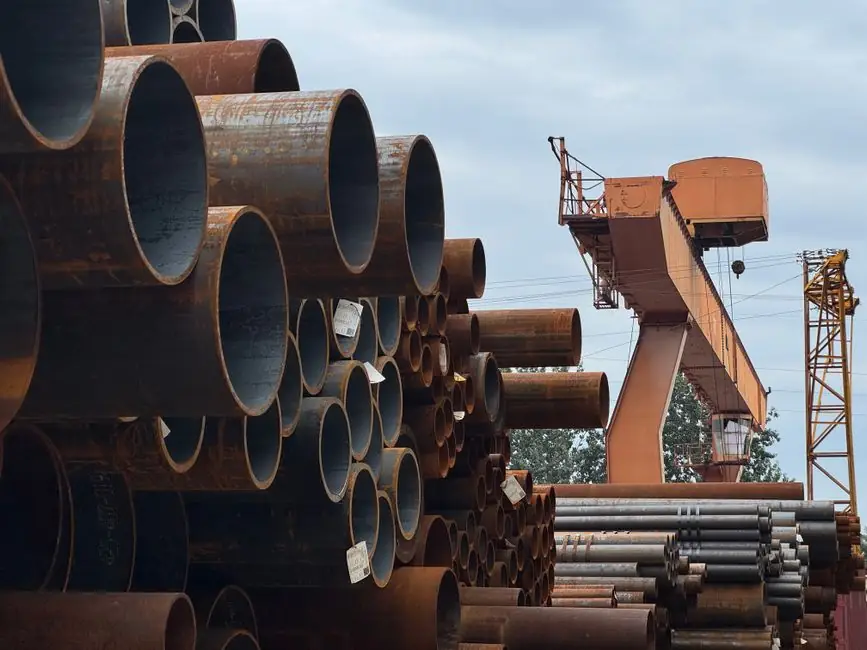
Building pipe and hardware occupies a foundational role in construction, serving two principal functions. The first is the conveyance of water, gas, oil, drainage, and chemical media within plumbing, HVAC, fire protection, and process systems. The second is structural and architectural use, where pipe sections, slip-on fittings, beam clamps, and guardrail components form frames, racks, handrails, and modular assemblies.
Specification professionals must reconcile application requirements against a wide envelope of material grades, schedule or gauge designations, end finishes, joining methods, and coating systems. International standards such as ASTM, EN, GB/T, and ISO establish the test methods, dimensional tolerances, and material chemistries referenced in project documents. The reference manual below organizes the category into six chapters covering principles, parameters, configurations, selection, compliance, and the purchasing landscape.
Building pipe and hardware encompasses the standardized steel and non-ferrous tubes, couplings, flanges, brackets, and connectors used to move fluids and to assemble structural and architectural elements in residential, commercial, and industrial construction. Procurement decisions in this category hinge on aligning mechanical properties, dimensional tolerances, corrosion protection, and applicable standards with the project's pressure, temperature, and load requirements.
Chapter 1 / 06
Fundamentals and Working Principle
Building pipe is a hollow tubular section manufactured by seamless hot-rolling, cold-drawing, or electric resistance welding (ERW), then cut to standardized lengths. The source data for construction steel pipe describes these three manufacturing routes and confirms that the resulting products can be supplied in round, square, or rectangular cross-sections. The wall and diameter combination determines the section's resistance to internal pressure, external loading, and bending moments.
Hardware used in building pipe assemblies spans two functional families. Structural fittings, such as the Kee Klamps, Kee Lite, and square fittings described in the Simplified Building product catalog, are slip-on components that grip the outside diameter of standard pipe and are secured with a set screw. These fittings convert a length of pipe into a structural node without welding, allowing field assembly and later disassembly for reconfiguration or relocation.
Joining and connection hardware for pressure piping, by contrast, relies on thread, groove, flange, or weld interfaces to create leak-tight boundaries under internal pressure. Pipe-to-pipe connectors, beam clamps, blind bolts, grating clips, and S-5 clamps form a separate hardware category used to attach pipe to structural steel members or to combine pipe with other building elements. The selection between slip-on and welded or threaded approaches is governed by load type, permanence, inspectability, and the governing standard.
Working principle for pressure service rests on the hoop stress equation, where the wall thickness and outer diameter establish the maximum allowable internal pressure at a given material yield. For structural service, pipe acts as a column or beam, and the relevant properties are moment of inertia, section modulus, and effective length. Because pipe simultaneously presents an inside diameter for fluid service and a load-bearing cross-section, dual-use applications such as rack frames and exposed handrails are common in the category.
Corrosion protection is integral to the working principle. Surface treatments documented for construction steel pipe include black varnish, galvanization, oiling, and anti-rust coatings. In the Simplified Building product comparison, Gator Tubing is described as offering Gator Shield, which the source notes is 'more resistant to corrosion than standard galvanization,' illustrating that surface engineering is itself a specification parameter rather than an afterthought.
Chapter 2 / 06
Specifications and Key Parameters
The dominant parameter set for construction steel pipe covers outer diameter (OD), wall thickness (WT), length, and the applicable material grade. Per the Lyrfy Steel product parameter table, the outer diameter range spans 21.3 mm to 610 mm, the wall thickness range spans 1.5 mm to 20 mm, and the standard stock length is 6 m to 12 m with customization available. Dimensional tolerances are listed as OD ±1 percent, WT ±10 percent, and length tolerance ±50 mm.
Material grade selection follows the standard or region of the project. The Lyrfy source lists Q195, Q235, Q345, S235JR, S355JR, ASTM A36, and equivalents as the available grades, paired with standards GB/T 8162, GB/T 8163, ASTM A53, ASTM A500, and EN 10210. The Simplified Building guide notes that structural steel pipe sold for handrail and industrial applications is 12 gauge (Gator Tubing) or Schedule 40 (galvanized steel), confirming that gauge and schedule number systems are the primary thickness classifiers used at distribution level in North America.
Pressure and temperature envelopes for general building pipe are described in the China Build Material source as a pressure rating of 150 PSI to 3000 PSI and a temperature range of -20 degrees Fahrenheit to 400 degrees Fahrenheit (-29 degrees Celsius to 204 degrees Celsius). The same source categorizes the diameter envelope from one half inch to 24 inches, and wall thickness from 0.5 mm to 6 mm, with explicit acknowledgement that the wall thickness range varies by material and application.
Mechanical performance for construction steel pipe is reported in the Lyrfy source as a tensile strength range of 400 to 550 MPa. End finish options documented in the same source include plain end, beveled end, and threaded end. Each end condition supports a different joining method: plain ends for coupling or grooved connections, beveled ends for field welding, and threaded ends for screwed fittings.
Testing and inspection methods called out in the construction steel pipe parameter table are hydrostatic test, ultrasonic test, dimensional inspection, and surface check. Surface quality is specified as smooth surface without cracks, dents, or visible defects. The China Build Material source adds that corrosion resistance is achieved through special coatings and that the products are described as compliant with ASTM, ISO, and ANSI certification systems.
The hardware side of the category inherits the pipe dimensions because fittings must match the outside diameter of the pipe they receive. The Simplified Building catalog lists three fitting families: Kee Klamps (steel, structural), Kee Lite (aluminum, corrosion resistant and light), and square fittings (galvanized steel, for square tubing). Connection hardware such as beam clamps, blind bolts, grating clips, and S-5 clamps is grouped separately and is selected based on the host structural member profile rather than pipe diameter.
Parameter
Construction Steel Pipe (Lyrfy source)
Building Pipe Range (China Build Material source)
Simplified Building structural pipe (per source)
Standards referenced
GB/T 8162, GB/T 8163, ASTM A53, ASTM A500, EN 10210
ASTM, ISO, ANSI compliant
Not listed in source
Material grades
Q195, Q235, Q345, S235JR, S355JR, ASTM A36, or equivalent
High-grade steel, PVC, or copper options available
Steel
Manufacturing method
Hot-rolled seamless, cold-drawn seamless, or electric resistance welded (ERW)
Not listed in source
Not listed in source
Outer diameter range
21.3 mm to 610 mm
1/2 inch to 24 inches
Not listed in source
Wall thickness range
1.5 mm to 20 mm
0.5 mm to 6 mm (varies by material and application)
12 gauge (Gator Tubing) or Schedule 40 (galvanized steel)
Length
6 m to 12 m (customized sizes available)
Not listed in source
Not listed in source
Tensile strength
400 to 550 MPa (typically)
Not listed in source
Not listed in source
Pressure rating
Not listed in source
150 PSI to 3000 PSI
Not listed in source
Temperature range
Not listed in source
-20 degrees F to 400 degrees F (-29 degrees C to 204 degrees C)
Not listed in source
Surface treatment
Black varnished, galvanized, oiled, or anti-rust coating
Special coatings available
Gator Shield (more resistant to corrosion than standard galvanization)
End finish
Plain end, beveled end, or threaded end
Not listed in source
Not listed in source
Dimensional tolerance
OD ±1 percent, WT ±10 percent, length tolerance ±50 mm
Building pipe sorts into four functional configurations in the source material: structural pipes, plumbing pipes, industrial pipes, and specialty pipes. The China Build Material source assigns carbon steel to structural pipes with a 2 inch to 24 inch range and a 1500 PSI maximum pressure, PVC and copper to plumbing pipes with a one half inch to 4 inch range and 300 PSI maximum pressure, and stainless steel to industrial pipes with a 1 inch to 12 inch range and 3000 PSI maximum pressure. These four designations cover the majority of building pipe procurement profiles.
Cross-sectional shape provides a second axis of configuration. Round pipe is the default for pressure service, while square and rectangular sections are used in structural and architectural applications where flat faces simplify fitting and finish. The Lyrfy source lists round, square, or rectangular as available shape options for construction steel pipe, and the Simplified Building catalog includes a dedicated Square Fittings line in galvanized steel for square tubing, confirming that the square format is a stocked structural configuration rather than a custom order.
Material family determines the corrosion profile and the joining method. Steel pipe dominates structural and high-pressure work and is supplied in black, galvanized, or specially coated variants. PVC and copper are documented for plumbing supply and drainage within the building pipe line. Stainless steel, copper, and specialty composites appear in industrial and chemical service per the China Build Material table. Where corrosion resistance is the priority, the Simplified Building source identifies Kee Lite aluminum fittings as 'corrosion resistant and light' alongside Gator Shield tubing.
Joining and connection hardware divide into slip-on structural fittings, threaded or grooved pressure fittings, and steel-to-steel connectors. Slip-on structural fittings include Kee Klamps, Kee Lite, and square fittings. Steel-to-steel connectors per the Simplified Building catalog include beam clamps, blind bolts, grating clips, and S-5 clamps. Each family is engineered for a specific interface: pipe-to-pipe, pipe-to-flat, or pipe-to-steel-beam.
Pre-engineered kit configurations are a common procurement unit. The Simplified Building source documents handrail kits for stairs, walls, and ramps, ADA railing kits, hybrid wall and stair mounted kits, OSHA guardrail kits, stair mounted handrail kits, wall mounted handrail kits, industrial pipe bed frames, and fitness equipment kits. Each kit packages pipe, fittings, and mounting hardware into a single part number, simplifying the bill of materials and shifting conformance responsibility to the kit supplier.
Specialty configurations round out the category. The China Build Material source describes insulated pipes with pre-installed foam or PVC insulation for energy efficiency and freeze protection, fire-rated pipes with special ceramic coatings providing 2 to 4 hour fire resistance, and soundproof pipes with dense composite materials providing noise reduction up to 50 dB. These specialty configurations are procured against application-specific performance criteria rather than the general building pipe envelope.
Chapter 4 / 06
Selection Criteria for Procurement
Application drives the first selection branch. The China Build Material source maps the application to a typical pipe type: residential construction uses one half inch to 2 inch copper or PVC for plumbing, commercial buildings often require 3 inch to 6 inch steel pipes for HVAC systems, industrial facilities may need specialty pipes with chemical resistance, and infrastructure projects use large diameter concrete or steel pipes for drainage. The same source also flags pressure requirements, temperature conditions, corrosion resistance needs, local building codes, and budget as the other primary selection factors.
Material compatibility with the conveyed medium must be confirmed before mechanical sizing. Plumbing systems prioritize pressure ratings and chemical resistance per the China Build Material guidance, while industrial chemical transport requires stainless or specialty alloy pipe. The Lyrfy source notes weldability and forming performance as 'excellent' for the listed carbon steel grades, which supports the use of welded fabrication for one-off structural assemblies and modified spool pieces in process work.
Dimensional and tolerance selection follows the governing standard. Where GB/T 8162, GB/T 8163, ASTM A53, ASTM A500, or EN 10210 is referenced, the Lyrfy tolerance envelope of OD ±1 percent, WT ±10 percent, and length tolerance ±50 mm applies. Where Schedule 40 or 12 gauge designations are referenced, the Simplified Building source indicates that the Gator Tubing SKU is 12 gauge steel and the galvanized SKU is Schedule 40, and that both products are 'industrial looking metal pipe finish' suitable for most industrial applications.
End finish and joining method must align with the installation plan. Plain end suits grooved or coupling joints that allow field adjustment; beveled end is required for butt welding where the weld is the primary pressure boundary; threaded end supports screwed fittings in lower pressure and smaller diameter work. The Lyrfy source enumerates these three end finishes as the standard offering, with other end configurations supplied on request.
Coating selection is governed by environment and life-cycle expectations. The Lyrfy source lists black varnished, galvanized, oiled, and anti-rust coating as standard surface treatments. The Simplified Building source introduces Gator Shield on Gator Tubing, described as more resistant to corrosion than standard galvanization. The China Build Material source adds that special coatings are available to extend corrosion resistance beyond the standard offering. Specifiers should match the coating life expectancy to the design life of the assembly and to any local atmospheric corrosivity classifications.
Procurement documentation should include the standard, grade, dimensions, tolerance, end finish, coating, test regime, and inspection acceptance criteria. The China Build Material source recommends that the specifier consult local building codes for installation-specific requirements such as support spacing (typically 4 to 6 feet for horizontal pipes), thermal expansion provisions for metal pipes, and minimum drainage slope (one quarter inch per foot minimum). The Lyrfy source confirms that hydrostatic test, ultrasonic test, dimensional inspection, and surface check constitute the standard inspection regime.
Chapter 5 / 06
Standards, Compliance, and Testing
Building pipe procurement in the supplied sources is anchored to four primary standards families: Chinese GB/T, American ASTM, European EN, and international ISO. The Lyrfy source lists GB/T 8162, GB/T 8163, ASTM A53, ASTM A500, EN 10210, or customer requirements as the standards referenced for construction steel pipe, and Q195, Q235, Q345, S235JR, S355JR, ASTM A36, or equivalent as the corresponding material grades. The China Build Material source states that the building pipe line is ASTM, ISO, and ANSI compliant without listing a specific clause number.
GB/T 8162 is identified by the Lyrfy source as a 'Structural Steel Pipe' standard (per the source's hot tag list), and GB/T 8163 is implied for fluid conveyance; both are referenced as the framework for the listed grade, dimensional, and tolerance parameters. ASTM A53 and ASTM A500 are the North American standards most often paired with Schedule 40 and structural round or shaped tube respectively. EN 10210 covers hot-finished structural hollow sections in Europe, and the S235JR and S355JR grades align with the European structural steel norm.
Test methods documented in the Lyrfy source cover both the pressure boundary and the material integrity. Hydrostatic test confirms leak-tightness at a defined internal pressure, ultrasonic test detects internal and surface defects in the pipe body, dimensional inspection validates the OD, WT, and length against tolerance, and surface check confirms the absence of cracks, dents, or visible defects. The Lyrfy source states that surface quality must be 'smooth surface without cracks, dents, or visible defects' as a pass criterion.
Fire and acoustic compliance are addressed through specialty pipe configurations. The China Build Material source documents fire-rated pipes with special ceramic coatings providing 2 to 4 hour fire resistance, and soundproof pipes with dense composite materials providing noise reduction up to 50 dB. These performance levels are application-specific and are typically invoked in project specifications where code-mandated fire resistance or acoustic isolation is required, rather than as a default.
ADA and OSHA compliance shapes the handrail and guardrail subset of the category. The Simplified Building source describes ADA Railing Systems as 'custom ADA railing systems designed by experts' and offers an ADA Guide covering the basics required for an ADA compliant handrail. The same source describes OSHA Guardrail as 'a cost-effective way to protect workers, pedestrians, and equipment,' indicating that OSHA-aligned guardrail configurations are stocked as standard kits.
Inspection acceptance for procurement should reference the standard explicitly and the test reports required. For construction steel pipe, the specifier should require the Lyrfy source's four-test regime and should confirm that the material certificate references the listed grade. For building pipe at large, the China Build Material source's installation guidance, including support spacing of 4 to 6 feet and drainage slope of one quarter inch per foot minimum, should be cross-referenced against the applicable plumbing or mechanical code.
Chapter 6 / 06
Market Landscape and Buying Process
The market for building pipe and hardware is split between mill-level producers, regional distributors, and pre-engineered kit suppliers. The Lyrfy source positions itself as a manufacturer of construction steel pipe and references adjacent offerings such as 5310 high pressure boiler tube, 8162 structural steel pipe, ASTM A106 seamless carbon steel pipe, and seamless fluid tube. The China Build Material source is presented as a supplier of high-quality customized building pipe solutions, listing steel, PVC, and copper options. Simplified Building is presented as a kit-and-fitting distributor organized around the Kee Klamps, Kee Lite, square fittings, and pre-engineered handrail, ADA, guardrail, and furniture kits.
Product breadth is a useful differentiator. Lyrfy covers a wide OD and WT envelope (21.3 mm to 610 mm OD, 1.5 mm to 20 mm WT) suited to infrastructure and structural work, with 6 m to 12 m standard length. China Build Material covers a wide material and pressure envelope (1/2 inch to 24 inches, 150 PSI to 3000 PSI) and includes specialty pipe configurations for fire, acoustic, and insulation duties. Simplified Building concentrates on the 12 gauge and Schedule 40 steel pipe sizes that match its Kee Klamps, Kee Lite, square fittings, and pre-engineered kit families.
Customization capability is documented at both mill and distributor tiers. Lyrfy states that 'customized sizes available' for length, and that the standard offering can be modified to customer requirements for grade, OD, and WT. China Build Material describes its offering as 'high-quality customized solutions' and offers to help assess project needs across cost, durability, maintenance, and local regulations. Simplified Building describes a 'I've Got An Idea' project assistance path and a 'Help Me' fitting selection path, with an in-house project specialist team.
The buying process follows a recognizable sequence. The specifier defines the application, medium, pressure, temperature, and governing standard. A shortlist of suppliers is drawn from the categories that hold the relevant certifications: mill suppliers for production runs against GB/T 8162, GB/T 8163, ASTM A53, ASTM A500, or EN 10210, and kit suppliers for handrail, ADA, OSHA guardrail, and modular structural assemblies. The supplier is asked to provide material certificates, dimensional and test reports per the Lyrfy inspection regime, and reference projects of comparable scale.
Pricing drivers visible in the sources include material grade, dimensional envelope, surface treatment, end finish, and test regime. Higher grades such as S355JR or Q345 command a premium over Q195 or S235JR, and thicker walls within the 1.5 mm to 20 mm envelope increase material cost proportionally. Coatings beyond the standard black, galvanized, or oiled finish, including Gator Shield, anti-rust, ceramic fire-rated, foam insulated, and acoustic composite, each add cost and lead time. The Simplified Building source highlights the price positioning of Gator Tubing as 'less expensive than other pipe' in the first-choice descriptor.
Lead time and logistics are influenced by length and customization. Standard 6 m to 12 m stock lengths are typically the shortest lead time, with custom lengths, custom end finishes, and special coatings extending schedules. Kit suppliers offer the shortest overall procurement cycle for handrail and guardrail because pipe, fittings, and hardware are pre-matched. The buyer should align the procurement method with project schedule: mill or distributor direct for engineered bill-of-material work, kit supplier for code-compliant handrail and guardrail.
FAQ
What is the typical outer diameter range for construction steel pipe?
Per the Lyrfy Steel product parameter table, construction steel pipe is offered in an outer diameter range of 21.3 mm to 610 mm. Standard stock lengths are 6 m to 12 m, with the OD tolerance stated as ±1 percent.
Which standards are most commonly referenced for building pipe?
The Lyrfy source lists GB/T 8162, GB/T 8163, ASTM A53, ASTM A500, and EN 10210 as the standards referenced for construction steel pipe. The China Build Material source additionally indicates that the building pipe line is ASTM, ISO, and ANSI compliant.
What pressure and temperature limits apply to general building pipe?
The China Build Material source states a pressure rating of 150 PSI to 3000 PSI and a temperature range of -20 degrees Fahrenheit to 400 degrees Fahrenheit (-29 degrees Celsius to 204 degrees Celsius) for the building pipe line. Specific ratings within these envelopes depend on the selected material, diameter, and wall thickness.
How does Schedule 40 pipe differ from 12 gauge structural pipe?
The Simplified Building source describes Gator Tubing as 12 gauge steel and the galvanized option as Schedule 40 steel. Both share an industrial metal pipe finish, but Schedule 40 follows the North American schedule wall-thickness system used in pressure and structural work, while 12 gauge is a thinner structural wall commonly used in furniture, handrail, and rack applications.
What coating options are available for corrosion protection?
The Lyrfy source lists black varnished, galvanized, oiled, and anti-rust coating as the standard surface treatments. The Simplified Building source introduces Gator Shield, described as more resistant to corrosion than standard galvanization. The China Build Material source adds that special coatings are available for applications requiring extended corrosion life.
What inspection tests are required for construction steel pipe?
The Lyrfy source specifies four inspection methods: hydrostatic test, ultrasonic test, dimensional inspection, and surface check. The source defines surface quality as smooth surface without cracks, dents, or visible defects, and confirms hydrostatic and ultrasonic testing as the standard non-destructive regime.
What installation practices are recommended for building pipe systems?
The China Build Material source recommends following manufacturer guidelines, using the correct joining method for the material, providing support spacing of typically 4 to 6 feet for horizontal pipes, allowing for thermal expansion in metal pipes, and maintaining a minimum drainage slope of one quarter inch per foot. Local building codes govern the specific requirements on any given project.