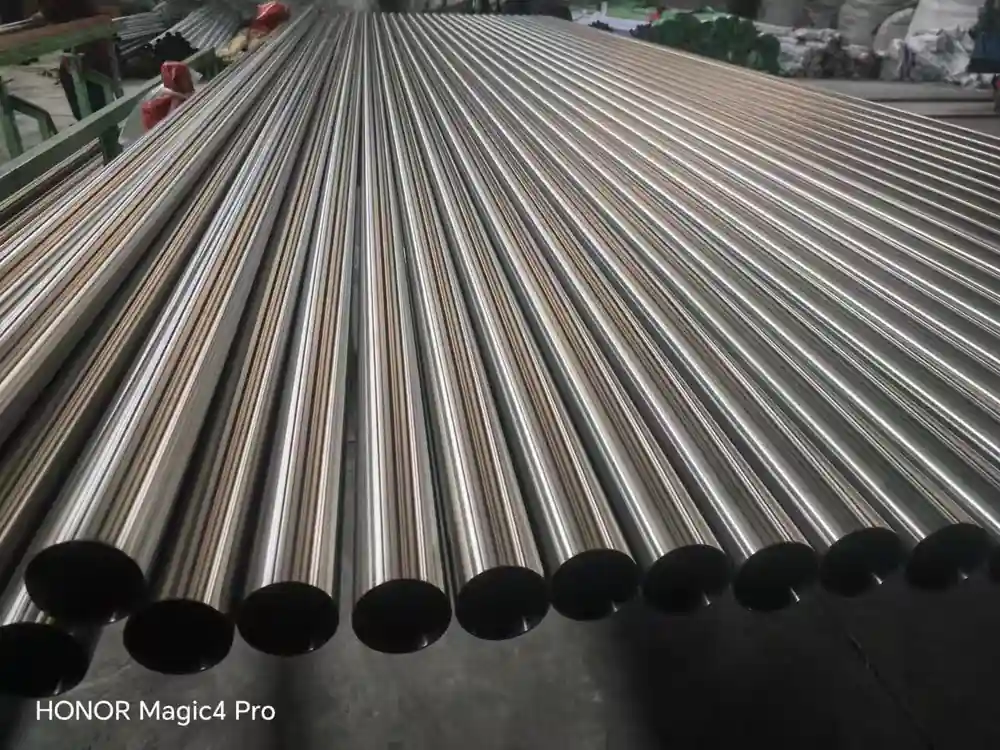
Duplex 2205 is the workhorse grade of the duplex stainless steel family, UNS S32205 (and its predecessor S31803), a nitrogen-alloyed chromium-nickel-molybdenum steel whose microstructure is roughly half austenite and half ferrite. That dual phase delivers about twice the yield strength of 316L with chloride pitting and stress-corrosion resistance that austenitic grades cannot match at the same nickel cost.
Specifying 2205 means specifying a product form and its correct ASTM standard: plate to ASTM A240, seamless and welded pipe to A790, tube to A789, welded pipe with filler to A928, wrought fittings and flanges to A182 (grades F51/F60), castings to A890. Each form carries its own chemistry limits, mechanical minimums, and test regime, and the RFQ that names the wrong product standard buys the wrong material with correct-looking paperwork.
The grade sits inside the corrosion-resistant alloy ladder. Below it, 316L stainless serves moderate chloride duty at half the strength; above it, super duplex grades and the nickel alloy family, 6Mo austenitics and beyond, take hotter and saltier service at several times the cost. 2205 is the economic middle of that ladder, which is why it anchors desalination, chemical, oil and gas, and infrastructure water service worldwide.
Duplex 2205 trades nickel for nitrogen and structure: half ferrite for strength, half austenite for toughness, with a pitting resistance number that justifies the upgrade from 316L on engineering grounds. This page decodes the composition, the phase balance and its temperature limits, the product-standard map by form, the PREN and wall-thinning arithmetic, and the welding and procurement lines that keep the upgrade honest from mill certificate to installed spool.
Chapter 1 / 06
What Is Duplex 2205
Nominal composition: about 22 percent chromium, 5 percent nickel, 3 percent molybdenum, and 0.17 percent nitrogen over an iron balance, with carbon held at or below 0.030 percent. The UNS S32205 version tightened the original S31803 ranges to guarantee corrosion performance; both names circulate, and ASTM specifications list them separately, so the purchase order writes the UNS number, not the trade shorthand. The 50/50 austenite-ferrite balance is achieved by design, controlled through composition and solution annealing, not left to chance. European practice knows the same metal as 1.4462, and the name on the mill certificate will follow the market it was rolled for; the RFQ that writes UNS S32205 alongside EN 1.4462 removes the last ambiguity.
The selection question arises in chloride-bearing service where 316L is marginal: seawater coolers and firewater systems, desalination plants and brine piping, chemical process equipment with hot chlorides, oil and gas flowlines and pipework, pulp bleaching washers, bridges and infrastructure exposed to de-icing salts and coastal atmosphere. The buyer is deciding between a cheaper austenitic grade that may pit or crack in a few years, 2205 as the engineering answer, and costlier super duplex or 6Mo grades for the harshest chemistry and temperature. Each of those duties has a reference installation history measured in decades now, which is itself a specification input: a grade with a recorded service record in the exact duty is worth more than an equivalent PREN number with none.
What is actually being decided is a strength-plus-corrosion package. Yield strength at 450 MPa minimum (65 ksi) against 316L's roughly 170 MPa lets designers thin sections by 25 to 40 percent in pressure and structural parts, which is where 2205 projects often pay for themselves despite a premium per kilogram. The pitting resistance equivalent number, PREN, lands in the mid-thirties against 316L's mid-twenties, and chloride stress-corrosion cracking, the silent killer of austenitics in hot brine, is essentially absent in 2205 at temperatures where 316L already cracks. Both facts belong in the calculation, not just the price-per-kg comparison.
In the materials library, 2205 is one rung of a ladder buyers climb deliberately. The general stainless steel page covers the austenitic families; carbon steel and alloy steel serve dry and moderate duty; cast iron holds water and drainage service; up the corrosion ladder sit super duplex, then the nickel alloy family for hot acids and seawater at temperature, and titanium alloy for the most aggressive condenser and heat-exchanger duty. Choosing a rung is a corrosion-mechanics exercise, and Chapter 5 works it as one.
The product forms 2205 actually ships in
Each product form carries its own market reality. A stainless pipe order in 2205 competes on schedule and heat availability as much as price, because fewer mills run duplex than run austenitics; a steel plate order in 2205 comes from a plate mill with heat-treatment certificates per plate. Structural sections are the thin end of the catalog: steel section shapes in duplex exist for bridge and architecture duty but command long lead times, and most structural duplex is fabricated from plate and bar instead. Forgings and castings fill the fitting and valve chain, bar and rod the fastener and shaft chain, and welding consumables close the loop for fabrication. The practical RFQ consequence: order all forms early in a duplex project, because the plate may arrive a month before the flanges do.
The neighboring metals in the stockyard each solve a different problem. Tool die steel answers hardness and wear, not corrosion; an aluminum alloy answers weight; a copper material answers conductivity and biofouling resistance in marine intakes, where cupronickel is the classic condenser answer; each has its page in this encyclopedia, and none of them substitutes for a corrosion-ranking decision on the chloride ladder. What they share with 2205 is the discipline of writing the product standard, the grade designation, and the certificate set on every purchase order line.
Chapter 2 / 06
Working Principle: The Two-Phase Structure
Why two phases
Austenitic stainless steels, the 300 series, are all austenite: tough, formable, non-magnetic, and moderate in strength. Ferritic structure is stronger and chloride-cracking resistant but brittle at coarse grain sizes and heavy sections. Duplex mixes them at roughly 50:50, so the ferrite carries strength and stress-corrosion immunity while the austenite carries toughness and weldability. The practical consequences run through the datasheet: higher yield without cold work, magnetic response on a magnet test, and a ductile-to-brittle transition that matters below about minus 50 deg C, the usual lower service limit quoted for the grade. The balance is also a living property, not a birthmark: welding, hot forming, and wrong anneals shift it, which is why the certificate set of Chapter 4 verifies phase balance on delivered product and on procedure qualifications rather than trusting the ingot's chemistry alone.
Nitrogen is the keystone element. It strengthens the austenite, slows harmful phase precipitation, and raises PREN directly through the 16 x N term; the S32205 nitrogen range, 0.14 to 0.20 percent, is what separates the modern grade from the older S31803's looser floor. Nickel, held near 5 percent rather than the 10 to 12 of a 316, is what makes duplex price-stable against nickel markets: less nickel per tonne of alloy is the economic thesis of the whole family. Molybdenum at 3.0 to 3.5 percent buys the pitting resistance through the 3.3 multiplier, and chromium at 22 to 23 percent sets the passive film that every other line of the composition depends on; the grade is a balanced portfolio, and the specification protects each holding with its own range.
Pitting and the PREN arithmetic
Pitting resistance is compared through PREN = %Cr + 3.3 x %Mo + 16 x %N. For S32205 the mid-range composition computes to roughly 35; 316L computes to roughly 24 to 26. As a working rule, PREN above 32 to 35 is the seawater-adjacent threshold, which is why 2205 sits at the bottom of the marine ladder and super duplex, PREN 40-plus, sits above it. The number is a ranking tool, not a guarantee: crevices, temperature, and the specific chemistry decide in the end, and critical pitting temperature measured by ASTM G150 or G48 practice ranks alloys for a given service far better than any single formula.
Stress-corrosion cracking immunity, within limits
Chloride stress-corrosion cracking drives the 316L-to-2205 upgrade more often than pitting does. Austenitics crack in hot chloride solutions with tensile stress present, a failure mode that gives little warning; the ferrite phase in duplex blocks the crack path, and 2205 resists cracking at temperatures where 316L fails readily. The honest limit is temperature: duplex grades embrittle slowly by third-phase precipitation when held hot, so continuous service is commonly capped around 300 deg C, and sour-service standards impose their own limits on hardness and temperature for 2205 in H2S exposure.
Galvanic position in mixed systems
Duplex sits nobler than carbon steel but less noble than some high alloys, so mixed systems need one paragraph of thought. Couple 2205 pipe to a carbon steel support or vessel shell and the steel corrodes preferentially, an acceptable geometry when the steel is coated or sacrificed deliberately, and unacceptable when the anode is a pressure part. Couple 2205 to a super duplex or 6Mo component in seawater and the small potential difference rarely matters; couple it to active titanium at scale and the design review earns its fee. The galvanic table belongs in the materials engineer's file for every 2205 project, because chloride service is exactly where mixed-metal systems live.
Physical properties worth knowing
Three physical lines shape design details. Thermal expansion runs roughly 30 percent below austenitics, which lengthens spans between expansion loops in hot lines and relaxes some layout constraints; the modulus sits near 190 to 200 GPa, close enough to austenitic practice that deflection checks port over; thermal conductivity is modestly higher, a small friend in heat-exchanger service. None of these decides the alloy, but each decides details, expansion compensation, support spacing, and exchanger performance margins, that a design lifted from a 316L precedent gets subtly wrong.
Chapter 3 / 06
Product Forms, Standards, and Duty Boundaries
The product-standard map
Every product form of 2205 is governed by its own ASTM standard, and mis-assigning them is the classic specification error: A312 covers austenitic pipe only, and 2205 pipe belongs to A790 (seamless and welded, without filler) or A928 (welded with filler). The full map: plate, sheet, and strip to A240; pipe to A790 and A928; tube to A789; bar and shapes to A276 and A479; wrought flanges, fittings, and forged parts to A182 grade F51 (or F60 for the S32205 composition); castings to A890 grade 4A or 5A (CD3MN family); and pressure-vessel use under ASME codes with the matching product specs. European practice parallels this with EN 10088 and EN 10216/10217 product standards over the 1.4462 number. The map matters because each standard carries its own chemistry limits, mechanical minimums, and mandatory or optional tests; a certificate against the wrong standard is a document that proves something other than what the drawing asked.
Product form
ASTM standard
Grade designation
Notes for the PO
Plate, sheet, strip
A240
UNS S32205 / S31803
mechanical mins per thickness class
Pipe, seamless and welded no filler
A790
S32205
not A312; hydro and NDT per order
Pipe, welded with filler
A928
S32205
corrosion test options on order
Tube
A789
S32205
general corrosion service
Bar, shapes
A276 / A479
S32205
A479 for pressure-retaining bars
Flanges, fittings, forgings
A182
F51 / F60
F60 = S32205 composition
Castings
A890
Gr 4A / 5A (CD3MN)
cast chemistry and ferrite check
Adjacent forms join systems: a 2205 pipeline pairs A790 pipe with A182 F51 flanges, the right gasket for flanged joints, an O-ring or appropriate seal ring on flangeless mechanical joints, and fasteners chosen with matching corrosion class; a vessel in A240 plate welds to A789 tubing for coils. The seamless steel pipe route serves high-pressure legs while the welded steel pipe route wins wall-thickness economics on the rest; both exist in the 2205 catalog, and the line between them is pressure code arithmetic, not preference. Sheet and strip close the form list for cladding, liners, and light-gauge fabrication where the same certificates apply at thinner gauges.
Read the map with mill economics in mind. The austenitic spec A312 is the volume product of the pipe world; duplex runs on fewer lines, in smaller lots, with chemistry and phase balance verified per heat, which is why delivery schedules and certificate completeness differ from the 316L order that procurement is used to. Order intervals, mill minimums, and the availability of standard schedules versus made-to-order walls all move on a duplex RFQ, and the buyer who treats it as a 316L reorder with a different grade line is the buyer whose project schedule learns about duplex mills the hard way.
Duty boundaries
State plainly where 2205 is the wrong rung. Above roughly 300 deg C continuous, or with long excursions into the 300 to 500 deg C band, embrittling phases (sigma and relatives) grow and toughness drains; that duty belongs to austenitics or nickel alloys. Below minus 50 deg C, toughness likewise declines and the austenitics or special low-temperature grades take over. Hot strong acids that 316L survives may attack duplex differently, and the nickel family, not a thicker 2205 wall, is the answer where chemistry says so. And in sour oil and gas service, hardness and environmental limits in the applicable sour-service standard constrain 2205 to defined temperature and H2S windows, inside which it performs excellently and outside which it must not be specified.
Chapter 4 / 06
Key Specification Parameters
The decode table lists the lines that decide material fitness, with the specified values and what each means at the fabrication shop.
Parameter
Duplex 2205 (S32205)
316L (S31603)
What it decides
Cr / Ni / Mo / N
22.0-23.0 / 4.5-6.5 / 3.0-3.5 / 0.14-0.20 %
16.5-18.5 / 10-14 / 2-3 / 0.10 max %
Corrosion class; PREN input
PREN (typical mid-range)
approx. 34 to 36
approx. 24 to 26
Chloride pitting ranking
Yield strength, min
450 MPa (65 ksi)
approx. 170 MPa (25 ksi)
Wall and section thinning headroom
Tensile strength, min
655 MPa (95 ksi)
485 MPa (70 ksi)
Pressure rating margin
Elongation, min
25%
40% typical spec
Formability expectation
Chloride SCC, hot brine
highly resistant
prone above about 60 deg C
The usual upgrade driver
Service temperature band
approx. -50 to +300 deg C
cryogenic to 425 deg C class
Embrittlement ceiling; low-temp limit
Magnetic response
magnetic (ferrite present)
essentially non-magnetic
Sort test; instrument siting
Relative material cost index
120 to 150
100
Basis of the thinning payback math
Read the two strength columns as a design input, not a trivia row: pressure-vessel and piping wall formulas go with yield and allowable stress, so a code calculation that assumes 316L and merely changes the material line is doing 2205 a disservice and the project a cost disfavor. The honest comparison runs the design twice, thinner 2205 against standard-wall 316L, with fabrication differences priced in: duplex work-hardens, springs back in forming, and demands controlled welding, all of which are shop costs that the raw kg price never shows.
Decode the certificate lines as a system of mutual checks. The heat analysis including nitrogen confirms the S32205 ranges that make the PREN real; the tensile values confirm the strength the thin-wall design assumed; the impact and phase-balance results confirm that the anneal and fabrication left the 50/50 structure intact; and the corrosion practice catches the third phases that chemistry alone can miss. One line without the others is a partial promise: the famous failure mode of duplex procurement is the heat that passes chemistry and fails toughness, discovered at minus temperatures or after hot service that the paperwork never mentioned.
The second table decodes the certificate lines to demand on every heat.
Certificate line
Method basis
Why it is on the PO
Heat analysis, full chemistry
ASTM product spec
Confirms S32205 ranges, N included
Tensile at temperature if service is hot
ASTM E8 / E21
Design allowable at condition
Impact energy, transverse
ASTM E23 / A923 practice
Toughness; embrittlement screen
Ferrite number / phase balance
ASTM E562 or per A923
Confirms the 50/50 structure
Corrosion test on order
ASTM G48 practice A / A923 C
Detects deleterious phases and pits
Product standard and grade
A240/A790/A789/A182...
The form-correct standard, per the map
PMI on delivery
XRF + carbon/nitrogen check
Keeps 2205 out of 316L spools
Chapter 5 / 06
Selection Decision Factors
Work the decision in this order; each step fixes a number or moves the alloy choice up or down the ladder.
Define the environment: chloride concentration, temperature band and excursions, pH, crevice sources, and any H2S partial pressure; write it as a service data sheet, not a note.
Rank alloys by measured thresholds: critical pitting and crevice temperatures and the applicable sour-service limits, using PREN only as a first screen.
Run the mechanical design twice: 2205 with its higher allowables against the incumbent austenitic, comparing installed cost of pipe or plate, supports, and welding, not kg price.
Check the temperature ceiling: continuous service at or below about 300 deg C, no long dwells in the embrittlement band; if the process disagrees, move to the austenitic or nickel rung.
Map the product forms the project needs, pipe, plate, fittings, castings, and specify each with its form-correct standard from the Chapter 3 table.
Qualify fabrication: weld procedure with the right filler (typically 2209), heat-input window, nitrogen backing for root passes, and the phase-balance and corrosion tests of Chapter 4 on procedure qualifications.
Plan material control: PMI at goods-in and at installation, heat-traceability for every spool, and segregation from austenitic stock in the yard.
Price the lifecycle: installed cost plus expected life against the incumbent, including the cost of a corrosion failure, which is usually the deciding line in chloride service.
The cost table shows the honest structure of the 316L-versus-2205 decision for a seawater cooling line; fill project quantities to make it live.
Cost element
316L option
2205 option
Notes
Material per tonne, index
100
120 to 150
nickel-content driven spread
Wall for same pressure
baseline
thinner by code calc
strength payback
Fabrication labor
baseline
+10 to 25%
control, filler, inspection
Expected life in hot chloride
pitting or SCC risk within years
design life typically met
the usual decider
Failure replacement cost
full re-install
largely avoided
include in lifecycle line
What to write in the RFQ, verbatim:
Grade: UNS S32205, with the product-standard and grade line per form (A240 plate, A790 or A928 pipe, A789 tube, A182 F60 flanges and fittings, A890 castings).
Service data sheet: chemistry, chloride content, temperature band and excursions, pressure, sour-service applicability, design life.
Certificate set: heat analysis including nitrogen, mechanical tests per product spec, impact energy, phase-balance or ferrite verification, and the corrosion test option on order.
Dimensions and tolerances: schedule or plate thickness, standard lengths, straightness, and end preparation; note the wall is set by code calc on 2205 allowables, not copied from 316L.
Traceability: heat numbers on certificates mapped to item numbers, PMI report on delivery, and segregation rules from austenitic stock in the same yard.
Joining annex: qualified weld procedures with filler class, heat-input limits, backing gas, and the weld acceptance tests to be witnessed.
System components ride the same corrosion class decision: flange sets and their gasket, fastener materials, valves such as a duplex or super duplex ball valve body for the most corrosive legs, and instrumentation nozzles all belong to the same PREN ladder, or the weakest item sets the system life. Heat exchangers face the same ladder in tube form; and when fabrication is done, any required heat treatment furnace work, stress relief excluded for duplex as a rule, happens on the ferrite-austenite balance's terms, not the shop's convenience. The arc welder and tig welder qualifications, the filler inventory, and the backing-gas kit are as much system components as the pipe itself, and the RFQ's fabrication annex is where the whole chain gets priced and held to one standard; a project that qualifies its pipe line but borrows its welders finds the gap during commissioning pressure tests, at the most expensive hour of the schedule.
Chapter 6 / 06
Field Practice: Fabrication, Welding, and Failure Modes
Welding discipline
2205 welds well under disciplined procedures. The qualified route uses matching-balance duplex filler, commonly the 2209 class, with controlled heat input in a window that holds the phase balance: too cold and the weld metal runs ferrite-rich and tough-poor; too hot and the heat-affected zone coarsens and grows embrittling phases. Root passes in pipe get nitrogen or argon-nitrogen backing to hold corrosion resistance at the ID. Post-weld inspection includes the usual visual and NDT plus duplex-specific checks, ferrite verification and, where suspicion exists, a corrosion practice from A923. An arc welder qualified on austenitics is not thereby qualified on duplex; procedure and personnel qualification are the purchase's quiet prerequisites, and the tig welder root-and-fill on thin tube is a specialist craft worth paying for.
Dissimilar joints deserve their own procedure and their own paragraph. Welding 2205 to carbon steel, common at battery limits and support interfaces, uses the duplex filler with technique adjusted for the dilution zone; welding to higher alloys uses the more noble side's logic. Each combination carries a qualification the fabricator must actually hold, and each should appear in the weld map with positions and counts, because mixed-material welds are where the galvanic and metallurgical questions of this page meet in one joint, and where audits look first.
Forming and machining
Expect springback roughly double austenitic practice in bending and forming, from the higher yield; bends need more over-bend allowance and often mandrel support. Work hardening raises cutting forces, so machining wants rigid setups, slower feeds than carbon steel practice suggests, and sharp carbide; shop planning treats a duplex spool as a different animal from a 316L one, with cycle times to match. Pickling and passivation follow stainless practice with duplex-appropriate chemistries and times, and post-fabrication cleaning, not just for cosmetics, restores the corrosion surface that fabrication heat tint damaged. Cold forming in thicknesses above the mill's strain limits wants a re-anneal, and the fabricator's plan states which bends trigger it; skipping that line is how a compliant plate becomes a noncompliant fitting with paperwork that still says A240.
Failure modes and their signatures
The recurring duplex failures are few and legible. Sigma and related phase embrittlement after hot dwell shows as toughness loss and brittle behavior, detected by impact tests or magnetic-response shifts long before service cracks; the cure is temperature discipline, and the salvage is re-annealing, rarely practical in the field. Hydrogen cracking in wet, cathodically protected or poorly backed welds, a known duplex sensitivity; the cure is welding-consumable dryness, backing control, and limits on cathodic protection coupling to carbon steel. Wrong-material substitution, 316L stamped into a 2205 system, is found by PMI programs, and its signature is the first pitting leak in the chloride line. Crevice corrosion under deposits and gasket faces reminds that PREN does not license poor design: drainage, flush gasket selection, and periodic cleaning remain part of the corrosion engineer's job even on the upgraded alloy.
Maintenance and records
In-service care is modest: inspection programs built on the corrosion-mechanism map above, external visual plus wall-thickness surveys at crevices and dead legs, toughness checks where hot excursions occurred, and a materials register mapping every heat to every spool. When repairs come, the same weld annex from the RFQ governs them, and the shop that kept its procedure qualifications current repairs in days what a cold start repairs in weeks. Duplex 2205 rewards exactly the disciplines this page has listed, specification precision, fabrication control, and honest lifecycle arithmetic, and punishes their absence with the same efficiency.
Documenting the upgrade for the next project
The last deliverable of a successful 2205 project is institutional: a one-page record of the service data sheet, the alloy decision with its measured thresholds, the wall comparison that justified the thin design, and the fabrication lessons, filed where the next chloride-service project will find it. Organizations that keep this record upgrade their whole ladder over time, because each project starts from evidence instead of folklore; organizations that do not, re-argue PREN and mill schedules from scratch every three years, and their procurement colleagues can tell. The materials register, the weld annex, and this decision record are the three documents that make 2205 a repeatable practice rather than a heroic purchase.
FAQ
What is the difference between S31803 and S32205?
Same family, different control. S32205 tightened the original S31803 ranges, especially nitrogen at 0.14 to 0.20 percent and chromium at 22 to 23 percent, to guarantee the corrosion performance the older looser spec sometimes missed. Modern orders write UNS S32205; the F60 forging grade carries the same tightened composition where F51 follows the older one. The two names are not interchangeable on paper, and certificates should match the PO line exactly.
Which ASTM standard governs 2205 pipe?
Seamless and welded-without-filler pipe is ASTM A790; welded pipe with filler is A928; tube for general corrosion service is A789. A312 does not apply, being the austenitic pipe specification, and ordering 2205 to it is a real and recurring paperwork error. Flanges and wrought fittings come under A182 grades F51/F60, castings under A890.
Is 2205 stronger than 316L, and can I thin the wall?
Yes, roughly twice the yield: 450 MPa minimum against about 170. Pressure-code calculations credit the higher allowables, and wall reductions of 25 to 40 percent are common where corrosion allowance allows. The wall must be recomputed for 2205 on its own allowables, not scaled informally from a 316L schedule, and fabrication handling of a thinner, stronger, springier pipe is part of the same decision.
What is PREN and what does 2205's number mean?
PREN = %Cr + 3.3 x %Mo + 16 x %N ranks pitting resistance across stainless families. Mid-range S32205 computes to roughly 35 against 316L's mid-twenties, which is why 2205 enters seawater-adjacent service and 316L hesitates. It is a screening tool: crevices, temperature, and measured critical pitting temperature per ASTM G150 or G48 decide the final call for a specific duty.
Can duplex 2205 be used above 300 deg C?
Not for continuous service by common guidance. Held in the roughly 300 to 500 deg C band, embrittling phases precipitate and toughness drains over time, so the practical ceiling is about 300 deg C with excursions tolerated briefly. Hotter duty moves to austenitics or nickel alloys, and the specification states the temperature ceiling explicitly so the process design cannot wander into it by accident.
Why is 2205 more price-stable than 316L?
Nickel content: about 5 percent against 10 to 12. Duplex was engineered to buy corrosion resistance with chromium, molybdenum, and nitrogen instead of nickel, so its price tracks nickel markets far less. When nickel spikes, the duplex premium narrows or inverts, which is when the engineering upgrade and the commercial cycle point the same way, and the wall-thinning arithmetic on top usually finishes the argument.
What welding precautions does 2205 need?
A qualified procedure with duplex filler (2209 class), controlled heat input inside the phase-balance window, and nitrogen-bearing backing gas on root passes. Welders and procedures qualified on austenitics do not carry over automatically. Post-weld, verify ferrite or phase balance and apply the A923 corrosion practices where the duty warrants; done properly, 2205 fabrication is routine, and done carelessly, the weld zone becomes the system's weak link that no base-metal certificate can cover.