A ball valve is a quarter-turn isolation valve that uses a bored sphere to start and stop flow. Rotating the stem 90 degrees aligns the ball bore with the pipeline for full flow, or rotates it across the flow path for tight shutoff. Ball valves dominate on-off isolation duty in oil and gas, chemical, water, and HVAC service because they offer bubble-tight sealing, low pressure drop in the full-bore form, fast operation, and long cycle life with few wetted moving parts.
Two construction families cover most of the market: floating ball valves, where the ball is held by the seats and shifts downstream to seal, and trunnion-mounted ball valves, where the ball is fixed on shafts and the seats are spring-loaded against it. The choice between them, together with bore pattern, seat material, body style, and pressure class, defines the valve and is the subject of this guide.
Photo: Dendyro, CC BY-SA 4.0, via Wikimedia Commons
This guide is written for procurement and design engineers specifying industrial ball valves. It covers 6 chapters from working principle, type classification, body and bore construction, seat and body materials, through spec-sheet decoding, to selection decisions, with 7 selection FAQs. All parameters reference public standards including API 6D (ISO 14313), API 608, ISO 17292, ASME B16.34, API 607 (ISO 10497) fire-safe testing, and ISO 15848-1 fugitive-emission testing.
Chapter 1 / 06
What is a Ball Valve
A ball valve is a quarter-turn rotary valve in which a spherical closure member, the ball, sits between two annular seats inside the body. A through hole, called the bore, runs across the ball. When the bore lines up with the pipeline the valve is fully open and the fluid passes with minimal disturbance; when the stem rotates the ball 90 degrees, the solid face of the ball blocks the flow and the seats press against it to form the seal. Because the travel is only a quarter turn, a ball valve opens and closes far faster than a multi-turn gate or globe valve, and the position is unambiguous from the handle angle.
The defining advantage of the ball valve is its sealing class. With soft polymer seats it routinely achieves bubble-tight shutoff to ISO 5208 rate A (zero visible leakage), which neither gate nor butterfly valves match without special trim. The full-bore form presents an unobstructed circular passage equal to the pipe, so the head loss is close to a straight length of pipe and a cleaning or inspection pig can travel through the valve. These two properties, tight shutoff plus low restriction, are why the ball valve became the standard pipeline isolation valve.
The ball valve is fundamentally an on-off device, not a throttling device. Holding the ball partly open exposes the soft seat edges to high-velocity flow and cavitation, which erodes the seat and destroys the seal within a short service life. Where modulation is required, a dedicated control valve or a special V-port segmented ball with a hard metal seat is used instead. Treating a standard ball valve as a throttling valve is one of the most common and costly field mistakes.
A standard isolation ball valve has six functional parts: the body and end connections, the ball, two seats, the stem, the stem packing or seals, and the actuator interface (a handle, gear, or powered actuator on an ISO 5211 mounting pad). Industrial-grade valves add three safety features that distinguish them from plumbing-grade products: a blowout-proof stem that cannot be ejected by line pressure, an antistatic device that drains static charge to ground, and on soft-seated valves a fire-safe metal secondary seat. These features are mandated by the design standards API 6D and API 608.
Ball valves cover an enormous span of duty. Sizes range from a few millimeters in instrument and analyzer tubing up to DN1200 (48 inch) and larger in cross-country gas transmission pipelines. Pressure classes run from low-pressure water service through ASME Class 2500 (roughly 420 bar at ambient) and the API 6A wellhead classes beyond. The same operating principle scales across this range, but the construction, material, and seating system change completely between a small two-piece threaded utility valve and a forged Class 1500 trunnion pipeline valve, which is why correct classification is the first step in selection.
Chapter 2 / 06
Ball Valve Types and Classification
Ball valves are classified first by how the ball is supported, because that single choice drives torque, size limits, pressure capability, and cost. The two families are the floating ball and the trunnion-mounted ball. A third axis, the number of ports, separates standard two-way isolation valves from three-way and multiport diverting valves. The table below compares the two structural families on the parameters that matter at selection.
Attribute
Floating ball
Trunnion-mounted ball
Ball support
Held by seats only, free to shift
Fixed on upper and lower trunnion shafts
Sealing mechanism
Ball pushed into downstream seat by line pressure
Spring-loaded seats pushed against fixed ball
Typical size limit
Up to DN200 (8 in)
DN50 to DN1200+ (2 to 48+ in)
Typical class limit
Up to Class 600
Class 150 to 2500
Operating torque vs. pressure
Rises sharply with pressure and size
Stays low, load carried by trunnions
Relative cost
Lower
Higher
Primary use
General isolation, utilities, small lines
Pipelines, high pressure, large bore, DBB
Floating ball valves hold the ball solely between the two seats. Line pressure acting on the upstream face of the ball pushes the entire ball a fraction of a millimeter downstream, loading it firmly into the downstream seat to make the seal. The design is simple, has few parts, and seals tightly at low and moderate pressures. Its limitation is mechanical: the full pressure load is transmitted through the ball into the downstream seat, so seat contact stress and stem torque grow with both pressure and diameter. Beyond roughly DN200 and Class 600 the torque and seat wear become impractical, which is why floating valves dominate small and mid-size general service but not pipelines.
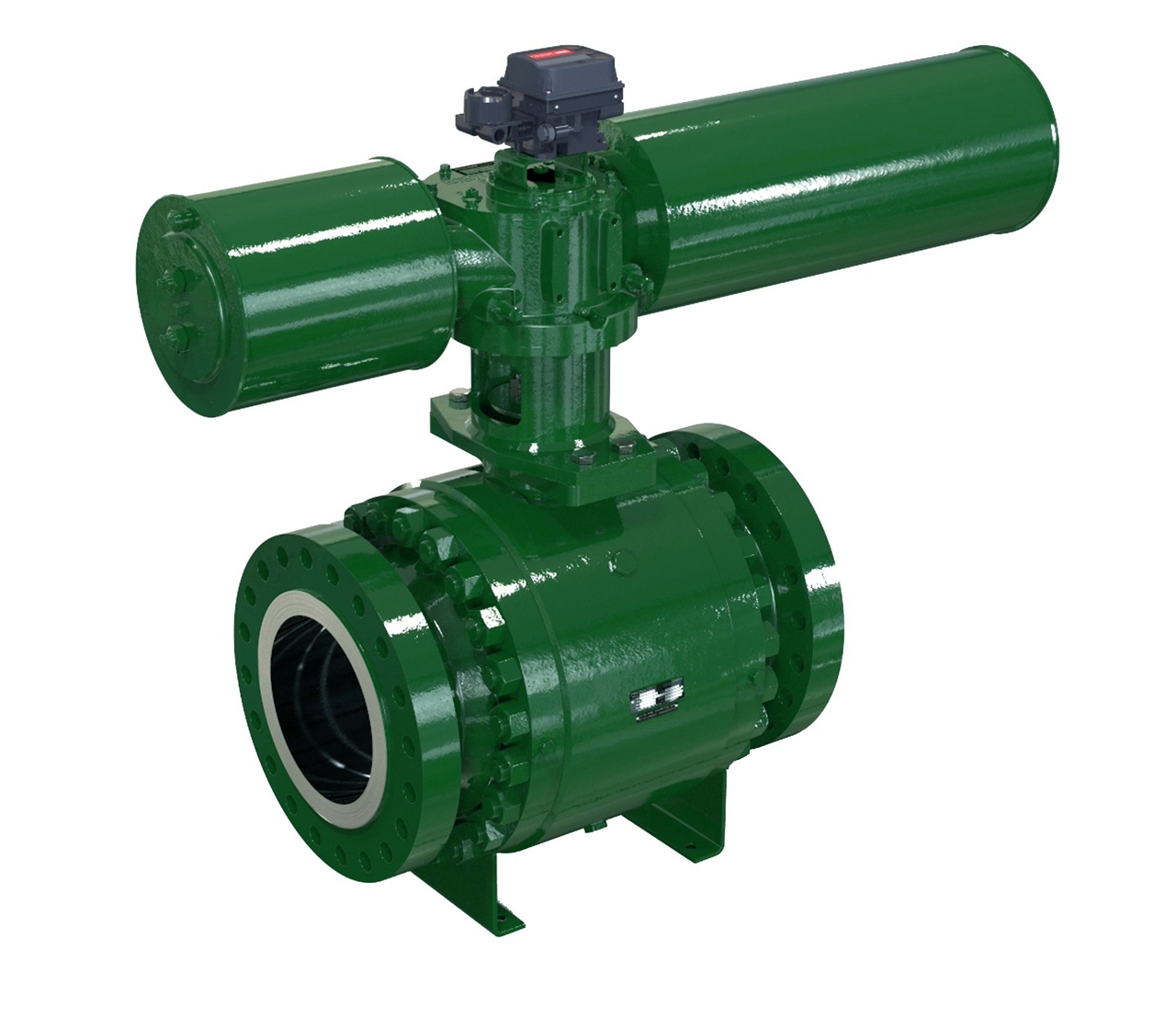
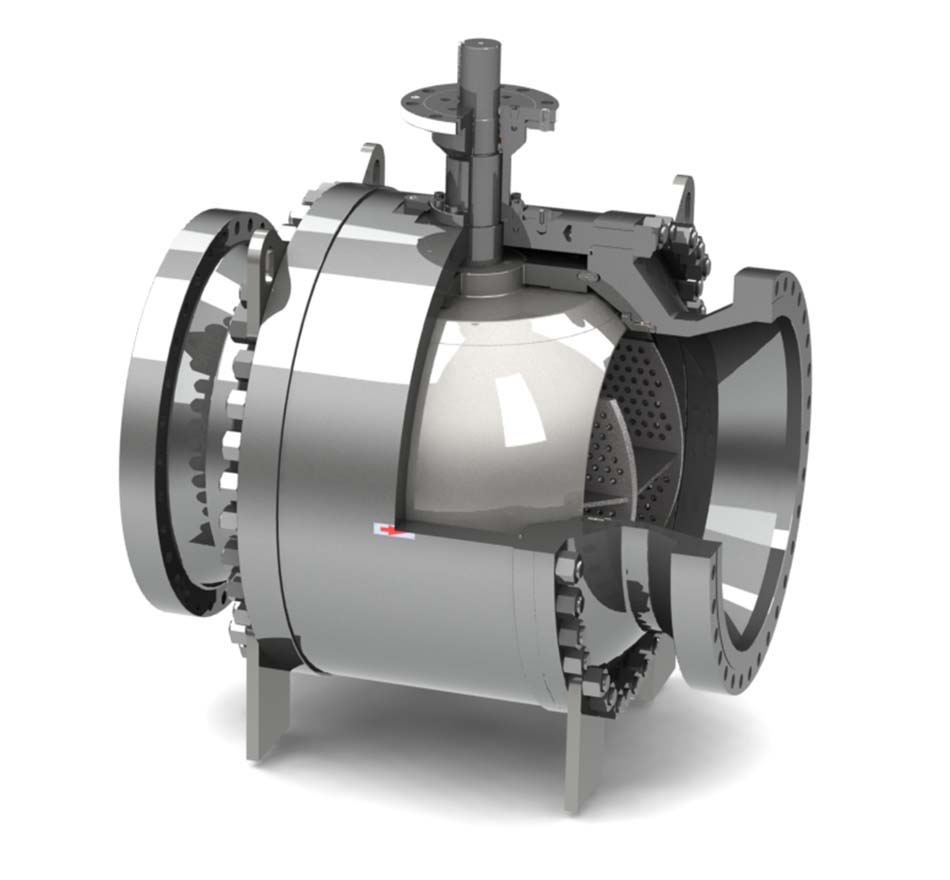
Trunnion-mounted ball valves fix the ball with integral or pinned trunnion shafts at top and bottom, supported in bearings. The ball does not move. Instead, each seat is a separate spring-energized assembly that the springs, plus line pressure entering behind the seat, push against the stationary ball. Because the trunnions carry the pressure load into the body, the seat load and the stem torque remain low even at very large sizes and high pressure classes. This is the standard architecture for cross-country pipelines, custody-transfer stations, and any Class 900 and above service. The trade-off is more parts, a larger body, and higher cost.
Three-way and multiport ball valves use a ball drilled with an L-shaped or T-shaped bore and a body with three (or more) ports. An L-port ball connects the common port to one of two outlets, acting as a selector or diverter that sends flow one way or the other. A T-port ball can connect all three ports or split and mix flow, serving as a mixing or distribution valve. Multiport valves replace several two-way valves and their fittings in tank-farm manifolds, sampling skids, and process distribution headers. Note that most three-way ball valves are not designed for tight bidirectional shutoff between every port, so the flow schematic must be verified against the maker port diagram.
Two further specialized types deserve note. V-port (segmented) ball valves replace the round bore with a V-shaped notch in the ball or seat, giving an approximately equal-percentage flow characteristic for control duty; paired with a positioner and a hard metal seat they handle slurry and fibrous media that would clog a globe control valve. Top-entry ball valves allow the ball and seats to be serviced through a bolted bonnet without removing the body from the line, which is valued on welded-in pipeline valves where break-out for maintenance is costly.
Chapter 3 / 06
Body Styles and Bore Patterns
Beyond the floating-versus-trunnion choice, two construction decisions shape every ball valve order: the body style (how the body is split for assembly and maintenance) and the bore pattern (how large the ball hole is relative to the pipe). These determine maintainability, leak-path count, weight, cost, and pressure drop. The table below summarizes the three common body styles.
Body style
Construction
In-line maintenance
Typical use
One-piece (unibody)
Single forging or casting, often reduced bore
No (non-serviceable)
Low cost OEM, utility isolation
Two-piece
Body plus screwed or bolted end cap
Limited (remove from line)
General industrial, full bore
Three-piece
Center body plus two bolted end connectors
Yes (swing-out center body)
Sanitary, frequent service, weld ends
One-piece (unibody) valves form the body and one or both ends from a single piece of metal. With the fewest joints they have the fewest external leak paths and the lowest cost, but the ball must be inserted from one side, which usually forces a reduced bore, and the valve cannot be opened for seat replacement. They suit high-volume OEM and non-critical utility isolation where the valve is treated as a replace-on-failure component.
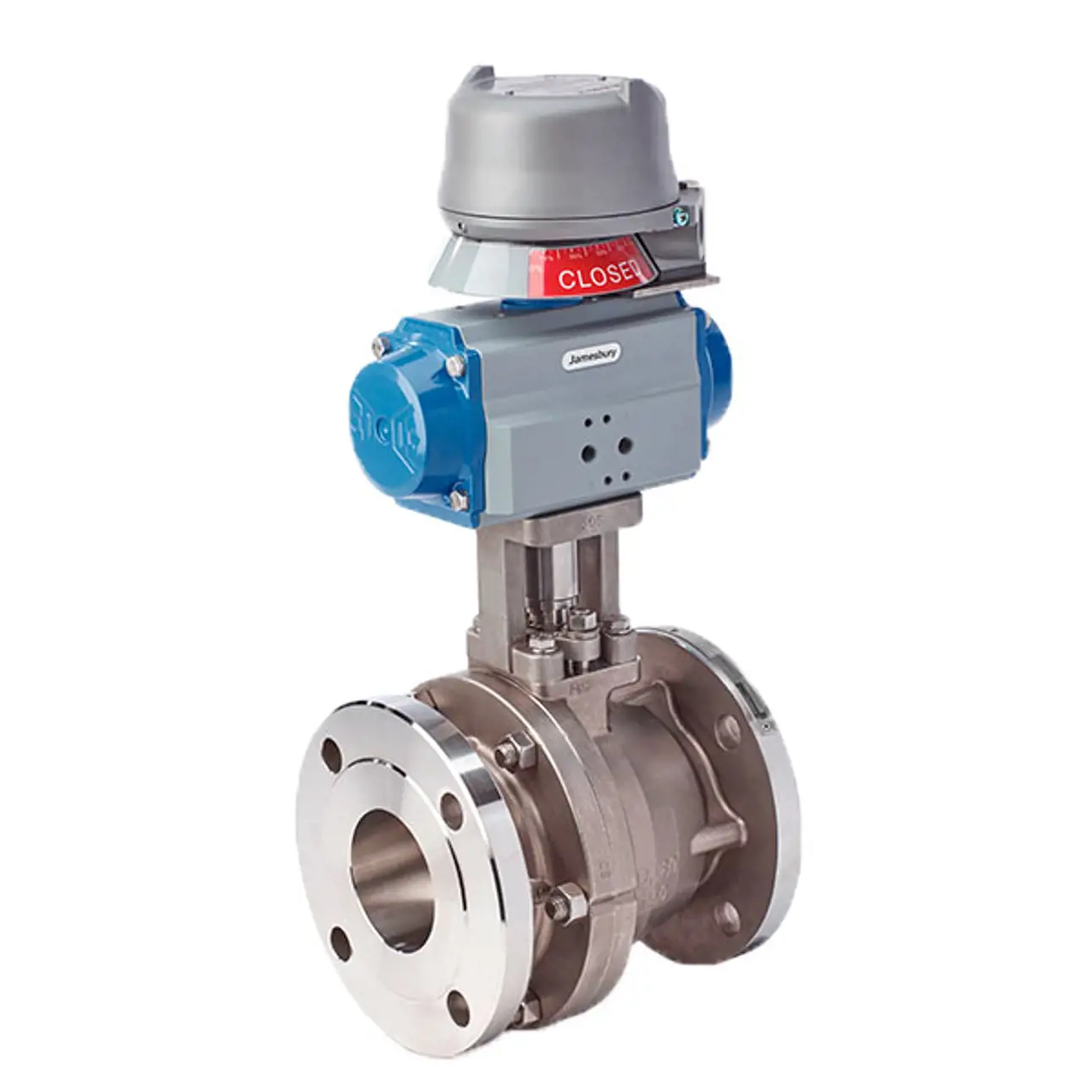
Two-piece valves consist of a main body and a separate end piece that threads or bolts on, trapping the ball and seats. Splitting the body lets the maker fit a larger, often full-bore ball, and allows seat replacement once the valve is removed from the line. This is the workhorse construction for general industrial process service and covers the bulk of flanged and threaded ball valves between DN15 and DN200.
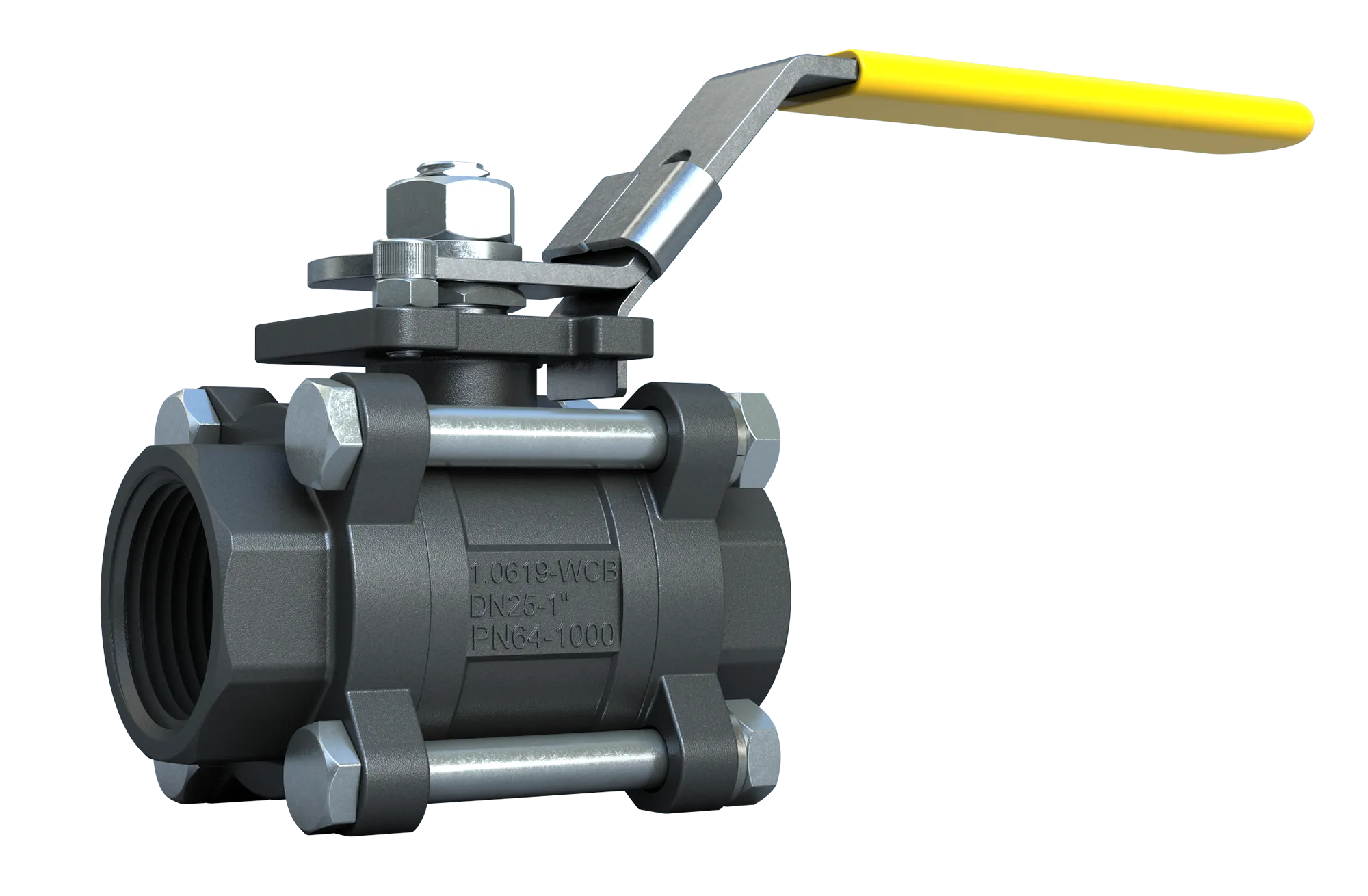
Three-piece valves use a center body clamped between two end connectors by long through-bolts. The end connectors stay welded or threaded to the pipe while the bolts are loosened and the center body, carrying ball, seats, and stem, swings out for service without disturbing the pipe joints. This in-line serviceability is essential for sanitary food, dairy, and pharmaceutical lines that demand frequent seat changes, and for socket-weld installations where unbolting the whole valve would be a major job.
The bore pattern is the second construction axis. ISO 17292 recognizes full bore, reduced bore, and double reduced bore seat openings. A full-bore (full-port) valve has a ball hole equal to the nominal pipe bore, so flow is essentially unrestricted and a pipeline pig passes through. A reduced-bore (standard-port) valve shrinks the opening by one nominal size, for example a DN100 valve with a DN80 ball bore, cutting cost, weight, and operating torque but adding pressure drop and turbulence. The table below contrasts the two.
Property
Full bore (full port)
Reduced bore (standard port)
Ball bore vs. pipe
Equal to nominal pipe bore
One nominal size smaller
Pressure drop
Minimal, near a pipe length
Higher, local restriction
Pigging
Yes
No
Weight and cost
Higher
Lower
Operating torque
Higher
Lower
Best for
Slurry, viscous, pump suction, pigging
Clean fluid on-off where head loss is tolerable
The rule of thumb is to specify full bore where pressure drop, pigging, slurry, or viscous media matter, and to accept reduced bore for routine isolation of clean fluids where a modest head loss is harmless and the cost and torque savings are worthwhile. End connection (threaded NPT or BSP, socket-weld, butt-weld, or flanged to ASME B16.5 or EN 1092) is chosen independently of bore and body style, driven by the pipe class and whether the line is welded or made up with flanges.
Chapter 4 / 06
Seat, Ball, and Body Materials
Material selection in a ball valve is really three decisions: the seat (which sets the temperature and tightness limits), the ball and wetted trim (which set corrosion and wear resistance), and the body (which sets the pressure rating). The seat is usually the limiting component, so it deserves the most attention. The table below summarizes the common seat materials and their continuous temperature limits.
Soft seats are polymer rings that deform slightly against the ball to give bubble-tight shutoff. Virgin PTFE is the baseline: chemically near-universal and tight to about 200 degrees Celsius, but prone to cold flow (creep) under repeated cycling, which can relax the seal over time. Reinforced PTFE, filled with glass or carbon fiber, raises the continuous limit to about 232 degrees Celsius (450 degrees Fahrenheit) and resists cold flow and wear far better, making RPTFE the most common general-purpose seat. PEEK extends the limit to roughly 260 degrees Celsius and withstands higher seat loads and abrasion, at higher cost.
Metal seats become necessary above the polymer limits, or for steam, superheated, abrasive, slurry, and coking duties where a soft seat would burn, swell, or erode. The seat and ball are hard-faced with cobalt-based Stellite 6 or tungsten carbide and lapped to a matched fit. Metal seats serve well beyond 400 degrees Celsius and survive particulate-laden media, but they require higher operating torque and accept a small specified leakage rate (ISO 5208 rate C or D rather than the bubble-tight rate A of soft seats). The choice of soft versus metal seat is therefore a trade-off between perfect tightness and high-temperature or abrasive survivability.
Ball and body materials follow the process media and pressure. The most common body materials are cast carbon steel ASTM A216 WCB for general service to about 425 degrees Celsius, forged carbon steel A105 for smaller forged valves, and stainless steel CF8M (cast 316) or A182 F316 for corrosive and clean service. The ball is typically the same grade as the wetted trim, often with a hard chrome or electroless nickel plating to reduce friction and wear against the seat. For aggressive media the same logic as other wetted equipment applies: 316L for water, steam, light hydrocarbons, and mild acids; duplex 2205 or super duplex for seawater and chlorides; and nickel alloys such as Hastelloy C-276 for wet chlorine, ferric chloride, and strong reducing acids.
Two non-metallic but critical materials are the stem seals and the body gasket. The stem packing is commonly PTFE or graphite; graphite is specified where fire-safe performance is required because PTFE burns away in a fire. Body and seat O-rings, where used, are selected from FKM (Viton), EPDM, NBR, or perfluoroelastomer (FFKM) according to media and temperature. For low fugitive-emission service to ISO 15848-1, the stem sealing system is upgraded, typically to live-loaded graphite packing, and the valve is type-tested for stem and body-joint leakage under thermal and mechanical cycling.
Chapter 5 / 06
Key Specification Parameters
A ball valve data sheet typically lists 15 to 30 parameters, but a manageable set drives the selection decision: nominal size, pressure class and pressure-temperature rating, bore pattern, seat and body material, leakage class, operating torque, flow coefficient, end connection, and applicable standards. Each is explained below so that two competing quotes can be compared on equal terms.
Nominal size and pressure class. Size is given as DN (millimeters) or NPS (inches), for example DN100 / NPS 4. Pressure class follows ASME B16.34 as Class 150, 300, 600, 900, 1500, or 2500, or the EN equivalent as PN16, PN40, PN100, and so on. The class is a rating index, not a working pressure. Under ASME B16.34, a Class 600 carbon-steel (A216 WCB) valve is rated about 102 bar (1480 psi) at 38 degrees Celsius, derating to roughly 57 bar (825 psi) near 425 degrees Celsius; a Class 900 WCB valve is rated about 153 bar (2220 psi) at 38 degrees Celsius. The body pressure-temperature curve and the soft-seat temperature limit must be read together, because whichever is lower governs.
Leakage class. Seat tightness is specified to ISO 5208 (or the older API 598 and FCI 70-2). Rate A is zero visible leakage (bubble-tight), the normal target for soft-seated valves; rates C and D allow a defined leakage and are typical for metal-seated valves. A quote must state the leakage rate, because a metal-seated valve and a soft-seated valve are not equivalent on shutoff even at the same size and class.
Operating torque. The torque needed to turn the ball determines handle, gear, or actuator sizing. It depends on pressure, size, seat type, and friction, and rises with differential pressure. The maker provides a breakaway torque (highest, at the start of travel) and a running torque. Actuators are sized with a safety factor over breakaway torque, commonly 1.25 to 1.5, so an undersized actuator that ignores this margin will stall on a pressurized line.
Flow coefficient (Cv / Kv). Cv is the flow of water in US gallons per minute through the fully open valve at 1 psi pressure drop; Kv is the metric counterpart in cubic meters per hour at 1 bar drop (Kv is about 0.865 times Cv). Full-bore valves have very high Cv (low restriction); reduced-bore valves have a markedly lower Cv. For pump-suction and gravity lines where head loss matters, the Cv comparison between full and reduced bore is decisive.
Standards and certifications. The applicable design and test standards belong on every line of a quote:
API 6D (ISO 14313): pipeline ball valves for the petroleum and natural-gas pipeline transportation industry, covering both floating and trunnion designs.
API 608: metal ball valves with flanged, threaded, and welding ends for general industrial service.
ISO 17292: metal ball valves for petroleum, petrochemical, and allied industries, defining full, reduced, and double reduced bore.
ASME B16.34: pressure-temperature ratings, dimensions, and materials for flanged, threaded, and welding-end valves.
API 607 / ISO 10497: fire type-test for soft-seated quarter-turn valves (the fire-safe certificate).
ISO 15848-1: measurement and qualification of fugitive (stem and body-joint) emissions.
Construction safety features.Industrial valves to API 6D and API 608 carry a blowout-proof stem (retained from inside so line pressure cannot eject it), an antistatic device (a spring-loaded contact that drains static charge to ground), and on soft-seated fire-safe valves a secondary metal seat. For trunnion valves, the seat design (self-relieving single-piston DBB versus double-piston DIB) and the presence of a body cavity relief or vent are specified explicitly, because they change how the trapped-cavity pressure is managed.
Chapter 6 / 06
Selection Decision Factors
To turn the preceding chapters into a specific model, work the decision sequence below in order. Most selection errors come not from a single wrong parameter but from skipping a level, for example fixing the body material before confirming the seat temperature limit. These eight steps double as an RFQ template.
Duty and function: Confirm the valve is for on-off isolation, not throttling. If modulation is required, move to a control valve or a V-port segmented ball with a metal seat; do not specify a standard ball valve to run part-open.
Size, class, and pressure-temperature point: Fix DN/NPS and the ASME class or PN, then plot the actual operating pressure and temperature against the body pressure-temperature curve and, separately, against the seat temperature limit. The lower of the two governs.
Floating or trunnion: Below roughly DN200 and Class 600, a floating valve is usually the economical choice. At larger size or Class 900 and above, or where low torque and double block and bleed are needed, specify trunnion-mounted.
Bore and body style: Choose full bore for pigging, slurry, viscous media, and pump suction; reduced bore for clean on-off where head loss is tolerable. Choose three-piece for frequent in-line service, two-piece for general process, one-piece for low-cost OEM.
Seat and wetted materials: Pick the seat from the temperature and media (RPTFE as default, PEEK for higher temperature or abrasion, metal for steam and above 260 degrees Celsius). Match the ball and body grade to corrosion (316 for general, duplex for chlorides, nickel alloy for aggressive acids).
End connection and actuation: Flanged, butt-weld, socket-weld, or threaded to suit the pipe class. Select handle, gearbox, or pneumatic / electric actuator on an ISO 5211 pad, sized at 1.25 to 1.5 times the breakaway torque with fail-safe position defined.
Certifications: Specify fire-safe API 607 / ISO 10497 for flammable service, antistatic and blowout-proof stem (standard under API 6D / API 608), fugitive-emission ISO 15848-1 where required, plus any project standard such as PED 2014/68/EU, NACE MR0175 for sour service, or sanitary 3-A / EHEDG.
Cavity and relief management (trunnion): Decide DBB self-relieving (single-piston) seats versus DIB double-piston seats, and where DIB is used confirm a separate body cavity relief valve is provided, since trapped liquid expansion can otherwise overpressure the body.
One dimension that is easy to overlook is manufacturer serviceability and traceability: availability of spare seat and seal kits, material test reports and EN 10204 3.1 certificates for the body, valve test certificates to API 598 or ISO 5208, and local field-service capability for large or welded-in valves. These determine repair turnaround years into the plant life. Established makers with documented series and global support include Emerson (KTM floating and trunnion series), Velan (BT2/BT3 API 6D side-entry trunnion valves), Cameron, and a broad field of API-monogram licensees; the right choice depends on the duty class, the certification stack, and the local support that the project actually requires.
FAQ
What is the difference between a floating and a trunnion-mounted ball valve?
In a floating ball valve, the ball is held only by the two seats and is free to shift slightly downstream under line pressure; that pressure pushes the ball into the downstream seat to form the seal. This is simple and economical, but seat load and operating torque rise with pressure and size, so floating designs are normally limited to roughly DN200 (8 inch) and Class 600 or below. In a trunnion-mounted valve, the ball is anchored by upper and lower trunnion shafts and does not move; spring-energized seats are pushed against the fixed ball by line pressure and springs. Trunnion designs carry the pressure load into the body rather than the seats, so torque stays low at large sizes and high classes, which is why pipeline valves from DN250 and Class 900 upward are almost always trunnion-mounted.
What is the difference between full bore and reduced bore?
Full bore (full port) means the ball hole diameter equals the nominal pipe bore, so flow passes with almost no extra restriction and a pipeline pig can travel through. Reduced bore (standard port) shrinks the ball hole by one nominal size, for example a DN100 valve with a DN80 bore, which lowers cost, weight, and torque but adds pressure drop and turbulence. ISO 17292 defines full bore, reduced bore, and double reduced bore seat openings. Choose full bore for pigging, slurry, viscous media, and pump-suction lines where pressure drop matters; reduced bore is acceptable for general on-off isolation of clean fluids where a small head loss is tolerable.
Which seat material should I choose for my temperature and media?
Virgin PTFE is the default soft seat for clean service up to about 200 degrees Celsius, with excellent chemical resistance but a tendency to cold-flow under cycling. Reinforced PTFE (RPTFE, glass or carbon filled) has a continuous limit near 232 degrees Celsius (450 degrees Fahrenheit) and better wear resistance, making it the most common general-purpose seat. PEEK raises the limit to roughly 260 degrees Celsius and tolerates higher pressure and abrasion. Above these temperatures, or for steam, superheated, and abrasive or coking duties, specify metal seats hard-faced with Stellite 6 or tungsten carbide, which serve well beyond 400 degrees Celsius at the cost of higher torque and a small allowable leakage rate.
What does fire-safe certification to API 607 mean?
API 607 (and the equivalent ISO 10497) is a fire type-test for soft-seated quarter-turn valves. The valve is filled, pressurized, and engulfed in flame at roughly 750 to 1000 degrees Celsius for 30 minutes; after the soft seats burn away, a secondary metal-to-metal seat behind them must still contain the fluid within defined leakage limits, both through the seat and to the outside. A fire-safe ball valve therefore includes a metal back-up seat, graphite stem packing, and a blowout-proof stem. Note that API 607 is a fire test, while API 608 and API 6D are the design and construction standards; a fire-safe valve carries both a design standard and the API 607 or ISO 10497 test certificate.
How do I read the pressure class and the pressure-temperature rating?
ASME B16.34 assigns valves to classes 150, 300, 600, 900, 1500, and 2500. The class is a reference number, not a working pressure: a Class 600 carbon-steel (ASTM A216 WCB) valve is rated about 102 bar (1480 psi) at 38 degrees Celsius, but that ceiling derates as temperature climbs, falling to roughly 57 bar (825 psi) near 425 degrees Celsius. A Class 900 WCB valve starts near 153 bar (2220 psi) at 38 degrees Celsius. Always read the maker pressure-temperature curve for the exact body material, because the soft-seat temperature limit, not the body rating, is often the true ceiling. PN ratings (PN16, PN40, PN100) are the EN equivalent expressed in bar.
What is a double block and bleed (DBB) ball valve?
A double block and bleed valve uses two independent seats with a bleed connection into the body cavity between them, so a single valve can isolate from both sides and let an operator vent and verify the seal through the bleed port instead of installing two valves and a spool. In the standard DBB configuration each seat is single-piston-effect and self-relieving: if cavity pressure rises above line pressure, the seat lifts slightly and relieves the cavity into the lower-pressure line, preventing overpressure from thermal expansion of trapped liquid. DIB (double isolation and bleed) instead uses double-piston-effect seats that seal from both directions for redundancy, which removes the self-relief and therefore requires a separate cavity relief valve.
Why do ball valves need an antistatic device and a blowout-proof stem?
When a non-conductive ball turns against soft seats it can build a static charge, and a spark across the body in flammable service is a hazard. An antistatic device, usually a spring-loaded pin or ball between the stem and ball and between the stem and body, maintains electrical continuity so charge drains to ground; it is required by API 6D and API 608. A blowout-proof stem is machined so the stem shoulder seats against the body from the inside: the stem cannot be ejected by line pressure even if the gland packing is fully removed, which protects personnel during maintenance. Both features, plus fire-safe packing, are standard on industrial-grade isolation ball valves.
Ball Valve Manufacturers
Source-backed product routes. Open a company dossier for procurement scope and cited evidence.