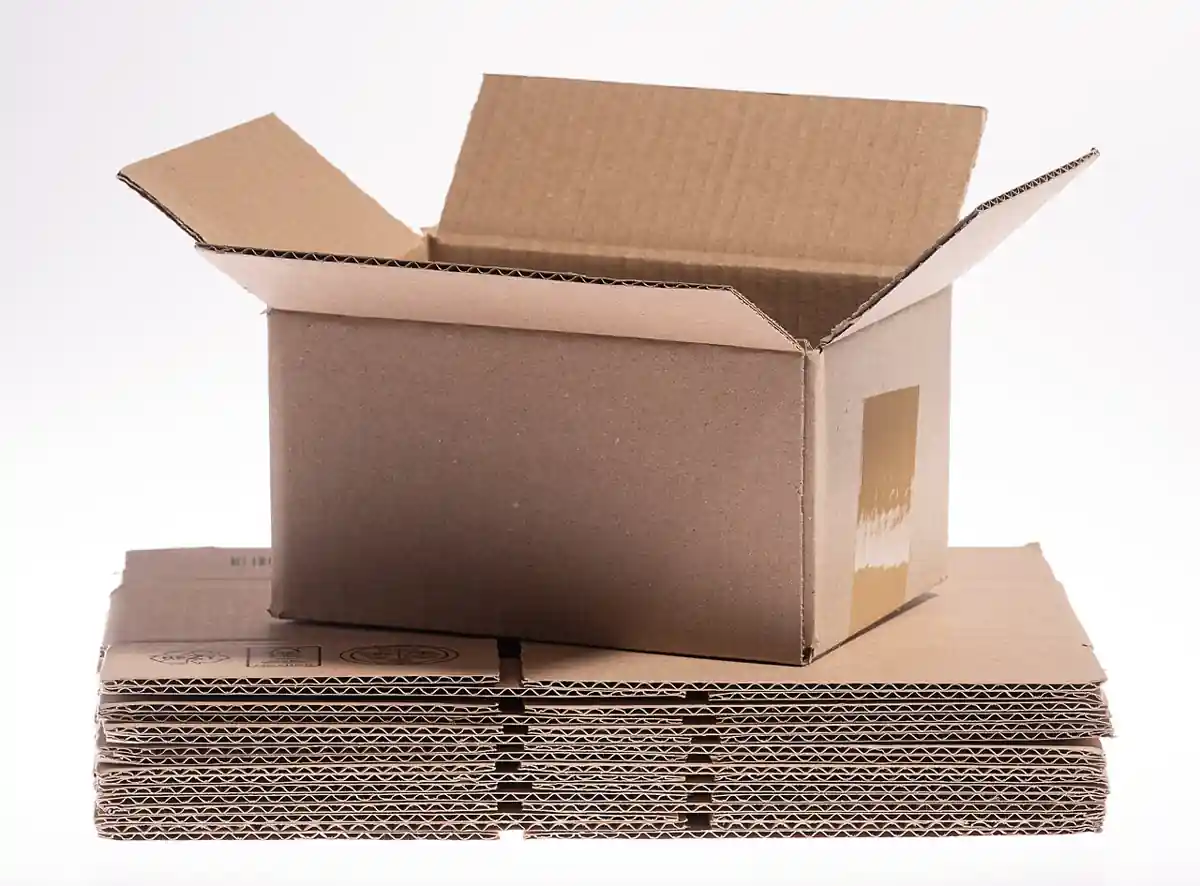
The edge crush test (ECT) measures the compressive strength of corrugated board edgewise, in kilonewtons per meter or pounds per inch, by crushing a small vertical strip of board between platens. It is the number the corrugated industry uses to grade board, to predict box stacking strength through the McKee formula, and to decide whether a carton survives the warehouse stack it was designed for.
Specifying by ECT means specifying a system: board grade and flute, box dimensions, the McKee prediction they feed, the humidity the stack will live in, and the safety factor between predicted and required compression. This page decodes the test itself, the grades a mill actually sells, and the design arithmetic that turns a strip of crushed board into a pallet-load decision.
ECT is the modern successor to Mullen burst as the grading basis for shipping containers: burst told you about puncture resistance against rough handling, while ECT tells you about stacking, which is how boxes actually fail in modern unitized distribution. The single-parameter leaf sits inside the packaging family: the carton box page covers the product itself, and this page covers the strength number printed on its certificate and board grade stamp.
An ECT value is a strip of board crushed in a lab standing in for a pallet of boxes crushed in a warehouse. This page explains the ISO 3035 and TAPPI T 811 test methods, the grades on a board certificate, the McKee path from ECT to box compression, and the humidity and safety-factor lines that decide whether the arithmetic survives the dock and the distribution chain beyond it.
Chapter 1 / 06
What Is the Edge Crush Test
Corrugated board is a sandwich: two liners around a fluted medium, and the flute arches are columns. Loaded edgewise, those columns carry compressive load the way a structural section does; loaded flat, they crush easily. The edge crush test loads the edge: a conditioned specimen, typically 25 by 100 mm or 2 by 4 inches per the method, is stood on end between parallel platens and compressed to failure; the peak force divided by the specimen width is the ECT value, reported in kN/m or lb/in. The specimen's short height is deliberate: it keeps the flute columns from buckling before the material itself fails, so the number measures material strength rather than column geometry, which is the box designer's job to add back through the McKee relationship.
The selection question arises at the design of any corrugated shipping container that will be stacked: master cartons on pallets, export cartons in containers, retail-ready trays under load. The buyer or packaging engineer sets a required stacking strength from load, height, storage time, and humidity, then works backward through the McKee relationship to the board grade and flute whose ECT delivers it. The ECT value is thus simultaneously a mill's product grade and a designer's input variable, which is why its test conditions matter as much as its number, and why this page treats the certificate, the formula, and the warehouse as one specification system rather than three separate documents.
What is actually being decided is a cost-strength trade in a commodity material. Single-wall B-flute at 32 ECT handles a broad retail range; heavier single-wall, then double-wall grades at 44, 48, and beyond, buy stacking strength at prices that climb stepwise; triple-wall and corrugated alternatives compete with wood crates. The decision is made honest by measuring: a certificate ECT under standard conditioning, converted to predicted box compression, compared against measured box compression on a sample run, with a safety factor covering everything the formula does not know. Buyers who skip the measurement step buy grades by folklore; buyers who skip the factor buy grades by luck; both approaches eventually meet in the same damaged-pallet photograph.
ECT grades displaced Mullen burst as the common basis in North American shipping because distribution changed: unitized pallet loads and automated handling reduced puncture incidents while high-bay storage increased stacking time. A 200 lb burst board and a 32 ECT board are different products with different failure modes, and mixing the two vocabularies in one specification is the most common error in packaging RFQs; this page keeps them separate and states what each is for.
The warehouse the number lives in
The stack the ECT feeds is an engineered structure made of commodity parts. Boxes sit on plastic pallets or timber ones, in a pallet rack bay or stacked three or four units high on the floor; a forklift places them, a belt conveyor or roller conveyor line moves them through the plant, and a storage rack in the finished-goods area holds the load for weeks or months. Every element changes the box's duty: rack beams support the pallet uniformly, floor stacks transfer load box to box, and conveyor transitions add shocks the certificate never measured. The packaging engineer who walks the warehouse before finalizing a grade is buying information no formula supplies; the one who works only from the McKee equation is designing a structure against an imagined building.
Alternatives define the boundary of corrugated's territory. A turnover box, rigid plastic and reusable, carries the heavy cycles that would eat a carton; a bulk bag handles powder and granule tonnage; and inside the plant a filling machine, a packaging machine, a labeling machine, or a coding machine each impose tolerances on the cartons they feed. Corrugated wins on cost, cube, print, and recyclability within its load envelope, and the ECT framework is precisely the instrument for finding that envelope honestly.
Chapter 2 / 06
Working Principle and Test Methods
The test itself
Two methods dominate. ISO 3035 is the international standard for edgewise crush resistance of corrugated board; TAPPI T 811 is the North American counterpart. The specimen is cut with flutes vertical, conditioned to standard atmosphere, typically 23 deg C and 50 percent relative humidity per the conditioning standards (ISO 187 / TAPPI T 402), and crushed in a calibrated compression tester at a specified rate with supports preventing buckling during alignment. Result: peak force per unit width. ISO 3035 also defines the neck-down method for boards that fail by liner buckling, one of several method details that make cross-lab numbers comparable only when the method annex matches. Specimen preparation is half the battle in practice: a strip cut with crushed flutes or ragged edges reads low by a margin that dwarfs lab-to-lab scatter, so serious labs die-cut specimens and reject any with visible edge damage before the platens close.
Related methods complete the strength family. Flat crush measures flute crushing under flat load, a rigidity indicator rather than stacking strength. Burst or Mullen (ISO 2759, TAPPI T 810) measures the hydraulic pressure to rupture the board, the puncture-and-abuse metric. Bending stiffness and short-span compression (ISO 9895) serve board-making control. The box compression test (BCT, ISO 12048 / TAPPI T 804) crushes the whole box, and is the ultimate referee between predicted and real stacking strength. Each method answers one question; the packaging standard names which question governs each purchase, and the rest of the numbers ride along as characterization rather than as acceptance gates.
From ECT to box compression: the McKee formula
The classic McKee relationship estimates top-to-bottom box compression from board properties: BCT is proportional to ECT times the square root of caliper times perimeter, in the familiar engineering-unit form BCT = 5.87 x ECT x sqrt(caliper x perimeter), with ECT in lb/in, caliper and box perimeter in inches, and BCT in pounds. The constant and the exponents come from regression on standard RSC boxes; refinements over the decades account for box aspect ratio, flute profile, and print and die-cut losses. Designers use it to pick a grade, then verify with a box compression test, because the formula knows nothing of humidity cycles, overhang, pallet deck gaps, or dynamic shocks. In metric practice the same structure holds with a converted constant; whatever the units, keep the habit of stating them on every calculation sheet, because unit slips in this formula produce errors of whole grades, not decimal dust.
Read the formula's structure and the physics follows: compression scales with ECT directly, with board stiffness through the square root of caliper, and with the square root of perimeter because a longer panel edge buckles sooner. That structure explains the practical levers: a taller box loses strength; a longer perimeter loses strength; adding a wall adds both ECT and caliper, a double dividend; and the same board grade in a different box shape is a different box in every sense that matters to the stack.
The formula's limits deserve their own sentence. McKee was regressed on standard slotted containers under short-duration platen load in conditioned air; it does not know about flute crush from conveyor transitions, about the strength subtracted by large print coverage and die-cut handles, or about the long-duration creep that governs three-month storage. That is why the workflow is always formula for selection, whole-box test for verification, and safety factor for the world; designers who quote a McKee result as if it were a guarantee have skipped two of the three steps.
Chapter 3 / 06
Board Construction, Flutes, and Duty Boundaries
Grades a mill actually sells
Board is specified by walls and by ECT grade. Single-wall dominates: E-flute (~1.5 mm) for retail print and light units, B-flute (~3 mm) for general shipping, C-flute (~4 mm) for stacking where caliper helps. Double-wall BC or EB combinations roughly double the stiffness for heavy or tall stacks, with ECT grades commonly 40 to 61 and above; triple-wall serves crates at 300 kg-plus per box. In North America the grade stamp carries the ECT number (32, 40, 44, 48 ECT...); elsewhere the certificate states kN/m (a 32 ECT board is roughly 5.6 kN/m, a 44 ECT roughly 7.7 kN/m). Liner and medium basis weights, and recycled versus virgin fiber content, set the ECT the mill can certify at each combination.
Behind the grade sits a fiber-market reality the buyer should understand. Recycled fiber lines cut cost and environmental load, and modern de-inking lines certify solid ECT, but each recycling cycle shortens fiber and costs some burst and fold endurance, so specifications that chase ECT alone can quietly buy boards that crack at the score lines. Virgin kraft liners buy puncture and abuse margin at a price step. The honest specification names basis weights and recycled-content policy alongside the ECT grade, then verifies with a whole-box test, because the certificate arithmetic cannot see a score-line crack that a packing line finds in a shift.
Converting operations and their toll
A board's certificate strength is measured on unconverted strips; the box that ships has been slotted, scored, printed, glued or stitched, and sometimes die-cut with handles and windows. Each operation subtracts: heavy flexographic coverage can cost a measurable share of compression, slots and scores concentrate stress, and a mis-adjusted scorer crushes flutes invisibly at the crease. Experienced buyers therefore verify on the finished box and audit the converter's own records, asking for the box compression result on production samples rather than on hand-made laboratory boxes, which is the difference between testing the board and testing the product.
Conditioning is part of the strength
Corrugated is a hygroscopic material: its strength falls steeply as relative humidity rises, and standard practice designs for the worst-case climate the distribution chain visits. Certified ECT is measured at 50 percent RH; the same board at 85 percent RH and tropical temperatures may deliver roughly half of its dry-climate compression, and long-cycle creep under sustained stack load steals more. Export packaging to humid climates and chilled distribution both carry explicit humidity derates in serious specifications. Chilled duty adds a condensation cycle the tropics do not: every move through a cold-store door wets and dries the board, and each cycle takes a small, permanent toll on both liners and adhesive, which is why chilled-chain cartons specify water-resistant adhesives as a matter of course.
Duty boundaries
State plainly where the ECT framework stops being the right tool. Puncture and tear dominated duty, sharp-edge industrial parts, mixed rough handling, still argues for burst-classified heavier boards or additional protection. Very heavy unit loads pass quickly from corrugated to rigid packaging: a plastic pallet box or a bulk bag handles what stacking board cannot. Point loads from concentrated product, bottle necks, and unprotected machinery feet crush locally regardless of ECT; the fix is packing design, dividers, and load spreading, not a higher grade. And moisture exposure beyond humidity, rain, condensation, or floor wetting, calls for water-resistant adhesives and coatings or alternative materials entirely, because wet linerboard has no grade.
Chapter 4 / 06
Key Specification Parameters
The decode table lists the lines that decide a corrugated specification, with typical catalog spreads and what each means at the stack.
Parameter
Single-wall typical
Double-wall typical
What it decides
ECT grade, lb/in
26 / 32 / 40 / 44
42 / 48 / 51 / 61
Stacking strength basis per board width
ECT, kN/m equivalent
4.6 / 5.6 / 7.0 / 7.7
7.4 / 8.4 / 9.0 / 10.7
Metric certificate basis
Caliper by flute
E 1.5 / B 3.0 / C 4.0 mm
EB 4.5 / BC 6.5 to 7 mm
McKee stiffness term; print and die detail
Predicted BCT, 400x300x300 RSC
approx. 250 to 400 kgf by grade
approx. 500 to 800 kgf
Stack design ceiling before safety factor
Burst (Mullen) if specified
150 to 275 lb
250 to 350 lb
Puncture duty vocabulary, not stacking
Conditioning
23 deg C, 50% RH, ISO 187 / TAPPI T 402
The number's meaning; comparability
Humidity derate by climate
tropical/chilled cycles derate to roughly 50 to 70% of standard
Worst-case design value
Stack safety factor
commonly 3 to 5 on BCT for static stacks; higher for dynamic or long storage
Margins for time, RH, handling shocks
Certificate basis
mill certificate ECT + basis weights; converter certificate construction
Traceability of every lot
Read the BCT line against the safety-factor line, never alone. A predicted 300 kgf box at a safety factor of 4 carries roughly 75 kgf of sustained top load, which is one layer of identical boxes plus the pallet above it, and nothing more; warehouses that stack by eye rather than by factor are the source of the slow creep failures that appear in month three of storage. The factor covers sustained-load creep, humidity excursions, pallet deck gaps, overhang, and the statistical spread of a commodity material; serious distribution chains state it in the packaging standard with the same authority as a torque spec.
Decode the conditioning line as part of the number, not a footnote. Certificate values assume 23 deg C and 50 percent RH; a test run at 30 deg C and 85 percent RH on the same board reads dramatically lower, and neither number is wrong, they answer different questions. When a supplier quotes an unusually strong ECT, check the climate behind it before comparing grades; serious suppliers state it, and the ones who do not are not necessarily weaker, only unverified.
The second table decodes the test-method vocabulary for the PO, because an ECT without its method annex is not a number.
Test line
Method basis
Report on certificate
Edge crush
ISO 3035 / TAPPI T 811
kN/m or lb/in, method stated
Box compression
ISO 12048 / TAPPI T 804
N or kgf at failure, box ID
Burst (Mullen)
ISO 2759 / TAPPI T 810
kPa or lb, method stated
Conditioning
ISO 187 / TAPPI T 402
climate and hours
Board construction
converter certificate
walls, flutes, basis weights
Chapter 5 / 06
Selection Decision Factors
Work the decision in this order; each step fixes a number or redirects the design.
Fix the load case: product mass, box count, stack pattern, stack height, storage duration, and the pallet and racking the boxes will sit on.
Set the worst-case climate the stack visits, warehouse, container at sea, chilled room; assign the humidity derate before any grade is chosen.
Compute required compression: boxes above the lowest layer times box mass, converted to force, times the safety factor.
Run McKee with candidate flute and grade combinations; iterate box dimensions toward the proportions the formula favors, taller boxes lose strength.
Check non-compression duties: puncture, abrasion, print, die-cut complexity, and handling; heavier liners or burst-classified board if these dominate.
Verify with box compression tests on production-run samples at the design climate, not just on certificate arithmetic.
Fix the closure and reinforcement: tape or strapping band pattern, interior fitments, column stacking versus interlock, and corner protection for heavy units.
Price the system: board cost per box, cube utilization, freight class impact, and damage-rate history, which is the ultimate referee of any packaging change.
The cost table shows the structure of a grade decision for a 400 x 300 x 300 mm RSC shipper; fill mill prices to make it live, and add the damage-rate line from history, because a grade that saves 8 percent on board and adds 2 percent of damage is a losing trade that only shows up after a quarter of shipments.
Element
Single-wall 32 ECT
Single-wall 44 ECT
Double-wall 48 ECT
Board cost index
100
115 to 130
160 to 190
Stack capability (design)
moderate
high for single-wall
highest
Cube and freight
lightest
same cube
same cube, heavier
Print surface
good on B/C
good
good, thicker die work
Typical duty
retail master cartons
heavy singles, longer stacks
export, high bays
What to write in the RFQ, verbatim:
Board: wall construction, flute profile, ECT grade with method basis (ISO 3035 or TAPPI T 811), liner and medium basis weights, and recycled content policy, all stated per lot on the mill certificate.
Certificate: mill certificate per lot with ECT and basis weights; converter construction certificate matching the sample.
Box: internal dimensions, style (RSC or other), joint type, board direction (flutes vertical in the panel carrying load), die-cut details, and print specification.
Verification: box compression test per ISO 12048 or TAPPI T 804 on production samples, at design climate, with a stated minimum.
Environment: design climate and humidity derate; water-resistant adhesive or coating if the chain includes exposure.
System: closure method, strapping and stretch film pattern, column stacking rule, and pallet compatibility including deck-board spacing.
Traceability: lot numbers on certificates tied to delivery dates and purchase order lines.
Two annexes prevent the recurring arguments. The climate annex: state the design climate chain, warehouse to destination, and the derate applied, so a tropical export carton and a domestic one are visibly different specifications rather than coincidentally identical quotes. The verification annex: name the whole-box compression minimum, the method, the sample source, and the retest cadence, annually or at any board or converter change, so the specification verifies the product the line actually receives, not the brochure the mill once printed.
Downstream packing lines ride the same specification. A carton erecting machine and a case packing machine set flap and panel tolerances the board must hold; a wrapping machine or a shrink wrapping machine adds unitization that changes the effective stack; a checkweigher catches the overfill that quietly exceeds the box rating; a vacuum packaging machine inside the carton protects the product while adding its own rigid volume that can share load if designed to. Packaging engineers who design the carton with the line's tolerances, instead of around them, are the ones whose stacking arithmetic survives production speeds.
Chapter 6 / 06
Field Practice: Testing, Humidity, and Stack Failures
Incoming and periodic testing
Treat board certificates like any incoming material document: match the lot, file the ECT and basis weights, and run a periodic verification crush on your own tester or at a lab, because commodity board drifts with fiber markets. A small compression tester, or a service lab running both ISO 3035 strips and whole-box ISO 12048 tests, closes the loop between what was bought and what arrived. Sample the box as shipped, with its print, die cuts, and closures, since converting operations subtract strength the certificate never saw. For plants without a tester, a quarterly service-lab campaign on the top five SKUs by damage history buys most of the same protection at a fraction of the equipment cost; what matters is that the samples come from production deliveries, on a schedule someone owns.
The audit trail earns its keep the day something fails in the field. With lot numbers on certificates tied to purchase orders and delivery dates, a complaint about a crushed pallet resolves in minutes to a mill lot, a converter run, or a warehouse aisle; without it, the same incident becomes a month of meetings in which everyone's theory is as good as everyone else's. Traceability in packaging is cheap, boring, and priceless exactly once per year, which describes most of the good practices on this page.
Stack failure signatures
Field failures are legible if you photograph before cleanup. Slow side-wall creep, panels bowing outward over weeks, is sustained overload or humidity derate: the McKee margin was consumed by time and climate. Sudden column buckling at the lowest layer under a shock is dynamic overload from handling drops or trailer vibration: add distribution testing or reduce drop exposure. Local crushing under product points is packing design, not board grade. Edge crushing where boxes overhang pallet edges or straddle deck gaps is pattern discipline; the same box fully supported carries multiples of its overhung self. Water-stained failure at the box bottom is floor moisture: pallet condition and placement fix it, not the board.
Diagnose with the stack's history, not just its wreckage. Ask when the failure appeared relative to the load date, whether a heat wave or a monsoon week intervened, whether the forklift route changed, and whether the failed boxes came from one delivery lot or several. A failure that tracks one lot points at the mill or converter; a failure that tracks one aisle points at the building; a failure that tracks one route points at the carrier. Ten minutes of questions usually replaces a week of board-grade debate with a specific fix.
Warehouse practice that protects the number
Column-stack pallets for storage, interlocked only where stability demands it and the grade was chosen for the loss; keep stacks inside the pallet footprint; rotate stock so the bottom layer is not a permanent tenant, because creep is time at load; and keep dock doors closed on humid days, since a warehouse at 80 percent RH quietly spends the derate you designed against. Where bays are high and storage long, the honest upgrade is not heroics with tape but the next grade of board, priced against one month of damage claims.
A damage log turns the warehouse into the best packaging lab the company owns. Record every crushed-box incident with load, height, dwell time, position in the stack, and the weather that week; after a season, the pattern is unmistakable and specific, the aisle with the humidity problem, the lane whose conveyor transition eats flute, the SKU whose pack pattern overhangs an inch. Specifications revised on that evidence survive contact with the supply chain; specifications revised on price alone usually get to meet the same failures again, at a different supplier.
Finally, feed failures back into the standard: every stack incident with a known load, height, duration, and climate is a free calibration point for the next McKee run. Packaging specifications that carry a revision history with their damage data become institutional knowledge; ones that do not are re-argued at every supplier review from the same first principles, and the company pays for the same education twice.
FAQ
What ECT grade do I need for my box weight and stack height?
Work it backward: total load on the lowest box (boxes above times mass, in force units), times a safety factor of 3 to 5 for static stacks, gives required compression. Run the McKee formula with your box dimensions and candidate grades; e.g. a 400 x 300 x 300 mm RSC needs roughly 32 to 40 ECT single-wall for moderate stacks and 44 ECT or double-wall once stacks grow tall or storage runs months. Verify with a box compression test before committing a production run.
ECT or Mullen burst: which should I specify?
Specify ECT when stacking strength governs, which is modern unitized distribution; specify burst when puncture and rough handling dominate, which is heavy, sharp, or abused freight. The numbers are not convertible: a 32 ECT board is not a 200 lb burst board in different units but a differently engineered product. Many export specifications now name both, with ECT as the stacking basis and burst or puncture as an abuse floor.
How much does humidity reduce corrugated strength?
Measurably and quickly. Standard certificates are conditioned at 23 deg C and 50 percent RH; sustained 85 percent RH tropical or monsoon conditions can cut effective compression toward half of the certificate basis, and long storage adds creep loss on top. Design to the worst-case climate in the chain, state the derate in the packaging standard, and verify critical designs with boxes tested at that climate.
Why did my boxes fail when the McKee number said they would hold?
Check the four usual gaps: the safety factor was skipped, so design load equaled predicted strength with no margin for time and humidity; the climate derate was ignored; the stack pattern had overhang or deck gaps, which slash effective strength; or converting, print, and die cuts subtracted from the certificate board. The McKee estimate is for a conditioned, column-stacked, fully supported box; every departure from that picture costs strength the formula does not know about.
Does flute direction matter in the box?
Decisively. Flutes run vertical in a standard RSC so the columns carry the stack load; a blank cut or erected with flutes horizontal turns the strongest axis sideways and the box loses most of its stacking strength. It is one of the most common and most expensive converting errors, invisible in a flat blank and obvious in a collapsed pallet, which is why the flute direction belongs on the drawing and in the inspection checklist.
Is double-wall always better than heavier single-wall?
Double-wall adds caliper and ECT together, so it wins tall stacks, long storage, and export abuse, at higher cost, weight, and die-making effort. Heavy single-wall (44 ECT class) often wins moderate duties on cost and cube, and prints and converts more easily. Run both candidates through McKee with your real dimensions, price both per box and per pallet position, and let the stack duration and climate break the tie.
What should a board certificate carry to be usable in an audit?
Mill, lot number, date, board construction (walls, flutes, basis weights), ECT value with the method basis (ISO 3035 or TAPPI T 811) and conditioning climate, plus burst and basis-weight data where the specification names them, tied to the purchase order line. Pair it with the converter's construction certificate for the finished box, and file both against delivery dates so any field failure can be traced to its lot in minutes.