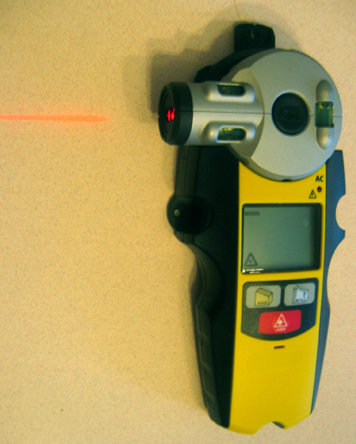
An infrared line level, more precisely a line laser level, is a layout instrument that projects one or more bright straight reference lines onto walls, floors and ceilings to establish level, plumb and square. Despite the colloquial "infrared" label, the projected beam is visible light: red diodes around 635 to 660 nm or green diodes around 510 to 532 nm, because the operator has to see the line to work to it. True infrared, beyond 700 nm, is invisible and belongs to distance sensors and night optics, not to layout tools.
These tools have replaced the spirit level and chalk line for a large share of interior fit-out work: a single self-leveling line laser sets a continuous level datum around a room in seconds, where a bubble vial gives one short reference at a time. This guide explains the device family, the principles behind self-leveling and laser-class safety, the spec-sheet numbers that actually matter, and how to map a job to a specific model.
This guide is written for purchasing engineers, site supervisors and design engineers selecting line laser levels. It covers 6 chapters from device definition, line and beam types, self-leveling and laser-safety principles, mounting and field practice, spec-sheet decoding, to selection decisions, with 7 selection FAQs and manufacturer comparisons. All parameters reference IEC 60825-1 (laser safety classification), IEC 60529 (IP ingress protection), and published manufacturer datasheets including the Bosch GLL 3-80 and Klein Tools planar laser series.
Chapter 1 / 06
What is an Infrared Line Level
A line laser level is a self-contained optical instrument that fans a laser diode's point into a thin straight line using a cylindrical or conical lens, then projects that line onto a surface as a continuous, dead-straight reference. The operator aligns trim, tile, cabinets, drop ceilings, drywall track or electrical boxes to the projected line instead of snapping chalk or sliding a spirit level along the work. The colloquial name "infrared line level" is a misnomer carried over from consumer marketing: construction line lasers emit visible red or green light, not infrared, because a layout line that cannot be seen is useless on site.
Functionally the tool answers the same question as a spirit level and a plumb bob, which is whether a surface is level or plumb, but it answers continuously across a whole room rather than at a single point. The two reference planes most line lasers establish are a horizontal level plane and a vertical plumb plane; where the two cross, the intersection marks a precise corner for squaring walls or aligning fixtures. Higher tiers add a third plane and a downward plumb dot for transferring a point from ceiling to floor.
The instrument has three core subsystems. First, the light source: one or more laser diodes, red near 635 to 660 nm or green near 510 to 532 nm, each paired with a beam-shaping optic that spreads the dot into a line spanning up to 360 degrees in premium tools. Second, the leveling mechanism: a gravity-referenced pendulum or an electronic servo that holds the line truly level or plumb regardless of small base tilt. Third, the housing and interface: an impact-resistant shell with an IP-rated seal, magnetic or threaded mounts, battery or removable-pack power, and controls for line selection, pulse mode and pendulum lock.
Historically, layout depended on the spirit level (the sealed bubble vial dates to the 17th century), the water level, the plumb bob and the chalk line. Helium-neon laser levels appeared in construction in the 1970s and 1980s but were bulky and fragile. The shift to compact, rugged tools came with inexpensive visible laser diodes in the 1990s, and again with affordable green diodes in the 2010s, which are far easier to see indoors. Self-leveling pendulum mechanisms turned the laser from a setup-intensive instrument into a point-and-shoot tool, which is why line lasers now dominate interior fit-out, while rotary lasers hold large outdoor grade work.
Four engineering metrics decide whether a given line laser fits a job: leveling accuracy (deviation in mm/m), beam visibility (color and working range with and without a detector), self-leveling range and time, and ruggedness (IP rating, drop height, pendulum lock). The remaining chapters work through each, because the headline price of a line laser correlates poorly with whether it will hold calibration through a building program.
Chapter 2 / 06
Line and Beam Types
Line lasers are one branch of a wider laser-level family. Understanding where the line laser sits clarifies when to reach for a different tool. The table below compares the main construction laser-level types by projected pattern, typical use and where they excel.
Laser type
Projected pattern
Typical working range
Best for
Dot / plumb laser
One to five points
10 to 30 m
Point transfer, plumb-bob replacement, anchor layout
Cross-line laser
One horizontal + one vertical line
10 to 20 m
Tiling, cabinets, general interior layout
Multi-line / 360 laser
Two or three 360-degree planes
15 to 30 m
Whole-room datum, drop ceilings, drywall track
Rotary laser
Spinning 360-degree plane
200 to 600 m (with detector)
Site grading, foundations, large floors
Pipe laser
Single aimed beam at set grade
5 to 150 m
Sewer and drainage pipe laying
Dot and plumb lasers project discrete points rather than continuous lines. They replace the plumb bob for transferring a point straight up or down, and are used to set anchor positions or align studwork, but they give no continuous reference, so they are rarely the only tool a finisher carries.
Cross-line lasers project a single horizontal line crossing a single vertical line, typically spanning around 110 to 180 degrees. This is the workhorse pattern for tiling, kitchen cabinets, dado lines and picture hanging. Compact, inexpensive and battery-frugal, the cross-line laser is the format most buyers picture when they say "line level."
Multi-line and 360-degree lasers project two or three full 360-degree planes, wrapping a level line completely around a room and a plumb line floor to ceiling. The Bosch GLL 3-80 is a reference example, projecting three 360-degree lines. These suit suspended ceilings, partition track and any task needing a single continuous datum on every wall at once, and they are the natural reading of "infrared line level" at the professional tier.
Rotary lasers spin a single beam to sweep a 360-degree plane and, paired with a detector on a grade rod, reach 200 to 600 m. They dominate exterior grading, foundations and large slabs, where line lasers cannot project far enough or survive sunlight. Pipe lasers project one aimed beam set to a precise grade down a pipe run for gravity drainage. Both are distinct categories from the indoor line level and are covered on their own pages.
Across line lasers, the second axis of choice is beam color. Red diodes near 635 to 660 nm are mature, cheap and power-efficient. Green diodes near 510 to 532 nm appear roughly four times brighter to the eye at equal power, because human photopic sensitivity peaks near 555 nm, so green wins for bright rooms, longer indoor runs and marginal outdoor visibility, at the cost of higher price and shorter runtime.
Chapter 3 / 06
Self-Leveling and Laser Safety
Two engineering ideas separate a real layout instrument from a toy: how it makes itself level, and how it stays within eye-safe limits. Both are governed by physical principles and, for safety, by an international standard.
Self-leveling is what lets an operator drop the tool on an uneven surface and trust the line. The classic mechanism is a pendulum: the laser diodes hang on a gravity-referenced pendulum so that, within a small tilt range, gravity pulls the optics back to true level and plumb. Eddy-current or magnetic damping settles the swing in about 3 to 6 seconds rather than letting it oscillate. A higher tier uses an electronic servo: tilt sensors drive small motors or steer the beam digitally, which allows a wider correction range and, on some tools, deliberate sloped lines. Either way, the published self-leveling range, commonly plus-or-minus 3 to plus-or-minus 4 degrees, is the maximum base tilt the mechanism can absorb. Set the tool beyond that range and it warns by blinking the beam or shutting it off, telling the operator to re-level the base manually.
A critical and often-ignored detail is the pendulum lock. When the tool is switched off or set to manual tilt mode, the pendulum should be clamped so it cannot swing freely. Transporting a tool with an unlocked pendulum lets it slam against its stops over every bump, which is one of the most common causes of lost calibration. Premium tools lock the pendulum automatically at power-off; budget tools rely on a manual switch the operator must remember.
Laser safety is governed by IEC 60825-1, which sorts laser products into classes by hazard. Most construction line lasers fall in Class 2: visible output at or below 1 mW, where the natural blink and aversion reflex (about 0.25 s) is assumed to protect the retina against brief accidental exposure. Class 2 still demands the basic discipline of never staring into the beam and never aiming it at a person's eyes. Brighter or longer-range tools may be Class 3R, which exceeds the Class 2 limit by up to five times and carries a real hazard on prolonged direct viewing, so eye protection and tighter controls are warranted. The Klein Tools compact green planar laser is a documented Class 2 example, with output at or below 1 mW at 508 to 525 nm.
The class is determined by wavelength, power and emission geometry, and is marked on the housing label along with the wavelength and maximum output. Regulatory regimes layer on top: in the United States the FDA references IEC 60825-1 editions through its Laser Notices, and some jurisdictions restrict permitted classes on site. In Australia, for example, the model WHS Regulations prohibit Class 3B and Class 4 lasers in construction work, making Class 3R the highest class permitted on site. The practical rule for a buyer is simple: read the class on the label, prefer Class 2 for general layout, and treat any Class 3R tool as requiring documented controls.
IEC 60825-1 class
Visible output limit
Eye-safety basis
Typical layout use
Class 1
Below AEL, fully enclosed
Safe under all normal use
Sealed sensors, not site lines
Class 2
≤ 1 mW
Blink reflex (0.25 s)
Most indoor line lasers
Class 2M
≤ 1 mW, diverging
Safe unaided; hazard with optics
Wide-fan line tools
Class 3R
≤ 5 mW (visible)
Low risk, no reflex reliance
Bright / long-range lasers
Chapter 4 / 06
Mounting, Range and Field Practice
A line laser only delivers its specified accuracy if it is mounted stably, used within its range, and verified before critical work. The mechanical interface, the beam range and a quick field check are as important as the headline accuracy number.
Mounting. Line lasers offer several attachment options, and the right one depends on the surface and the height required. A built-in 1/4 inch tripod thread fits compact photo and laser tripods; many professional tools add a 5/8 inch thread for heavy surveying tripods, and the Bosch GLL 3-80 carries both. Strong rare-earth magnets and a swiveling bracket let the tool clamp to steel studs, track and conduit. An adjustable telescoping pole, or jamb pole, braces floor to ceiling to set the tool at any height without a tripod, which is standard practice for ceiling grids. Whatever the mount, it must be rigid: a line laser on a flexing bracket reports its own vibration as line wander.
Working range and detectors. Two ranges appear on every datasheet. The unaided working range is how far the eye can see the projected line, commonly 15 to 30 m and shrinking sharply in bright light. The detector range is how far the beam reaches when read electronically by a laser receiver clamped to a grade rod, commonly 50 to 120 m; the Bosch GLL 3-80 quotes 30 m visual and 120 m with a receiver. The detector holds photodiodes that sense the beam and signal on-grade with a beep and LED arrows, so it works in full sun where the human eye fails entirely. Most detectors require the tool's pulse, or receiver, mode to be switched on, which modulates the beam so the electronics can distinguish it from sunlight.
Field verification. A laser that has been dropped or shipped can read off without any visible damage, so professionals run a quick calibration check before precision work. For the horizontal plane, the standard procedure is to mark the level line on two opposite walls a fixed distance apart, then rotate the tool 180 degrees and re-mark from the same spot; any difference between the two marks is twice the leveling error at that distance. A similar flip check verifies the plumb plane against a known vertical reference. If the error exceeds the tool's specification, the unit needs factory or service-center recalibration, which is why local service availability belongs in the purchase decision.
Power and runtime. Entry tools run on alkaline AA or AAA cells; professional tools increasingly use removable lithium-ion packs shared across a brand's cordless platform, often with an alkaline adapter as a backup. The Bosch GLL 3-80 specifies up to four hours in three-line mode on 4 x 1.5 V AA cells. Green tools draw noticeably more current than red, so a green laser's runtime per charge is shorter, sometimes only a few hours, which matters for a full shift of continuous use.
Environment. The IP rating per IEC 60529 sets dust and water tolerance: IP54 (dust-protected, splash-proof) covers general framing, tiling and drywall; IP65 (dust-tight, water-jet-resistant) suits wetter or dustier trades. Operating temperature ranges are typically about -10 to +40 degrees C for the tool to self-level and project within spec; older green diodes in particular struggled at the cold end, so cold-weather sites should confirm the rated minimum. Storage ranges are wider than operating ranges, but a tool stored cold should be allowed to reach operating temperature before precision use.
Chapter 5 / 06
Key Specification Parameters
A line laser datasheet lists a dozen or more parameters, but only eight drive a buying decision: leveling accuracy, beam color and wavelength, number of lines and fan angle, working range with and without detector, self-leveling range and time, laser class, IP rating, and power and runtime. Each is decoded below, followed by a key-specification comparison of two reference tiers.
Leveling accuracy is quoted as deviation per metre, such as plus-or-minus 0.2 mm/m, and scales linearly: 0.2 mm/m is about 3 mm over 15 m. Imperial datasheets quote the equivalent as a fraction at a fixed distance, for example 1/8 inch at 30 ft. Beam color does not affect accuracy; the leveling mechanism, factory calibration and calibration retention do. Treat any tool sold without a stated accuracy figure as a DIY toy.
Beam color and wavelength set visibility, not accuracy. Red near 635 to 660 nm is mature, efficient and easy on batteries. Green near 510 to 532 nm appears around four times brighter to the eye at equal power and is preferred for bright or long indoor runs, at the cost of price and runtime. The wavelength is printed on the laser-class label.
Number of lines and fan angle describe the projected pattern: a single cross (one horizontal, one vertical), or two or three full 360-degree planes, plus optional plumb dots. More planes mean a faster whole-room datum but a higher price and shorter runtime.
Self-leveling range and time state the maximum base tilt the mechanism corrects, typically plus-or-minus 3 to plus-or-minus 4 degrees, and how fast the line settles, around 3 to 6 seconds. Laser class per IEC 60825-1 (usually Class 2, sometimes 3R) sets the eye-safety regime. IP rating per IEC 60529 sets dust and water tolerance.
Specification
Professional tier
DIY / value tier
Leveling accuracy
±0.2 mm/m
±0.3 to ±0.5 mm/m
Projected lines
2 to 3 x 360-degree planes
Single cross line
Range, unaided
30 m
10 to 20 m
Range, with detector
Up to 120 m
Often not supported
Self-leveling range
±4°
±3 to ±4°
Leveling time
~4 s
3 to 6 s
Laser class
Class 2 (some 3R)
Class 2
Ingress protection
IP54 to IP65
IP54 or lower
Power
Li-ion pack or AA
AA / AAA alkaline
Power and runtime close the list. Alkaline AA or AAA cells suit occasional use; removable lithium-ion packs shared across a cordless platform suit daily professional use. Quoted runtime always assumes a stated line count, so a three-line figure and a single-line figure are not comparable. Green tools run shorter than red at the same battery capacity. Read the runtime in the same line mode you will actually use.
Chapter 6 / 06
Selection Decision Factors
To turn the preceding five chapters into a specific model, follow the decision sequence below. Most selection mistakes come not from one wrong answer but from deciding price before requirements. These eight steps double as a fixed RFQ template.
Pattern and planes: Decide whether the job needs a single cross line (tiling, cabinets, picture rails) or two to three 360-degree planes (whole-room ceiling grids, partition track). Do not pay for 360-degree planes a finish carpenter will never use, and do not buy a cross line for a job that needs a continuous room datum.
Beam color: Green near 520 nm for bright interiors, long indoor runs and marginal outdoor visibility; red near 635 nm for short indoor work, dim sites, tight budgets and longest runtime. Accuracy is identical at matched calibration grade.
Accuracy class: Plus-or-minus 0.2 mm/m for professional finish and precision layout; plus-or-minus 0.3 to 0.5 mm/m is adequate for rough framing and DIY. Reject any tool with no stated accuracy.
Range and detector: Confirm the unaided range covers your room size, and whether the tool supports a pulse mode and a compatible laser detector for any work beyond about 20 m or in bright light. Verify the detector is sold or bundled.
Self-leveling and lock: Confirm the self-leveling range (plus-or-minus 3 to plus-or-minus 4 degrees), the leveling time, the out-of-range warning, and that the pendulum locks for transport, ideally automatically at power-off.
Mounting: Check the tripod threads (1/4 inch, and 5/8 inch for surveying tripods), magnetic bracket, and pole compatibility against how the tool will actually be positioned on site.
Ruggedness and environment: IP54 for general indoor and sheltered work, IP65 for wet or dusty trades; verify the rated drop height and the operating temperature range, with attention to the cold-end limit for green tools.
Safety and certification: Confirm the IEC 60825-1 laser class (prefer Class 2 for general layout), the wavelength marking, and that any Class 3R tool comes with documented controls and meets local site rules.
One last and commonly overlooked dimension is serviceability and calibration support. A line laser is a precision instrument that loses calibration through drops and rough transport, so confirm that the unit ships with a calibration certificate, that the manufacturer offers recalibration, and that a service center is reachable in your region. Run the two-wall flip check before any critical layout, lock the pendulum before every move, and treat the calibration certificate, not the price tag, as the real measure of a professional tool. Brands such as Bosch, DeWalt, Hilti, Leica Geosystems, Stabila and Klein Tools maintain service and recalibration networks, which makes them defensible choices for sustained professional use.
FAQ
Is an infrared line level actually infrared, or does it use visible light?
Despite the name, a working line level used for layout almost never emits infrared light. Construction line lasers project visible beams: red diodes near 635 to 660 nm and green diodes near 510 to 532 nm. Visible light is mandatory because the operator must see the projected line on the wall. The colloquial term infrared level conflates two things: true infrared (700 nm and longer) is invisible and is used in distance-measuring sensors and night-vision optics, not in layout lasers. When a product is marketed as an infrared line level for construction, treat it as a visible-light line laser and verify the actual wavelength and IEC 60825-1 laser class on the datasheet before purchase.
What accuracy can I expect from a line laser level?
Leveling accuracy is quoted as deviation per unit distance and scales linearly. Professional self-leveling line lasers such as the Bosch GLL 3-80 specify plus-or-minus 0.3 mm/m, which is about plus-or-minus 3 mm over a 10 m span and roughly 1/8 inch at 30 ft. The best professional units reach plus-or-minus 0.2 mm/m, and budget DIY tools land near plus-or-minus 0.5 mm/m, or about 1/4 inch at 30 ft. Beam color does not set accuracy: a red and a green laser built to the same calibration grade are equally accurate. The real drivers are pendulum or electronic-leveling quality, factory calibration, and how well the tool holds calibration through jobsite vibration and transport.
Red or green laser: which line level should I choose?
Green beams near 520 nm appear about four times brighter to the human eye than red beams near 635 nm at equal optical power, because the eye is most sensitive to green. Green is the better choice for bright interiors, longer indoor distances, and any outdoor work near the visibility limit. The trade-offs: green diode modules cost more, draw more current and shorten runtime (some green tools run only a few hours per charge), and older green designs were less tolerant of low temperatures. Red remains a sound choice for short-range indoor work, dim conditions, tight budgets, and the longest battery life. Accuracy is identical when calibration grade is matched.
What does self-leveling mean, and what is the leveling range?
Self-leveling means the tool corrects small setup errors automatically so the projected line is truly level or plumb without the operator touching a bubble vial. The mechanism is usually a gravity-referenced pendulum carrying the diode, damped magnetically, or an electronic servo. The self-leveling range, typically plus-or-minus 3 to plus-or-minus 4 degrees, is the maximum tilt the tool can correct. Set it within that window and the line snaps level in roughly 3 to 6 seconds; tilt it beyond the range and the unit warns by blinking the beam or refusing to project. Lock the pendulum before transport, since an unlocked pendulum swinging against its stops is a common cause of decalibration.
What is the working range, and why does a detector extend it?
Working range without a receiver is the distance at which the unaided eye can still see the projected line, commonly 15 to 30 m for line lasers, shrinking in bright light. With a laser detector (receiver) clamped to a grade rod, range extends to roughly 50 to 120 m: the Bosch GLL 3-80 quotes 30 m visual and 120 m with receiver. The detector contains photodiodes that sense the beam electronically and indicate on-grade with an audible beep and LED arrows, so it works in full sun where the eye cannot see the line. Pulse, or receiver, mode must be switched on for most detectors to register the beam.
Are line laser levels safe for the eyes?
Mainstream construction line lasers are Class 2 under IEC 60825-1, with visible output at or below 1 mW. Class 2 relies on the natural blink and aversion reflex, about 0.25 seconds, to protect the eye, so brief accidental exposure is not expected to cause injury, but you should never stare into the beam or aim it at others. Some brighter or long-range tools are Class 3R, which carries a higher hazard and benefits from eye protection. Verify the laser class marking and the wavelength on the housing label. In some jurisdictions, including Australia under the model WHS Regulations, Class 3B and Class 4 lasers are prohibited in construction work, so Class 3R is the highest class permitted on site.
Which manufacturers make professional line laser levels?
Established professional brands include Bosch (GLL 3-80 and GLL series), DeWalt (DW088 red and DCE089 green cordless lines), Hilti (PM series such as PM 30-MG and PM 20-CG), Leica Geosystems (Lino L2 and L4 series), Stanley/FatMax, Stabila, Makita and Klein Tools (93 series planar lasers). Value and DIY tiers include Huepar, Kaiweets, Bosch GLL DIY models and Kapro. When comparing, hold beam color, working range with and without receiver, leveling accuracy in mm/m, self-leveling range, IP rating and laser class constant rather than headline price, and confirm the unit ships with a calibration certificate and that local service or recalibration is available.