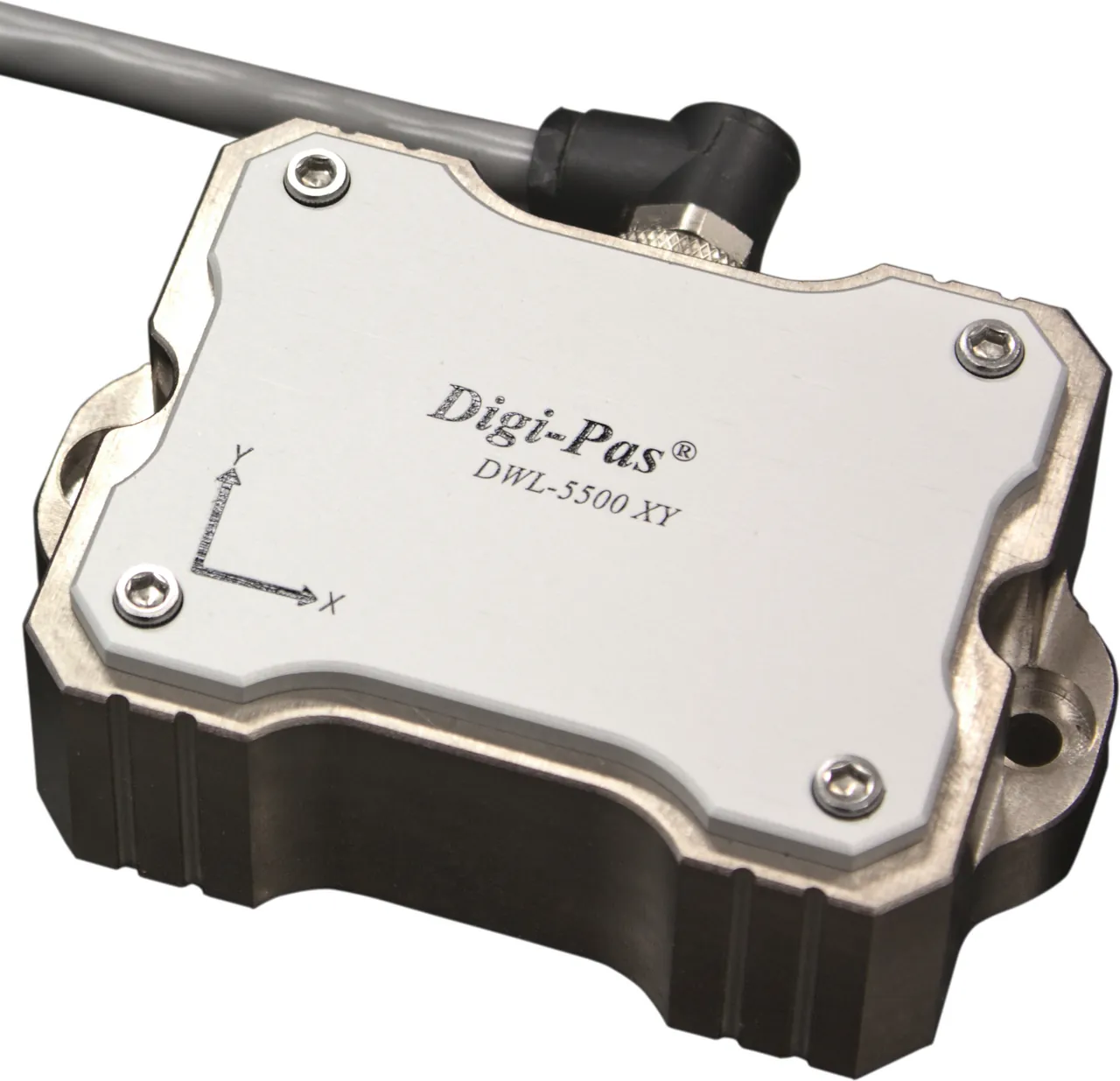
A tilt sensor reports the angle between its sensing axis and the direction of gravity, turning a mechanical inclination into an electrical or digital signal. The gravity vector is its only reference, which makes the device elegantly simple in concept and surprisingly demanding in practice: the same physics that lets a stationary sensor read a slope also makes it confuse vibration and acceleration with tilt. The terms tilt sensor, inclinometer, and clinometer are used interchangeably across catalogs, with inclinometer usually implying a calibrated angular scale and a stated accuracy class.
This guide separates the four sensing families (MEMS, electrolytic, force-balance, and capacitive or fluidic), explains single versus dual-axis geometry, decodes the spec sheet, and maps the output protocols (4-20 mA, RS-485, CANopen per CiA 410, and SAE J1939) that dominate structural monitoring, construction, and mobile machine control.
This guide is written for industrial purchasing engineers and design engineers comparing inclinometers before a project commitment. It covers 6 chapters, from working principle and the four sensing families through axis geometry, spec-sheet parameters, environment and protocols, to a structured selection sequence, with 7 selection FAQs and verified manufacturer comparisons. Where standards are referenced they are the publicly published IEC 60529 ingress code, the ISO 20653 IP69K washdown rating, the CAN in Automation CiA 410 inclinometer profile, and the SAE J1939 vehicle network standard.
Chapter 1 / 06
What is a Tilt Sensor
A tilt sensor is a measurement device that determines the angular orientation of an object relative to the earth's gravity vector. Unlike a pressure or flow sensor, which responds to a process variable carried in a pipe, a tilt sensor responds to a field that is always present and effectively constant: the 1 g gravitational acceleration that points toward the center of the earth. By measuring how that vector projects onto one or more internal sensing axes, the device computes pitch, roll, or a single inclination angle. This is why a tilt sensor needs no external excitation source and why, at the same time, it cannot tell the difference between true tilt and any other acceleration acting on its proof mass.
The vocabulary is loose and worth pinning down before reading any datasheet. A tilt sensor is the general class. An inclinometer is conventionally a tilt sensor packaged with a calibrated angular scale, temperature compensation, and a guaranteed accuracy class, the word that appears in geotechnical, construction-equipment, and crane catalogs. A clinometer is the same thing in surveying language. A tiltmeter is the high-resolution variant used to watch a structure, a dam, or a volcano move by micro-radians over months. An accelerometer is a close cousin that measures linear acceleration directly; because static gravity is itself an acceleration, a stationary multi-axis accelerometer becomes a tilt sensor as soon as firmware converts the gravity components into an angle.
The history runs from the spirit level to the silicon chip. The bubble level, a curved glass vial with a gas bubble in liquid, has been a workshop reference since the seventeenth century and is still the conceptual ancestor of the electrolytic tilt sensor. Servo or force-balance pendulum inclinometers, developed for guidance and geophysics in the mid-twentieth century, set the bar for precision by holding a pendulous mass at a null position and reading the restoring current. The decisive shift came with micro-electro-mechanical systems: from the 1990s onward, MEMS accelerometers shrank the proof mass and its capacitive pickoff onto a silicon die a few millimeters across, collapsing the cost of an angle measurement by orders of magnitude and putting inclinometers into vehicles, drones, smartphones, and disposable instruments.
The application scale is wide. At the coarse end, a roll-over warning on a forklift or aerial work platform needs perhaps one degree of accuracy across a wide range. In the middle, leveling a solar tracker, a satellite dish, a platform, or an agricultural implement asks for a few tenths of a degree. At the fine end, structural and geotechnical monitoring of bridges, tunnels, retaining walls, and dams resolves thousandths of a degree, and a precision tiltmeter watching crustal deformation works in micro-radians, where one micro-radian is roughly 0.00006 degree. A single sensing principle cannot span that whole range, so selection always starts by placing the application on this scale and then choosing the family of technology that fits.
Four engineering properties dominate the quality of any tilt sensor: angular accuracy across the full range, resolution and repeatability, behavior under temperature change, and behavior under motion. The last point separates the market into static and dynamic instruments and is the most common source of field disappointment, because a sensor that reads beautifully on a bench can be useless on a machine that vibrates or accelerates while it measures.
Chapter 2 / 06
Sensing Technology Families
Four physical principles dominate industrial tilt sensing: MEMS capacitive accelerometer, electrolytic (liquid) cell, force-balance servo pendulum, and the older fluidic or bubble approach. Each occupies a different point on the cost, range, and precision plane, and there is no universal best. The table below compares the engineering character of the four families before each is discussed in turn.
Technology
Typical Accuracy
Typical Range
Relative Cost
Best Fit
MEMS accelerometer
0.01 to 0.5°
±90° or 0 to 360°
Low to medium
Machine control, mobile, OEM, general industry
Electrolytic
0.001 to 0.1°
±1° to ±45°
Medium to high
Structural and geotechnical monitoring, leveling
Force-balance servo
0.0001 to 0.01°
±1° to ±90°
High
Reference standards, geophysics, alignment
Fluidic / bubble
0.1 to 1°
±3° to ±60°
Low
Cost-sensitive level indication, OEM tooling
MEMS accelerometer is the volume leader. A micromachined silicon proof mass hangs on flexible silicon springs; gravity deflects it, and the deflection is read as a change in capacitance between the moving mass and fixed electrodes. The chip outputs the acceleration component on each axis, and on-chip or downstream firmware converts those components into an angle. The advantages are small size, low cost in volume, a wide measurement range that can reach plus-or-minus 90 degrees per axis or a full 360 degrees, and easy integration of temperature compensation and digital buses. The limitation is intrinsic: because the mass responds to all acceleration, plain MEMS inclinometers are static instruments that must be still to read correctly, which is why dynamic gyro-fused variants exist (covered in Chapter 3).
Electrolytic sensors descend from the spirit level. A small sealed glass or ceramic envelope holds a conductive liquid (commonly a salt such as potassium iodide dissolved in an alcohol or glycol) over a set of electrodes, with a gas bubble that moves as the cell tilts. As the bubble shifts, it changes the relative immersion of the electrodes, unbalancing an AC bridge in proportion to the tilt angle. Electrolytic cells deliver excellent resolution and stability over a narrow to moderate range, which is why they remain a first choice for structural monitoring, geotechnical tiltmeters, and precision leveling. Their weaknesses are a limited measurement range, sensitivity to temperature through the electrolyte viscosity, and a settling time as the liquid comes to rest.
Force-balance servo inclinometers hold a pendulous mass at a fixed null position with a closed feedback loop. A position detector senses any attempt of the mass to swing under gravity, and a coil drives exactly the current needed to return it to null; that restoring current is proportional to the tilt. Because the mass barely moves, mechanical non-linearity and hysteresis are tiny, and these instruments reach the highest accuracy and resolution of any family, into the micro-radian region. The cost is correspondingly high, and the complexity of the servo electronics limits them to reference, geophysical, and alignment duty rather than mass-market machine control.
Fluidic and bubble approaches, including capacitive and resistive liquid level cells and the simple optical or contact bubble switch, sit at the low-cost end. They suit applications that need only a coarse angle or a level-reached threshold, such as a tool that must signal when it is roughly horizontal. They are inexpensive and robust but offer modest accuracy and are typically limited in range and temperature stability. In modern designs they have largely been displaced by low-cost MEMS, which delivers a continuous angle for a similar price.
Chapter 3 / 06
Single Axis, Dual Axis, and the Gravity Geometry
The number of sensing axes is not a marketing tier; it changes the mathematics of the measurement and therefore the achievable accuracy. Understanding the gravity geometry is the single most useful thing an engineer can carry into a tilt-sensor selection, because it explains both why a two-axis sensor is usually worth the premium and why the same sensor can read brilliantly in one orientation and poorly in another.
A single-axis tilt sensor measures the projection of gravity onto one axis and converts it with the arcsine function: angle equals arcsin of the measured acceleration divided by g. This is correct only when the rotation that you are measuring happens in the vertical plane that contains the sensing axis. The moment the sensor is also rotated about another axis, the magnitude of gravity seen on the measured axis drops, and the computed angle is wrong. Published analyses show that computing a tilt angle from a single axis can carry an error on the order of 12 degrees under off-plane rotation, whereas computing the same angle from two axes with the arctangent formula reduces the error to well under 1 degree.
A dual-axis sensor reads two orthogonal acceleration components and uses the arctangent of their ratio, angle equals arctan of ay over ax. Because the arctangent of a ratio is insensitive to the overall scale of the two signals, the result stays correct even when the sensor is tilted about the third axis, and it self-compensates small mounting misalignment. Dual-axis sensing also fixes the resolution problem described next. A practical integrity check that dual or triple-axis devices use is the gravity norm: the square root of the sum of the squared axis readings should equal 1 g when the only acceleration is gravity, so a measured norm far from 1 g flags that external motion is corrupting the angle and the output should be rejected.
The sine-curve sensitivity issue follows directly from the geometry. Output tracks the sine of the angle from horizontal, and the slope of the sine curve is not constant. Near horizontal the curve is steep, so a small angular change produces a large signal change and resolution is at its best. Near vertical the curve flattens toward its peak, so the same angular change barely moves the signal and resolution collapses. A single-axis sensor that resolves a hundredth of a degree near zero may resolve far less near 90 degrees. In a dual-axis device the two axes trade off: as one axis loses incremental sensitivity approaching vertical, the orthogonal axis gains it, so the arctangent combination keeps sensitivity roughly uniform across the range. The table below summarizes how axis count maps to behavior.
Configuration
Math
Range Behavior
Off-Plane Error
Typical Use
Single axis
arcsin(a/g)
Best near 0°, poor near 90°
High (up to ~12°)
Boom angle, simple level in one plane
Dual axis
arctan(ay/ax)
Roughly uniform across range
Low (<1°)
Pitch and roll, platform leveling
Triaxial / 360°
vector resolve
Full sphere, no blind orientation
Low
Mobile machinery, roll-over, robotics
Dynamic (IMU fusion)
accel + gyro fusion
Stable while moving
Low under motion
Cranes, AWP, vehicles on slopes
The fourth row introduces the static versus dynamic divide, which is really a geometry problem in disguise. A static inclinometer assumes the measured acceleration is purely gravity. The instant the platform vibrates or accelerates, that assumption breaks and the angle reading swings. A dynamic inclinometer adds a MEMS gyroscope to the accelerometer, forming a six-axis inertial measurement unit, and runs a sensor-fusion filter so the gyroscope carries the angle through transient motion while the accelerometer corrects its drift during quiet intervals. This is why a slewing crane, a driving aerial work platform, or a tractor on a hillside needs a dynamic unit, while a building or retaining wall that is still between readings does not.
Chapter 4 / 06
Environment, Protocols, and Standards
Once the sensing principle and axis count are settled, a tilt sensor must survive its environment and talk to the control system. For industrial and mobile-machine duty these two factors, ingress protection and communication protocol, often eliminate more candidate models than accuracy does. This chapter covers the housing and protocol layer and the standards that govern them.
Ingress protection is defined by the IEC 60529 code, written as IP followed by two digits: the first for solids, the second for water. IP65 keeps out dust and resists low-pressure water jets, suitable for a panel or a sheltered location. IP67 survives temporary immersion to one meter and is the workhorse rating for outdoor and mobile equipment. IP68 survives continuous immersion at a manufacturer-stated depth, the rating for borehole, buried, and subsea tiltmeters. IP69K is a separate, more severe test defined in ISO 20653 for close-range high-temperature, high-pressure washdown; it is the rating to demand for vehicles and food or pharmaceutical equipment cleaned with steam lances, because a connector that passes IP67 can still fail under a steam jet.
Temperature range and compensation belong here too, because the operating environment sets them. Industrial inclinometers commonly specify a compensated operating range of -40 to +85 degrees Celsius and publish a temperature coefficient, the residual error per kelvin after the factory thermal table is applied. Outdoor structural sensors face large daily thermal swings, so for that duty the temperature coefficient and the breadth of the compensated range matter more than the accuracy quoted at +25 degrees alone. Vibration and shock ratings, drawn from the IEC 60068-2 environmental test series, round out the mechanical qualification for machinery use.
The output and protocol layer determines how the angle reaches the controller. The table below lists the mainstream interfaces and where each fits.
Two protocol standards deserve a note. The CAN in Automation CiA 410 inclinometer profile defines a standardized object dictionary for a CANopen inclinometer so that devices from different makers behave consistently on the bus; its CiA 410-J variant maps the inclination values onto SAE J1939 parameter groups, and the current profile defines four device classes spanning one-axis and two-axis sensors with 16-bit and 32-bit measurement. SAE J1939 is the application-layer standard for the CAN backbone in trucks and off-highway machinery, so a J1939 inclinometer drops straight onto an existing vehicle network. For machinery where a wrong tilt reading could cause a roll-over, makers increasingly offer units rated to a functional-safety Performance Level such as PL d under ISO 13849, which the buyer should confirm rather than assume.
Chapter 5 / 06
Key Specification Parameters
Tilt-sensor datasheets share a small set of parameters whose definitions are easy to confuse. Eight of them drive nearly every selection decision: measurement range, accuracy, resolution, repeatability, temperature coefficient, response time or bandwidth, output and protocol, and ingress and safety rating. Each is explained below in the language of a spec sheet.
Measurement range is the angular span the sensor reads, written as plus-or-minus degrees per axis (for example plus-or-minus 15, plus-or-minus 30, plus-or-minus 45, plus-or-minus 90 degrees) or as a full 0 to 360 degrees for a single-axis rotational device. Narrower ranges generally buy better resolution because the same electronics resolve a smaller span, which is why a precision structural sensor might be plus-or-minus 1 degree while a roll-over sensor is plus-or-minus 90. Choose the smallest range that still covers the worst-case angle with margin.
Accuracy is the maximum deviation between the reported angle and the true angle, the headline number, often quoted as plus-or-minus degrees over a stated range and temperature. Watch the conditions: an impressive accuracy specified at +25 degrees Celsius only is not the same as accuracy held across the full -40 to +85 range. Verified examples span a wide band, from roughly plus-or-minus 0.25 degree for compact industrial MEMS units such as the SICK TMS22 and TMM22, to about plus-or-minus 0.15 degree for dynamic units such as the Pepperl+Fuchs IMU F99, to a few thousandths of a degree for electrolytic cells from The Fredericks Company, and down to 0.01 degree and finer for high-precision modules.
Resolution is the smallest angular change the sensor can detect, distinct from accuracy: a sensor can resolve a thousandth of a degree yet be accurate only to a tenth. High-precision inclinometers reach resolutions of 0.001 degree and finer. Remember the sine-curve effect from Chapter 3: a single-axis resolution figure is best near horizontal and degrades toward vertical, so a resolution number is meaningful only with the orientation it was measured in.
Repeatability is the spread of readings when the same angle is presented repeatedly under identical conditions; it bounds the random error and is often better than accuracy. For relative measurements, such as watching a structure move from a baseline, repeatability and resolution matter more than absolute accuracy. Temperature coefficient states the residual zero and span drift per kelvin after compensation, the parameter that governs real outdoor performance.
Response time and bandwidth describe how fast the output tracks a change. A static structural sensor can afford heavy filtering and a slow response that suppresses noise; a dynamic machine-control sensor needs a higher bandwidth and a gyro-fused architecture to follow motion without lag. Heavier output filtering improves apparent resolution at the cost of speed, so the two are traded against each other.
Output and protocol and ingress and safety rating close the list and were detailed in Chapter 4. The mainstream outputs are 0.5 to 4.5 V ratiometric, 4-20 mA, RS-485 Modbus, CANopen per CiA 410, and SAE J1939; the mainstream environmental envelope is IP65 to IP69K with a -40 to +85 degree compensated range, plus a Performance Level rating where a tilt fault carries a safety consequence. Reading these eight parameters together, rather than fixating on the single accuracy headline, is what separates a sound selection from a returned unit.
Chapter 6 / 06
Selection Decision Factors
To turn the preceding five chapters into a specific model, follow the decision sequence below. Most selection errors come not from one wrong parameter but from deciding too early at the wrong level, such as fixing on a brand before deciding whether the application is static or dynamic. These eight steps double as a fixed RFQ template.
Static or dynamic: First settle whether the sensor will be still while it measures. A structure, a parked platform, or a manually leveled tool can use a static MEMS or electrolytic sensor. Anything that vibrates or accelerates while measuring (a slewing crane, a driving aerial work platform, a vehicle on a slope) needs a dynamic gyro-fused inclinometer. This single decision eliminates most of the catalog.
Range and axis count: Pick the smallest angular range that covers the worst case with margin, then choose single or dual axis. Use dual axis whenever rotation can occur about more than one axis or when mounting near vertical, because the arctangent geometry keeps sensitivity uniform and tolerates misalignment.
Accuracy, resolution, and repeatability: Separate the three. Absolute leveling needs accuracy; movement monitoring from a baseline needs resolution and repeatability. Confirm the conditions under which each figure is specified, especially the temperature, and demand full-range numbers rather than the +25 degree value.
Sensing technology: Map the duty to a family per Chapter 2: static MEMS for general machine and OEM use, electrolytic for narrow-range precision structural monitoring, force-balance servo for reference and geophysical accuracy, dynamic IMU for moving machinery.
Environment: Set the ingress rating (IP65 indoors, IP67 general outdoor and mobile, IP68 submerged or buried, IP69K for steam washdown) and confirm the compensated temperature range, vibration, and shock ratings match the installation.
Output and protocol: Choose 4-20 mA or 0.5 to 4.5 V for a single point into a PLC, RS-485 Modbus for multi-drop distributed monitoring, and CANopen per CiA 410 or SAE J1939 when the machine already runs a CAN bus.
Functional safety: Where a wrong tilt reading can cause a roll-over or a fall, require a stated Performance Level (for example PL d under ISO 13849) and supporting documentation, rather than inferring safety from a rugged housing.
Mounting and calibration: Plan the mechanical mounting reference and a zero-setting procedure, since installation misalignment is a leading real-world error. Confirm the unit offers a field zero or teach-in and, for monitoring, a way to log a baseline.
One last commonly overlooked dimension is manufacturer serviceability and ecosystem: availability of the matching connector and mounting bracket, the device-description or EDS file for the chosen bus, firmware configurability, and local calibration support. Among verified suppliers, SICK (TMS22 and TMM22), POSITAL (TILTIX static, dynamic, and explosion-proof), Pepperl+Fuchs (INX360D-F99 and IMU F99), The Fredericks Company (electrolytic cells), Level Developments, Gefran, Rieker, elobau, and Axiomatic each cover overlapping but distinct slices of this map, so the right choice is the series whose range, dynamics, environment, and protocol all match the duty, not simply the most accurate unit on paper.
FAQ
What is the difference between a tilt sensor, an inclinometer, and an accelerometer?
The three terms overlap because they share physics, not because they are identical. A tilt sensor is the general category: any device whose output represents the angle between its sensing axis and gravity, or between its axis and the horizontal plane. An inclinometer is usually a packaged tilt sensor with a calibrated angular scale and a defined accuracy class, the term favored in geotechnical, construction, and machine-control catalogs. An accelerometer measures linear acceleration; because static gravity is a constant 1 g acceleration, a stationary multi-axis accelerometer can be turned into a tilt sensor by computing the angle of the gravity vector. The practical distinction is that a true inclinometer adds temperature compensation, cross-axis correction, and a guaranteed angular accuracy specification, while a raw accelerometer leaves that math and calibration to the integrator.
How does a MEMS tilt sensor convert gravity into an angle?
A MEMS tilt sensor contains a micromachined proof mass suspended on silicon springs. Gravity pulls the mass, and the displacement is read capacitively as the projection of the 1 g gravity vector onto each sensing axis. The chip therefore reports acceleration components, and firmware converts them to an angle. A single-axis device uses the arcsine function, angle = arcsin(a/g), which is accurate only if rotation happens in the plane of gravity. A dual-axis device uses the arctangent of two axes, angle = arctan(ay/ax), which stays accurate even when the sensor is rotated about a third axis and reduces the worst-case error from roughly 12 degrees to under 1 degree. A useful field check is that the vector sum of the three axes should equal 1 g; a value far from 1 g flags that external acceleration is corrupting the reading.
Why is tilt resolution worse near vertical than near horizontal?
Because the output follows the sine of the tilt angle, the change in signal per degree is not constant. Near horizontal, the sine curve is steep, so a small angular change produces a large signal change and resolution is best. Near vertical, the sine curve flattens, so the same angular change produces almost no signal change and resolution collapses. This is why a single-axis sensor specified at plus-or-minus 0.01 degree near 0 degrees may only resolve a fraction of that near 90 degrees. Dual-axis sensing mitigates this: as one axis loses sensitivity approaching vertical, the orthogonal axis gains it, so the arctangent combination keeps incremental sensitivity roughly constant across the range. For wide-range or near-vertical mounting, always choose a two-axis device.
What output and protocol should I choose for mobile machinery?
For off-highway and mobile machinery, the dominant interfaces are CANopen and SAE J1939, because these vehicles already run a CAN backbone. CANopen tilt sensors follow the CiA 410 inclinometer profile, which defines a standardized object dictionary and, in CiA 410-J, maps the inclination values onto J1939 parameter groups, with four device classes covering one-axis and two-axis sensors in both 16-bit and 32-bit resolution. Analog 4-20 mA or 0.5-4.5 V ratiometric outputs remain common for simple level or boom-angle loops wired straight to a controller. RS-485 with Modbus suits longer cable runs and multi-drop. The decision rule: if the machine has a CAN bus, specify J1939 or CANopen; if it is a single point measurement into a PLC analog card, specify 4-20 mA.
What is a dynamic inclinometer and when do I need one?
A static (or gravity-referenced) inclinometer assumes the only acceleration acting on it is gravity, so any vibration, shock, or vehicle acceleration corrupts the angle. A dynamic inclinometer fuses a MEMS accelerometer with a MEMS gyroscope (a six-axis IMU), then runs a sensor-fusion filter so the gyroscope provides angle during motion and the accelerometer corrects long-term drift when the machine is still. You need a dynamic unit whenever the platform moves while you measure: a crane slewing, an aerial work platform driving over rough ground, an agricultural machine on a slope, or a hull that pitches and rolls. For a structure that is essentially static between readings, such as a building or a retaining wall, a plain static MEMS or electrolytic sensor is cheaper and adequate.
How do temperature changes affect tilt sensor accuracy?
Temperature is the largest real-world error source after mounting alignment. It shifts the zero offset and changes the sensitivity (span) of the sensing element, and in electrolytic cells it changes the viscosity and conductivity of the electrolyte. Industrial inclinometers therefore publish a temperature coefficient, typically expressed in degrees of error per kelvin, and a compensated operating range such as -40 to +85 degrees Celsius. Better units store a factory thermal-calibration table so that residual drift across the full range stays within the stated accuracy. When the specification quotes accuracy at +25 degrees only, treat the field accuracy as worse and ask for the temperature coefficient. For outdoor structural monitoring with daily thermal swings, the temperature behavior matters more than the headline accuracy number.
What does IP69K mean and which ingress rating do I need?
Ingress protection codes come from IEC 60529. The first digit is solids, the second is water: IP65 resists dust and low-pressure water jets, IP67 survives temporary immersion to 1 meter, and IP68 survives continuous immersion at a depth the manufacturer states. IP69K is a separate rating from ISO 20653 for high-temperature, high-pressure close-range washdown, the test used for vehicles and food equipment cleaned with steam lances. Choose IP65 for indoor panel mounting, IP67 for general outdoor and mobile-machine use, IP68 for submerged or buried installations such as borehole and subsea tiltmeters, and IP69K when the sensor will be pressure-washed. A common mistake is buying IP67 for a wash-down line and finding the connector fails under the steam lance.