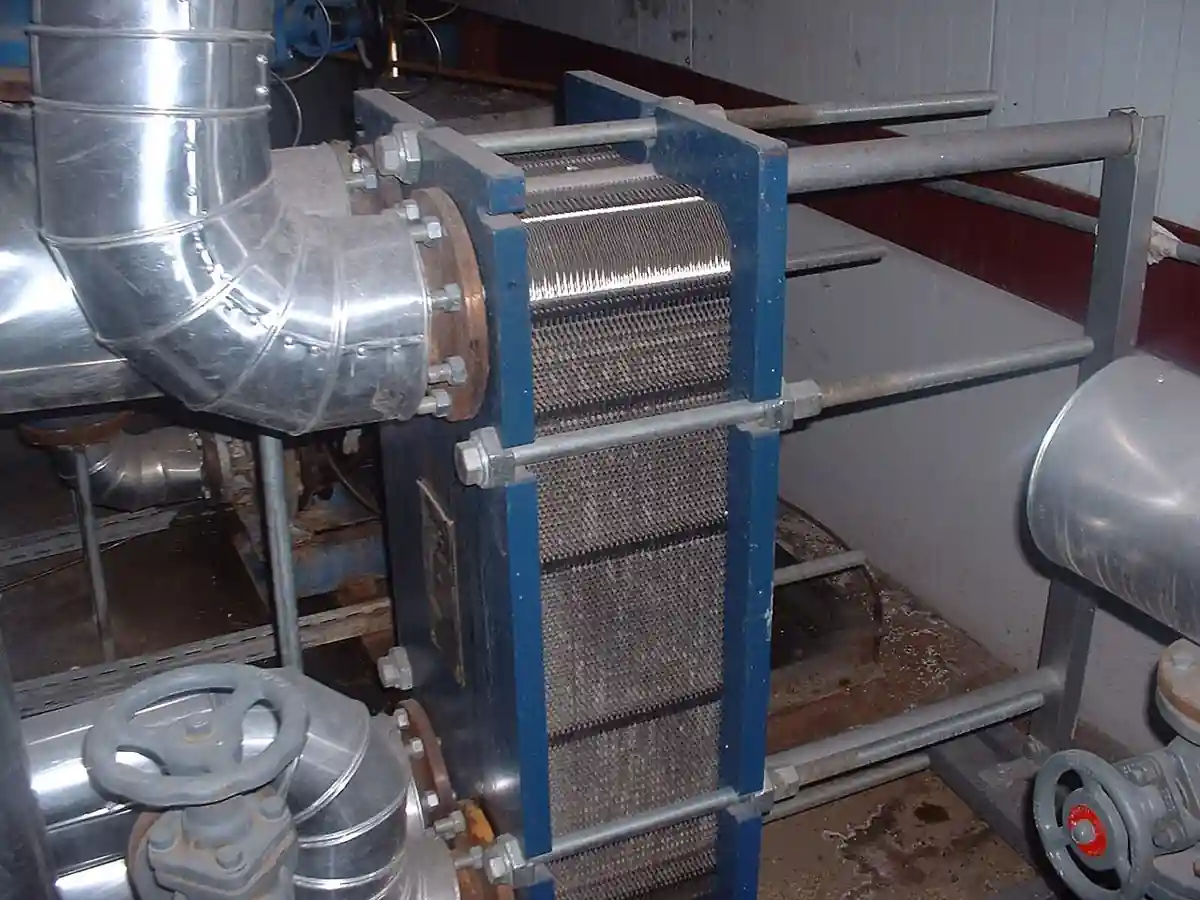
A plate heat exchanger is a compact device in which two fluids exchange heat through thin, corrugated metal plates without contacting each other. The corrugation pattern promotes turbulence, increases effective surface area, and supports the plates against differential pressure. According to vendor and manufacturer documentation, plate designs can deliver heat transfer coefficients three to five times higher than tubular equivalents at the same pressure loss, while occupying roughly one third of the installation area, and can achieve heat recovery rates up to 90 percent.
Plate heat exchangers are produced as gasketed plate-and-frame units, brazed plate units, and fully welded plate units, and are selected for duties that range from sanitary pharmaceutical water-for-injection loops and dairy pasteurization to district heating substations, chemical process heating, marine engine cooling, and swimming pool water heating. The reference-manual pages that follow document working principles, specification parameters, configuration variants, selection criteria for procurement, applicable standards and testing practice, and the structure of the vendor landscape, all grounded in the supplied vendor and manufacturer literature.
A plate heat exchanger transfers heat between two fluids across a stack of corrugated metal plates. The category includes gasketed, brazed, welded, and specialty units in stainless steel, titanium, and other alloys. Plate designs achieve high heat recovery in compact footprints across HVAC, chemical, food, pharmaceutical, marine, and pool heating applications.
Chapter 1 / 06
Fundamentals and Working Principle
A plate heat exchanger transfers heat between two fluids that flow through alternating channels formed by a pack of thin, corrugated metal plates. The plate pack is compressed between a fixed frame plate and a movable pressure plate, and tightening bolts maintain the seal load across the gaskets. Corner ports route each fluid into its dedicated channels, so the two streams exchange heat through the plate wall while remaining physically separated. This indirect transfer is what makes plate units suitable for duties that require hygiene, contamination control, or strict cross-leak limits.
Heat transfer performance in a plate unit is driven by plate geometry rather than bare plate area. The herringbone corrugations described in vendor literature increase fluid turbulence, enlarge the effective heat transfer area beyond the flat footprint, and mechanically support each plate against the differential pressure of the adjacent channel. According to the equipment-structure descriptions, the channels are arranged so that hot and cold media flow in complete counter-current configuration, which is the most thermodynamically efficient flow arrangement. A minimum logarithmic mean temperature difference of 0.5 degrees Celsius is achievable in properly designed units, which allows plate units to recover heat in applications where shell-and-tube designs would be impractical.
A standard plate pack consists of a fixed plate, a set of heat transfer plates, gaskets on every plate, a back plate, a back framework, support columns, a lower guide bar, tightening threaded rods, a top carrying bar, and the connection ports. The fixed plate and the pressure plate are suspended from the upper carrying bar and located by the lower guiding bar, both of which are fixed to the support column. This suspension arrangement allows plates to be added or removed without disturbing the piping, and additional plates can be installed later to expand heat transfer capacity when process requirements grow.
Compared with a shell-and-tube exchanger at equal pressure loss, a plate heat exchanger has a substantially higher heat transfer coefficient and a smaller installation footprint. Vendor sources state that the heat transfer coefficient of a plate exchanger is three to five times higher than that of a tubular exchanger, the heat transfer area is about one third that of a tubular design, and the heat recovery rate can reach 90 percent. These gains are a direct consequence of the thin plates, the high turbulence from the corrugations, and the true counter-current flow pattern that plate geometry makes possible.
Chapter 2 / 06
Specifications and Key Parameters
The specification table that follows consolidates values drawn directly from the supplied sources, and each row identifies the originating vendor or standard. Because no single manufacturer publishes a complete cross-vendor specification, the table groups parameters by data source rather than presenting a fictitious industry-wide range. Where a source does not publish a value, the cell reads varies by model. All numbers are reproduced verbatim from the cited source.
Plate heat exchangers are commonly characterized by single-plate heat transfer area, plate pack dimensions, plate thickness, port diameter, corrugation geometry, maximum working pressure, maximum allowable temperature, and overall heat transfer coefficient. Across the cited product lines, single-plate area ranges from 0.05 square meters in compact sanitary models to more than 2,400 square meters of combined heat transfer area in large industrial frames. Plate thickness in the cited catalogs spans 0.4 to 0.8 millimeters, which balances thermal conductivity against mechanical robustness, and standard plate material offerings include AISI 304, AISI 316L, titanium, and Alloy 20/18/6 in the Alfa Laval M10 line.
Pressure and temperature ratings depend strongly on frame selection and gasket selection. The Alfa Laval M10 family offers 1.0 megapascal at 160 degrees Celsius for the FM frame, 1.6 megapascal at 180 degrees Celsius for the FG frame, 2.5 megapascal at 160 degrees Celsius for the FD frame, and an FG variant approved for 1.2 megapascal at 200 degrees Celsius for steam service. The Wenzhou Lihong Br series is rated 0.4 to 2 megapascals and 120 to 160 degrees Celsius in general service, with 250 degrees Celsius available for special requirements. ETW International lists a customization range up to 25 bar working pressure, 2,400 square meters of heat transfer area, and connection sizes from DN32 to DN450, with overall heat transfer coefficients reported in the 2,000 to 6,000 watts per square meter per degree Celsius range.
Frame and connection materials complete the specification picture. Standard frame offerings in the cited sources are mild steel with epoxy coating or stainless steel, and standard connection materials are epoxy-coated carbon steel, stainless steel, and titanium. Gasket materials include nitrile, EPDM, FPM, Viton, HNBR, EPDM-FDA, HeatSeal, and silicon to cover temperature, chemical compatibility, and sanitary service. Liquid flow rates in the cited Alfa Laval M10 family reach up to 50 kilograms per second depending on media, pressure drop, and temperature program, and water heating by steam is published in the 0.7 to 3.0 megawatt range. The compact IR reference units published by ETW International range from 19 cubic meters per hour at DN32 to 2,575 cubic meters per hour at DN450.
Plate heat exchangers are divided into three principal construction families: gasketed plate-and-frame units, brazed plate units, and fully welded plate units. The gasketed plate-and-frame is the most common industrial configuration, with each plate fitted with a gasket that seals the interplate channel and directs the fluids into alternate channels. The plate pack is compressed by tightening bolts between a fixed frame plate and a movable pressure plate, and the number of plates is determined by flow rate, fluid properties, pressure drop, and the temperature program. Gasketed units are detachable for cleaning, inspection, and plate or gasket replacement.
Brazed plate heat exchangers use a vacuum-brazed copper or nickel joint instead of gaskets, which eliminates the leak path and allows higher temperature and pressure operation. Welded plate heat exchangers use welded plate pairs in place of gaskets for the most aggressive service, and are typically selected for refrigerant duties, ammonia, and process fluids that would attack elastomer gaskets. Both brazed and welded variants sacrifice the easy-clean benefit of gasketed units in exchange for higher pressure ratings and reduced maintenance.
Specialty configurations serve narrow applications. Titanium plate heat exchangers are offered for pool and spa heating, for seawater service, and for chloride-containing process fluids, with plate materials in stainless steel 304, stainless steel 316, and titanium listed in the ETW customization range and a dedicated Peraqua titanium plate heat exchanger product family serving swimming pool heating. High-temperature and high-pressure units such as the Yingling Machinery YLM-EH target extreme process duty, with attributes including high-temperature resistance, high-pressure performance, reliable sealing, leak prevention, and stable operation under demanding conditions.
Plate selection within a frame is an additional layer of configuration. Vendors offer multiple plate types per frame, such as the Alfa Laval M10B, M10M, and M10MD plates paired with FM, FG, and FD frames, and each plate type provides a different corrugation geometry, pressure rating, and heat transfer characteristic. Frame models can be matched to AL, Sondex, APV, Tranter, and GEA replacement series, as documented in the cross-reference product listings, which means a buyer can specify replacement frames and plates against an incumbent installed base rather than committing to a single proprietary platform. Plate pack length scales with the number of plates, and published length ranges in the ETW IR series span 110 to 6,585 millimeters across the model lineup.
Gasketed plate-and-frame (detachable, cleanable)
Brazed plate (copper or nickel brazed, higher pressure)
Fully welded plate (highest pressure and temperature)
Titanium plate (chloride, seawater, pool heating)
High-temperature and high-pressure plate (process duty)
Compact IR-style plate (sanitary and small flow rates)
Procurement of a plate heat exchanger begins with the thermal and hydraulic duty. The buyer must supply the flow rate, the inlet and outlet temperatures of both fluids, the desired working pressure, the maximum permitted pressure drop, the physical properties of the fluids if they are not water, and, for steam heating, the available steam pressure. The Alfa Laval M10 quotation particulars list these exact inputs, and the same data set is generally required by every plate exchanger vendor. The minimum logarithmic mean temperature difference of 0.5 degrees Celsius published for plate units is a useful early screen to confirm feasibility.
Frame selection follows the pressure and temperature envelope. The Alfa Laval M10 line offers 1.0 megapascal at 160 degrees Celsius for FM, 1.6 megapascal at 180 degrees Celsius for FG, 2.5 megapascal at 160 degrees Celsius for FD, and an FG variant approved for 1.2 megapascal at 200 degrees Celsius for steam service. The ETW International customization range extends to 25 bar working pressure, 2,400 square meters of heat transfer area, and connection sizes from DN32 to DN450. The Wenzhou Lihong Br series is rated 0.4 to 2 megapascals and 120 to 160 degrees Celsius in general service, with 250 degrees Celsius for special requirements.
Material selection is driven by fluid compatibility. Plate material options in the cited catalogs are stainless steel AISI 304, stainless steel AISI 316L, titanium, and Alloy 20/18/6 in the Alfa Laval M10 line, with titanium recommended for chloride, sea water, and aggressive chemical service. Gasket materials range across nitrile, EPDM, FPM, Viton, HNBR, EPDM-FDA, HeatSeal, and silicon, and the right choice depends on the fluid chemistry and the peak temperature. Connection materials follow the same logic, with epoxy-coated carbon steel, stainless steel, and titanium as standard offerings.
Commercial terms are part of the specification. Unit pricing in the published product listings ranges from USD 100 to USD 10,000 per set for frame-and-plate components and from USD 500 to USD 100,000 per unit for complete units, with a one-year warranty as the standard vendor offering. Standard packaging is a plywood case, lead time is 10 to 15 working days for stocked frame lines and about 30 days for engineered units, supply capacity is up to 500 units per month on the cited listings and 5,000 pieces per month on the enhanced-surface-area product line, and payment methods include T/T, L/C, D/A, D/P, and Western Union. The minimum order quantity is one unit or one set, and replacement-frame products support AL, Sondex, APV, Tranter, and GEA cross-references for retrofit procurement.
Chapter 5 / 06
Standards, Compliance and Testing
Plate heat exchangers are designed and tested against a layered set of standards that cover quality management, mechanical design, and end-use compliance. Wenzhou Lihong states that its products are designed and manufactured strictly in accordance with ISO 9001-2000 international quality standards and that they comply with the 2010 GMP medical standard, which is a baseline requirement for pharmaceutical and sanitary applications. ISO 9001 governs the quality system, while the GMP reference covers hygienic design for pharmaceutical service.
Mechanical design standards in the cited catalogs include DIN 2501 PN10, PN16, and PN25 flange classes and ANSI 150 and ANSI 300 (ASME) flange classes, as published in the Alfa Laval M10 connection schedule. The ASME rating is invoked where the unit is to be installed under ASME Boiler and Pressure Vessel Code jurisdiction, which is common in chemical, petrochemical, and power plant service. The published design and test pressures for a representative reference unit are 1.0 megapascal design and 1.3 megabascal test, which corresponds to the standard 1.3 times hydrostatic test factor applied to the design pressure.
End-use compliance varies by industry. For sanitary service in pharmaceutical, dairy, food, and beverage applications, GMP-compliant hygienic design is required, and the vendor literature ties this to stainless steel plate and frame construction, detachable plates for clean-in-place, and FDA-grade gaskets such as EPDM-FDA. For HVAC, district heating, and general industrial service, the relevant compliance is the pressure equipment directive or its national equivalent, and the plate exchanger is typically supplied with a declaration of conformity to the applicable pressure code. For marine and offshore service, classification society rules apply, and material traceability and impact testing are added requirements.
Testing and documentation typically include hydrostatic pressure test of the plate pack at 1.3 times design pressure, leak test of the gasketed joints, material certificates for plates, gaskets, and frame, and a performance test against the specified heat transfer duty. Plate thickness tolerance, gasket compression set, and tightening-bolt torque are documented for the buyer. The Alfa Laval M10 documentation states that the number of tightening bolts varies with the pressure rating, and the Wenzhou Lihong Br series notes that the sheet thickness is held at 0.8 millimeters across the three standard sizes, both of which are typical of the controlled specifications that procurement will receive for review.
Chapter 6 / 06
Market Landscape and Buying Process
The plate heat exchanger market is a multi-tier landscape that spans global original equipment manufacturers, regional fabricators, and trading companies that offer cross-vendor replacement frames. The original equipment manufacturers documented in the supplied sources include Alfa Laval with the M10 family, ETW International with the IR series, Wenzhou Lihong with the Br series sanitary line, and Yingling Machinery with the YLM-EH heavy-duty and YLM-EC corrosion-resistant models. Each of these vendors offers a different combination of plate material, frame rating, and customization range, and the buyer's choice depends on the duty profile, the installed base, and the preferred supply chain.
The replacement and retrofit segment is a distinct sub-market. Product listings explicitly cross-reference AL, Sondex, APV, Tranter, and GEA frame models, with plate material options in SS304, SS316, titanium, nickel, and SMO254, and gasket materials in NBR, EPDM, Viton, HNBR, and CR. This allows a plant operator to specify a replacement frame and plate pack against an incumbent installed base without committing to a single proprietary platform, and the published price band for frames and plates is USD 100 to USD 10,000 per set. The segment also includes suppliers such as Peraqua that focus on a single application, in this case titanium plate heat exchangers for swimming pool heating.
Buying process and commercial terms are consistent across the cited vendors. The standard packaging is a plywood case, which is suitable for export crating, and the lead time is 10 to 15 working days for stocked lines and about 30 days for engineered units. Payment methods are T/T, L/C, D/A, D/P, and Western Union for the China-based vendors in the supplied sources, with the minimum order quantity set at one unit or one set. The supply capacity figures range from 500 units per month on complete units to 5,000 pieces per month on the enhanced-surface-area plate line, and the warranty is one year across the cited vendors. Factory audits, sample testing, and pre-shipment inspection are routinely available on request, and the Wenzhou Lihong FAQ confirms factory visits are welcomed at the company site in Wenzhou, Zhejiang Province.
The buying decision should weigh duty fit, material compatibility, frame rating, lead time, and after-sales support. The buyer should request the calculation sheet that shows the selected plate type, the number of plates, the pressure drop on each side, the heat transfer coefficient, and the approach temperature, all of which are standard deliverables from the major vendors. The buyer should also confirm the gasket replacement schedule, the available spare parts, and the local service footprint, because plate exchangers are field-serviceable but require periodic gasket inspection and replacement. Once these factors are aligned, the order can be placed against the published price band, with the option to negotiate volume pricing for fleet purchases and multi-unit orders.
FAQ
What is a plate heat exchanger?
A plate heat exchanger is a device that transfers heat between two fluids through a pack of corrugated metal plates. The two fluids flow through alternating channels, are kept separate by gaskets, and exchange heat through the plate wall without direct contact. Plate designs achieve higher heat transfer coefficients and smaller footprints than tubular designs at the same pressure loss.
What materials are available for plates and gaskets?
Plate materials in the cited catalogs include stainless steel AISI 304, stainless steel AISI 316L, titanium, and Alloy 20/18/6. Gasket materials include nitrile, EPDM, FPM, Viton, HNBR, EPDM-FDA, HeatSeal, and silicon. The right choice depends on fluid chemistry, peak temperature, and whether the service is sanitary or industrial.
What is the typical pressure and temperature rating?
Pressure ratings across the cited sources range from 0.4 megapascals in sanitary frames to 2.5 megapascals in heavy-duty industrial frames, with the ETW International customization range extending to 25 bar. Temperature ratings range from 120 to 160 degrees Celsius in general service, with up to 200 degrees Celsius on steam-rated frames and 250 degrees Celsius available on special builds.
What is the typical heat transfer coefficient?
The Wenzhou Lihong Br series publishes a heat transfer coefficient of 2,000 to 6,000 watts per square meter per degree Celsius. Vendor literature more generally states that the heat transfer coefficient of a plate exchanger is three to five times higher than that of a tubular exchanger at the same pressure loss, with a heat recovery rate up to 90 percent.
What standards apply to plate heat exchangers?
Wenzhou Lihong states that its products are designed and manufactured in accordance with ISO 9001-2000 and comply with the 2010 GMP medical standard. Mechanical design standards in the cited catalogs include DIN 2501 PN10, PN16, and PN25 and ANSI 150 and ANSI 300 (ASME). End-use compliance is driven by the application, with GMP for sanitary service and the pressure equipment directive for industrial service.
What is the lead time and warranty for a plate heat exchanger?
Stocked frame and plate products from the cited China-based vendors ship in 10 to 15 working days, and engineered units ship in about 30 days. The standard warranty is one year across the cited vendors, and the standard packaging is a plywood case suitable for export crating.
Can a plate heat exchanger be expanded after installation?
Yes, gasketed plate-and-frame units are detachable and additional plates can be added to increase heat transfer capacity. The ETW International product description lists flexible capacity expansion as a standard feature, and most plate pack designs are sized to allow future plate insertion without changing the frame.