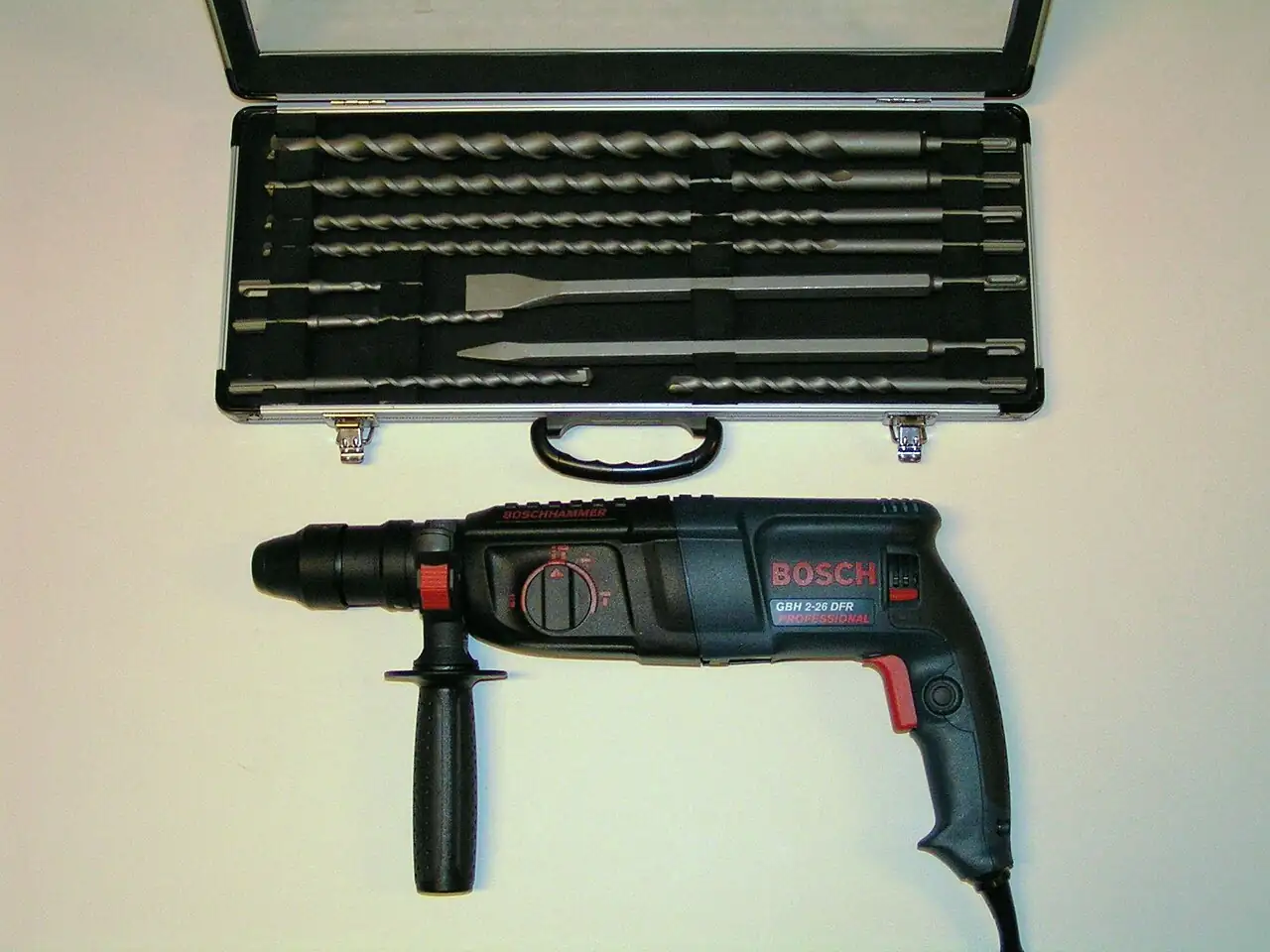
An SDS-Plus rotary hammer is a electro-pneumatic hammer drill whose 10 mm slotted shank system accepts bits up to roughly 30 mm in concrete. The piston-cylinder power plant delivers impact energy independently of the operator's push force, which is why it drills concrete several times faster than a hammer drill and why the bit changes without tools, two pockets of the shank locking into the chuck and transmitting blow and torque without slipping. For a procurement engineer the tool is best understood as a consumables platform: the machine outlasts hundreds of bits, and the purchase decision that matters is matching the energy class to the hole list so both machine and operator last the project.
Specifying one is a match between impact energy class and hole list. The datasheet lines that matter are single-blow impact energy in joules, rated bit capacity in concrete, holes per charge for battery platforms, vibration emission and triaxial figures, and the mode set: rotary hammer, rotation-stop for light chiseling, and hammer-only for demolition work within the tool's class.
SDS-Plus is the middle sibling of the shank family. Below it, plain hammer drills and an impact drill serve wood, steel, and light masonry with a keyed or keyless three-jaw chuck; above it, SDS-Max machines in the demolition hammer class drive 18 mm shanks for heavy chiseling and large-diameter work. This page is about the SDS-Plus tool: the 2 to 4 kg class that installs anchors and runs conduit routes all day, and where its duty genuinely ends.
An SDS-Plus rotary hammer is bought for one honest purpose: making the day's anchor and fixing holes in concrete without wearing out the operator or breaking the site's health rules. This page decodes impact energy classes, bit capacity, measured drilling rates, the vibration and silica-dust framework, and the RFQ lines that separate a two-year fleet tool from a one-season consumer tool.
Chapter 1 / 06
What Is an SDS-Plus Rotary Hammer
The name decodes the mechanism. SDS stands for the slotted drive system, from the German Steck-Dreh-Sitz, insert, twist, seat: the bit shank carries two closed slots that lock into the chuck and two open slots that let the bit slide a few millimeters axially. The hammer strikes the bit's end through that axial play; the chuck never has to grip the shank to transmit the blow. Plus marks the 10 mm shank diameter with its four pockets; Max is the larger 18 mm system. Rotary hammer names the power plant: an electro-pneumatic crank drives a piston that air-couples to a flying mass, which strikes the drill bit, so blow energy does not depend on how hard the operator leans in.
The selection question arises whenever the work is repetitive anchor drilling in concrete, brick, or block: anchoring equipment bases and pipe supports, installing a chemical anchor or an expansion anchor, running cable tray and conduit routes, or setting dowels for formwork. One-off holes in soft brick are a hammer drill's job; hundreds of holes a day in hard concrete are this tool's job; large-diameter coring and heavy chipping belong upward in the SDS-Max and breaker classes.
What is actually being decided is the energy-to-weight point on the curve that matches the hole list. A 1.7 J compact drills 8 mm anchor holes fast enough at 2.3 kg; a 2.7 J mid-class drills 12 mm holes all day at 2.8 to 3.2 kg; a 3.5 to 4 J heavy SDS-Plus opens 24 to 30 mm holes and borders on SDS-Max chipping duty at 4 to 6 kg. Above the class, the tool accelerates fatigue and wrist strain; below it, the work rate collapses and bits overheat in deep holes.
The tool sits in a family whose other members appear on the same tool list. A demolition hammer or breaker covers heavy chiseling; an angle grinder and a circular saw cut rather than crush; a concrete vibrator serves pours, not drilling; the SDS-Plus tool's sharpest distinction is against the smaller impact drill, which hammers by cam action with blow energy tied to feed force and never approaches electro-pneumatic drilling rates in hard aggregate.
The same crew's tool cupboard places the SDS-Plus machine in context and sharpens the purchase logic. A renovation fit-out might carry a marble cutter and a general cutting machine for slab and steel work, a floor grinder for surface prep, and the rotary hammer for everything that anchors; a mechanical contractor leans on a pneumatic tool line, with an air impact wrench running off the same compressor that could drive a pneumatic hammer, trading electric convenience for compressor logistics. Each power tool purchase competes for the same fleet budget and the same charger shelf, which is why platform compatibility and duty balance, not single-tool specs, decide most professional purchases. The SDS-Plus rotary hammer earns its place as the highest-hours electric tool on most concrete sites, and the rest of the cupboard is arranged around what it does not do.
Why the shank system decided the market
Before slotted shanks, masonry bits were held in keyed chucks and hammered through friction, so blow energy was limited by how tightly a human could wrench a chuck and how much slip the jaws tolerated. The slotted shank decoupled the two jobs: torque through the closed slots, blow through the shank end, retention through the chuck collar. That decoupling is what made electro-pneumatic power plants practical on handheld tools and what still limits each system's energy ceiling: SDS-Plus's 10 mm shank sections are sized for its 2 to 4 J class, and pushing the same shank with 8 J would fatigue the shank shoulders and the chuck pockets, which is precisely why SDS-Max exists with twice the diameter. Buy the shank that matches the energy class of the work; the systems are deliberately not interchangeable upward.
Chapter 2 / 06
Working Principle and Tool Types
The electro-pneumatic power plant
A motor spins a crank; the crank drives a piston in a cylinder; the piston pumps air; an air spring hurls the striker mass against the bit shank end at a blow rate commonly between 4,000 and 5,500 blows per minute in this class. Because the coupling is air, there is no rigid mechanical link to hammer the bearings, and the operator's feed force mostly serves to keep the bit seated, typically 10 to 20 kg of lean, not a shove. Blow energy separates cleanly from rotation: the motor also drives the chuck rotation at 500 to 1,100 rpm, and the mode selector disengages either half for chiseling or pure rotation.
Three consequences follow for the specifier. Blow rate and energy trade against each other within one tool, so a single headline joule number does not predict drilling speed; honest comparisons use measured drilling time in a named concrete. The air spring means a bit that is not held against the work lets the striker bounce, and idle running in hammer mode accelerates chuck and striker wear; the clutch slips when a bit jams, protecting both the operator's wrist and the gearbox, and its response is a quality line that separates catalog tiers. And because the mechanism is sealed, lubrication is a service-plug affair on a maintenance schedule rather than a daily oiling chore.
Temperature and altitude are the quiet modifiers. Sustained full-power drilling heats the cylinder and the gearbox; professional tools manage this with duty-cycle guidance in the manual, and ignoring it on hot days shows up as gearbox grease breakdown long before the motor complains. At altitude the thinner air spring slightly softens blow coupling, a marginal effect at 2,000 m and worth knowing rather than worrying about. Cold weather stiffens grease and battery chemistry: cordless tools lose a visible share of holes per charge below freezing, so winter fleets store packs warm and rotate two packs inside the operator's jacket on exposed work.
Types a catalog actually offers
Corded classes run from roughly 800 W light-duty to 1,300 to 1,500 W top-tier SDS-Plus. Cordless classes now cover most of the same range on 18 to 36 V platforms with brushless motors; published work capacities run to roughly 50 to 150 holes of 8 mm x 80 mm per battery depending on pack and concrete. Combo kits pair the tool with an angle grinder or a circular saw on one battery platform, which matters to fleet buyers standardizing chargers. Within the class, three-mode machines (drill, hammer drill, chisel) dominate; a few compacts drop the rotation-stop to save length.
Chuck and handling lines finish the type map: a tool-free SDS chuck with dust-sealed collar; a depth rod for consistent embedment; a 360-degree side handle with vibration decoupling; variable speed trigger with electronic speed stabilization under load; and a service indicator or maintenance light on professional tiers. LED worklights are near-universal. Long-run favorites in this class are the 2.5 to 3 J tools around 3 kg that anchor crews carry up ladders; the 4 J tools suit floor and groundwork where weight matters less.
Chapter 3 / 06
Construction, Components, and Duty Boundaries
Build anatomy
The load path runs motor, gearbox, crank and piston, striker, chuck, bit. Professional tiers differ from consumer tiers in exactly the places that decide two-year survival: the gearbox sits in a metal housing or a heavy composite with metal inserts; the chuck carries a sealed bearing collar with a dust-extraction-ready shroud; the motor is brushless with electronics that soft-start and hold speed under load; and the whole assembly is rated for the drop and dust reality of scaffold work. Sealing is the quiet differentiator: concrete dust is abrasive in every bearing it enters, and the dust-extraction port is now both a health feature and a machine-life feature.
Bits and consumables
SDS-Plus bits are the tool's real running cost. Carbide-tipped masonry bits in 4 to 30 mm, self-feed auger-style bits at larger diameters, thin-wall core cutters to roughly 50 to 90 mm within class limits, plus chisels: pointed, flat, and scaling in rotation-stop mode. Bit geometry varies by target: flute designs for fast dust transport in deep holes, reinforced heads for rebar-rich concrete, and rebar-cutting-rated carbide grades that survive hitting steel reinforcement. The bit's condition drives both speed and vibration: a dull head lowers blow transfer, raises friction heat, and multiplies wrist load.
Grade the bit inventory like the tool fleet. A two-grade policy pays for itself: standard carbide for brick, block, and plain concrete; a reinforced or rebar-rated grade held in the common diameters for structural zones where reinforcement contact is expected, not discovered. Depth discipline belongs to the consumables list too: stop-depth bits, bits with depth stops, and a depth rod on the tool keep embedment inside the anchor approval, and a hole drilled past approval depth is a nonconformance even when the anchor feels tight. Clean and inspect bits weekly on heavy weeks; retire on carbide rounding, bent shanks, or flute damage, and date-mark the survivors so the oldest go to the lightest duty.
Duty boundaries
State plainly where SDS-Plus stops. Diameter: bits above 30 mm and cores beyond the class limit step up to SDS-Max machines whose 18 mm shank carries the blow energy of 8 J and up. Duty: sustained chiseling of tile screeds, chases, and demolition work belongs to a dedicated demolition hammer, whose oil-filled paving-breaker mechanism is built for hours of chipping, not drilling. Material: wood and steel drilling is a drill-chuck job; a three-jaw chuck adapter on an SDS tool exists but turns a precision hammer into a mediocre drill, and most professional crews carry a separate drill instead. And precision: close-tolerance anchor patterns in hardened aggregate drill better on a tool with electronic speed control and a sharp bit than on a bigger joule number leaned on hard.
The site safety ecosystem around the tool
The tool's chapter in the site safety plan names its neighbors, because the rotary hammer is the anchor of the PPE kit as much as of the tool cupboard. Head protection is non-negotiable where overhead drilling throws chips and where access runs under open edges: a safety helmet with a chin strap on scaffold work. Foot protection: proper safety shoes with protective toecaps and puncture-resistant soles, because dropped bits and rebar stubs are the unit of currency on concrete floors. Eye and face protection at the hole, hearing protection always, and the respiratory layer chosen honestly: a dust mask serves incidental exposure, but regulated silica work with sustained drilling demands a fit-tested respirator plus extraction, in that order of control. Electrical work nearby introduces its own line: insulated tools for the electrician routing the containment the anchor holes serve, and a tool check before drilling into walls that may hide live circuits, scanned and marked out per the site's services drawings. The RFQ buys the machine; the method statement buys the operator's decade.
Chapter 4 / 06
Key Specification Parameters
The decode table lists the lines that decide fit to work, with class spreads and what each means at the wall.
Read the energy line with the weight line together, because the ratio is the operator's day. A 3 J tool at 2.9 kg all-day-carried beats a 4 J tool at 5.5 kg for overhead anchor work; the reverse holds on floor plate work where the heavier tool's blow energy digs the big holes faster and its mass rests on the work. The drilling-rate row is the honest comparator: require vendor or independent measured times for your hole in your concrete class, because joule figures are measured to different internal procedures across makers and are not directly comparable.
The vibration and noise lines deserve equal standing with the performance lines, because they cap the tool's legal daily use. Declared vibration emission per the EN 60745 and successor EN 62841 standards, with the measurement uncertainty stated, feeds directly into the daily exposure calculation: an 8 m/s2 tool and a 12 m/s2 tool differ materially in permitted trigger time under European exposure action and limit values, and a damping side handle is not cosmetic. Sound power in the 95 to 105 dB(A) band sets the hearing-protection requirement and, on occupied fit-out sites, the working-hour windows. Require both figures with their uncertainty in the quotation, and treat a datasheet without them as incomplete rather than as good news.
Battery-platform lines only look like marketing. Holes per charge measured on a named hole, charge time, pack amp-hours, and above all compatibility with the chargers and packs the fleet already owns decide the real cost of a cordless tool over two years. A tool that arrives with its own unique charger and pack family quietly doubles the fleet's battery logistics; a tool joining an existing platform is a tool whose spares are already on the shelf.
The second table is the consumables economics that belongs in the same RFQ.
Cost element
Notes per 1,000 holes, 10 x 80 mm
Bits
2 to 5 bits consumed; carbide grade and rebar contact decide
Batteries (cordless fleet)
2 packs in rotation per tool; 300 to 600 cycles to 80% capacity
Service intervals
grease plug every 6 months professional duty; chuck replacement by wear
Dust extraction consumables
filter bags and pre-separators; vacuum rated for concrete dust class
Work the decision in this order; each step fixes a number or eliminates a class.
List the holes: diameters, depths, and daily counts by anchor type, including an expansion anchor or chemical anchor embedment requirements from their approvals.
Split the list by position: overhead and vertical work favors lighter tools; floor work favors energy; the split decides one tool or two.
Choose energy class from the largest 20 percent of holes; do not size for the rare big hole that a rental SDS-Max covers better.
Choose power platform: corded for fixed-power sites and maximum duty cycle; cordless for scaffold and rooftop fleets, with published holes-per-charge checked against the daily count.
Verify the health file: vibration triaxial figures and stated uncertainty, sound power, and dust extraction compatibility with a vacuum rated for the site's silica rule.
Check the consumables chain: bit availability in your region, chuck service parts, and service turnaround, because a tool awaiting a chuck bearing is a hole list that stops.
Price the two-year system: tool, spare bits, batteries and charger, extraction, and PPE, not the bare tool.
The cost table shows the structure of a fleet decision for an anchoring crew; fill local pricing to make it a decision table.
Element
Corded mid-class
Cordless mid-class
Cordless heavy 4 J
Tool, relative index
100
150 to 190
200 to 260
Energy source
site power, leads
2 packs + charger
2 to 3 packs
Duty cycle
unlimited within rating
pack swaps
pack swaps, heat rests
Best duty
fixed benches, plant work
scaffold, rooftop, fit-out
floor anchoring, big fixings
Weight carried all day
tool + lead
tool + spare pack
tool + 2 packs
What to write in the RFQ, verbatim:
Duty annex: hole list by diameter, depth, material class, and daily count; share of overhead versus floor work.
Performance: measured drilling time for a named hole (e.g. 12 mm x 100 mm in C30/37 concrete) and holes per charge at that duty for cordless.
Health lines: vibration emission with uncertainty per EN 60745/62841 and declared sound power; dust-extraction port and shroud compatibility.
Fleet lines: battery platform compatibility with existing tools, charger specification, bit catalog availability and lead time.
Service: service interval schedule, spares availability commitment, and warranty terms naming chuck and gearbox coverage.
Training and PPE: operator training content for overhead drilling and jam response; PPE list with hearing protector, safety glasses, and respirator ratings.
Ask for two demonstration items at delivery. First, a timed drilling demonstration on the hardest block the site can provide, at the RFQ's named hole, with the stopwatch and the extraction running; this single test collapses brochure claims into a number both parties can recheck. Second, a jam-response demonstration: deliberately trap a bit in a scrap footing and show the clutch behavior and handle reaction the operator will manage overhead. Tools that pass both on the bench rarely surprise anyone on the scaffold, and the demonstration minutes are the cheapest training the fleet will ever receive.
Adjacent tool decisions ride along on the same purchase. The anchor plan names the drilling tolerance, and each anchor family's approval sheet is the governing document: an expansion anchor lists hole diameter and cleaning regime; a chemical anchor adds hole brushing and blow-out steps that the tool's extraction must support. Reinforcement scanning before drilling belongs to the layout crew, and where the pattern hits rebar, the rebar-cutting bit grade is a consumables line, not an improvisation.
Chapter 6 / 06
Field Practice: Safety, Bits, and Maintenance
Operating discipline
Two hands, always: one on the trigger grip, one on the side handle, with the handle set to throw the tool's torque reaction away from the body. Let the tool drill: steady lean of 10 to 20 kg, no shoulder drive; the electro-pneumatic plant converts feed beyond seating force into nothing but operator fatigue. When the bit jams in aggregate or rebar, the clutch slips; release the trigger and back out, never fight the twist. Overhead work: bits out of the chuck kill and injure, so pull the bit before climbing down or use a retention lanyard; and never lock a trigger on for two-hand positioning above the shoulders. This tool is strictly a two-hand machine, and every serious maker's manual states it.
Dust and noise law
Concrete dust carries respirable crystalline silica, and modern regulation treats it accordingly: under the OSHA construction standard 1926.1153 and its counterparts elsewhere, drilling in concrete requires engineering controls, which in practice means extracting at the bit with a vacuum rated for the dust class, plus respiratory protection where the exposure assessment calls for it. The practical package: extraction shroud on the chuck, M- or H-class vacuum by local rule, pre-separator on high-volume days, and a respirator correctly fitted as the backup layer. Noise runs 95 to 105 dB(A) at the operator; hearing protection is not optional, and a face shield or at minimum safety glasses guards against chip spray on pull-out.
Bit care
Bit condition is speed, vibration, and cost at once. Inspect heads for carbide rounding and flute packing; dress or replace on wear instead of pushing harder. Clean deep holes per the anchor approval, brush and blow for chemical duty, because dust left in the hole is the most common cause of anchor pull-out failures. Store bits dry in their case; a corroded shank sliding badly in the chuck both loses blow energy and hammers the chuck itself. Match bit to layer: a sharp standard bit in brick, a reinforced-head grade in rebar concrete, and never a masonry bit spun into steel plate. On fit-out crews that also marble cut and chase walls, keeping the hammer's bits in a separate marked case from the cutting inventory stops the two consumable streams from cross-contaminating each other's tolerances.
Maintenance cadence
Daily: chuck collar wipe and slide check, handle security, cord or pack contacts, extraction shroud condition. Weekly on professional duty: blow out vents, check depth rod, inspect trigger lockout. Scheduled: grease service at the manufacturer interval, commonly every six months of professional use, through the service plug with the specified grease only; chuck replacement when axial play grows; brushless motor tiers extend the electrical service life but still demand vent cleaning. Log the tool's service dates in the fleet register: vibration exposure tracking is a legal duty in many jurisdictions, and the register plus hours is how it is audited. Retirement criteria are honest wear items: chuck play that survives service, gearbox growl under load, or housing cracks from drops; a tool that fails under an operator's hands overhead is a liability no repair budget justifies.
Fleet economics over the first two years
Cost the tool the way a fleet manager does, per hole. The purchase price divides over roughly 20,000 to 60,000 holes of professional life in this class; bits divide over roughly 2,000 to 5,000 holes each; extraction consumables and PPE run per operator-month; and the two battery packs amortize over 300 to 600 cycles to their 80 percent capacity floor. On those numbers the bare tool is rarely the deciding term: bit grade choice, extraction discipline, and service turnaround dominate the cost per hole. That is also why the RFQ asks for the bit catalog and service network in the same envelope as the tool: a superb hammer starved of sharp bits drills slower than an average one fed well.
FAQ
What does SDS-Plus actually mean, and what fits it?
SDS-Plus is a 10 mm slotted shank system: two closed slots lock the bit, two open slots let it slide so the hammer strikes through axial play, not friction. It accepts masonry bits roughly 4 to 30 mm and small chisels, and it is not compatible with SDS-Max, whose 18 mm shank carries far higher blow energy. Adapters between systems exist but sacrifice performance and safety margins, so the fleet decision should follow the work, not the adapter.
How many joules do I need for anchor holes?
Match the class to the hole: 1.7 to 2.3 J for 6 to 10 mm anchors at volume, 2.5 to 3.2 J for the everyday 8 to 16 mm range with the best all-day weight balance, 3.5 to 4 J for 20 mm-plus fixings. Above that, rent or buy an SDS-Max machine rather than pushing a heavy SDS-Plus to its limit. Judge by measured drilling time in your concrete, not by the headline joule figure, which makers measure differently.
Rotary hammer or hammer drill for brick and block?
For a handful of holes in soft brick, a hammer drill is enough and lighter. For repetitive work, hard concrete, or anything in engineered masonry, the electro-pneumatic rotary hammer wins several times over in speed and in operator load because blow energy does not depend on feed force. Hammer drills also cannot run rotation-stop chiseling, which the SDS tool uses for tile and light patching duty.
Why do my bits keep dulling or snapping?
Three usual causes: rebar contact with a standard carbide grade, where a rebar-rated bit is the fix; running dull beyond economic sharpening, which multiplies heat and vibration; and poor shank condition sliding rough in a worn chuck, which hammers both bit and tool. Also check hole cleaning practice: packed dust flutes raise friction heat and can false-fail an anchor approval that assumes a cleaned hole.
Is cordless strong enough for production anchoring?
Current 18 to 36 V brushless SDS-Plus tools drill the same hole within seconds of corded equivalents, and published capacities of roughly 40 to 100 holes per charge cover a shift with two packs in rotation. The honest limits are sustained heavy duty, where packs and motors heat-manage, and cold weather, which cuts capacity. Fleets that standardize one battery platform across an angle grinder, a circular saw, and the hammer simplify logistics enough to decide the brand question on its own.
What dust and vibration rules affect buying this tool?
Silica rules in most industrial markets require extraction at the bit with a rated vacuum and often respiratory protection as backup, so the extraction shroud and vacuum class are purchase lines. Vibration emission figures, declared per EN 60745/62841 with uncertainty, feed the daily exposure calculation many jurisdictions require; a lower-emission tool with damping handle extends permitted daily trigger time directly. Both health lines now belong in the RFQ next to joules and kilograms.
How should the tool be handled overhead?
Two-handed with the side handle oriented to control torque reaction, steady feed instead of shoulder force, and trigger discipline: never taped or locked on. Remove the bit before descending or lanyard the tool, and stage holes so the operator works from stable access equipment, not a ladder stretch. Jammed-bit torque reaction is the classic injury mechanism in this class; the clutch mitigates it, but the technique decides.