A cable tray is a rigid support assembly that carries and protects insulated electrical and communication cables through a building or plant. It is an open, accessible alternative to running every circuit in conduit, and in industrial power distribution it is the backbone wiring method, supporting feeders, branch circuits, instrument bundles, and fiber along a common route from substation to load.
Although casually grouped with conduit and trunking, a cable tray is a structural member first: it must carry the static weight of its cables plus environmental loads such as ice, snow, and wind within a defined deflection limit, then survive corrosion for decades. Selection turns on three independent axes that this guide unpacks: tray geometry (ladder, perforated, solid bottom, wire mesh, channel), material and finish, and the load class certified to NEMA VE 1 or IEC 61537.
Photo: Santeri Viinamäki, CC BY-SA 4.0, via Wikimedia Commons
This guide is written for industrial purchasing engineers and electrical design engineers. It references the public standards that govern cable tray systems: NEMA VE 1 and VE 2 (North America), IEC 61537 and EN 61537 (international and Europe), NEC Article 392 / NFPA 70 for fill and grounding, and ASTM A123 / EN ISO 1461 for hot-dip galvanizing. Across six chapters it covers tray types, materials and finishes, load classification, fill and grounding rules, spec-sheet parameters, and the selection decision sequence, with two comparison tables and seven selection FAQs.
Chapter 1 / 06
What is a Cable Tray
A cable tray is a prefabricated structural assembly, usually formed from sheet steel, extruded aluminum, or molded fiberglass, that supports and routes insulated power, control, instrument, and data cables along an open path. It is one of the recognized wiring methods in the electrical codes, sitting alongside conduit, busway, and direct burial as a way to carry conductors from source to load. Where conduit encloses each circuit in a sealed pipe, a cable tray holds many cables in the open, which makes a tray faster to install, easier to inspect, and far simpler to extend when a plant adds equipment.
Functionally, a cable tray must satisfy two distinct duties at once. As a mechanical member it carries the dead weight of its cable population plus any environmental load, and it must hold that load between supports without exceeding a defined deflection. As an electrical component it provides a continuous, bonded metal path that, when correctly sized and maintained, can serve as the equipment grounding conductor for the circuits it carries. A tray that satisfies the first duty but fails the second, for example a corroded splice that breaks electrical continuity, is a latent safety hazard even though it still physically holds the cables.
The cable tray as an engineered product emerged with mid-twentieth-century industrial electrification, when petrochemical plants, power stations, and steel mills needed to route thousands of cables that conduit could not economically handle. The National Electrical Manufacturers Association issued the first dedicated load and dimension standard, NEMA VE 1, to make tray strength comparable across makers, and a companion installation guide, NEMA VE 2. Internationally, IEC 61537 unified cable tray and cable ladder requirements, with the current third edition published in 2023 superseding the 2006 edition; the European adoption is EN 61537. These documents define how a tray is tested, classified, and marked, so an engineer can specify strength and corrosion class without naming a brand.
The scale of a cable tray system is set by the plant it serves. A small machine room may use a single 100 mm (4 in) wide perforated tray; a refinery or data center routes parallel banks of 600 to 900 mm (24 to 36 in) ladder trays carrying tens of thousands of cables over runs measured in kilometers. Because the tray is exposed for its whole service life, its finish is as important as its strength: a structurally adequate tray that rusts through in a coastal plant has failed just as surely as one that sagged. The chapters that follow treat geometry, material, and load rating as the three independent decisions that together define a compliant tray.
Four engineering attributes determine cable tray quality over its life: the certified load class at the chosen support span, the corrosion protection of the material and finish, the fill and ventilation that preserve cable ampacity, and the electrical continuity that keeps the tray a valid grounding path. A tray bought on price alone, with thin pre-galvanized finish in an outdoor run, may show edge rust within a few years, forcing partial replacement at a cost that dwarfs the original saving. The remainder of this guide maps each of these attributes to a measurable specification.
Chapter 2 / 06
Cable Tray Types
Cable trays are classified by the geometry of the surface that supports the cables, and that geometry decides three things at once: how much weight the tray can carry, how well heat escapes from the cables, and how much the cables are protected from falling debris. The five mainstream styles are ladder, perforated (ventilated trough), solid bottom, wire mesh basket, and channel. Choosing the wrong style is a common error: putting heavy power feeders in a wire mesh basket overloads it, while routing a handful of data cables in a heavy ladder wastes material and money. The table below compares the five styles on the criteria that drive selection.
Type
Construction
Ventilation
Typical Span
Best Use
Ladder
Side rails plus transverse rungs
High (open between rungs)
Up to 6 m (20 ft)
Heavy power feeders, long runs
Perforated trough
Continuous base with slots or holes
Moderate
1.5 to 3 m (5 to 10 ft)
Mixed power and control cabling
Solid bottom
Continuous unperforated base
Low (sealed base)
1.5 to 3 m (5 to 10 ft)
Sensitive low-voltage, fiber, EMI-prone runs
Wire mesh basket
Welded steel wire grid
Very high
1.5 to 2.4 m (5 to 8 ft)
Data, telecom, light control wiring
Channel
Single rolled C or U section
Moderate
1.5 to 3 m (5 to 10 ft)
Few cables, drops and branches, tight space
Ladder tray is the workhorse of industrial power distribution. Two longitudinal side rails are joined by transverse rungs spaced typically at 150, 225, or 300 mm (6, 9, or 12 in) on center, leaving the support surface non-continuous. The open structure gives free airflow around the cables, which is essential because power cables generate heat and trapped heat derates ampacity. Rungs also give cable ties a natural anchor point at every interval. Ladder is preferred for the longest support spans and the heaviest loads, which is why feeders and large multiconductor cables almost always travel by ladder.
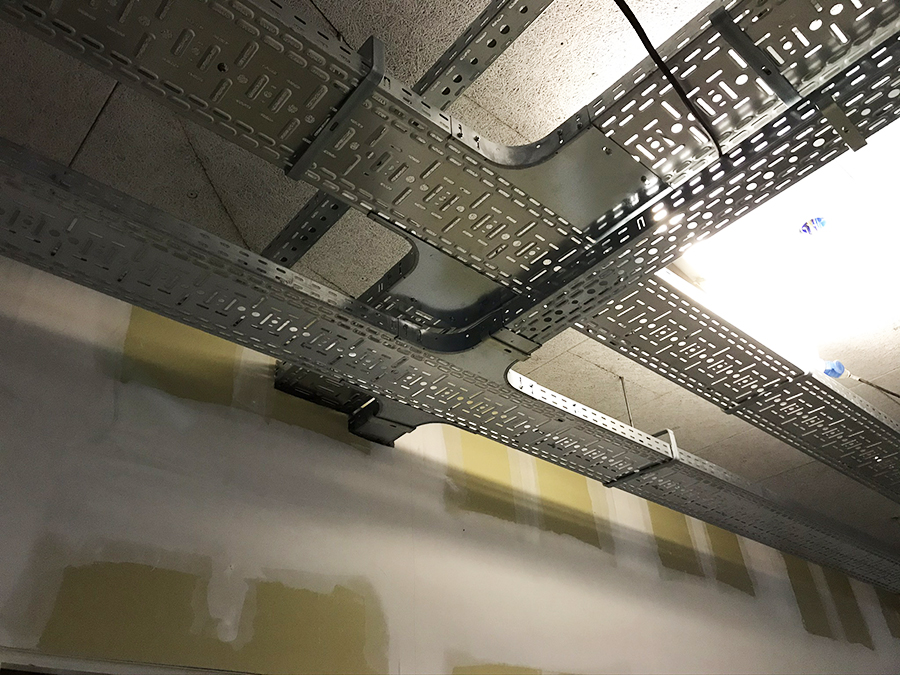
Perforated trough has a continuous base punched with slots or louvers. It supports cables along their whole length rather than only at rungs, which suits smaller diameter control and instrument cables that could bow between rungs, while the perforations still allow moderate ventilation. It is the most general-purpose style for mixed power-and-control runs. Solid bottom trades ventilation for protection: the unperforated base blocks dust, falling debris, and moisture, and the closed metal channel offers a degree of electromagnetic shielding, so it is favored for sensitive low-voltage signal cable and fiber. The trade is reduced cooling, so power cable ampacity in solid-bottom tray must be derated.
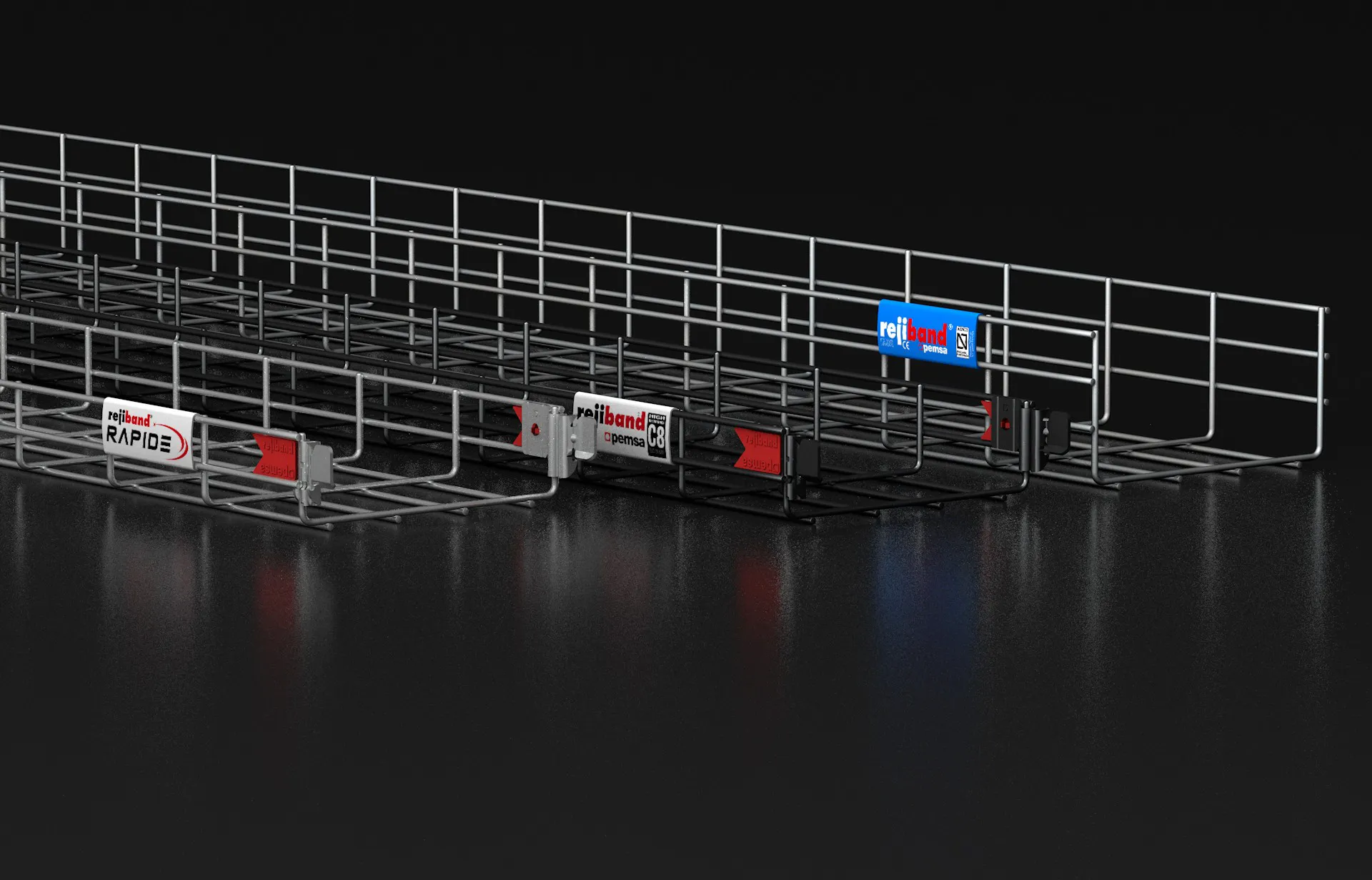
Wire mesh basket is a welded grid of steel wires forming a lightweight, highly ventilated channel. Strength comes from the distributed wire intersections rather than solid rails, so a basket is light, fast to cut and form on site, and ideal for data, telecom, and light control cabling, especially in raised-floor and overhead office and data-center environments. It is not a substitute for ladder under heavy power loads. Channel tray is a single rolled C- or U-shaped section used where only a few cables run, where conduit is undesirable, and where space is tight, for example branch drops feeding individual machines. Each style exists because no single geometry optimizes strength, ventilation, and protection simultaneously.
Chapter 3 / 06
Materials and Finishes
After the tray style is fixed, the second independent decision is material and finish, and it is governed almost entirely by the corrosivity of the installation atmosphere. The wrong finish does not fail on day one; it fails slowly, as edge rust, white storage staining, or chloride pitting, until the tray loses both strength and the electrical continuity it needs to remain a grounding path. The mainstream choices are pre-galvanized steel, hot-dip galvanized steel, Type 304 and 316L stainless steel, aluminum alloy 6063, and fiberglass reinforced polyester (FRP). The table below summarizes their corrosion behavior and economics.
Material / Finish
Standard
Coating / Note
Best Environment
Relative Cost
Pre-galvanized steel
ASTM A653 (G90)
~18 to 20 um/side, cut edges bare
Dry indoor only
Lowest
Hot-dip galvanized steel
ASTM A123 / EN ISO 1461
~65 to 85 um, covers edges
Outdoor, general industrial
Low to medium
Stainless steel 316L
ASTM A240
Mo-bearing, chloride resistant
Coastal, marine, chemical
High
Aluminum 6063
ASTM B221
~50% weight of steel
Weight-critical, non-magnetic
Medium to high
Fiberglass (FRP)
Vinyl ester / polyester resin
Non-conductive, no corrosion
Aggressive acids, splash zones
High
Pre-galvanized (mill-galvanized) steel is coil that was zinc-coated before forming, leaving roughly 18 to 20 micrometers of zinc per side. The fatal weakness is that every cut edge, punched hole, and bolt slot is created after coating, exposing bare steel that becomes the first point of attack in any damp or aggressive atmosphere. Pre-galvanized tray belongs only in permanently dry, conditioned indoor spaces. Hot-dip galvanized after fabrication, to ASTM A123 in North America or EN ISO 1461 internationally, dips the finished tray into molten zinc, forming a metallurgically bonded coating typically 65 to 85 micrometers thick that flows over and seals every cut edge and hole. This is the universal choice for outdoor and general industrial runs, and the difference in edge protection is the reason hot-dip outlasts pre-galvanized many times over in the same environment.
Stainless steel is specified where chlorides attack zinc and carbon steel. Type 304 covers mildly corrosive interiors; Type 316L adds 2 to 3% molybdenum, which sharply raises resistance to chloride pitting and crevice corrosion, making 316L the standard for coastal, marine, splash, and many chemical-processing installations. The low-carbon L grade resists sensitization at welds. Aluminum alloy 6063, a copper-free silicon-magnesium alloy, forms a self-healing oxide film and is chosen where weight matters: a 36 in (900 mm) wide, 24 ft (7.3 m) ladder section weighs roughly half its hot-dip galvanized steel equivalent, easing handling and reducing support steel. Aluminum is also non-magnetic, useful around sensitive instrumentation, and field cuts need no touch-up coating.
Fiberglass reinforced polyester (FRP) uses glass fibers in a thermoset resin matrix and does not corrode at all. With vinyl ester resin it withstands hydrochloric acid, chlorine, bleach, and many solvents that aggressively pit even 316L stainless, which is why FRP dominates in chemical plants, chlor-alkali units, wastewater works, and offshore splash zones. FRP is also electrically non-conductive, an advantage for isolation but a consequence engineers must plan for: an FRP tray cannot serve as an equipment grounding conductor, so a separate grounding conductor must be run. Material choice therefore ripples into the grounding design of the whole system.
Chapter 4 / 06
Load Classes and Standards
The third independent decision is the certified load rating, and this is where engineers most often compare incompatible numbers. A cable tray is a beam, and its allowable load depends on the support span: the same tray carries far less at a 6 m span than at a 1.5 m span. Two standard frameworks express this, NEMA VE 1 in North America and IEC 61537 internationally, and their numbers are derived differently and are not interchangeable. The first task in any load comparison is to confirm both quotes cite the same standard.
NEMA VE 1 pairs a support span with a working load. A load class is written as a number followed by a letter: the number is the support span in feet, historically 8, 12, 16, or 20, and the letter is the allowable uniformly distributed working load in pounds per linear foot, where A equals 50 lb/ft, B equals 75 lb/ft, and C equals 100 lb/ft. A class 20C tray therefore carries 100 lb/ft when supported every 20 ft. The working load is defined as the destruction test load divided by a 1.5 safety factor. Critically, the rating is a total load, so in outdoor runs the cable weight plus ice, snow, and wind must all fit under the class figure. Current VE 1 editions also let makers mark exact rated loads beyond the four historic spans, but the span-and-class shorthand remains the common procurement language.
IEC 61537 (and the identical EN 61537) defines a Safe Working Load (SWL) rather than a NEMA class. The SWL is the lower of two limits, found by a uniformly distributed load test at both minimum and maximum working temperature: the load at which mid-span deflection reaches 1/100 of the support span, or the test load divided by a 1.7 safety factor, with lateral deflection held under 1/20 of the tray width. IEC also classifies a tray by temperature range, electrical continuity, and corrosion-protection class. Because the deflection criterion (1/100 of span) and the safety factor (1.7) both differ from NEMA, an IEC SWL in kilograms per meter cannot be converted to a NEMA class by arithmetic; the tray must be tested and marked to the standard the project specifies. The table below contrasts the two frameworks.
Attribute
NEMA VE 1 (North America)
IEC 61537 / EN 61537 (International)
Rated quantity
Working load (lb/ft) at a fixed span
Safe Working Load (kg/m or N/m)
Load designation
Span-class, e.g. 12C, 20C
SWL value plus support distance
Deflection limit
Not the governing limit
1/100 of span (vertical); 1/20 of width (lateral)
Safety factor
1.5 on destruction load
1.7 on test load
Load letters
A=50, B=75, C=100 lb/ft
Not used (numeric SWL)
Companion install guide
NEMA VE 2
National wiring rules (e.g. IEC 60364)
Beyond the mechanical rating, two installation standards complete the load picture. NEC Article 392 (NFPA 70) governs how much cable a tray may carry, by area or by cable diameters, and the limit is set by ampacity rather than mechanical room: trapped heat in a full tray derates the conductors. Thermal expansion must also be designed for, because metal trays grow and shrink with temperature and aluminum moves about twice as much as steel. Per NEMA guidance, for a 100 degree Fahrenheit (about 56 K) seasonal swing, steel needs an expansion connector roughly every 128 ft (about 39 m) and aluminum about every 65 ft (about 20 m), with a practical rule of expansion joints near 30 m intervals in long outdoor runs. The installation-day metal temperature sets the gap, and a bonding jumper bridges every expansion joint so the grounding path stays continuous.
Chapter 5 / 06
Key Specification Parameters
A cable tray data sheet lists many figures, but only a handful drive a compliant selection: load class at the working span, side-rail depth, standard width, finish thickness, fill allowance, and bonding continuity. Reading them correctly is the core skill, because each parameter is an independent limit and overshooting one cannot compensate for undershooting another. Each is explained below.
Load class and support span are inseparable, as Chapter 4 established. Always read the rating at the span you will actually use, not at the maker's headline span. The same ladder rated 20C at a 20 ft span carries proportionally more at a 12 ft span; halving the span roughly multiplies the safe load. Specify the support spacing first, then read the required class. Remember that the class is a total uniformly distributed load and that outdoor runs must reserve capacity for ice, snow, and wind.
Side-rail depth and width set both strength and capacity. Deeper side rails (commonly 75, 100, 125, or 150 mm; 3 to 6 in) give a stiffer beam that carries more load at a given span, so depth is a strength lever, not just a cosmetic one. Standard widths step through 100, 150, 200, 300, 450, 600, 750, and 900 mm (roughly 4 to 36 in); width sets the usable fill area. A common mistake is specifying width for today's cable count with no spare, leaving no room for the plant's inevitable future additions; a 25 to 50% spare width is normal good practice.
Finish and coating thickness must be stated as a measurable value, not just a finish name. Hot-dip galvanizing to ASTM A123 yields roughly 65 to 85 micrometers; pre-galvanized G90 is only about 18 to 20 micrometers per side and leaves cut edges bare. For stainless and aluminum, the alloy grade (316L versus 304, 6063 versus generic aluminum) is the figure that matters. Requiring the coating thickness and the governing standard on the purchase order prevents a low bid from quietly substituting a thinner, shorter-lived finish.
Cable fill and ventilation are electrical, not mechanical, limits. Under NEC 392.22, power cables 4/0 AWG and larger lie in a single layer; smaller cables fill by cross-sectional area up to the tabulated maximum for the tray's inside width and depth, and solid-bottom trays carry a lower allowance than ventilated ones because they trap heat. The practical consequence is that two trays of identical dimensions but different ventilation have different legal cable capacities. Plan fill against ampacity tables, not against how many cables physically fit.
Electrical continuity and bonding decide whether the metal tray can act as the equipment grounding conductor. Two figures govern: the total side-rail cross-sectional area, which under NEC Table 392.60(A) must meet a minimum for the upstream fuse or breaker rating, and the splice-plate continuity rating. Steel trays cannot be the sole grounding conductor for circuits with ground-fault protection above 600 A, and aluminum cannot above 2000 A. Even when a separate grounding conductor is run, every metal tray must still be bonded to the building grounding system, with listed bonding jumpers across expansion joints and any non-continuous splice, and grounding connections made at intervals (commonly every 15 m, about 50 ft) and at both ends of a run.
Load class at working span: read at the actual support spacing, total UDL including environmental load.
Side-rail depth: 75 to 150 mm (3 to 6 in); deeper equals stiffer and stronger at a given span.
Standard width: 100 to 900 mm (4 to 36 in); add 25 to 50% spare for future cables.
Finish thickness: hot-dip A123 ~65 to 85 um; pre-galv G90 ~18 to 20 um/side; state the standard.
Fill allowance: per NEC 392.22, ventilation dependent, ampacity driven.
Bonding continuity: side-rail area per Table 392.60(A); jumpers at joints; bond regardless of EGC use.
Chapter 6 / 06
Selection Decision Factors
To turn the preceding five chapters into a specific purchase, follow the decision sequence below. Most cable tray errors come not from one wrong figure but from deciding parameters in the wrong order, for example fixing a width before knowing the cable population, or pricing a finish before classifying the atmosphere. These steps double as a fixed RFQ template.
Define the cable population and route: count power, control, instrument, and data cables, sum their outside diameters and weights per linear meter, and map the route length, bends, drops, and vertical risers. The cable weight per meter and the future spare set the width and load class.
Choose the tray style: ladder for heavy power feeders and long spans, perforated trough for mixed power and control, solid bottom for sensitive signal and fiber, wire mesh basket for data and telecom, channel for a few cables or branch drops. Style fixes ventilation and protection together.
Classify the atmosphere and select material and finish: dry indoor (pre-galvanized acceptable), general outdoor and industrial (hot-dip galvanized to ASTM A123 or EN ISO 1461), coastal or chloride (316L stainless), aggressive acids and chlorine (FRP), weight-critical or non-magnetic (aluminum 6063). Remember FRP and the grounding consequence.
Set the support spacing and read the load class: decide the span from available structure, then read the NEMA class (e.g. 12C, 20C) or IEC Safe Working Load at that span, confirming the total UDL covers cables plus ice, snow, and wind. Both quotes must cite the same standard.
Verify cable fill against ampacity: apply NEC 392.22 single-layer or area-fill limits for the chosen width, depth, and ventilation, and confirm the conductor ampacity after any tray derating. Fill is an electrical limit, not a packing exercise.
Design grounding and bonding: decide whether the metal tray is the equipment grounding conductor (check side-rail area against NEC Table 392.60(A) and the 600 A steel / 2000 A aluminum limits) or whether a separate grounding conductor is run; in all cases bond every section, jumper every expansion joint and non-continuous splice, and ground at intervals and both ends.
Plan thermal expansion and supports: for long metal runs, place expansion connectors per the temperature differential (steel ~128 ft / 39 m, aluminum ~65 ft / 20 m for a 100 F swing; practical ~30 m), set the gap to the installation-day temperature, support within ~600 mm of each splice, anchor near the midpoint, and float the rest on expansion guides.
Specify fittings, accessories, and documentation: bends, tees, reducers, covers, dividers (segregating power from signal), splice plates with a stated electrical-continuity rating, and the required coating-thickness and load-test certificates. Missing fittings stall installation as surely as a wrong tray.
A final dimension that buyers often overlook is serviceability and standardization: matching splice and fitting systems across a site, holding spare straight sections and bends in inventory, and confirming the maker's fittings interchange with the straight tray. A cable tray system lives for decades and is extended many times; choosing a maker whose profiles, finishes, and load classes stay in production, and whose splice plates carry documented continuity statements, keeps every future modification fast and code-compliant. Eaton B-Line, Atkore Cope and US Tray, Legrand Cablofil, Niedax, and OBO Bettermann all maintain broad, long-lived catalogs that ease this multi-decade standardization for large projects.
FAQ
What is the difference between a cable tray and a cable ladder?
In strict standards language a cable ladder is one form of cable tray. Under IEC 61537 the family term is cable tray system, and a cable ladder system is the variant whose support surface for cables is non-continuous, formed by two longitudinal side rails joined by transverse rungs. A cable tray system in the narrower sense has a continuous base that may be solid bottom or perforated. In everyday English, ladder means the open rung style used for heavy power feeders on long spans, while tray loosely means the perforated or solid-bottom troughs used for mixed and lighter cabling. Wire mesh basket is a third distinct style. When writing a specification, always cite the standard so the words are unambiguous.
What does a NEMA load class such as 20C mean?
NEMA VE 1 load classes pair a support-span number with a load letter. The number is the support span in feet (historically 8, 12, 16, or 20) and the letter is the allowable uniformly distributed working load in pounds per linear foot: A equals 50 lb per ft, B equals 75 lb per ft, and C equals 100 lb per ft. A 20C tray therefore safely carries 100 lb per linear foot when supported every 20 feet. The working load equals the destruction test load divided by a 1.5 safety factor, and the rating is a total load that must also cover ice, snow, and wind in outdoor runs. The current VE 1 edition lets makers mark exact rated loads beyond the four historic spans.
What is the difference between NEMA VE 1 and IEC 61537 load ratings?
They are different rating systems and the numbers are not interchangeable. NEMA VE 1 (North America) expresses a working load in pounds per linear foot at a fixed span, derived from a destruction test divided by a 1.5 safety factor. IEC 61537 (international and EN 61537 in Europe) defines a Safe Working Load that is the lower of two limits: the load at which mid-span deflection reaches 1/100 of the support span, or the test load divided by a 1.7 safety factor, with lateral deflection held under 1/20 of the width. IEC also classifies a tray by working temperature, electrical continuity, and corrosion-protection class. Because the deflection criterion and safety factor differ, a tray must be tested and marked to whichever standard the project specifies.
How full can a cable tray be loaded under NEC Article 392?
NEC Article 392 limits fill by cross-sectional area or by cable diameters, and the real driver is ampacity rather than mechanical room. For multiconductor power and lighting cables 4/0 AWG and larger in a ladder or ventilated trough, conductors are laid in a single layer. For cables smaller than 4/0 AWG, the sum of cable cross-sectional areas must not exceed the maximum fill area tabulated in NEC Table 392.22(A), which depends on the inside tray width and usable depth. Solid-bottom trays use lower fill allowances than ventilated trays because trapped heat reduces ampacity. Overfilling does not break the tray, it derates the cables, so fill is an electrical limit first.
When can a metal cable tray serve as the equipment grounding conductor?
NEC 392.60 permits a metal tray to act as the equipment grounding conductor only if the system is under continuous qualified maintenance, the tray sections and fittings are identified for grounding or bonded continuously, and the total cross-sectional area of both side rails meets the minimum in NEC Table 392.60(A) for the upstream fuse or breaker rating. Steel trays cannot be the sole grounding conductor for circuits with ground-fault protection above 600 A, and aluminum trays cannot above 2000 A. Even when the tray is not the grounding conductor, every metal tray must still be bonded to the building grounding system per Article 250, with listed bonding jumpers across expansion joints and non-continuous splices.
Which material and finish should I pick for a corrosive or coastal site?
Match the finish to the atmosphere. Pre-galvanized (mill-galvanized, roughly 18 to 20 micrometers per side) suits dry indoor runs only. Hot-dip galvanized after fabrication to ASTM A123 (about 65 to 85 micrometers) is the universal outdoor and industrial choice because the zinc covers cut edges and bolt holes. For salt spray, coastal, and chemical splash zones, Type 316L stainless steel resists chloride pitting through its molybdenum content. For aggressive acids such as hydrochloric acid, chlorine, or bleach, fiberglass reinforced polyester (FRP) with vinyl ester resin outperforms stainless and is non-conductive and maintenance free. Aluminum 6063 is chosen where weight matters: a section weighs about half its galvanized-steel equivalent.
Which manufacturers make standards-compliant cable tray and ladder systems?
For NEMA VE 1 markets, Eaton B-Line (imperial ladder, perforated, and KwikRail), Atkore Cope and US Tray (steel, aluminum, and fiberglass profiles), and Chalfant are established North American makers. For IEC and EN 61537 markets, Legrand Cablofil wire mesh, Niedax, OBO Bettermann, Vantrunk, and Unitrunk supply ladder, perforated, and basket systems. Hot-dip galvanizing partners are audited to ASTM A123 or EN ISO 1461. When comparing quotes, confirm that the load rating is stated to the same standard (NEMA span-and-class versus IEC Safe Working Load), that the finish thickness is documented, and that splice plates carry an electrical-continuity statement so bonding jumpers can be reduced where the standard allows.
Cable Tray Manufacturers
Source-backed product routes. Open a company dossier for procurement scope and cited evidence.