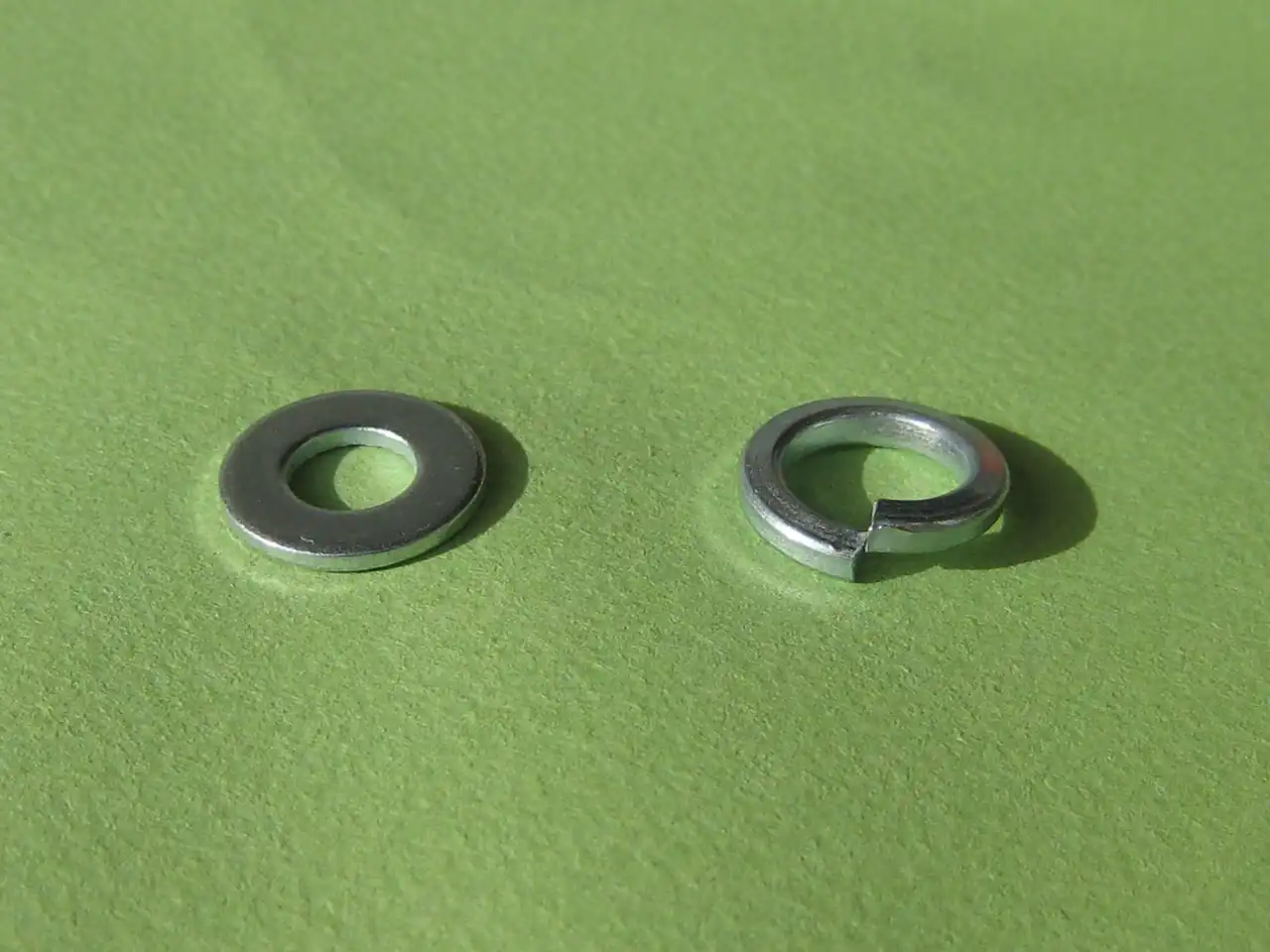
A spring washer is a hardened, elastically deflecting washer placed under a bolt head or nut to store a portion of the assembly preload. It absorbs settlement, dampens vibration, and in some forms maintains clamp force as a joint relaxes. The family spans four very different members: the familiar split helical lock washer (DIN 127), the curved and wave washers (DIN 128 and DIN 137), the dished conical washer (DIN 6796), and the precision disc spring or Belleville washer (DIN 2093).
This guide treats spring washers as a procurement engineer must: not all of them lock, and the most common one is the weakest. We separate the marketing claim from the test data, map each type to the standard that governs it, and give the spring-steel grades, dimensions, finishes and selection logic needed to specify the right part for a bolted joint.
This guide is written for industrial purchasing and design engineers. Across 6 chapters it covers what a spring washer is, the helical, curved, wave, conical and disc types, the spring mechanics behind each, the materials and finishes that govern strength and corrosion, the datasheet parameters that drive a decision, and a step-by-step selection sequence, closing with 7 selection FAQs. All values reference public standards including DIN 127, DIN 128, DIN 137, DIN 6796, DIN 2092/2093 (DIN EN 16983), ASME B18.21.1 and the NASA RP-1228 Fastener Design Manual.
Chapter 1 / 06
What is a Spring Washer
A spring washer is a washer formed from hardened spring material so that, when it is compressed between a bolt or nut and the joint surface, it deflects elastically and pushes back with a defined or partly defined force. That stored elastic energy is the whole point: a plain flat washer only spreads load over a larger area, whereas a spring washer adds a compliant element into the bolted joint. Depending on its geometry it can take up small amounts of settlement, cushion vibration, supply a measured preload, or maintain clamp force as the joint creeps. Spring washers sit alongside flat washers, locking nuts, and chemical thread lockers as one of the four mainstream ways to manage what happens to a bolted joint after the wrench is removed.
The category is broader than most buyers assume, and the differences matter more than the similarities. At one end is the split helical lock washer, a single coil of square or trapezoidal section steel with the ends offset by roughly one thickness. At the other end is the disc spring, a precision conical disc whose force-deflection curve is calculated to a published mathematical model and held to a tolerance. Between them are the curved washer, the wave washer, and the heavier dished conical washer. They share the word spring, but their stored force ranges from a few tens of newtons for a thin wave washer to several kilonewtons for a stacked disc-spring column, and only some of them have any genuine anti-loosening function.
The history of the part runs through the railway age. As bolted machinery and track hardware multiplied in the late nineteenth century, vibration-induced loosening became a chronic maintenance problem, and the split spring washer was patented and adopted as a cheap, universal answer. For decades it was specified almost reflexively on every fastener. The reckoning came in the 1960s, when Gerhard Junker built a transverse-vibration test rig that imposed the dynamic side loading that actually unwinds threaded fasteners. Under the Junker test the split lock washer offered little or no benefit, and on high-strength bolts it could even loosen faster than a bare nut. The NASA RP-1228 Fastener Design Manual later codified this finding for aerospace use, describing free-spinning split and tooth lock washers as providing minimal, if any, locking.
That history is why a modern reference treats the spring washer family as a decision tree rather than a single product. The conical washer and the disc spring earned their place by delivering a calculable, repeatable force; the wedge-locking washer (a separate, non-spring family covered briefly in this guide) earned its place by locking through geometry. The plain split washer survives because it is inexpensive and adequate for low-strength, low-vibration take-up duty, not because it is a reliable lock on a structural joint.
Four engineering metrics decide whether a given spring washer is right: the spring force or take-up travel it delivers, the material strength and corrosion grade, the dimensional fit to the bolt and bearing surface, and the standard it is built to. Get those four right and the part is invisible in service for the life of the joint. Get them wrong and the washer either does nothing, fractures from hydrogen embrittlement under its own spring tension, or accelerates the loosening it was meant to prevent.
Chapter 2 / 06
Spring Washer Types and Standards
Five distinct geometries are sold under the spring washer label, each tied to its own standard. Choosing the wrong geometry is the most common and most expensive mistake, because the cheap split washer looks superficially similar to the engineered conical washer but behaves nothing like it. The table below maps each type to its governing standard, defining feature and intended duty.
Type
Standard
Defining feature
Primary duty
Split helical lock
DIN 127 / ASME B18.21.1
Single coil, offset split ends
Low-strength take-up
Curved spring
DIN 128 A
Rectangular ring curved into an arc
Gentle elastic take-up
Wave spring
DIN 137 B / DIN 128 B
Ring waved into 3 or more crests
Light cushioning, rattle control
Conical spring
DIN 6796
Thick dished disc, defined force
Maintained preload to class 10.9
Disc spring (Belleville)
DIN 2093 / DIN EN 16983
Precision cone, calculated curve
High repeatable force, stackable
Split helical lock washer (DIN 127) is the part most people picture. It comes in Form A, with the ends bent up into raised tangs, and Form B, with plain square-cut ends, the more common variant. ASME B18.21.1 covers the inch-series equivalent in regular, heavy, extra-duty and high-collar weights. A practical caution: DIN 127, 128 and 137 were formally withdrawn as active DIN standards and have no ISO successor, yet manufacturers still produce to those dimensions, so the numbers remain a valid commercial reference even though the documents are archived.
Curved and wave washers (DIN 128, DIN 137) trade locking pretension for a softer, longer spring travel. A curved washer is a flat ring bent into a single arc; a wave washer is pressed into three or more sinusoidal crests. Both deliver a low, progressive force over a larger deflection than a split washer, which makes them useful for taking up axial play, cushioning a bearing race, or silencing rattle in sheet-metal and electrical assemblies. They are not anti-vibration locks for structural bolts.
Conical spring washer (DIN 6796) is the workhorse of the family for real preload maintenance. It is a single thick, dished disc dimensioned so that flattening it under the bolt produces a defined spring force, and it is rated effective up to property class 10.9. Where a split washer flattens and vanishes, a DIN 6796 washer keeps storing force, compensating for embedding, gasket set and thermal movement. Below is a dimensional and force reference for common sizes.
Size
Inner dia d1 (mm)
Outer dia d2 (mm)
Thickness s (mm)
Approx. spring-force class (kN)
M6
6.4
14.0
1.5
3.8
M8
8.4
18.0
2.0
5.1
M10
10.5
23.0
2.5
7.8
M12
13.0
29.0
3.0
10.5
M16
17.0
39.0
4.0
19.6
M20
21.0
45.0
5.0
30.5
Disc spring or Belleville washer (DIN 2093) is the precision end of the spectrum. It is a conical disc whose load-deflection behaviour is computed under the companion calculation standard DIN 2092, then manufactured and tested to DIN 2093 (also published as DIN EN 16983). Disc springs are sorted into three groups by thickness, under 1.25 mm, 1.25 to 6 mm, and over 6 mm, and within each group into three dimensional series, A, B and C, which differ in the ratio of cone height to thickness and therefore in curve shape. They can be stacked in series and parallel to hit an exact force and travel, which is why they appear in clutch packs, valve actuators, bolted flange sets and machine-tool preload columns.
Chapter 3 / 06
How Each Type Springs and Locks
To specify a spring washer you have to understand the physics of how it stores force and whether that force does anything useful against loosening. The four mechanisms below behave very differently, and conflating them is the root cause of most field failures. The table compares them on the two questions that matter: how much force they store and whether they genuinely resist self-loosening under transverse vibration.
Mechanism
Force stored
Deflection range
Anti-loosening (Junker)
Split helical
Low, ill-defined
~1x thickness
Poor on class 8.8+
Wave / curved
Very low
Long, soft
None (take-up only)
Conical (DIN 6796)
High, defined
Short, stiff
Good to class 10.9
Disc spring (DIN 2093)
Very high, calculated
Tunable by stacking
Maintains preload
The split washer mechanism, and why it disappoints. When a split lock washer is tightened, the sharpened ends of the coil are meant to bite into the nut face and the joint surface, while the coil itself acts as a spring. The flaw is geometric: by the time a properly torqued bolt reaches its design preload, the washer has flattened almost completely. NASA RP-1228 describes the flattened washer as effectively a solid flat washer with no remaining spring action. Under the Junker transverse-vibration test the washer therefore contributes little resistance, and on high-strength bolts the small residual ramp can even encourage rotation. The bite is only meaningful on soft or low-strength assemblies where the ends can actually embed.
The wave and curved mechanism. A wave washer behaves like a very soft, long-travel spring. Because the crests deflect over a much greater distance than a split coil, the washer can absorb axial tolerance stack-up, thermal growth in a short bearing assembly, or the rattle in a panel without ever reaching a hard preload. The trade is that the force is tiny, far below what is needed to lock a structural bolt, so these washers are correctly classed as take-up and cushioning elements, not locks.
The conical mechanism (DIN 6796). A conical washer is thick and dished, so flattening it stores a large, defined force in a short stroke. Crucially it does not fully flatten at working preload, so it continues to act as a live spring across the small movements caused by embedding, gasket set and differential thermal expansion. That sustained force is what keeps clamp load above the threshold at which a joint begins to self-loosen, which is why DIN 6796 is rated effective up to property class 10.9 whereas the split washer is not recommended above about class 6.8.
The disc-spring mechanism (DIN 2093) and stacking. A disc spring is engineered to a chosen point on its load-deflection curve, and the curve shape is governed by the cone-height-to-thickness ratio h0/t. A ratio near 0.4 (series A) gives a nearly linear curve; higher ratios produce a flattening or even regressive curve where force can stay constant or fall as deflection increases, which is ideal for holding a steady preload. The defining trick is stacking. Nesting discs in parallel, cones facing the same way, adds their forces while travel stays the same, so n discs give about n times the force. Alternating discs in series, cone tips opposed, adds their travel while force stays the same. Mixed stacks reach an exact force-and-travel target. Parallel nesting adds roughly 2 to 3 percent friction per interface and raises hysteresis, so engineers keep parallel groups short and guide tall stacks on a mandrel or in a bore per the DIN 2093 guide clearance, working the springs near 75 percent of cone height for best fatigue life. Disc-spring material is high-grade spring steel with an elastic modulus near 206,000 N/mm-squared, which is what makes the calculated curve reliable.
The wedge-locking alternative. Where genuine transverse vibration must be defeated, the answer is usually not a spring washer at all but a wedge-locking washer pair of the Nord-Lock pattern. Two identical washers carry cams on their mating faces and radial ribs on their outer faces. The cam rise angle is made greater than the thread lead angle, so any tendency for the bolt to back off forces the cam pair to climb, which increases bolt tension rather than releasing it. This locks by geometry and preload instead of friction, works up to property class 12.9, and is reusable. It belongs in the decision set whenever a joint genuinely vibrates.
Chapter 4 / 06
Materials, Hardness and Finishes
A spring washer only works if it stays elastic over its life, so material and heat treatment matter more than for a plain washer. The base metal sets the spring force and fatigue life; the heat treatment sets the hardness and therefore the strength; and the finish sets the corrosion resistance and, critically, the risk of hydrogen embrittlement. Common base materials are the carbon spring steels 65Mn and C75S, the chrome-vanadium alloy 51CrV4, austenitic stainless A2 and A4, precipitation-hardening 17-7PH (AISI 631), martensitic AISI 301, and phosphor bronze.
Carbon spring steels (65Mn, C75S). These are the default for split and conical washers. They are inexpensive, take a clean heat treatment, and after quench-and-temper reach the hardness needed for repeatable spring action. ASME B18.21.1 specifies a carbon-steel hardness of 38 to 46 HRC (372 to 458 HV) for helical lock washers; conical washers are typically run a little higher, around 42 to 50 HRC, to hold their defined force. The weakness is corrosion: bare carbon spring steel must be coated, and once coated it inherits the embrittlement risk discussed below.
Chrome-vanadium 51CrV4. For higher-duty conical washers and for disc springs, 51CrV4 is the established grade. It carries the higher fatigue strength and consistent elastic modulus (about 206,000 N/mm-squared) that a calculated load-deflection curve depends on. DIN 2093 lists 51CrV4 and the carbon grades C67S and C75S as standard disc-spring materials, with the carbon grades restricted to the thinnest group-1 springs.
Stainless and PH grades. Where corrosion rules out coated carbon steel, A2 (AISI 304) and A4 (AISI 316) cover mild spring duty, though their lower yield strength limits the force they can store. For applications that need both corrosion resistance and high spring force, precipitation-hardening 17-7PH (AISI 631) or cold-worked martensitic AISI 301 are the engineering choice, common in marine, food and chemical equipment. Phosphor bronze (ASTM B103 alloy 510) is selected when electrical conductivity, non-magnetic behaviour or spark-free service is required.
Finishes and the hydrogen-embrittlement trap. Because spring washers are hard, typically above about 320 HV (roughly 1,000 MPa), they fall squarely into the zone where hydrogen embrittlement causes delayed brittle fracture. Acid pickling and ordinary electrolytic zinc plating charge atomic hydrogen into the steel; under sustained spring tension that hydrogen migrates to stress points and can crack the washer hours or days after assembly. The two accepted answers are a post-plating bake at 190 to 230 degrees Celsius for several hours to drive hydrogen out, or coatings that avoid electrolytic charging in the first place, namely mechanical galvanizing and zinc-flake systems such as Geomet and Dacromet. The table below summarizes the common finish choices.
Finish
Corrosion (neutral salt spray)
Embrittlement risk
Notes
Bright zinc + bake
~72 to 96 h
Low if baked
Cheapest; bake mandatory
Mechanical galvanizing
~96 to 200 h
Very low
No electrolytic hydrogen step
Zinc-flake (Geomet / Dacromet)
~500 to 1,000 h
Very low
Thin, high salt-spray life
Black oxide + oil
~24 h
Low
Indoor / oiled service only
Stainless A2 / A4 (none)
Inherent
None
Lower spring force
Chapter 5 / 06
Key Specification Parameters
Reading a spring-washer datasheet is mostly about matching geometry to the bolt and force to the joint. The same washer can be quoted under DIN or ASME with different naming, but only a handful of parameters drive the decision: bore and outside diameter, section or thickness, spring force or take-up travel, hardness and material, and finish. Each is decoded below, followed by a worked dimensional reference for the split type.
Inner diameter (d1) and outer diameter (d2). The bore is sized to clear the bolt shank with a small allowance, and the outside diameter must fit within the bolt-head or nut bearing face and not foul a counterbore or adjacent hardware. For a split washer the section is close to square, so d2 is only a few millimetres larger than d1. Conical and disc washers have a much larger d2 because the spring force is generated across the dished annulus.
Section, thickness (s) and free height (h or h0). For a split washer the section width and thickness together set how much force the coil can store; heavier ASME series (heavy, extra-duty) simply use a larger section for the same bolt size. For conical washers the thickness s plus the free overall height h define the dish and therefore the spring force. For disc springs the cone height h0 and thickness t, expressed as the ratio h0/t, set the entire shape of the load-deflection curve, so this single ratio is the most important number on a disc-spring datasheet.
Spring force or test force (F). This is the parameter the split washer lacks and the engineered washers provide. DIN 6796 conical washers are tabulated with a defined spring-force class, for example roughly 5.1 kN at M8 and 10.5 kN at M12, so you can match the washer to the bolt preload. Disc springs are quoted with the force at a stated deflection, usually near 75 percent of cone height. If a datasheet gives no force figure, the washer is a take-up element only and must not be relied on for preload.
Hardness and material. Confirm the grade and hardness against the duty: 38 to 46 HRC carbon steel for general ASME helical washers, 42 to 50 HRC for conical and disc types, or a stainless / PH grade where corrosion demands it. Hardness that is too low loses spring force; too high without correct finish raises embrittlement risk.
Finish and standard. Specify the coating explicitly with its embrittlement control (zinc plus bake, mechanical galvanizing, or zinc-flake) and cite the governing standard (DIN 127/128/137, DIN 6796, DIN 2093 / DIN EN 16983, or ASME B18.21.1) so the supplier and the receiving inspection agree on dimensions. The split-washer dimensional reference below shows how DIN metric and ASME inch sizes line up.
Type / size
Inner dia (≈)
Outer dia (≈)
Section / thickness (≈)
DIN 127B M6
6.1 mm
11.8 mm
1.6 mm
DIN 127B M8
8.1 mm
14.8 mm
2.0 mm
DIN 127B M10
10.2 mm
18.1 mm
2.5 mm
DIN 127B M12
12.2 mm
21.1 mm
3.0 mm
ASME 3/8 in regular
0.377 in
0.680 in
0.094 in
ASME 1/2 in regular
0.502 in
0.869 in
0.125 in
ASME 3/4 in regular
0.753 in
1.265 in
0.188 in
Chapter 6 / 06
Selection Decision Factors
The single most useful thing this guide can give a buyer is a decision order, because most spring-washer mistakes come from picking a type before defining the duty. Work the following steps in sequence, and the choice of split, wave, conical, disc, or wedge washer falls out almost automatically. This list doubles as an RFQ template.
Define the joint duty first. Decide which problem you are solving: simple take-up of settlement, cushioning and rattle control, maintained preload against creep and thermal cycling, or genuine anti-loosening under transverse vibration. The duty, not habit, selects the family.
Check the bolt property class. Below about class 6.8 a split washer may bite usefully into soft parts. At class 8.8 and above, abandon the split washer for preload-critical joints and move to a conical washer (to class 10.9), a disc spring, or a wedge-locking washer (to class 12.9).
Match force or travel to the requirement. For maintained preload, read the DIN 6796 spring-force class or compute a disc-spring stack to the target clamp load. For take-up, choose a wave or curved washer sized to the expected axial movement. Never use a force-less washer where preload must be held.
Fit the geometry. Confirm bore clearance over the bolt and that the outer diameter sits within the bearing face and clears any counterbore or adjacent hardware. For disc-spring stacks, allow for guide clearance on the mandrel or in the bore per DIN 2093.
Select material for the environment. Coated 65Mn or 51CrV4 for dry industrial use, A2/A4 stainless for mild corrosion, 17-7PH or AISI 301 for high force plus corrosion, phosphor bronze for conductivity or non-magnetic service.
Specify the finish with embrittlement control. For high-strength coated washers require either a post-plating bake or a non-electrolytic coating (mechanical galvanizing or zinc-flake). Demand a salt-spray hours figure so corrosion life is contractual, not assumed.
Cite the governing standard. Put DIN 127/128/137, DIN 6796, DIN 2093 / DIN EN 16983 or ASME B18.21.1 on the line item so dimensions and acceptance are unambiguous, and note where a withdrawn DIN number is used only as a dimensional reference.
Confirm assembly and reuse rules. State whether the washer is single-use, whether a defined torque or angle is required, and whether the joint will be disassembled, since disc springs and wedge washers behave well on reuse while a flattened split washer should be discarded.
One dimension buyers routinely overlook is serviceability and traceability. For disc-spring stacks in clutches, actuators and machine-tool spindles, the relevant questions are whether the manufacturer can supply matched replacement discs, whether a material and hardness certificate (3.1 per EN 10204) is available, and whether the load-deflection curve is documented. Established makers including Schnorr, Mubea, Christian Bauer, Belleville Springs, Solon and the Nord-Lock Group (for wedge-locking) supply certified parts with published curves, which separates a reliable preload column from a generic stamped washer that happens to be the right diameter.
FAQ
Do split lock washers actually prevent bolts from loosening?
For high-strength joints the honest engineering answer is no. The NASA RP-1228 Fastener Design Manual states that a helical spring (split) lock washer flattens completely by the time a bolt is properly torqued, behaving like a plain flat washer with negligible locking ability. In the Junker transverse-vibration test that Gerhard Junker developed in the 1960s, split lock washers loosened roughly as fast as, or faster than, a bare nut. They retain marginal value only on low-strength fasteners up to about property class 6.8 or on soft substrates, where the sharpened split ends can dig in. For class 8.8 bolts and above the controlling lock is correct preload, and a conical, wedge, or chemical locking method should be used instead.
What is the difference between a spring washer and a disc spring?
A split spring lock washer (DIN 127) is a single coil of square or rectangular section steel whose only job is to take up small amounts of settlement, and it carries a low, poorly defined spring force. A disc spring or Belleville washer (DIN 2093) is a precision conical disc engineered to a calculated load-deflection curve under the companion standard DIN 2092. Disc springs hold high, repeatable clamp force over a defined deflection, can be stacked in series to add travel or in parallel to add force, and are used to maintain preload against thermal expansion, gasket creep and joint relaxation. The conical washer DIN 6796 sits between the two: it is a thicker, dished spring washer dimensioned to deliver a defined preload.
What do DIN 127, DIN 128, DIN 137 and DIN 6796 each mean?
DIN 127 is the split helical spring lock washer, Form A with raised tangs and Form B with square cut ends. DIN 128 is a curved or wave spring washer made from rectangular section, Form A curved and Form B waved. DIN 137 is a thin wave or curved spring washer used for light take-up and as a vibration cushion. DIN 6796 is the conical spring washer for bolted connections, designed to deliver a defined spring force and effective up to property class 10.9. Note that DIN 127, 128 and 137 were withdrawn as active DIN standards and have no ISO successor, yet they remain in wide commercial use as dimensional references. DIN 6796 and DIN 2093 remain current, with DIN 2093 also published as DIN EN 16983.
What materials and hardness are spring washers made from?
Standard carbon spring steels are 65Mn, C75S and the higher-grade alloy 51CrV4 (chrome-vanadium), heat treated to roughly 42 to 50 HRC for split and conical types. ASME B18.21.1 specifies 38 to 46 HRC (372 to 458 HV) for carbon-steel helical lock washers. Corrosion-resistant grades are austenitic stainless A2 (AISI 304) and A4 (AISI 316) for mild duty, and precipitation-hardening 17-7PH (AISI 631) or martensitic AISI 301 where higher spring force and corrosion resistance are both required. Phosphor bronze (ASTM B103 alloy 510) is used for electrical conductivity and non-magnetic service. Disc springs to DIN 2093 use 51CrV4 or C67S/C75S with an elastic modulus of about 206,000 N/mm-squared.
Why can plated spring washers cause hydrogen embrittlement?
Spring washers are hardened to high strength, and any part above roughly 320 HV (about 1,000 MPa) is sensitive to hydrogen embrittlement. Acid pickling and conventional electroplating, such as electrolytic zinc, drive atomic hydrogen into the steel lattice. Under sustained spring tension that hydrogen migrates to stress concentrations and can cause sudden delayed brittle fracture, sometimes hours or days after assembly. Mitigations are a post-plating bake at 190 to 230 degrees Celsius for several hours to drive off hydrogen, or mechanical galvanizing and zinc-flake (Geomet, Dacromet) coatings that deposit zinc without an electrolytic hydrogen-charging step. For high-strength spring washers, zinc-flake or mechanical plating is the safer default.
How do I stack disc springs to tune force and travel?
Disc springs stack two ways. In parallel (nested, cones facing the same direction) the forces add while deflection stays the same, so n discs in parallel give roughly n times the force. In series (alternating, cone tips opposed) the deflections add while force stays the same, so n discs in series give n times the travel. Mixed stacks, for example pairs in parallel arranged in series, let you hit an exact force and travel target. Parallel nesting adds friction of about 2 to 3 percent per interface, which raises hysteresis, so keep parallel groups short. Always guide a tall stack on a mandrel or in a bore per the DIN 2093 guide clearance to prevent buckling, and keep working deflection near 75 percent of the cone height for the best fatigue life.
When should I use a wedge-locking washer instead of a spring washer?
Use a wedge-locking washer (the Nord-Lock pattern of two cams with radial ribs) whenever the joint sees genuine transverse vibration or dynamic shock and a split lock washer would be ineffective. The cam faces have a rise angle greater than the thread lead angle, so any attempt to rotate loose forces the pair to climb and increase tension rather than release it. This locks by geometry and preload rather than friction, works up to property class 12.9, and is reusable. Choose a wedge washer for rail, mining, heavy mobile equipment and high-strength structural joints. Reserve plain spring washers for low-strength, low-vibration take-up duty, and disc springs for joints needing maintained preload against creep and thermal cycling.