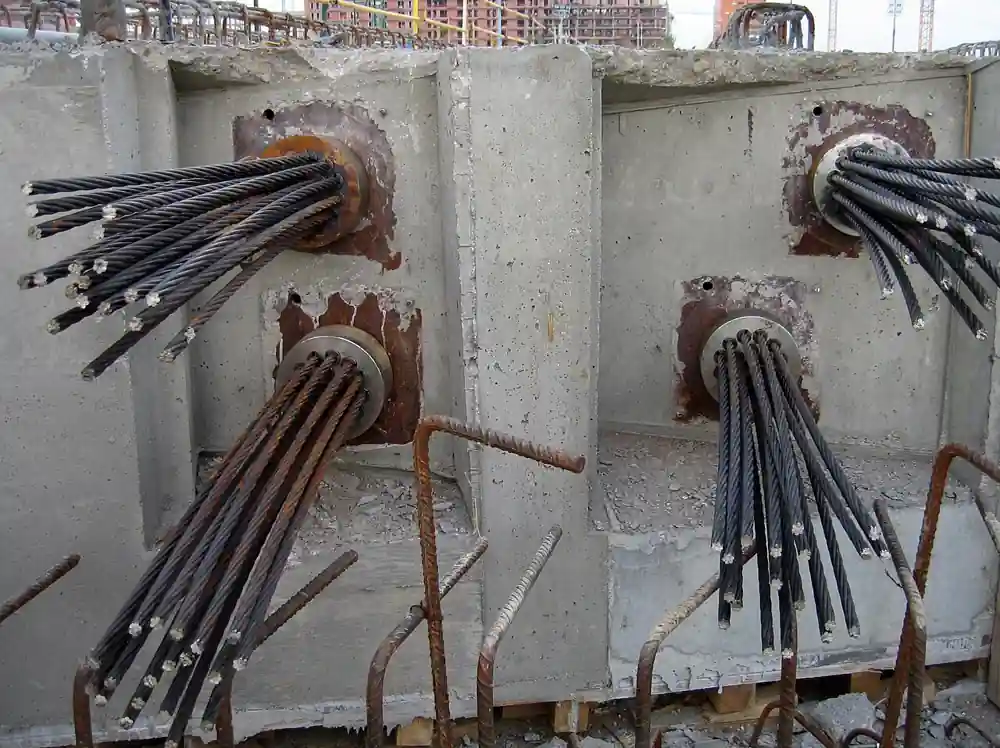
Steel strand, in the construction sense, is a high-carbon steel cable formed by helically twisting several cold-drawn wires around a central wire, then stabilizing the assembly so it holds tension with very little loss over time. The dominant product is the seven-wire prestressing strand used to compress concrete in bridges, slabs, sleepers, and tanks. The same family also covers the greased and sheathed monostrand of post-tensioned floors and the galvanized strand inside cable-stayed bridges.
Because a single seven-wire strand can carry well over 250 kN, strand is one of the highest stressed materials placed in everyday civil structures. That is why it is governed by tightly written standards such as ASTM A416, EN 10138-3, and GB/T 5224, and why every procurement decision turns on a small set of certified numbers rather than on marketing claims.
This guide is written for civil and structural buyers, precast plant engineers, and post-tensioning specifiers. It covers 6 chapters from what steel strand is, through construction types and strength grades, to material processing, spec-sheet decoding, and selection decisions, with 7 procurement FAQs and comparison tables. All parameters reference public standards: ASTM A416/A416M, EN 10138-3, GB/T 5224, JIS G3536, and BS 5896.
Chapter 1 / 06
What is Steel Strand
Steel strand is a structural cable made by twisting several high-strength steel wires together into a single helical bundle. In prestressed concrete, the standard product is the seven-wire strand: six outer wires laid in a tight helix around one slightly larger central wire, so the cross section looks like a hexagonal cluster around a core. This geometry packs the maximum steel area into a round envelope, lets the strand grip mechanical wedge anchors, and gives it enough flexibility to spool onto a coil and bend through a curved duct without kinking.
The reason strand exists, rather than a single solid bar of equal area, is the physics of cold-drawn steel. Drawing a high-carbon rod down to a thin wire produces extremely high tensile strength, on the order of 1860 MPa, but a thick bar cannot be drawn to that strength uniformly through its core. Bundling thin, fully drawn wires keeps every fibre at full strength while delivering a large total force. A 15.24 mm seven-wire Grade 270 strand carries a minimum breaking force of about 261 kN, the equivalent of hanging roughly 26 tonnes from one cable barely wider than a pencil.
Functionally, strand is the tension element of prestressed concrete. Concrete is strong in compression but weak in tension, so engineers stretch strand and lock that tension into the member, putting the concrete into permanent compression. When service loads later try to bend the member and open cracks, they must first overcome that built-in compression. This is why prestressed girders span farther, deflect less, and crack later than ordinary reinforced concrete, and why almost every long-span bridge deck, parking structure, and precast floor plank made since the 1950s contains strand.
The technology has a clear lineage. The principle of prestressing was patented by French engineer Eugene Freyssinet in 1928, who recognized that only very high-strength steel could hold useful prestress after concrete creep and shrinkage relaxed the section. Industrial seven-wire strand for prestressed concrete matured in the United States in the 1950s, and ASTM A416 was first issued to standardize it. Low-relaxation strand, produced by a continuous thermo-mechanical stabilizing line, became the dominant grade from the 1980s onward and is now the default specified worldwide.
It is important to separate the prestressing product from other things also called steel strand. Utility guy strand (ASTM A475), messenger strand for overhead cable, and general wire rope are also stranded steel, but they use lower-carbon wire, looser lay, and far lower strength, and they are governed by different standards. Throughout this guide, steel strand means the prestressing-concrete product governed by ASTM A416, EN 10138-3, and GB/T 5224, the version that appears on bridge and building purchase orders.
Chapter 2 / 06
Construction and Product Types
Strand products differ along two axes: the wire construction (how many wires and how they are laid) and the corrosion-protection system (bare, greased and sheathed, epoxy-coated, or galvanized). Construction sets the mechanical performance and anchorage compatibility; the protection system is driven by exposure and by whether the tendon is bonded or unbonded. The table below summarizes the mainstream constructions.
Construction
Wires
Typical use
Notes
Seven-wire (1x7)
6 + 1
Prestressed concrete, the default
Best area-to-envelope ratio; wedge-gripped
Two-wire / three-wire
2 or 3
Small precast, sleepers, joists
Lower force per strand, simpler tooling
Compacted (drawn) seven-wire
6 + 1
Stay cables, high force per duct
Die-compacted; higher area for same diameter
Indented / spiral-ribbed
6 + 1
Pretensioned members needing bond
Surface indents shorten transfer length
Nineteen-wire (1x19)
multi-layer
Very large tendons, ground anchors
Higher single-element force, less common
Seven-wire strand is the workhorse. The six outer wires are laid left-hand or right-hand around the slightly oversize king wire at a defined lay length, which is why an anchor wedge can bite into the helical outer wires and hold the full breaking force. It is supplied bright (uncoated) for bonded tendons that will be grouted or cast directly into concrete, where the surrounding cement provides corrosion protection and the strand transfers force along its whole length.
Unbonded monostrand is a single seven-wire strand coated with a corrosion-inhibiting grease or wax and extruded inside a continuous high-density polyethylene (HDPE) sheath. The grease fills the gaps between the wires and the annular space inside the sheath, so the strand is sealed against moisture and is free to slide. This is the standard tendon for post-tensioned building slabs: the strand is cast into the concrete inside its sheath, then jacked and locked off at edge anchorages after the concrete hardens, transferring force only at its ends.
Coated and galvanized variants address aggressive environments. Fusion-bonded epoxy coating gives a continuous dielectric barrier for de-iced bridge decks and marine work; a grit-impregnated epoxy version restores the bond that smooth epoxy would otherwise lose. Hot-dip galvanized strand, often combined with wax filling and an HDPE outer sheath to form a triple-protection system, is specified for the stay cables of cable-stayed bridges, suspension hangers, and external post-tensioning where the tendon is exposed and must last the life of the structure.
Cross-cutting all of these is the bonded-versus-unbonded distinction, which is a construction-method choice rather than a product grade. Pretensioning stretches bare bonded strand against fixed abutments before the concrete is poured, so the precast member leaves the bed already prestressed; this dominates the precast industry. Post-tensioning casts the concrete first around ducts or sheathed strand, then stresses the tendons once the concrete has gained strength; this dominates cast-in-place bridges and slabs. The same Grade 270 strand can serve either method, but the protection system and the anchorage hardware differ.
Chapter 3 / 06
Strength Grades and Standards
Steel strand is specified by a strength grade, a relaxation class, and a governing standard. Get any one of these wrong and a coil that looks identical can be non-conforming. The strength grade names the minimum tensile strength of the wire; the relaxation class names how much tension the strand loses over time; the standard ties both to defined test methods and tolerances. The table below maps the major grades across the standards that buyers most often encounter.
Standard
Region
Common grades
Relaxation reference
ASTM A416 / A416M
Americas
Grade 250 (1725), Grade 270 (1860)
Low-relax 2.5% at 1000 h, 70%
EN 10138-3
Europe
Y1770S7, Y1860S7, Y1960S7
Class 2 (low relax), Class 1 (normal)
GB/T 5224
China
1720, 1860, 1960
Low-relax 2.5% at 1000 h, 70%
JIS G3536
Japan
SWPR7B (1860 class)
Low-relax (Type B)
BS 5896
UK (legacy)
Super, Drawn (1770 to 1860)
Relaxation Class 1 / Class 2
Strength grade is the headline number. ASTM Grade 270 means a minimum tensile strength of 270 ksi, which is 1860 MPa; Grade 250 is 1725 MPa. The European Y1860S7 and the Chinese 1860 grade name the same 1860 MPa class, and a Y1770S7 names the 1770 MPa class. Grade 270 / 1860 is the global default for new bridge and building work because it puts the most force into the smallest anchorage; 1960 MPa product exists for weight-critical or compact applications, while Grade 250 survives mainly in legacy and repair specifications.
Relaxation class is the second axis. Relaxation is the slow loss of tension that happens when strand is held at constant length under high stress, exactly the condition of a service tendon. Low-relaxation strand, produced by stabilizing, loses about 2.5 percent of its load over 1000 hours at 70 percent of breaking force; older stress-relieved (normal-relaxation) strand loses roughly 8 percent under the same conditions. EN 10138 calls these Class 2 and Class 1 respectively. Low-relaxation is now the default and most mills no longer stock normal-relaxation product, but a designer reusing an old detail must confirm which class the loss calculation assumed.
Equivalence between standards is close but not exact. A Grade 270 strand, a Y1860S7 strand, and a GB/T 5224 1x7 1860 strand are nominally interchangeable on strength, and large mills routinely produce GB/T 5224 product to ASTM A416 dimensions for export. The differences live in the details: the exact nominal area assigned to a diameter, the dimensional tolerances, the minimum elongation gauge length, the relaxation test temperature, and the qualification and certification regime. Specify the standard and its edition explicitly, and require the mill test certificate to cite the same standard, so the tested values match the design assumptions.
One practical note: in most codes the design modulus of elasticity of seven-wire strand is taken as approximately 195 GPa, slightly below the roughly 200 to 205 GPa of plain steel because the wires are laid in a helix and the bundle stretches partly by tightening the lay. This single value feeds the elastic-shortening and elongation-check calculations, so it is worth confirming against the supplier datasheet rather than assuming the bar-steel figure.
Chapter 4 / 06
Raw Material and Manufacturing
Strand performance is decided long before stranding, in the chemistry of the wire rod and the cold-drawing line. The raw material is a high-carbon steel wire rod, most commonly the SWRH82B grade, with a carbon content near the eutectoid point at roughly 0.80 to 0.85 percent. This composition is chosen so that controlled cooling produces a fully pearlitic microstructure, the fine lamellar ferrite-and-cementite structure that can be drawn to very high strength without becoming brittle. Manganese (around 0.7 to 0.9 percent) supports strength and hardenability, while phosphorus and sulphur are held low to protect ductility and resist cracking.
The first metallurgical step is patenting: the rod is heated above the austenitizing temperature and then cooled at a controlled rate, typically in a lead or fluidized bath, to develop fine pearlite with a lamellar spacing on the order of 100 to 200 nanometres. Finer pearlite spacing lets the wire be drawn harder before it work-hardens to its limit. After surface preparation to remove scale, the patented rod, usually 11 to 13 mm in diameter, is cold-drawn through a series of dies in multiple passes, with a total area reduction that can reach 80 to 90 percent. Drawing both reduces the diameter and aligns the pearlite lamellae along the wire axis, raising tensile strength from roughly 1100 to 1200 MPa in the rod to 1860 MPa or more in the finished wire.
The drawn wires are then stranded: six wires are laid helically around a slightly larger king wire at a controlled lay length. At this point the strand is strong but still carries the residual stresses and the relaxation tendency left by drawing. The decisive final step is stabilizing, a continuous thermo-mechanical treatment in which the strand is passed under tension through a heating zone. This relieves residual stress, raises the elastic limit so that the load at 1 percent extension reaches about 90 percent of breaking force, and, most importantly, suppresses long-term relaxation to the low-relaxation level. The table below contrasts the two relaxation classes that result.
Property
Low-relaxation (stabilized)
Normal-relaxation (stress-relieved)
1000-hour relaxation at 70% load
about 2.5%
about 8%
1000-hour relaxation at 80% load
about 3.5%
about 12%
Load at 1% extension
about 90% of breaking
about 85% of breaking
EN 10138 class
Class 2
Class 1
Current availability
Default, widely stocked
Legacy, rarely stocked
Two durability hazards are set by this material chemistry and must be respected in service. The first is hydrogen-induced stress corrosion cracking: high-strength pearlitic steel held at high stress is susceptible to sudden brittle failure if hydrogen reaches the metal, which is why pickling, certain platings, stray current, and aggressive grouts are tightly controlled, and why galvanized and epoxy systems exist. The second is fatigue: strand in members that see cyclic live load, such as bridge girders, must meet a stress-range fatigue limit, and fretting between wires at anchorages and deviators is a known crack initiator. Neither hazard appears on a simple strength datasheet, so both belong in the project specification.
A final manufacturing note concerns surface and form. Bright strand carries a controlled light oxide and no lubricant residue that would impair bond or grip. Indented and spiral-ribbed strand is given surface deformations during or after stranding to shorten the transfer length in pretensioned members. Compacted strand is drawn through a die after stranding so the wires deform into each other, raising the steel area packed into a given diameter, which is valued in densely loaded stay-cable and ground-anchor tendons.
Chapter 5 / 06
Key Specification Parameters
A strand datasheet looks busy, but only a handful of certified numbers govern selection and acceptance: nominal diameter, nominal steel area, minimum breaking force, minimum load at 1 percent extension, relaxation class, minimum elongation, and modulus of elasticity. The dimensional table below lists the most-used ASTM A416 Grade 270 (1860 MPa) seven-wire sizes, which the EN and GB families track closely; values are the published nominal figures and should always be confirmed against the mill certificate.
Nominal diameter
Steel area
Min. breaking force
Nominal mass
9.53 mm (0.375 in)
54.8 mm²
102 kN (23,000 lbf)
0.432 kg/m
11.11 mm (0.438 in)
74.2 mm²
138 kN (31,000 lbf)
0.582 kg/m
12.70 mm (0.500 in)
98.7 mm²
184 kN (41,300 lbf)
0.775 kg/m
13.20 mm (0.520 in)
107.7 mm²
200 kN (45,000 lbf)
0.851 kg/m
15.24 mm (0.600 in)
140.0 mm²
261 kN (58,600 lbf)
1.102 kg/m
17.78 mm (0.700 in)
189.7 mm²
353 kN (79,400 lbf)
1.487 kg/m
Nominal diameter and steel area are paired. The 12.70 mm (half-inch) and 15.24 mm (0.6 inch) sizes dominate global practice, with Europe also using the 12.5, 12.9, and 15.7 mm designations for the same strength class. Note that the nominal area, not a geometric circle area, is the figure used to convert stress to force; for example the 12.70 mm Grade 270 strand carries a nominal area of 98.7 mm2, so its 1860 MPa class translates to the 184 kN breaking force shown.
Minimum breaking force is the single most important acceptance value, because it is what the anchorage, the jack, and the design force all reference. ASTM A416 expresses it as a guaranteed minimum in kN and lbf; EN 10138 expresses the characteristic maximum force Fm with a companion 0.1 percent proof force Fp0.1 at about 0.86 of Fm. Always read whether a quoted force is a minimum or a typical value, and whether it is stated per strand or per square millimetre.
Load at 1 percent extension (the yield-equivalent in ASTM, the proof force in EN) is the working limit you actually design to, because tendons are never taken to breaking. Low-relaxation strand reaches about 90 percent of breaking force at 1 percent extension, which is what allows a safe jacking stress around 70 to 75 percent of breaking with a comfortable margin below yield.
Relaxation class, elongation, and modulus complete the set. Relaxation class (low-relaxation, 2.5 percent at 1000 hours and 70 percent load) feeds the long-term prestress-loss calculation. Minimum total elongation at maximum force Agt, typically 3.5 percent, is a ductility floor that guards against brittle behaviour. Modulus of elasticity, taken as about 195 GPa, governs the elastic-shortening loss and the elongation check used on site to verify the jacking force. The following list shows where each parameter is used in practice:
Breaking force: sizes anchorages, jacks, and the strand count; the basis of the safety factor.
1% extension load: sets the allowable jacking stress and the working limit.
Relaxation class: drives long-term prestress-loss estimates over the structure life.
Elongation Agt: ductility acceptance; flags brittle or over-hard heats.
Modulus 195 GPa: converts jacking force to measured stretch for on-site verification.
Diameter and area: match strand to duct, wedge, and bearing-plate hardware.
Chapter 6 / 06
Selection Decision Factors
Selecting steel strand is less about picking a brand and more about pinning down a small set of project facts in the right order, then matching strand, anchorage, and protection to them. Most strand problems trace not to a bad coil but to a decision made out of sequence, such as choosing a diameter before checking the anchorage block or ignoring seating loss. The eight steps below work as a fixed RFQ template.
Construction method: Decide pretensioned (bonded, stressed before pour) or post-tensioned (bonded grouted, or unbonded greased monostrand). This fixes whether you need bright, sheathed, or grouted-duct strand and dictates the anchorage family.
Grade and relaxation class: Default to Grade 270 / 1860 MPa, low-relaxation (EN Class 2). Only depart for legacy details (Grade 250) or weight-critical work (1960 MPa), and state the relaxation class explicitly so loss calculations match.
Diameter and strand count: From the required effective force after losses, divide by the working force per strand (jacking stress about 70 to 75 percent of breaking). For 15.24 mm Grade 270 that is roughly 183 to 196 kN per strand. Round up and confirm the count fits the anchorage and duct.
Governing standard and edition: ASTM A416, EN 10138-3, GB/T 5224, JIS G3536, or BS 5896. Name the edition; require the mill certificate to cite the same one so tested values match design assumptions.
Corrosion protection and exposure: Bright bonded strand for grouted or cast interior work; epoxy-coated for de-iced or marine decks; galvanized with wax plus HDPE for stay cables and external tendons. Match the protection to the exposure class, not to strength.
Anchorage and system compatibility: Strand, wedges, anchor head, and bearing plate must come from a qualified post-tensioning system (for example one holding a European Technical Assessment). Mixing a wedge to an off-system strand is a frequent and dangerous error.
Losses to verify: Friction and wobble in the duct, anchorage seating draw-in (commonly about 6 mm), elastic shortening, plus time-dependent relaxation, creep, and shrinkage. Under-counting strands or ignoring seating loss is the most common prestress mistake.
Certification and traceability: Require a mill test certificate per coil covering breaking force, 1 percent extension load, elongation Agt, and relaxation class, with coil identification traceable to the heat. For fatigue-loaded members, also require stress-range qualification data.
One last dimension that buyers underweight is supplier serviceability and qualification breadth: whether the mill can certify to the exact standard edition the project names, whether it offers the diameters and protection systems together, and whether its product is recognized by the post-tensioning system holder. International strand makers such as Bekaert, Sumitomo Electric, Insteel, Tycsa, and Usha Martin, alongside large Chinese mills supplying GB/T 5224 product to ASTM A416 dimensions, cover most needs; for the system around the strand, name a holder such as DYWIDAG, Freyssinet, VSL, or BBR so the anchorages, ducts, and wedges are guaranteed to match the strand you specify.
FAQ
What is the difference between steel strand, PC strand, and prestressing strand?
In construction these three terms usually name the same product: a seven-wire helically stranded high-carbon steel cable used to apply prestress to concrete. Steel strand is the broad material term, PC strand is short for prestressed-concrete strand, and prestressing strand is the term used in EN 10138 and bridge codes. Outside prestressing, steel strand can also mean general wire rope, guy strand for utility poles, or messenger strand for overhead cable, which use different standards (ASTM A475, A363) and softer wire. When a datasheet cites ASTM A416, EN 10138-3, or GB/T 5224, it is the prestressing product, not wire rope.
What does Grade 270 mean and how does it map to MPa?
Grade 270 is the ASTM A416 designation for strand with a minimum tensile strength of 270 ksi, which equals 1860 MPa. Grade 250 corresponds to 1725 MPa. The European Y1860S7 and Chinese 1860-grade designations refer to the same 1860 MPa class, so a Grade 270 strand, a Y1860S7 strand, and a GB/T 5224 1x7 1860 strand are nominally interchangeable on strength, though tolerances, relaxation classes, and qualification testing differ between the standards. Grade 270 is the global default for new bridge and building work; Grade 250 survives mainly in legacy and repair specifications.
What is low-relaxation strand and why does it matter?
Relaxation is the gradual loss of tension that occurs when strand is held at constant length under high stress, which is exactly the service condition of a prestressing tendon. Low-relaxation strand is given a continuous thermo-mechanical stabilizing treatment after stranding, which cuts the 1000-hour relaxation loss to about 2.5 percent at 70 percent of breaking load (EN 10138 Class 2), against roughly 8 percent for older stress-relieved (normal-relaxation) strand. Lower relaxation means less long-term prestress loss, so the designer can use a smaller tendon or count on more residual force. Low-relaxation is now the default, and most plants no longer stock normal-relaxation product.
How do I read the key numbers on a steel strand datasheet?
Six numbers drive most decisions: nominal diameter (for example 12.7 mm or 15.24 mm), nominal steel area (98.7 mm2 and 140 mm2 respectively), minimum breaking force (184 kN and 261 kN for Grade 270), minimum load at 1 percent extension expressed as a percentage of breaking force (90 percent for low-relaxation), relaxation class and 1000-hour loss, and minimum total elongation Agt (3.5 percent under ASTM, 3.5 percent under EN). Modulus of elasticity is taken as about 195 GPa for design. Always confirm the grade and the standard edition, because area and force values shift slightly between ASTM A416, EN 10138-3, and GB/T 5224.
What is the difference between bonded, unbonded, and epoxy-coated strand?
Bonded bright strand is grouted into a duct or cast directly into concrete so it transfers force along its whole length and is protected by the cement. Unbonded monostrand is coated with corrosion-inhibiting grease or wax and extruded inside an HDPE sheath, so it slips inside the concrete and relies on its anchorages and the sheath for protection; it is the standard for post-tensioned slabs. Epoxy-coated strand carries a fusion-bonded epoxy layer for aggressive or de-iced environments, and grit-impregnated epoxy variants restore bond. Galvanized and wax-plus-HDPE strand add corrosion layers for stay cables and external tendons. The choice is driven by the construction method and the exposure class, not by strength.
How do I size the strand and count how many to use?
Start from the required effective prestress force after losses, then divide by the working force per strand. A common rule limits the initial jacking stress to about 70 to 75 percent of the minimum breaking force, so a 15.24 mm Grade 270 strand at 261 kN breaking gives roughly 183 to 196 kN of jacking force per strand. Divide the total tendon force by that figure, round up, and confirm the count fits the chosen anchorage block and duct. Then check losses: friction, anchorage seating (typically 6 mm draw-in), elastic shortening, relaxation, creep, and shrinkage. Under-counting strands or ignoring seating loss is the most common prestress error.
Which manufacturers and standards should I specify for steel strand?
Specify the governing standard first: ASTM A416 in the Americas, EN 10138-3 and the related ETA approvals in Europe, GB/T 5224 in China, JIS G3536 in Japan, and BS 5896 where still referenced. For the strand itself, established makers include Bekaert, Sumitomo Electric, Insteel, Tycsa, and Usha Martin internationally, plus large Chinese mills supplying GB/T 5224 product to ASTM A416 dimensions. For post-tensioning systems and anchorages, name a system holder such as DYWIDAG, Freyssinet, VSL, or BBR that carries a European Technical Assessment or equivalent. Always require a mill test certificate covering breaking force, 1 percent extension load, elongation, and relaxation class for the delivered coil.