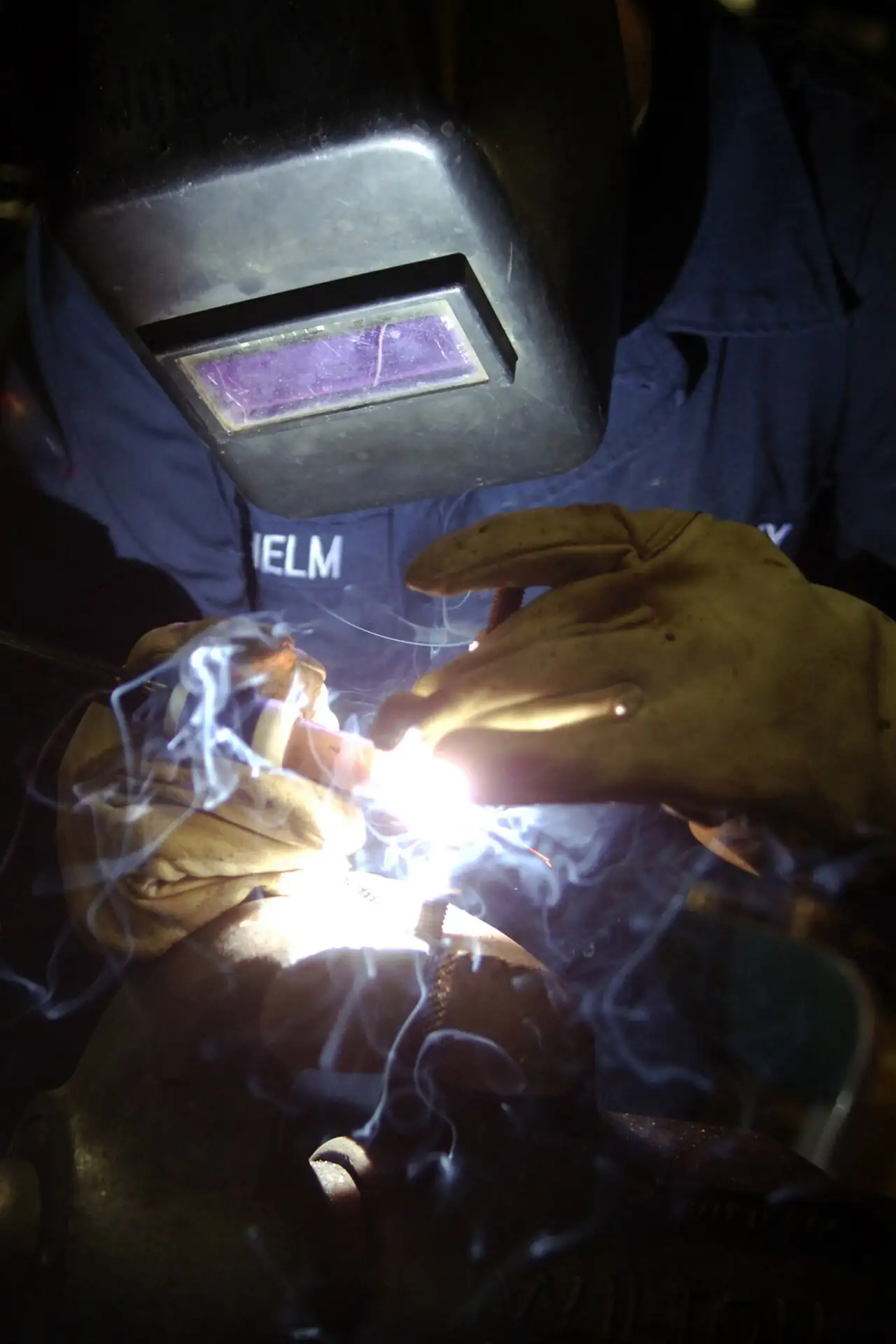
A stud welder is a specialized arc welding power source and hand or fixtured gun that fuses a metal fastener, the stud, onto a workpiece in a single automatic cycle. Unlike general arc welding, the operator does not steer a weld pool: the machine times the arc, lifts the stud to draw it, then plunges the molten stud base into a melted pool on the parent plate, producing a full-strength fusion joint across the entire stud cross-section in a fraction of a second. The result is a threaded, plain or shouldered fastener welded from one side with no access needed behind the sheet.
Two process families dominate. Drawn arc stud welding uses a continuous DC source, a ceramic ferrule and weld times in the hundreds of milliseconds to attach heavy structural studs up to 25 mm. Capacitor discharge welding releases energy stored in a capacitor bank through a small ignition tip in 1 to 6 milliseconds, joining thin sheet and small studs with almost no back-face marking. This guide decodes both against ISO 14555, ISO 13918, AWS D1.1 Clause 7, and the IEC 60974-1 power-source standard.
This guide is written for industrial purchasing engineers and design engineers. Across 6 chapters it covers what a stud welder is and its industrial history and scale, the drawn arc, short cycle and capacitor discharge process families, the consumable studs and ceramic ferrules standardized in ISO 13918, the base-metal and material compatibility rules, the spec-sheet parameters that drive selection, and a step-by-step decision sequence, closing with 7 selection FAQs and manufacturer references. All parameters reference ISO 14555, ISO 13918, AWS D1.1 Clause 7, and the IEC 60974-1 welding-equipment standard.
Chapter 1 / 06
What is a Stud Welder
A stud welder is the combination of a welding power source, a control timer and a stud gun that welds a metal fastener to a base metal in one automated arc cycle. The defining feature is automation of the arc itself: the operator positions the loaded stud against the work and pulls a trigger, after which an electromagnet in the gun lifts the stud a controlled distance to draw an arc, an electronic timer holds that arc for a set number of milliseconds to melt the stud face and a matching pool in the plate, and a spring then plunges the stud into the pool, where the two melts coalesce and solidify. Because the entire weld-base area fuses at once, a correctly set stud weld is typically stronger than the stud itself, so failure tests pull the parent metal or the stud shank rather than the joint.
The hardware divides into the same three subsystems found across arc welding, reorganized for single-shot operation. First is the power and storage stage: a continuous DC rectifier or inverter for drawn arc work, or a bank of charged capacitors for capacitor discharge work, sized to deliver a very high current for a very short time. Second is the control and timing stage, which sets weld time, lift height and plunge, and increasingly logs each weld for traceability. Third is the gun and tooling, holding the stud in a chuck or collet, providing the lift solenoid, and locating the ceramic ferrule or gas shroud. Fixtured and robotic versions replace the hand gun with a weld head for high-rate production.
The process was invented by Edward Ted Nelson at the Mare Island Naval Shipyard in Vallejo, California, around 1939, to speed the attachment of wood decking and insulation to steel ship decks during wartime construction. It spread rapidly through shipbuilding to aircraft carriers and battleships, then into building construction, automotive bodies, electrical enclosures and appliances. The shear connector, a headed stud welded to a steel beam so it bonds to the concrete slab above, made composite steel-concrete floor construction practical and remains one of the largest single applications of drawn arc stud welding today.
In scale terms the process spans a wide range of fastener sizes and rates. Drawn arc systems weld studs from roughly 3 mm to 25 mm in diameter using welding currents from a few hundred amperes up to about 3,000 amperes. Capacitor discharge systems handle smaller studs from about M3 to M10 (14 gauge to 3/8 inch) but cycle in milliseconds, so an automated head can place many studs per minute. A single shear-connector crew on a steel deck may weld thousands of 19 mm studs in a shift, while an appliance line may capacitor-discharge weld hundreds of thousands of small fasteners with no visible mark on the show face.
Four engineering metrics determine stud welder capability: the maximum stud diameter and material it can weld, the available weld current and time envelope, the minimum base-metal thickness it can fasten to without burn-through, and the process accessories it supports (ceramic ferrule, shielding gas, capacitor charge control). These four together decide whether a machine fits structural steelwork, sheet-metal fabrication, or fine decorative work, because no single stud welder spans the whole range from a 0.5 mm appliance panel to a 25 mm structural shear connector.
Chapter 2 / 06
Stud Welding Process Families
ISO 14555 distinguishes three core stud welding processes: drawn arc stud welding with ceramic ferrule or shielding gas, short-cycle drawn arc stud welding, and capacitor discharge stud welding, the last subdivided into tip-ignition and gap (lift) ignition. They differ mainly in how the arc is started and how long energy is delivered, which in turn sets the stud-size range, the minimum plate thickness, and whether a ferrule or gas is needed. Choosing the wrong family is the most common selection error, because a machine optimized for heavy drawn arc studs cannot weld thin appliance sheet, and a capacitor discharge unit cannot place a 19 mm shear connector. The table below compares the four process variants.
Process
Stud Diameter
Weld Time
Min. Base Thickness
Ferrule / Gas
Drawn arc (ARC)
3 to 25 mm
100 to 1,500 ms
~1.5 to 2 mm
Ceramic ferrule above 12 mm
Short cycle (SC)
3 to 16 mm
Up to 100 ms
~0.5 to 1 mm
Shielding gas above 8 mm
CD tip ignition
M3 to M10
1 to 3 ms
~0.5 mm
None
CD gap / lift ignition
2 to 10 mm
~1 ms
~0.5 mm
None
Drawn arc stud welding is the structural workhorse. The gun first presses the stud to the plate to complete the circuit, then a pilot and main arc strike as the solenoid lifts the stud a set height; the continuous DC source feeds the arc for 100 to 1,500 milliseconds depending on diameter, melting the entire stud base and a deep pool in the parent metal, after which a spring plunges the stud home. Welding currents range from roughly 250 to 3,000 amperes. A single-use ceramic ferrule, recommended above 12 mm diameter, concentrates the heat, shields the pool and shapes the visible 360-degree fillet. This is the process used for shear connectors and heavy fasteners on plate.
Short-cycle drawn arc is a faster variant capped at about 100 milliseconds and usually limited to roughly 16 mm or smaller. By shortening the arc and often substituting shielding gas (argon or argon-CO2) for the ceramic ferrule above about 8 mm, it puts much less heat into the work, so it can weld thinner sheet, around 0.5 to 1 mm, and galvanized or thin structural material where a full ferrule weld would burn through. It trades some weld-pool depth for speed and lower distortion, and is widely used in automotive and general fabrication.
Capacitor discharge stud welding stores energy in a large capacitor bank, charged to a preset voltage to suit the stud diameter, then discharges it through a small ignition tip on the stud end when the gun fires. The tip vaporizes, initiating an arc that melts the joint in only 1 to 6 milliseconds before the stud is forced down. Because the heat-affected zone is microscopic and cools almost instantly, there is no ferrule, no flux, no gas, and no discoloration on the reverse of sheet as thin as 0.5 mm. In tip ignition the stud rests on the plate and the tip sets the gap; in gap or lift ignition the gun lifts the stud a tiny distance before discharge. The trade-off is a smaller stud-size ceiling, roughly M3 to M10.
Chapter 3 / 06
Studs, Ferrules and Consumables
The stud is the consumable that the machine welds, and it is standardized internationally in ISO 13918, which fixes the dimensions, material classes, and weld-base geometry of studs and the matching ceramic ferrules. Specifying a stud correctly is as important as choosing the machine, because the weld-base diameter and the ignition feature (drawn arc weld pip and flux ball, or capacitor discharge tip) must match the process. The table below summarizes the common ISO 13918 stud types and their typical use.
Type
Description
Typical Process
Typical Use
RD
Threaded stud, reduced shaft
Drawn arc
Bolting points on plate
PD / FD
Partial / full threaded stud
Drawn arc
General fastening
UD
Unthreaded (plain) stud
Drawn arc
Locating pins, anchors
ID
Internally threaded stud
Drawn arc
Female bolt bosses
SD
Shear connector (headed)
Drawn arc
Composite steel-concrete decks
PT
Threaded stud, tip ignition
Capacitor discharge
Thin sheet, enclosures
Material and class. Drawn arc studs are commonly supplied in low-carbon steel of property class 4.8 per ISO 13918, or in austenitic stainless grades A2 (similar to 304) and A4 (similar to 316) where corrosion resistance is needed. Shear connectors for composite construction use a defined low-carbon steel with specified yield and tensile properties so the welded stud develops its full design shear strength. The stud material must be compatible with the base metal: welding a stainless stud to mild steel, or vice versa, can give a brittle or unpredictable joint, so the rule is to match compositions unless a qualified procedure proves otherwise.
The drawn arc weld base. Drawn arc studs carry a small aluminium or flux ball pressed into a recess in the weld end. When the arc strikes, this flux deoxidizes the pool and stabilizes the arc, and its consumption is part of why the weld base finishes flush and fused. The base is also machined to a slight chamfer or pip so the arc starts evenly around the rim. Specifying the wrong base geometry, or reusing a stud meant for a different process, is a frequent cause of incomplete fusion at the edge of the weld.
The ceramic ferrule. For drawn arc welding above about 12 mm, a single-use ceramic ferrule fits over the stud base inside the gun foot. It performs four jobs at once: it concentrates arc heat onto the joint, it shields the molten pool from oxygen and nitrogen in the air, it retains the expelled molten metal so the weld forms a uniform 360-degree fillet, and it confines spatter. Ferrules are matched to stud diameter and are consumed one per weld, so they are a recurring cost and a logistics item; running out of the correct ferrule stops production as surely as running out of studs.
The table below is a quick reference matching common fastening tasks to a stud type and process. It is for initial orientation only; for structural or safety-critical joints, always qualify the procedure to ISO 14555 or AWS D1.1 and verify with the equipment maker's stud-and-parameter chart.
Task
Stud Type
Process
Note
Composite floor shear connector
SD (headed)
Drawn arc, ferrule
13 to 25 mm typical
Bolt point on structural plate
RD or PD
Drawn arc
6 to 16 mm
Galvanized or thin steel sheet
PD
Short cycle, gas
~0.5 to 1 mm sheet
Stainless enclosure standoff
PT
Capacitor discharge
No back-face mark
Insulation pin on duct
UD or weld pin
Capacitor discharge
High rate
Aluminium bracket boss
ID (aluminium)
Capacitor discharge
Tight parameter band
Chapter 4 / 06
Base Metals and Material Compatibility
Stud welding quality depends as much on the base metal as on the stud. The parent surface must be clean, sound and thick enough to absorb the heat without burning through, and its alloy must be metallurgically compatible with the stud. The most common base metals are carbon and low-alloy structural steels, austenitic stainless steels, and, for capacitor discharge work, aluminium and brass. Coatings, mill scale, rust, paint and oil all degrade the weld and must be removed at the stud location before welding.
Carbon and structural steel is the default base for drawn arc welding. Shear connectors and structural studs weld readily to S235 to S355 grade plate and similar carbon steels, developing a joint stronger than the stud. The main precautions are adequate thickness, so the pool does not penetrate the back face, and dry conditions, because moisture and a high-carbon or high-sulphur steel can give porosity or cracking. Preheat is rarely needed for ordinary mild steel but may be specified for thick or higher-strength sections under the qualified procedure.
Galvanized and coated steel is a common challenge. Zinc vaporizes well below steel's melting point, so it boils off in the arc and can cause porosity if trapped. Short-cycle drawn arc and capacitor discharge, with their tiny heat inputs, handle thin galvanized sheet better than full drawn arc, but the procedure should still expel or burn clear the coating at the weld and the connection should be tested. Painted or primed surfaces must be ground back to bare metal at each stud location, since organic coatings carbonize and prevent fusion.
Stainless steel welds well with matching stainless studs in grades A2 or A4. The keys are matching the stud and base grade to avoid a brittle or corrosion-prone joint, controlling heat input so the heat-affected zone does not sensitize and lose corrosion resistance, and, on thin decorative stainless, choosing capacitor discharge so the reverse face stays unmarked. Aluminium is weldable but unforgiving: its oxide film and high thermal conductivity demand shielding gas for drawn arc work and a narrow, well-controlled parameter band, and most aluminium stud welding in practice uses capacitor discharge on thin sections.
The table below summarizes base-metal guidance. It is for initial selection only; before production, qualify the actual stud-base-process combination by bend, torque or tensile test as required by the governing code.
Base Metal
Recommended Process
Matching Stud
Caution
Carbon / structural steel
Drawn arc
Class 4.8 steel
Thickness, moisture
Thin / galvanized steel
Short cycle or CD
Class 4.8 steel
Zinc porosity
Stainless steel
Drawn arc or CD
Stainless A2 / A4
Match grade, limit heat
Aluminium / alloys
Capacitor discharge
Aluminium stud
Oxide film, narrow band
Brass
Capacitor discharge
Brass stud
Thin sections only
Painted / primed steel
Any, after prep
Per substrate
Grind to bare metal
Chapter 5 / 06
Key Specification Parameters
Reading a stud welder data sheet is a core skill for purchasing engineers. Machines list many figures, but only a handful truly drive the selection decision: maximum stud diameter and material, weld current and time envelope, capacitor capacity and charge voltage (for capacitor discharge units), lift and plunge control, input supply and duty rating, and gun and automation options. Each is explained below.
Maximum stud diameter and material is the headline rating, but it must be read together with material, because a machine rated for 25 mm in mild steel may be limited to a smaller diameter in stainless, which needs more energy. The data sheet should give a chart of stud diameter against process and material, not a single number. For drawn arc machines this ceiling tracks the available welding current; for capacitor discharge it tracks the stored energy of the capacitor bank.
Weld current and time define the energy delivered. Drawn arc machines specify a maximum welding current, commonly stated up to 1,500, 2,000 or 3,000 amperes, and a settable weld time from roughly 100 to 1,500 milliseconds. Both rise with the square of stud diameter, because weld-base area scales with the square. The machine should let the operator set lift height, weld time and current (and gas, where used) and store them per stud, so the parameter chart can be reproduced exactly.
Capacitor capacity and charge voltage are the equivalent parameters for capacitor discharge units. The capacitor bank, sometimes tens of thousands of microfarads (values around 70,000 microfarads appear on larger machines), is charged to a preset voltage selected to suit the stud diameter; the weld time is then fixed by the discharge itself at 1 to 6 milliseconds and is not separately adjustable. Larger banks and higher charge voltage extend the maximum weldable diameter. The only routine setting is the charge voltage per stud size, which makes capacitor discharge welders simple to operate once characterized.
Lift, plunge and gun control govern weld quality on drawn arc machines. Lift height sets the arc length, plunge depth and damping set how the molten stud meets the pool, and a good controller holds these repeatably weld after weld. Poor lift or plunge control gives undercut, incomplete fusion at one side, or excessive spatter. Production guns add features such as foot pieces matched to ferrule size, automatic stud feed, and weld logging for traceability.
Input supply and duty determine where the machine can run. Small capacitor discharge and light drawn arc units run on single-phase mains, while heavy drawn arc machines drawing thousands of amperes at the stud need three-phase supply and have a duty cycle expressed, like any welding power source under IEC 60974-1, as a percentage of a 10-minute period at a stated output. Output protection, enclosure IP rating and the relevant CE, UKCA or national mark complete the supply-side specification, alongside the welds-per-minute rate that fixes production throughput.
The five core parameter groups are summarized below.
Stud diameter and material: the diameter-versus-material chart, not a single headline number.
Weld current and time: drawn arc current up to ~3,000 A and time 100 to 1,500 ms, both scaling with diameter squared.
Capacitor capacity and charge voltage: for CD units, bank size and preset charge voltage fix the 1 to 6 ms weld.
Lift, plunge and gun control: repeatable arc length and plunge for a uniform 360-degree fillet.
Input supply and duty: single or three phase, duty cycle per IEC 60974-1, enclosure rating and certification.
Chapter 6 / 06
Selection Decision Factors
To turn the preceding five chapters into a specific machine and consumable choice, follow the decision sequence below. Most selection mistakes come not from one wrong answer but from deciding the machine before the joint, so work from the joint outward. These eight steps can serve as a fixed RFQ template.
Stud type and size: First fix the fastener from ISO 13918 (RD, PD, FD, UD, ID, SD shear connector, or PT) and its diameter and material, because this drives every later choice. Structural shear connectors of 13 to 25 mm point straight to drawn arc; small fasteners on sheet point to capacitor discharge.
Base metal and thickness: Identify the thinnest member and its alloy. Thick steel plate allows full drawn arc; sheet around 0.5 to 1 mm needs short cycle or capacitor discharge to avoid burn-through; coatings and dissimilar metals narrow the options further.
Process family: Combine the first two steps to choose drawn arc, short cycle, or capacitor discharge. Confirm the chosen process can both reach the stud diameter and respect the minimum base thickness, since these two limits often conflict.
Current, time and energy envelope: Verify the machine's weld current and time (drawn arc) or capacitor capacity and charge voltage (capacitor discharge) cover the stud chart for your largest stud in your base material, with margin.
Consumable supply: Confirm a reliable source of matching ISO 13918 studs and, for drawn arc above 12 mm, the correct ceramic ferrules. The recurring consumable cost and lead time often matter more over a product line's life than the machine price.
Standards and qualification: Decide the governing code (ISO 14555 or AWS D1.1 Clause 7 for structural steel) and ensure the supplier can support procedure qualification, including bend, torque or tensile testing and the documented WPS.
Supply, duty and certification: Match input phase and current, duty cycle per IEC 60974-1, enclosure rating, and CE, UKCA or national marks to the production environment and throughput, including welds per minute for automated work.
Gun, automation and ergonomics: Choose hand gun, fixtured head or robotic system, with the lift and plunge control, stud feed, foot pieces, and weld logging that the production rate and traceability requirements demand.
One last and commonly overlooked dimension is manufacturer serviceability: availability of matching studs and ferrules, spare guns and chucks, controller calibration and repair, procedure-qualification support, and operator training. These seem secondary at purchase but determine downtime once the line is running. Nelson Stud Welding (Stanley Engineered Fastening), Koco, HBS, Heinz Soyer, Bolte, Image Industries and Tru-Weld maintain equipment, consumable and service networks, which makes them dependable choices for ongoing production rather than one-off jobs.
FAQ
What is the difference between drawn arc and capacitor discharge stud welding?
Drawn arc stud welding sustains a controlled arc from a continuous DC power source while the stud is lifted off the plate, melts the full stud base and a pool of parent metal, then plunges the stud home; weld times run from roughly 100 to 1,500 milliseconds and currents from about 250 to 3,000 amperes, which suits studs from 3 to 25 mm. Capacitor discharge welding instead dumps energy stored in a capacitor bank through a small ignition tip on the stud end, melting the joint in only 1 to 6 milliseconds with no ceramic ferrule and no flux. The very short cycle keeps heat input tiny, so capacitor discharge welds thin sheet down to about 0.5 mm and dissimilar metals such as steel to aluminium, but it is limited to smaller studs of roughly M3 to M10 (14 gauge to 3/8 inch).
What is the ceramic ferrule for and when is it required?
In drawn arc welding the ceramic ferrule is a single-use ring that surrounds the stud base. It concentrates the arc heat, shields the molten pool from the atmosphere, retains and shapes the expelled weld metal into the visible 360-degree fillet, and confines spatter. Ferrules and studs are standardized together in ISO 13918. Drawn arc welding with a ceramic ferrule is recommended for studs larger than about 12 mm in diameter, where the larger weld pool needs containment. Below that size, or for the short-cycle variant, the ferrule is often replaced by shielding gas (argon or argon-CO2 mixtures), and capacitor discharge welding uses neither ferrule nor gas because its weld time is too short for the pool to oxidize.
Which standards govern stud welding equipment and procedures?
Two ISO standards anchor the consumable and procedure side: ISO 13918 specifies the studs and ceramic ferrules (dimensions, material classes and stud types such as RD, PD, FD, UD, ID and the SD shear connector), and ISO 14555 covers welding procedure specification, qualification, examination, testing and quality requirements for arc stud welding. In North American structural work the governing rule is AWS D1.1/D1.1M Clause 7, which sets stud application qualification, production procedures and inspection for steel construction, supported by the AWS C5.4 recommended practices for stud welding. The welding power source itself is built to IEC 60974-1 for arc welding equipment safety. Shear-connector studs for composite steel-concrete construction are additionally specified through these structural codes.
How do I size weld current and time for a given stud diameter?
For drawn arc welding the rule is that current and time both scale with weld-base area, so they rise with the square of stud diameter. As an order of magnitude, a small 6 mm drawn arc stud needs a few hundred amperes for around 100 milliseconds, a 19 mm shear connector typically needs roughly 1,500 to 2,000 amperes for 600 to 900 milliseconds, and the largest 25 mm studs approach 3,000 amperes. The equipment maker publishes a parameter chart per stud diameter and material; always start from that chart, weld test coupons, and verify by bend and torque test before production. For capacitor discharge the operator sets only a charge voltage to suit diameter because the weld time is fixed at 1 to 6 milliseconds by the capacitor discharge itself.
What base-metal thickness can each process weld onto?
Heat input drives the minimum plate thickness. Drawn arc welding melts a deep pool, so a common guideline is that the plate should be at least the stud diameter divided by about five, with roughly 1.5 to 2 mm a practical floor for general studs and burn-through a risk on thinner sheet. The short-cycle drawn arc variant, with weld times capped near 100 milliseconds, welds down to about 0.5 to 1 mm. Capacitor discharge, with its 1 to 6 millisecond pulse, deposits so little heat that it fastens studs to sheet as thin as 0.5 mm without marking or discoloring the reverse face, which is why it dominates appliance panels, stainless enclosures and decorative metalwork. Match the process to the thinnest member in the joint.
How is a stud weld inspected and accepted?
Stud welds are normally proven by visual inspection plus a mechanical bend or torque test rather than radiography, because the joint is buried under the stud. Visually, a sound drawn arc weld shows a full 360-degree flash of expelled metal around the base with no evidence of undercut into the stud and no incomplete fusion. Under AWS D1.1, production studs are bend tested by deflecting them about 30 degrees from their original axis; a conforming weld shows no fracture in the weld or heat-affected zone. Threaded studs may instead be torque tested to a value set in the procedure. ISO 14555 specifies parallel acceptance criteria, including bend, tensile and macro-section tests for procedure qualification. Failed studs are removed and the location is repaired by an approved method.
Which materials can be stud welded together?
Drawn arc welding is mainly used for carbon and low-alloy steels and for austenitic stainless steels, with studs typically supplied in steel property class 4.8 or in stainless grades A2 and A4 per ISO 13918, welded to a steel or stainless base of similar composition. Capacitor discharge widens the palette: because the molten zone is microscopic and cools in milliseconds, it joins mild steel, stainless steel, brass and aluminium and its alloys, and can even weld dissimilar pairs such as a steel stud to an aluminium sheet that would crack under a slower process. Aluminium drawn arc welding is possible but needs shielding gas and tight parameter control. Always confirm stud and base alloy compatibility and any plating, because zinc and other coatings can embrittle or porosity the weld.