A fuse is the simplest and oldest overcurrent protection device: a calibrated fusible element that melts and interrupts a circuit when current exceeds a safe value for too long. Despite a century of competing technology, the fuse remains the benchmark for high breaking capacity and current limitation, routinely interrupting fault currents of 80 to 200 kA in a body small enough to hold in one hand.
This guide is written for procurement and design engineers who must specify the correct fuse against IEC 60269 or UL 248. It separates the two standards families, decodes the gG, aM, and UL class systems, and explains the four ratings that actually drive selection: rated current, rated voltage, breaking capacity, and let-through energy.
Photo: Widar23, CC BY-SA 4.0, via Wikimedia Commons
This guide covers 6 chapters from fusing fundamentals and history, through IEC 60269 and UL 248 type systems, construction and element design, sizing and standards, key spec-sheet parameters, to a structured selection sequence, with 7 FAQs and manufacturer references. All parameters reference the public standards IEC 60269 (low-voltage fuses), UL 248 (low-voltage fuses), BS 88, and IEC 60127 (miniature fuses).
Chapter 1 / 06
What is a Fuse
A fuse is an overcurrent protective device whose operating element is a metal conductor sized to melt when the current through it exceeds a defined value for a defined time. When the element melts, an arc forms across the gap; the fuse design then quenches that arc and the circuit is permanently open until the link is replaced. Unlike a circuit breaker, which uses mechanical contacts and a trip mechanism, the fuse has no moving parts: the conductor itself is both the sensor and the interrupting element. This simplicity is the source of the fuse's two enduring advantages, very high breaking capacity and very fast current limitation, and its one inherent limitation, single-shot operation.
Functionally, every fuse performs two jobs. Under a moderate, sustained overload it must eventually open to protect cables and equipment from thermal damage, but slowly enough to ignore harmless transients. Under a severe short circuit it must open extremely fast, ideally within the first half-cycle, to limit the energy delivered into the fault. These two requirements pull in opposite directions, which is why the element is rarely a plain wire: it is a shaped strip with reduced-section necks and, often, a low-melting-point alloy spot that tunes the slow overload response separately from the fast short-circuit response.
The history of the fuse runs alongside the history of electrical distribution itself. By 1864 reduced-section wire and foil fusible elements were already in use to protect telegraph cables and lighting installations, and Thomas Edison patented a fuse in 1890 as part of his electric distribution system. The high-rupturing-capacity (HRC) sand-filled cartridge, which made the modern industrial fuse possible by reliably quenching very high fault currents, was developed in the early twentieth century and standardized in Britain under BS 88. International harmonization arrived with IEC 60269, while North America developed its own parallel framework under UL 248, with rejection features that prevent a low-capacity fuse being fitted where a high-capacity one is required.
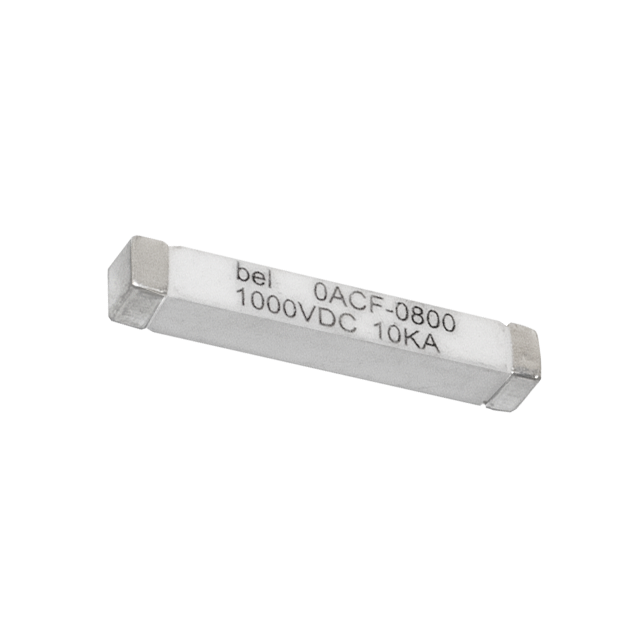
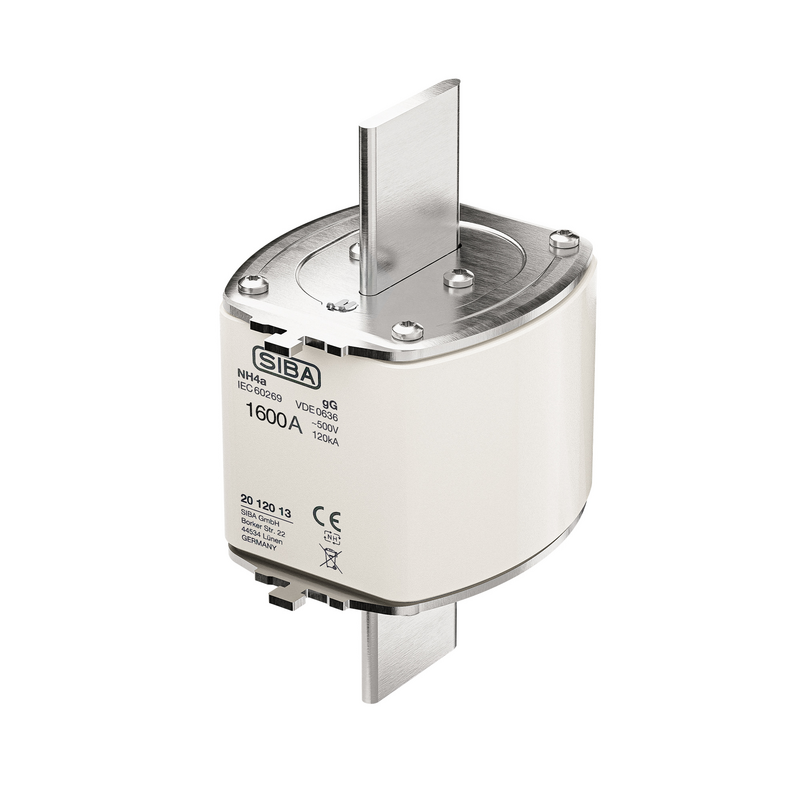
In application scale, fuses span an enormous range. A miniature glass fuse to IEC 60127 may be rated 32 mA at 250 V to protect a printed circuit board, while a Class L or NH4 power link is rated thousands of amperes: NH size 4 links cover roughly 500 to 1250 A, and UL Class L fuses run from 601 A up to 6000 A. Breaking capacity scales from about 35 A in a miniature fuse to 200,000 A or more in an industrial current-limiting link. No single fuse covers this range; selecting a fuse is the act of matching one narrow band of this spectrum to one specific circuit.
Four engineering metrics govern fuse selection and recur throughout this guide: rated current, rated voltage, breaking capacity, and the time-current and let-through characteristic. The rest of the guide is organized so that each chapter adds the context needed to read these four numbers correctly, because a fuse chosen on rated current alone, with the wrong voltage class or an inadequate breaking capacity, is not protection at all but a latent hazard.
Chapter 2 / 06
Fuse Types and Classification
Industrial fuses are classified under two parallel standards families that do not directly cross-reference: IEC 60269 (with BS 88 in the UK) and the North American UL 248. The single most common selection error is mixing them, for example assuming a UL Class J interrupting rating applies to an IEC gG link. The first decision in any project is which standard governs the installation, because it determines the body styles, the rejection features, and the published ratings you are allowed to rely on.
Under IEC 60269, a fuse is described by a two-letter utilization category. The first lowercase letter is the breaking range: g is full-range (the fuse breaks every current from the smallest fusing current up to rated breaking capacity), and a is partial-range (the fuse only breaks high fault currents above a threshold, typically several times rated). The second uppercase letter is the object protected: G general / cables, M motor circuits, R semiconductors, Tr transformers, PV photovoltaic. So gG is general-purpose full-range, aM is motor-rated partial-range, and gPV is full-range solar. The legacy designation gL is the old name for what is now gG.
Under UL 248, fuses are sorted into letter classes that bundle physical dimensions, voltage, interrupting rating, and current-limiting behavior together, each governed by a sub-part of the standard. The classes are not interchangeable, and fuseholders use rejection features so that, for example, a non-current-limiting fuse cannot be installed in a Class R holder. The most common classes and their headline ratings are summarized below.
UL class
UL 248 part
Amperes
Voltage (AC)
Interrupting rating
Class CC
248-4
0 to 30 A
600 V
200 kA
Class J
248-8
0 to 600 A
600 V
200 kA
Class T
248-15
0 to 1200 A
300 / 600 V
200 kA
Class RK1 / RK5
248-12
0 to 600 A
250 / 600 V
200 to 300 kA
Class L
248-10
601 to 6000 A
600 V
200 kA
Class G
248-5
0 to 60 A
480 V
100 kA
The practical distinctions within UL classes are physical size and speed. Class CC is a compact 10 by 38 mm cylindrical fuse for control circuits and small motors. Class J is the modern current-limiting workhorse for branch and feeder protection, more compact than the older Class H dimensions it replaces. Class RK1 and RK5 are dimensionally interchangeable with legacy Class H and K fuses but add a rejection ring; RK1 limits energy far more aggressively than RK5. Class L is a bolt-in design for the very large currents of service entrances and main feeders. Class T is notably compact for its rating, useful where panel space is tight.
A second axis cuts across both standards: speed, or time-delay behavior. Fast-acting fuses open quickly even on modest overloads and are used to protect semiconductors and resistive loads. Time-delay (slow-blow) fuses tolerate the inrush of motors, transformers, and capacitor banks for a defined period before opening, so they can be sized closer to running current without nuisance operation. Choosing fast versus time-delay independently of the class is part of matching the fuse to the load's inrush profile.
Chapter 3 / 06
Element Design and Construction
The performance of a fuse is set almost entirely by the geometry of its element and the medium that surrounds it. A modern HRC cartridge is far more sophisticated than a plain wire, and understanding its construction explains why two fuses of the same ampere rating can have completely different short-circuit behavior.
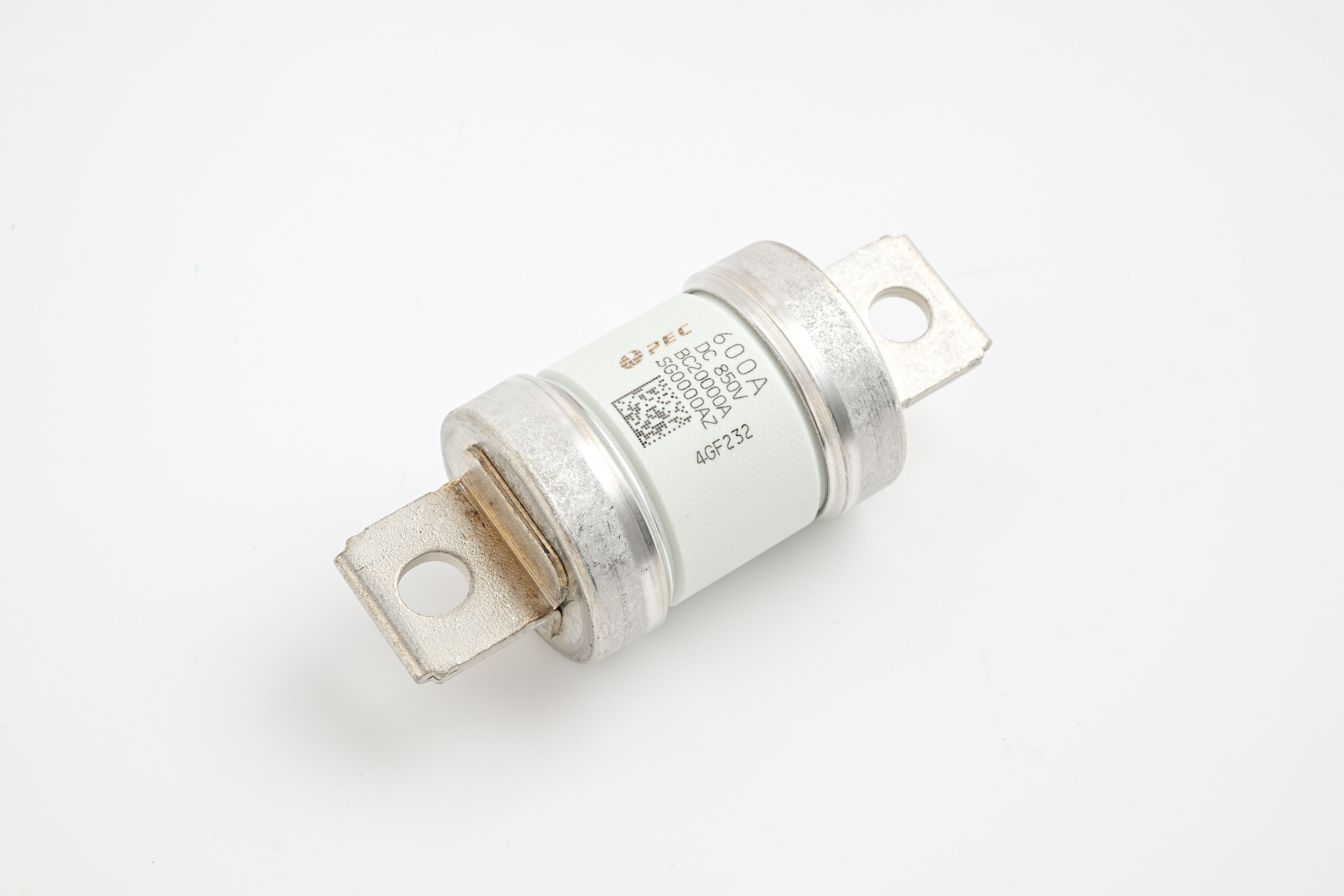
The fusible element is a stamped or wound metal strip, most commonly silver, copper, or an alloy, chosen for predictable melting temperature and resistance to oxidation and creep. Silver is favored in high-quality power fuses because its low and stable resistivity keeps watt loss and self-heating low and gives repeatable melting. The strip is not uniform: it has one or more reduced-section necks where the cross-section is locally narrowed. These necks concentrate heat and define where the element melts first. Under a heavy short circuit, every neck melts almost simultaneously, splitting the arc into several short series arcs that are far easier to quench, which is the core mechanism of current limitation.
For controlled overload behavior, many power fuses add the M-effect: a small blob of low-melting-point metal (often tin or a tin alloy) deposited on the silver element. Under a moderate, sustained overload the blob slowly diffuses into and dissolves the silver, raising local resistance until the element parts, all at a temperature well below silver's own melting point. This is what gives a dual-element or time-delay fuse its slow overload response while preserving a fast short-circuit response from the necks. It also lets the fuse run cooler at rated current.
The element is suspended inside a body, historically ceramic or glass-reinforced material rated for the thermal shock of an internal arc, and the void around it is packed with quartz silica sand filler of controlled grain size and purity. The sand is the heart of an HRC fuse: when the element vaporizes, the arc plasma fuses the surrounding sand into a glassy, non-conductive mass called a fulgurite, which absorbs arc energy, deionizes the gap, and extinguishes the arc within milliseconds. The quality and packing density of the filler directly determine the breaking capacity. A fuse without filler, such as a cheap rewirable or glass type, cannot reach the 80 to 200 kA ratings of a sand-filled HRC link.
End connections vary by body style and define how the fuse mounts. The table below compares the main construction families an engineer will encounter.
Construction
Termination
Filler
Typical breaking capacity
NH knife-blade (IEC)
Blade contacts in spring jaws
Quartz sand
120 kA
Cylindrical cartridge (IEC)
End ferrules in clip holder
Quartz sand
100 kA
UL Class J / CC
Ferrule or blade, rejection
Quartz sand
200 kA
UL Class L
Bolt-in copper tags
Quartz sand
200 kA
Miniature glass (IEC 60127)
End caps in clip
Air or sand
35 A to 1.5 kA
Blade / automotive
Spade prongs
None
1 to 2 kA
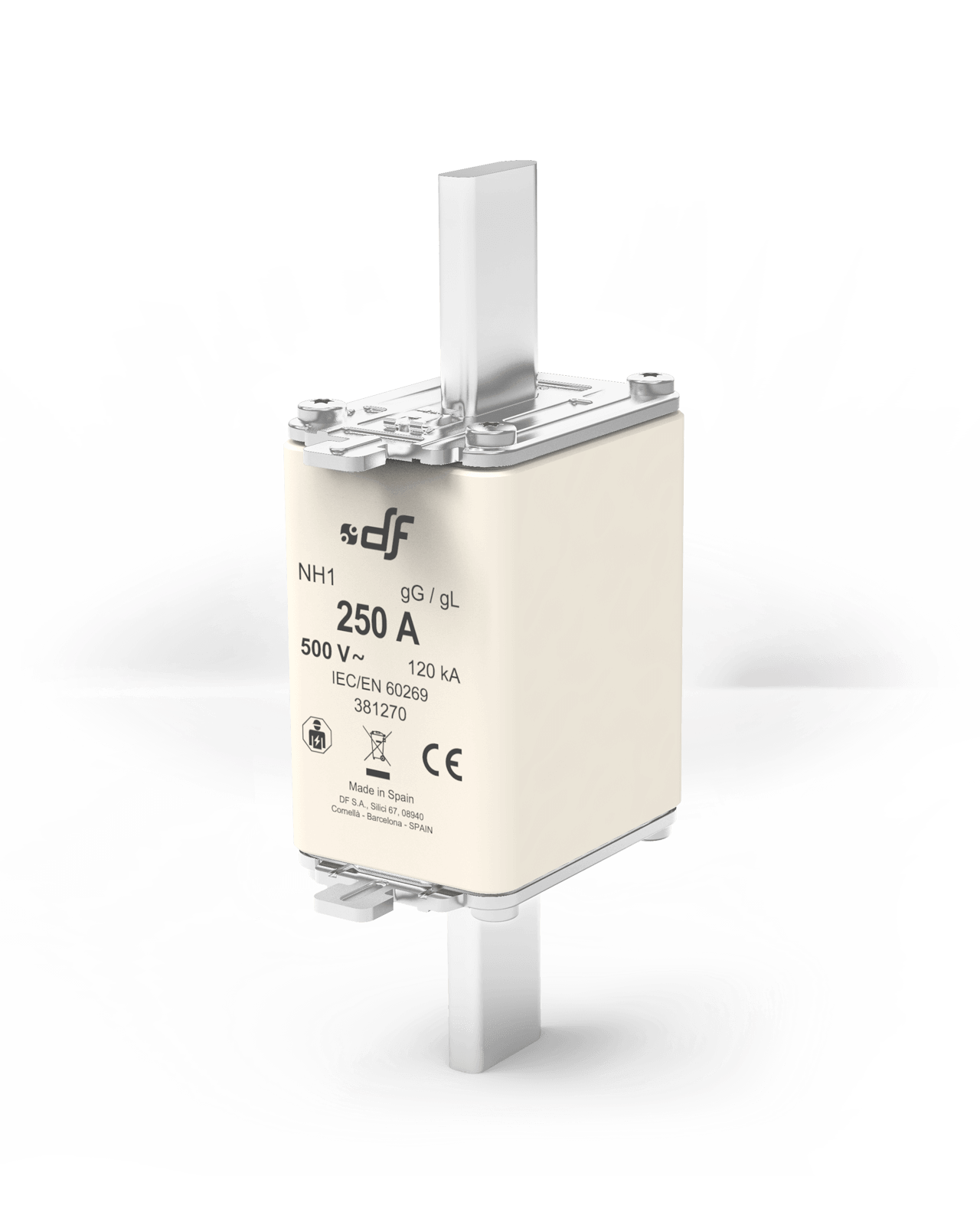
Two construction families deserve a note. NH (Niederspannungs-Hochleistung) knife-blade fuses are the dominant industrial form in IEC markets: a rectangular ceramic body with flat blade contacts gripped by a spring-loaded fuse base, inserted and withdrawn with an insulated handle under a degree of arc protection. Semiconductor fuses (IEC aR, gR, gS; Mersen Protistor and similar) use a flat, multi-neck silver element optimized for extremely low I2t, because they must clear before a thyristor or IGBT junction overheats, a window of only a few milliseconds. They are the fastest power fuses made and are not interchangeable with general-purpose gG links.
Chapter 4 / 06
Sizing, Sizes, and Standards
Sizing a fuse correctly is the central design task, and it depends on three independent constraints that must all be satisfied: the conductor it protects, the load it feeds, and the fault current available at its location. Getting only the ampere rating right while ignoring the other two is the most common field mistake.
The first constraint is the protected conductor. The fuse rated current must not exceed the continuous current-carrying capacity of the smallest downstream power cable, so the fuse opens before the cable insulation is thermally damaged. IEC 60269 and the wiring rules express this through a coordination condition: the cable rating must be at least the fuse rated current, and the fuse conventional fusing current must be within the cable's short-time withstand. The second constraint is the load profile. For a steady resistive load a fuse can be sized just above the operating current, but for motors and transformers the fuse must ride through inrush, typically 6 to 8 times rated for a few seconds on an AC motor and far higher for a transformer, which is why aM and time-delay links exist.
The third constraint, and the one most often underestimated, is the available fault current. The fuse breaking capacity must equal or exceed the prospective short-circuit current at the point of installation. That fault level is set by the upstream power transformer rating and impedance and the supply network, not by the load, and it can be tens of kiloamperes even on a small final circuit close to a large transformer. This is why HRC and UL current-limiting fuses with 80 to 200 kA ratings exist: they provide headroom that a 10 kA rewirable or miniature fuse cannot.
For IEC NH (knife-blade) fuses, the physical body size is standardized so that ampere ranges map to mechanical sizes. The table below gives the common NH size to current mapping, which sets the fuse base and switch-disconnector frame you must order alongside the link.
NH size
Typical rated current
Typical voltage
Breaking capacity
NH000 / NH00
2 to 160 A
400 to 690 V AC
120 kA
NH1
80 to 250 A
400 to 690 V AC
120 kA
NH2
125 to 400 A
400 to 690 V AC
120 kA
NH3
315 to 630 A
400 to 690 V AC
120 kA
NH4 / NH4a
500 to 1250 A
400 to 690 V AC
120 kA
The governing standards differ by region and by fuse family, and the certification printed on the body is what a project audit checks. IEC 60269 is the international low-voltage fuse standard, in multiple parts covering general requirements, fuses for industrial use (gG, aM and related), and supplementary types. BS 88 is the long-established British HRC standard, now harmonized with IEC 60269 and still widely referenced. UL 248 is the North American standard, published in 19 parts, one per fuse class plus general requirements, and it extends to PV fuses up to 1500 V DC. IEC 60127 governs miniature fuses for electronic equipment. For DC systems, note that fuse DC voltage ratings and breaking are tested separately, because a DC arc has no natural current zero and is harder to extinguish than an AC arc of the same magnitude.
Chapter 5 / 06
Key Specification Parameters
A fuse datasheet can list a dozen parameters, but only a handful drive a correct selection. Reading them precisely, and understanding which are independent of each other, is the difference between protection and a latent fault. The six parameters below are the ones to extract from every datasheet.
Rated current (In) is the maximum current the fuse carries continuously without opening, at a reference ambient temperature. It is not the operating point alone: derating for elevated ambient, for enclosure heat, and for grouping must be applied, and a fuse run continuously near In in a hot panel will age. Note that the conventional fusing current, the value the fuse is guaranteed to clear within the conventional time (commonly 1.6 times In for gG), is what actually defines overload protection, not In itself.
Rated voltage is the maximum system voltage at which the fuse can interrupt a fault and still extinguish the arc. It must equal or exceed the circuit voltage. AC and DC ratings are different and are printed separately: a link rated 690 V AC may be rated only a few hundred volts DC. Grossly overrating voltage is also discouraged, because a fuse used far below its voltage rating may not clear small overloads cleanly.
Breaking capacity (interrupting rating) is the maximum prospective short-circuit current the fuse can safely interrupt. HRC and NH links to IEC 60269 and BS 88 typically reach 80 to 120 kA; UL current-limiting classes commonly reach 200 kA and some 300 kA. This rating must always equal or exceed the available fault current at the installation point. A fuse subjected to a fault above its breaking capacity can rupture violently.
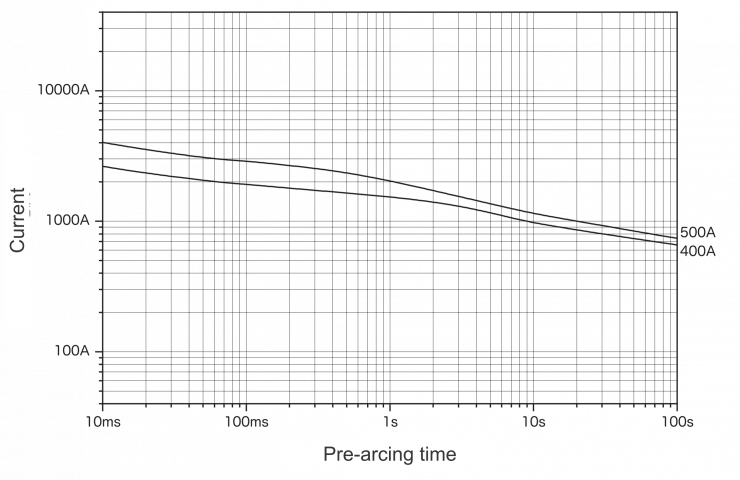
Time-current characteristic is the log-log curve of clearing time versus current, the single most important behavioral specification. It tells you how the fuse discriminates between inrush, overload, and short circuit. The two key landmarks are the conventional fusing point and the short-circuit region. For coordination, two related I2t values are published: the melting (pre-arcing) I2t and the larger total clearing I2t. The selection summary table below lists representative spec values across the common types.
Type
Speed
Typical In range
Voltage
Breaking capacity
gG (NH, IEC)
General
2 to 1250 A
400 to 690 V AC
120 kA
aM (motor, IEC)
Partial-range
2 to 630 A
400 to 690 V AC
120 kA
aR / gS semiconductor
Ultra-fast
10 to 1600 A
690 to 1000 V AC
100 to 200 kA
Class J (UL)
Time-delay / fast
1 to 600 A
600 V AC
200 kA
Class L (UL)
Time-delay / fast
601 to 6000 A
600 V AC
200 kA
Class CC (UL)
Time-delay / fast
0.1 to 30 A
600 V AC
200 kA
Let-through energy (I2t) and peak let-through current (Ip) quantify current limitation. A current-limiting fuse clears in under a half-cycle, so the fault current never reaches its prospective peak; the published Ip and I2t curves let you verify that the energy passed to a downstream cable, busbar, or semiconductor stays below its withstand rating. Lower I2t also means lower incident arc-flash energy, which is increasingly a safety-driven selection criterion. The final parameter, power dissipation (watt loss) at rated current, matters for enclosure thermal design and for selectivity, since a hotter fuse ages faster and shifts its curve slightly.
Chapter 6 / 06
Selection Decision Factors
To turn the preceding five chapters into a specific catalogue number, follow the ordered sequence below. Most selection errors come not from a single wrong value but from deciding a later step before an earlier one is fixed. These eight steps work as a fixed RFQ template.
Standard and class: First fix whether the installation is governed by IEC 60269 / BS 88 or by UL 248, because that determines the entire class system, body style, and rejection scheme. Do not mix ratings across the two families.
Object protected and category: Decide what you are protecting: cable / general (gG, Class J or RK), motor (aM plus overload relay, or Class J time-delay), semiconductor / drive (aR, gR, gS), transformer (gTr), or PV string (gPV, UL PV). Motor-circuit links typically sit inside a motor control center alongside the contactor and overload relay. This selects the time-current shape you need.
Rated current: Size In above the steady load but below the smallest downstream conductor rating, applying ambient and enclosure derating. For motors and transformers, ride through inrush with a time-delay or partial-range link rather than oversizing.
Rated voltage: Confirm the AC voltage rating equals or exceeds the system voltage, and separately confirm the DC rating for any battery, solar, or traction circuit. Verify both numbers on the current datasheet.
Breaking capacity: Calculate the prospective short-circuit current at the installation point from the upstream transformer and network, and choose a fuse whose breaking capacity equals or exceeds it, with margin. Do not rely on the load to limit fault current.
Coordination and selectivity: Check selectivity with upstream and downstream devices using a 2:1 ampere ratio as a screen, then confirm with melting and clearing I2t and time-current curves. Verify let-through I2t and Ip stay below the withstand rating of protected cables and semiconductors.
Mounting, holder, and accessories: Match the body style to its base or holder (NH size and fuse-switch frame, cylindrical clip, Class J/CC/L holder with the correct rejection), and specify any blown-fuse indicator, microswitch, or striker pin needed for motor single-phasing protection.
Total cost of ownership: Account for the holder and disconnector, the cost and availability of spare links, and the operational cost of single-shot operation versus a resettable breaker. For critical loads, stock spares on site so a blown link does not extend downtime.
One dimension is easy to overlook: serviceability and availability. A fuse is a consumable, so local stock of the exact link, holder compatibility across maintenance years, and a manufacturer that keeps the series in production all matter more over a 10-to-20-year plant life than a small unit-price difference. Eaton Bussmann, Mersen, Siemens, ABB, and Littelfuse all maintain broad IEC and UL ranges with documented cross-references and current certification, which makes them dependable choices where long-term spare availability is a project requirement. Always confirm the specific catalogue series carries the certification you cite, IEC 60269, UL 248, or both, on the live datasheet rather than on a third-party cross-reference table.
FAQ
What is the difference between a gG and an aM fuse?
Both are defined by IEC 60269 utilization categories. The lowercase letter sets the breaking range and the uppercase letter sets the protected object. gG is a full-range general-purpose link: it breaks any current from its smallest fusing current up to its rated breaking capacity, so it protects cables and distribution against both overload and short circuit. aM is a partial-range motor link: it only breaks high fault currents above roughly 4 to 6.3 times rated, and deliberately ignores overloads and motor inrush, which is handled by a separate thermal overload relay. Never use aM as standalone cable protection, because it will not clear a sustained overload.
What does breaking capacity mean, and why is 120 kA common?
Breaking capacity (also called interrupting rating) is the maximum prospective short-circuit current the fuse can safely interrupt without rupturing the body or sustaining an arc. HRC fuse-links to IEC 60269 and BS 88 are typically rated 80 to 120 kA at 400 to 690 V AC, and many NH links carry 120 kA. UL 248 current-limiting classes such as Class J, RK1, T, and L are commonly rated 200 kA rms symmetrical, and some reach 300 kA. The installed fuse rating must equal or exceed the available fault current at its location, which is determined by transformer size and impedance, not by the load.
What does current-limiting actually do during a fault?
A current-limiting fuse clears so quickly, in under one half-cycle, that the fault current never reaches its prospective peak. The element melts before the first peak, then the arc is quenched in the silica sand filler. The result is a much lower peak let-through current and a far smaller I2t (let-through energy in ampere-squared-seconds). Lower I2t protects downstream cables and semiconductors from thermal damage and dramatically reduces incident arc-flash energy. Manufacturers publish peak let-through and I2t curves so you can verify a fuse limits energy below the withstand rating of the gear it protects.
Why must I match the fuse voltage rating to the system?
The voltage rating is the maximum open-circuit voltage the fuse can interrupt while still extinguishing the arc. It must equal or exceed the circuit voltage, but you should not grossly overrate it either. A 32 V automotive glass fuse cannot reliably break a 230 V or 400 V fault, because the arc restrikes across the gap. DC is harder than AC because there is no natural current zero, so a fuse rated 500 V AC may be rated only 250 V or less for DC. Always confirm the separate AC and DC voltage ratings printed on the body before applying a fuse to a battery, solar, or traction circuit.
How do I read a fuse time-current curve?
A time-current characteristic plots clearing time against current as a multiple of rated current, on log-log axes. Reading it tells you how fast the fuse opens for a given overload. A gG link typically clears in about 1 to 2 hours at its conventional fusing current (1.6 times rated), within a few seconds at 5 times rated, and in roughly 0.1 to 0.2 seconds at 10 times rated. Fast-acting fuses sit far to the left, time-delay links sit to the right to ride through motor inrush. For selectivity, the total clearing curve of the downstream fuse must not cross the melting curve of the upstream fuse.
What does a 2:1 ratio mean for fuse selectivity?
Selectivity (also called discrimination) means only the fuse nearest the fault opens, leaving upstream circuits energized. For current-limiting fuses of the same class and family, a widely used rule of thumb is a 2:1 ampere ratio: the upstream fuse rated at least twice the downstream fuse will normally be selective up to high fault levels, because the downstream link clears within its own I2t window before the upstream one melts. The ratio is only a screening guide. For exact coordination, compare the published melting and clearing I2t and time-current curves, or use the manufacturer selectivity tables.
When should I choose a fuse over a circuit breaker?
Fuses offer higher breaking capacity in a smaller body (commonly 100 to 200 kA versus 6 to 25 kA for many MCBs, with MCCBs reaching higher), superior current limitation, and very low let-through energy, which reduces arc-flash energy and protects semiconductors. They have no moving parts to wear, age, or fall out of calibration. The trade-offs are single-shot operation, the need to keep spare links, and the risk of single-phasing a three-phase motor if only one fuse blows. Breakers are resettable, provide a visible switching function, and integrate adjustable trip electronics. Many designs combine both: current-limiting fuses for short-circuit backup ahead of a breaker or contactor that handles switching and overload.
Fuse Manufacturers
Source-backed product routes. Open a company dossier for procurement scope and cited evidence.