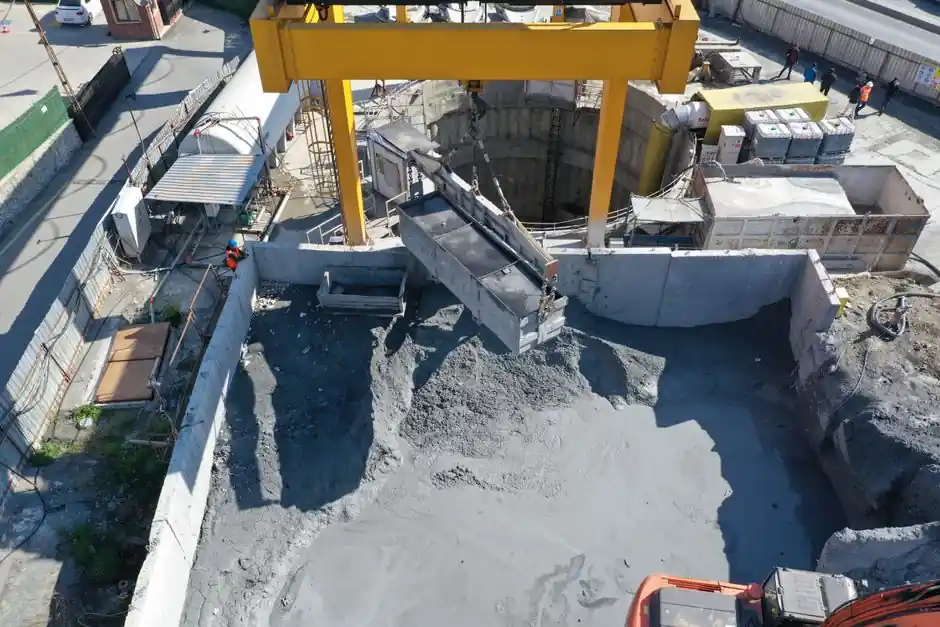
A 2000 ton (20,000 kN) class cold chamber die casting machine lands on the plant floor at roughly 120-180 tonnes, with the heaviest single sub-assembly (platen, shot end, or tie-bar set) commonly in the 30-60 tonne range, and the machine footprint typically spanning 8-12 m in length and 3-5 m in width [S1][S3].
For cell planning, the lift envelope is the binding constraint: the bridge crane (or tandem pair, or portal/gantry) must clear the heaviest single piece with a working safety factor of 1.25-1.5 above the rated load, account for rigging weight, and keep the hook height above the machine's tallest assembly so the unit can be set on its grouted foundation in one or two pieces [S4].
Where the weight number actually comes from
Published specifications show a clear scaling pattern. The DC1300T (1300 ton / 13,000 kN cold chamber platform) is published at approximately 95 tonnes machine weight with 13-36 kg aluminum shot and a 100-140 mm plunger range [S1]. A 400 ton class cold chamber machine, by contrast, sits around 17 tonnes with 22.4 kW connected load [S6].
Shibaura Machine confirms that the cold chamber HPDC envelope now extends from 1350 kN up to 35,000 kN (3500 metric tons) in servo-hydraulic platforms, with a 1500+ machine installed base in North America alone since 1975 [S4]. Haitian Die Casting states its current product range spans 180T through 8000T clamping force, with the 8000T platform supported by a new heavy base currently being ramped [S7].
Scaling linearly from a 1300 ton machine at ~95 tonnes gives ~145 tonnes for a 2000 ton cold chamber machine, but in practice the figure trends higher, 150-180 tonnes, because the platen, tie-bar diameter, shot-end, and accumulator package grow disproportionately at the 20,000 kN tier [S1][S4]. A 2000 ton class cold chamber machine is most commonly described in the same family as the DC1300T platform, which is the canonical reference architecture for large-tonnage cells.
Choosing the right crane configuration
Three configurations dominate the field. A single 200+ tonne bridge crane is the cleanest solution but requires a heavy EOT (electric overhead travelling) crane with reinforced bridge girders, larger end-carriage trucks, and a higher-capacity hoist. A tandem lift using two 100 tonne cranes, with one carrying ~60% of the load and the other ~40% to keep the center of gravity over the platen, is the most common retrofit path in plants that already own 100 tonne EOTs [S4].
For new builds and outdoor staging, a heavy-duty gantry on rails (or a hydraulic gantry system from manufacturers such as Enerpac) handles 200+ tonnes without tying into the building structure, which simplifies permits and avoids the reinforcement cost of an EOT upgrade. For facility context on rigging and site logistics, single girder crane specs for pipeline construction sites gives a useful cross-reference on the kind of rated-load and span math that applies to any heavy industrial lift plan.
The crane decision must be locked before the foundation is poured, not after the machine ships, because the foundation block, embedment depth, and leveling shim stack are all sized from the machine's center-of-gravity and footprint, not just its static weight [S1].
Foundation, rigging, and acceptance criteria
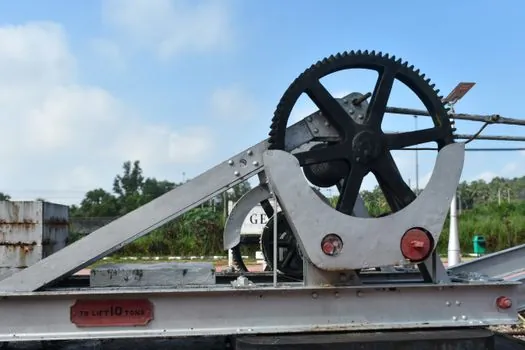
A 2000 ton cold chamber machine carries a 120-180 tonne static load into a foundation block that is typically 1.5-2.5 m deep, reinforced with rebar and isolated from the building slab to keep die-casting vibration out of neighboring metrology or assembly cells. The JB/T 8084.1-2000 standard governs cold chamber machine accuracy and inspection, including platen parallelism, tie-bar load distribution, and shot-end alignment, all of which must be verified on the foundation before the machine is commissioned [S5].
Rigging hardware is the failure mode most often overlooked. Spreader beams must be rated for 1.5x the heaviest single-piece weight, and the sling angle kept above 60 degrees from horizontal to prevent sling tension from exceeding the rigging rated load. D-shackles and master links should be individually traceable with current certificates; a single unmarked shackle in the rigging chain is a documented audit failure in most EPC handovers [S1].
Site acceptance testing typically follows three gates: leveling (machine flat within 0.05 mm/m across the platen), platen parallelism (within the JB/T 8084.1-2000 envelope), and a no-load cycle test (50-100 strokes at low pressure to confirm hydraulic integrity before the first melt). Each gate produces a signed record that the OEM warranty and the installer's liability both depend on, so skipping or speeding the sequence is a downstream risk, not a schedule saving [S5].
Limits of the published numbers
Published tonnage and weight figures are model-class references, not machine-specific values. The DC1300T published 95 tonnes is for the base configuration with standard platen size; adding a larger die-height envelope, an extended tie-bar set, an accumulator-based shot end, or a third-party automation cell changes the shipped weight and the heaviest single-piece lift by 10-25% in either direction [S1].
Second-hand machines complicate the math further. Used listings on the major resale channels show wide weight dispersion even within the same nominal tonnage class, because rebuilds, retrofits, and control upgrades have been applied over decades of service life [S2]. A 1990s-vintage 2000 ton machine purchased used should be re-weighed and re-measured, not assumed to match the original build sheet, especially if the shot end or hydraulic powerpack has been replaced.
For aluminum work the standard 2000 ton cold chamber covers most structural and large-mobility parts; for magnesium the same tonnage gives a wider shot envelope but requires sealed-shot-end and inert cover-gas options that the OEM should list separately, not assume is included in the published platform weight [S1]. Cell planners working with aluminum die casting machine platforms should request the magnesium option delta as a line item before the RFQ is signed.
Standards and sourcing that govern the install
The cold chamber accuracy and inspection regime is anchored in JB/T 8084.1-2000, which is the published reference for platen parallelism, tie-bar load distribution, and shot-end alignment in Chinese-built platforms, and which most global OEMs either adopt directly or mirror in their own acceptance protocols [S5]. Plant-side, the European EN standards for machine safety (the EN 60204-1 and EN ISO 12100 family) apply to the integrated cell including the loader, spray, and trim press, even when the OEM ships the die caster with a CE mark for the machine alone.
Manufacturer-published tonnage tables should be read as a class envelope, not a build sheet. Shibaura publishes its full cold chamber range at 100, 250, 300, 350, 400, 450, 500, 550, 600, 650, 700, 750, 800, 850, 900, 950, 1000, 1500, 2000, 2500, 3000, 3500, and above metric and US tons, with the 2000 ton point sitting in the upper third of the standard catalog [S4]. Haitian's published range of 180T to 8000T places a 2000 ton order firmly in the mid-upper catalog, which shortens lead time but does not eliminate the engineering review [S7].
The signal to track on the next planning cycle: confirm with the OEM in writing whether the 2000 ton platform uses a two-piece or three-piece platen design, because the platen count sets the number of crane picks required for the install and the maximum single-piece weight the crane must clear. That single data point, on a signed project document, drives the foundation, the crane, and the rigging budget more than any other line in the RFQ [S1][S4].
Component reference pages worth checking: die casting machine.