
K-grade is a filament count, not a quality grade: 3K holds 3,000 filaments per tow, 12K holds 12,000, and 24K holds 24,000, with each filament typically 5–8 micrometers in diameter [S3]. The decision between 3K, 12K, and 24K is a procurement and layup decision driven by surface finish, drapability, fabric weight, and cost per kilogram, not by fiber modulus [S2].
Specifying the wrong K-grade affects weight, surface quality, manufacturing throughput, and unit cost on every part, so the trade-off needs to be evaluated before the fabric is ordered, not after the mold is tooled [S2].
What the K Number Actually Means
A carbon fiber tow is a bundle of continuous carbon filaments, and the number before the K indicates how many thousands of filaments are bundled together; 3K = 3,000, 12K = 12,000, 24K = 24,000 [S1][S3]. K grade and modulus grade are independent classifications: a 3K tow and a 12K tow can carry identical standard-modulus, intermediate-modulus, or high-modulus fiber, with all mechanical properties of the cured laminate held equal at the same fiber volume fraction [S2].
What changes with K grade is tow width, areal weight per ply, weave pattern resolution, and how the fabric handles curves during layup, and that is the entire scope of the decision [S1][S6]. For buyers comparing composite reinforcement to metallic stock, the same logic of matching carbon fiber areal weight to part geometry applies: the reinforcement has to conform to the load path and the mold, not just meet a strength number.
Side-by-Side Comparison: 3K, 12K, 24K
Across the three most common K grades, the practical envelope diverges sharply. A 3K woven fabric typically lands at 198–240 g/m² areal weight, a 12K fabric at 400–600 g/m², and a 24K fabric at 600–800+ g/m², so a single ply of 12K or 24K replaces roughly two to four plies of 3K for the same thickness [S1][S3].
On the cost axis, 12K tows are about four times more efficient to produce per unit weight than 3K tows, which translates to lower filament separation cost and lower per-kg fabric price; 24K extends that economy further but at the expense of surface texture and drapability [S4]. On the surface axis, 3K gives a tight, classic twill weave that reads as the standard "carbon fiber look", 12K shows a visibly coarser pattern about four times larger than 3K in the same weave, and 24K produces an industrial, coarse texture that is rarely specified for visible cosmetic surfaces [S2][S3]. On the mechanical axis, 3K shows higher elongation at break and higher ultimate tensile strength than 6K, 9K, or 12K in equivalent weaves, while stiffness and cured-laminate strength for the same fiber type and volume fraction remain effectively independent of tow size [S3].
3K: The Workhorse for Curved, Cosmetic, and Precision Parts
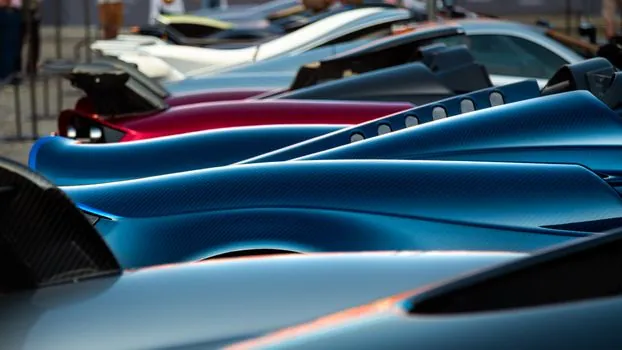
3K is the most widely specified carbon fiber grade in composite manufacturing, used for UAV frames, bicycle frames and forks, automotive body panels, RC aircraft components, and sports equipment [S2]. The 198–240 g/m² fabric weight lets builders stack thin plies to tune thickness, and the fine weave drapes cleanly into compound curves without the wrinkling that larger tows produce on tight radii [S1][S3].
Use 3K when the part has visible cosmetic surfaces, tight radii, or features that demand CNC machining at cut edges without delamination; the smaller tow bundle keeps edge quality clean [S2]. 3K is also the right pick for thin-laminate drone and bicycle parts where stiffness-to-weight at low thickness matters more than per-kg cost [S2]. The trade-off is moderate-to-high unit cost and slower area coverage during manual layup, so 3K is rarely the right answer for thick structural laminates or infrastructure work.
12K: The Industrial Mainstay for Structural and High-Volume Layups
12K is the workhorse grade for industrial, automotive, and high-stress structural parts, including military hardware, industrial robotics, scientific equipment, wind turbine blade components, and marine structures [S1][S2][S3]. At 400–600 g/m² per ply, a builder often needs only one layer where 3K would need three to hit the same thickness, which cuts layup time and labor cost on thick laminates [S1][S3].
12K is also the right call when the build program values throughput over surface finesse: it weaves faster, costs less per kilogram, and lays down material quickly, so it dominates production runs where the part will be painted, buried in a mold, or otherwise hidden [S1][S4]. On the same modulus fiber, 12K and 3K deliver the same cured stiffness and strength at the same fiber volume fraction; the difference is purely in tow size, ply thickness, and cost [S3]. For high-stress localized zones, 12K is frequently used in critical areas like bottom-bracket zones, head-tube zones, and chainstays in bicycle frames, often paired with 3K or unidirectional plies elsewhere in the laminate [S3].
24K and Above: Infrastructure, Wind, and Civil Reinforcement

24K tows at 600–800+ g/m² per ply and 48K+ tows above 800 g/m² are specified for bridges, wind turbine blades, precast concrete panels, structural retrofits, and other large-surface civil and infrastructure applications where material volume and cost per kilogram dominate every other variable [S1][S2]. At this scale, 24K weaves deposit the most material per tow and are the most economical to produce, but the resulting fabric is heavy, coarse-textured, and lacks the drapability needed for tight cosmetic surfaces [S4].
Use 24K or larger only when the part is large, the surface will not be visible, and the laminate thickness justifies the coarser weave; for anything in the consumer, automotive interior, or sporting-goods space, 24K is the wrong call [S1][S2]. Procurement teams should also note that 24K and 48K fabrics are typically sold as unidirectional or heavy twill reinforcement, not as cosmetic twill, so the visual signature of "carbon fiber" is effectively absent.
Selection Rules and Decision Matrix
The selection logic collapses to four criteria: surface finish, drapability, ply thickness per layer, and cost per kilogram. Score each candidate part on those four axes before ordering fabric. [S1]
For visible cosmetic parts with compound curves, such as dashboards, hoods, mirror caps, interior panels, phone cases, and premium sporting goods, specify 1K or 3K and accept the higher unit cost; 3K is the practical default [S1][S2]. For functional structural parts such as brackets, automotive chassis components, mechanical reinforcement ribs, and mid-range sporting goods, specify 6K or 12K, with 12K favored when build volume and layup time matter [S1]. For thick structural laminates, high-stress localized zones, and any painted or buried ply stack, specify 12K as the baseline and consider hybrid stacks with 3K or unidirectional plies where surface or directional stiffness demands it [S3]. For bridges, wind turbine blades, and other infrastructure-scale reinforcement where surface appearance is irrelevant, specify 24K or 48K to minimize cost per kilogram of material placed [S1][S2]. When in doubt, hybridize: a high-stress section of the part can use 6K or 12K tows while a flexible or cosmetic area uses 1K or 3K, optimizing performance and cost across a single laminate [S1].
Limits, Failure Modes, and Common Mis-Specifications
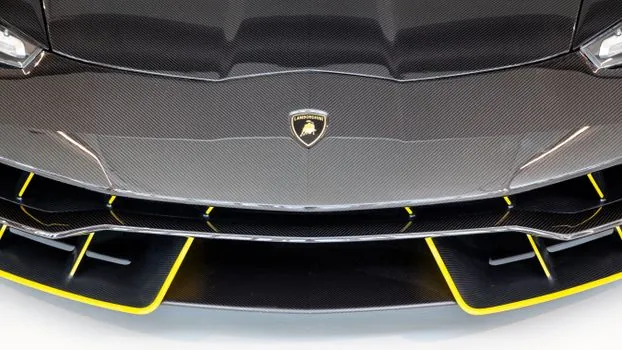
Larger tows are stiffer in fabric form and conform less to tight radii, so forcing 12K or 24K onto a compound curve produces wrinkles and resin-rich voids that drop in-service strength [S1]. The risk of voids during cure rises with tow size because the larger bundle traps air more easily; 3K and 6K weaves wet out more predictably in hand layup and vacuum bagging [S1]. K grade is not a quality or strength rating, so a 12K fabric on a standard-modulus fiber is not "stronger" than a 3K fabric on the same fiber; the laminate's cured strength and stiffness are governed by fiber modulus, fiber volume fraction, and ply orientation, not by how many filaments share a tow [S2][S3]. Finally, for high-temperature or corrosive service where carbon fiber reinforcement is paired with metallic hardware, the same carbon steel and aluminum alloy fastener rules apply at the joint, independent of K-grade choice.
Track these signals on the next quoting cycle: ask the fabric supplier for the exact tow size in writing, confirm areal weight in g/m² rather than relying on "3K" or "12K" alone, and verify modulus grade (standard, intermediate, high) separately from K grade to lock the spec.