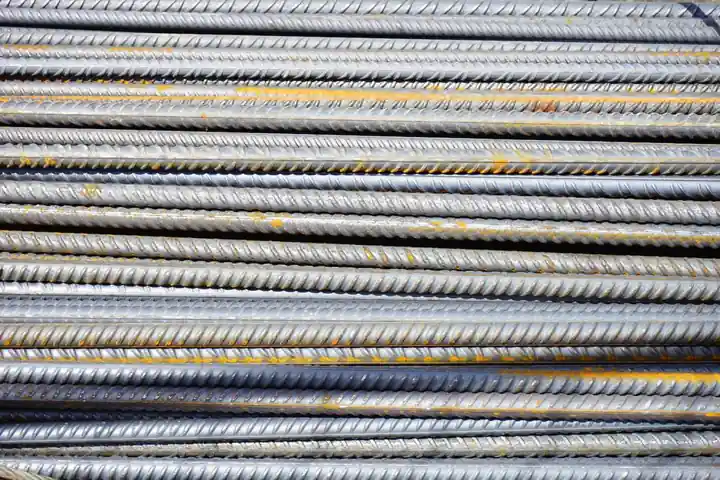
42CrMo4 is the stronger choice for quenched-and-tempered rings, reaching approximately 800–1300 MPa tensile strength and 280–320 HBW after heat treatment [S1].
The comparison covers 42CrMo4, EN material 1.7225, against 50Mn, a non-alloy manganese steel, for shaft rings, collars, spacers, and related high-load mechanical parts.
42CrMo4 and 50Mn: the material distinction
42CrMo4 is a chromium-molybdenum alloy steel classified under EN ISO 683-2:2018, with material number 1.7225 and approximate equivalence to AISI/SAE 4140 [S1]. Its specified chemistry includes 0.38–0.45% carbon, 0.90–1.20% chromium, and 0.15–0.30% molybdenum [S1].
50Mn is a non-alloy carbon-manganese steel, so its strength comes primarily from carbon content and heat treatment rather than the alloying contribution of chromium and molybdenum. A grade-name comparison is not enough for ring procurement: delivery condition, section diameter, heat-treatment route, and inspection requirements must be checked on the drawing and purchase specification.
42CrMo4 is intended for components subjected to fatigue and torsion, including drive shafts, gears, pins, and connecting rods [S1]. It is not automatically the correct choice for every ring. A low-stress, non-critical ring may be over-specified in 42CrMo4, while 50Mn can be more economical where its load capacity and toughness are adequate.
Strength and hardness after quenching and tempering
Quenched-and-tempered 42CrMo4 has a section-dependent tensile-strength range of approximately 800–1300 MPa and typical hardness of 280–320 HBW [S1]. For bars up to 16 mm diameter, the quoted properties are 1100–1300 MPa tensile strength, at least 900 MPa yield strength, and at least 10% elongation [S1].
As section size increases, the 42CrMo4 property bands fall: 16–40 mm bars have 1000–1200 MPa tensile strength, 40–100 mm bars have 900–1100 MPa, and 100–160 mm bars have 800–950 MPa [S1]. Yield strength correspondingly decreases from about 900 MPa in small sections to about 550 MPa at 100–160 mm diameter [S1].
Ovako reports that 42CrMo4 can be through-hardened after oil quenching up to 60 mm bar diameter; in larger dimensions, the microstructure is not fully martensitic [S2]. That dimensional limit is a process constraint, not a universal maximum. A ring supplier must confirm the actual quench medium, section, tempering cycle, core hardness, and surface condition.
For a ring made from 50Mn, the comparable QT data must come from the governing material standard or supplier certification. The available research does not provide a 50Mn QT strength, hardness, or hardenability band, so substituting one for the other without those values would be technically unsound.
Decision criteria for ring selection

On load capacity, 42CrMo4 offers a documented advantage: quenched-and-tempered tensile strength reaches 1300 MPa in sections up to 16 mm, while yield strength is at least 900 MPa [S1]. 50Mn has no equivalent QT values in the supplied research, so the selection must be based on its own certified properties rather than a general assumption that it is suitable.
On hardenability, the 0.90–1.20% chromium and 0.15–0.30% molybdenum in 42CrMo4 support greater through-hardening capability than a plain carbon-manganese grade such as 50Mn [S1]. Ovako identifies 60 mm as the through-hardening limit for oil-quenched 42CrMo4 bar, with partial martensite in larger sections [S2].
On wear and surface hardening, 42CrMo4 can be induction hardened, with surface hardness specified as greater than 53 HRC [S2]. The same source states that induction hardening is applicable, while the available 50Mn data does not establish equivalent surface-hardening performance.
On toughness and fatigue, 42CrMo4 is specifically described as a quenching-and-tempering steel with a good combination of strength and toughness [S2]. For dimensions above 16 mm, the quoted minimum Charpy impact energy is 35 J through the 100–160 mm band [S1]. 50Mn can be selected where its certified toughness and fatigue requirements are sufficient, but the supplied research does not establish a like-for-like QT impact comparison.
On cost and processing, 50Mn is generally the simpler material route because it contains no chromium or molybdenum, but that is a purchasing and processing consideration rather than a strength specification. 42CrMo4 is available in annealed, hot-rolled, and quenched-and-tempered conditions, and it can be supplied with controlled inclusions or improved machinability for defined production needs [S1][S2].
Which grade fits which ring application?
Specify 42CrMo4 for a shaft ring, spacer, collar, or retaining element that carries substantial bending, torsion, impact, or fatigue loading, especially when section hardening and consistent QT properties are required. Its 800–1300 MPa tensile-strength range, 280–320 HBW typical hardness, and 35 J minimum impact energy for the listed 16–160 mm size classes provide a defensible basis for that selection [S1].
Use 50Mn for a simpler ring with modest loads, generous section allowance, limited fatigue demand, and no requirement for alloy-steel surface hardening. The decision must be supported by the applicable 50Mn product standard and the supplier’s certified QT properties, including tensile strength, yield strength, elongation, hardness, and section size.
42CrMo4 is not for non-critical parts where extra alloy content and heat-treatment controls add cost without a measurable load benefit. Likewise, 50Mn is not for a heavily loaded ring whose design requires the documented strength, hardenability, or fatigue margin of 42CrMo4.
For a shaft-mounted spacer, a shaft collar can use either grade if the specified loads and tolerances are met. For a locking element where axial retention is central, the material decision should be coordinated with the locking assembly, not made from hardness alone.
Failure modes, dimensions, and procurement checks
The most common selection error is treating the grade designation as a complete material specification. 42CrMo4 strength depends on diameter, with quoted tensile strength dropping from a maximum of 1300 MPa at 16 mm or less to 950 MPa at 100–160 mm [S1]. A small-section coupon result cannot be assumed to represent the full section of a large ring.
A second error is confusing surface hardness with through-hardened properties. Induction hardening can exceed 53 HRC at the surface of 42CrMo4, but that does not guarantee the same hardness through the core [S2]. The procurement document should distinguish surface induction hardening from a full-section quenched-and-tempered condition.
A third error is accepting an equivalent designation without comparing requirements. AISI 4140, SAE 4140, JIS SCM440, and EN 42CrMo4 have related chemistry, but different standards can set different composition limits, mechanical requirements, product forms, and test conditions [S3]. A close equivalent is therefore not automatically a drop-in substitute.
For procurement, specify the governing standard, grade, material number where applicable, product form, diameter or section range, delivery condition, heat-treatment cycle, tensile and yield requirements, hardness limits, impact requirements, surface condition, and inspection documentation. For 42CrMo4, request verification against the relevant dimensional class rather than a single generic 800–1300 MPa description [S1].
Heat treatment and inspection criteria
42CrMo4 must be specified in the quenched-and-tempered condition for the high-strength ring comparison, and the material can also be supplied annealed or hot-rolled for later processing [S1]. The 42CrMo4 designation alone does not establish that a delivered ring has received the required cycle, so certification of heat treatment is part of material acceptance.
Section size remains the main variable in the QT result. EN ISO 683-2:2018 properties cited for 42CrMo4 include minimum yield strength of 900 MPa at 16 mm or less, 750 MPa above 16–40 mm, 650 MPa above 40–100 mm, and 550 MPa above 100–160 mm [S1]. These are dimensional-class limits, not a substitute for the actual drawing tolerance and design stress.
Inspection should match the component function. Use tensile and yield testing for load resistance, hardness surveys for heat-treatment verification, impact testing where toughness is required, and dimensional inspection for ring fit. Where the ring depends on a retaining feature, the groove or axial-retention geometry must be assessed separately from the steel grade, as discussed in retaining ring selection for steel mills.
The practical decision is straightforward: specify 42CrMo4 for high-load, fatigue-sensitive, hardenable rings where its 800–1300 MPa QT strength and chromium-molybdenum hardenability are justified; specify 50Mn only when the ring's section, loads, fatigue life, and certified QT properties support that lower-alloy route.