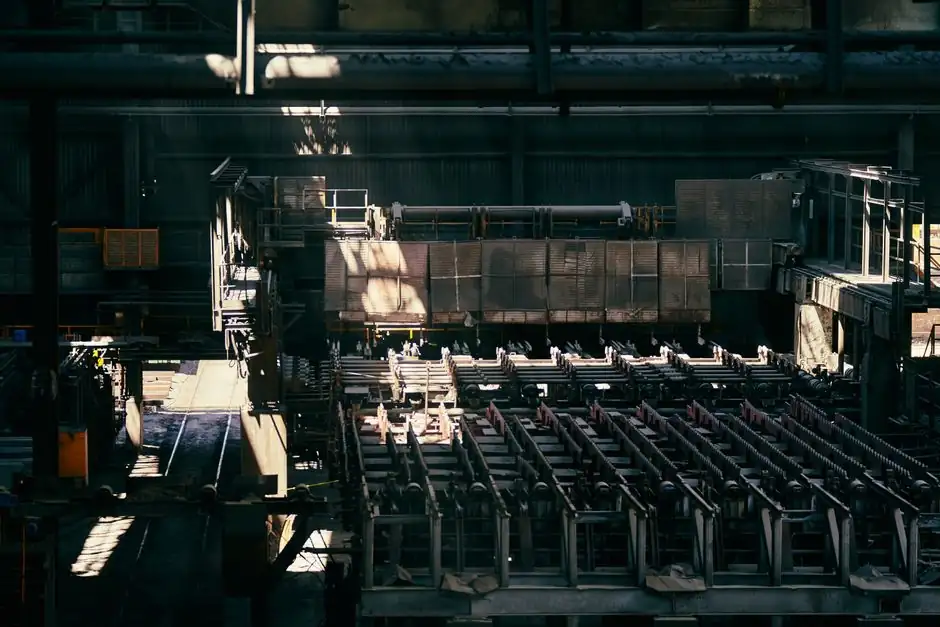
Steel-mill service is one of the harshest retaining-ring environments: continuous exposure to water, rolling-mill scale, hydraulic oil, and cyclic impact on drives, plus ambient temperatures that routinely reach 150-200 deg C near stands and 250-300 deg C at coiler/reheat interfaces. Standard carbon spring steel in the SAE 1060-1090 range remains the default for cost-driven applications [S7], while 302 and 316 stainless covers wet, acidic, and high-temperature zones [S1].
The selection flow for a mill engineer starts with three decisions: internal (housing) vs external (shaft) fit, ring family (tapered section, constant section snap, spiral, or self-locking), and material/finish. Standard sizes from major suppliers cover 0.040 in. to 47 in. (1 mm to 1200 mm) diameters [S2], and a typical housing ring such as the WH-100 in the ASME/Smalley catalog sits in a 1.043 in. groove with 0.042 in. groove width for a 1 in. bore [S3].
Ring Family Comparison for Mill Service
Constant section (snap) rings are the general-purpose default and the most widely used style, offering uniform cross-section and three-point groove contact in tight radial envelopes [S2][S3]. Tapered-section circlips (DIN 6799 / Truarc family) use a tapered section that stays round under expansion or contraction, supporting higher thrust loads in the same groove envelope [S5]. Spiral retaining rings (Spirolox and equivalents) provide 360 deg groove contact, a uniform cross-section, and "No Ears to Interfere" with adjacent components, making them well suited where adjacent bearings or seals are close to the groove [S3].
For mill drives, the practical comparison lines up as: constant section snap ring = lowest cost, moderate thrust, easy with stamped rings; tapered section circlip = moderate cost, higher thrust, requires lug pliers; spiral / Spirolox = higher cost per ring, highest uniform thrust, hand-installable, no special removal tools [S3][S5]. Self-locking grip rings and push-on rings require no groove and tolerate low thrust, useful for guard panels, sensor mounts, and idler covers rather than drive shafts [S2][S5].
Material and Finish for Heat, Scale, and Coolant
Carbon spring steel (SAE 1060-1090) is the most widely used retaining-ring material, offering the right combination of hardness, elasticity, and cost for the bulk of mill applications, with heat treatment to roughly 44-52 HRC typical of stamped snap rings [S7]. When the location is wet, acidic (pickle-line splash, acid regeneration), or runs hot, 302 stainless covers general corrosion at higher cost, and 316 stainless is specified where chlorides and acidic condensate are present [S1]. Spirolox rings in carbon steel, 302 stainless, and 316 stainless are all standard catalog items, with special alloys available on custom runs [S1][S3].
Finishes matter: a phosphate or oil finish on carbon steel is the stock offering for general mill use; for hot zones above ~200 deg C, beryllium copper, Inconel, or other high-temperature alloys are the practical path because standard carbon steel begins to lose tempered hardness as service temperature approaches 180-200 deg C. Galvanic compatibility is also worth checking: a 316 stainless ring in a carbon-steel shaft groove is fine, but pairing an active zinc-plated ring against a stainless shaft in a coolant-wet pocket will pit the plating quickly.
Thrust Load, Groove Geometry, and the Edge Margin
Retaining rings most often fail by deflection, not by shear, so groove geometry and edge margin drive real capacity more than the ring's own tensile strength [S4]. Both groove walls must be parallel and perpendicular to the shaft axis, groove depth must be held to spec because depth plus groove-bottom radii set the support the load-bearing wall can give, and the distance from groove to the end of the shaft (the edge margin) is engineered to resist shear at maximum load [S4].
On the retained-part side, sharp corners on the part give the best ring contact and the best load support; a chamfer or radius on the retained part reduces the effective thrust capacity because contact moves outward and the lever arm on the loaded groove wall grows [S4]. If the retained part must have a chamfer, or if loads are heavy, a reinforced / heavy-duty ring (greater section height and lug thickness) is the next step before re-machining the shaft. Reinforced E-rings also grip the groove bottom with 3-5 times the radial force of a standard E-ring and resist high-vibration, high-RPM, cyclic loading better [S4].
Where Each Ring Fits in a Mill
For conveyor idlers, table rolls, and entry/exit bridle rolls, external constant-section snap rings on a shaft groove are the workhorse solution: low cost, easy field replacement, adequate thrust for the radial and modest axial loads on these shafts. For coiler mandrels, pinch rolls, and tension reel drive shafts where thrust loads are high and adjacent bearing geometry is tight, multi-turn spiral or Spirolox rings give 360 deg contact without a lug protruding into the bearing area, and they remain groove-interchangeable with most stamped snap rings, which simplifies MRO spares [S3].
For roll-balance cylinders, hydraulic actuator ends, and valve stems exposed to coolant and emulsions, 302 or 316 stainless with a smooth-ground finish is the spec; for pickle-line and acid-regeneration areas, 316 stainless is non-negotiable. Self-locking push-on or grip rings suit low-thrust locations such as encoder mounts, tachometer brackets, and sheet-strip guide hardware where machining a groove is impractical. The same heat/vibration/reinforced-ring logic also appears in adjacent process industries, e.g. mining conveyor pulleys face similar dust, vibration, and shock trade-offs, and a comparison of mining retaining-ring selection is a useful parallel reference.
Common Selection Mistakes in Steel Mills
Three errors show up repeatedly. First, specifying a standard carbon-steel constant section ring for a coiler or hot-runout table location: the ambient temperature plus radiant heat drops hardness into the low end of the tempered range, and the ring will deflect under load within a season. Specify high-temperature alloy or move the groove outward into a cooler shaft section. Second, accepting a chamfered or radiused retained part because it is easier to machine, then using a basic-section ring: the chamfer shifts contact outward and reduces effective thrust capacity noticeably, so either sharpen the part corner or move to a reinforced/heavy-duty ring [S4].
Third, mixing ring families in a single assembly that all share the same groove. A spiral ring and a stamped snap ring of the same dash size are usually groove-interchangeable, but the radial envelope and clearance to adjacent components differ, and lugs on a circlip can interfere with a seal or bearing that a spiral ring would clear. Confirm both the groove dimensions and the radial envelope, not just the dash number, before issuing a substitution on a maintenance work order.
Standards, Sourcing, and Spec Discipline
Retaining rings themselves are not heavily standardized the way flanges or bolting are, but the most common references are DIN 6799 (E-clips / retaining washers), DIN 471/472 (external / internal circlips), and the Waldes Truarc dash-number system carried forward by Rotor Clip and Smalley [S2][S5]. Material property citations trace back to SAE J403 for the carbon-steel grades (1060-1090) used in spring-tempered rings and to ASTM A313 / A580 for the 302 and 316 stainless wire used in coiled rings [S7]. Spec sheets from Smalley, Rotor Clip, Daemar, Huyett, Lawson, and Seeger-Orbis all use these material callouts and will certify to them on request [S1][S2][S4][S5][S6][S8].
For purchasing, the practical baseline for a steel-mill storeroom is: external and internal constant-section snap rings in carbon steel (SAE 1060-1090), phosphate and oil finish, 0.040 in. to 10 in. shaft / bore; spiral / Spirolox equivalents in carbon steel, 302, and 316 stainless at the same size range for the higher-load and corrosion-zone replacements; plus a small stock of 316 stainless push-on rings for sensor and guard hardware. Custom diameters beyond 16 in. (400 mm) are available from Smalley for furnace and coiler rolls where standard sizes do not fit [S3]. Spare-part standardization around a single dash-number system per groove family will cut MRO mistakes and keep the storeroom manageable.
Trackable signals for the next planning cycle: confirm 316 stainless pricing for pickle-line and acid-regeneration spares against current mill shutdown schedules, audit reinforced/heavy-duty ring usage on coiler mandels and tension reel drives where deflection failures have been logged, and verify that 302/316 stainless spiral rings are stocked for the high-temperature zones identified in the last hot-mill audit. For more on fastener and ring logic in heavy industry, the retaining ring encyclopedia entry covers the full taxonomy of types, materials, and groove geometry.