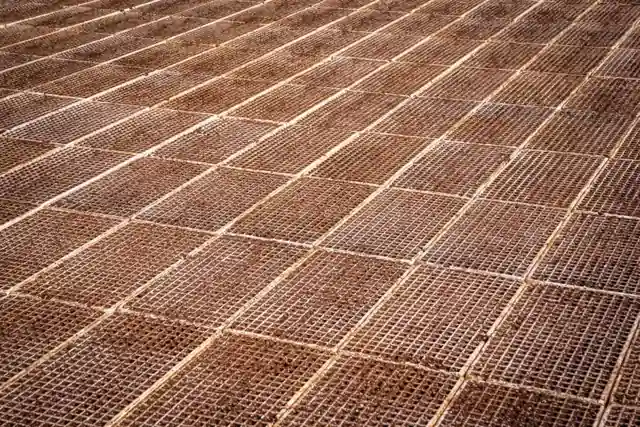
For ASTM A1064 welded wire reinforcement (WWR) on a 6x6 inch grid, the W1.4xW1.4 style carries 0.014 sq in of steel per wire at 0.21 lb/sqft, while the W2.9xW2.9 style carries 0.029 sq in per wire at 0.42 lb/sqft, exactly double both metrics [S2].
The choice between the two governs steel cross-section per foot of width, sheet weight, placing cost, and crack-width control for residential and light-commercial slabs; both are commonly stocked in rolls and sheets, with the W2.9 also the default sheet item in most U.S. distributor catalogs [S1][S4].
Reading the Style Code: W1.4 vs W2.9 Decoded
The "W" prefix denotes plain (smooth) wire and the number is the cross-sectional area in hundredths of a square inch, so W1.4 equals 0.014 sq in and W2.9 equals 0.029 sq in [S2][S4]. The first two numbers, "6x6", are the longitudinal and transverse wire spacing in inches, not wire diameter, which trips up a lot of new specifiers [S4]. A 6x6 W1.4xW1.4 sheet was historically called "6x6-10x10" in the obsolete gauge system because the smooth wire was about 10 gauge (roughly 0.135 in diameter), and 6x6 W2.9xW2.9 was formerly "6x6-6x6" at about 6 gauge (roughly 0.192 in diameter) [S4]. Specifiers moving to deformed wire will see the same numerical sizes prefixed with "D" (e.g., D2.9) at the same 0.029 sq in steel area, gaining mechanical bond at the cost of slightly higher unit price [S4].
Weight, Steel Area, and Sheet Math
Per the WRI/ASTM A1064 published weight table, 6x6 W1.4xW1.4 weighs 0.21 lb/sqft (1.03 kg/sqm) and 6x6 W2.9xW2.9 weighs 0.42 lb/sqft (2.05 kg/sqm), a clean 2.0x multiplier that matches the 2.0x multiplier in steel area (0.014 vs 0.029 sq in per wire) [S2]. On a standard 5 ft x 10 ft sheet, that translates to 10.5 lb versus 21 lb per sheet, which feeds directly into labor and freight cost per square yard of slab [S2]. A 6x6 W2.0xW2.0 (0.020 sq in, 0.30 lb/sqft) sits roughly midway between the two and is the usual upgrade step when W1.4 is under-spec but W2.9 is over-budget [S1][S2]. Going to a 4x4 grid at the same wire size roughly doubles wire count per square foot: 4x4 W1.4xW1.4 is 0.31 lb/sqft versus 6x6 W1.4xW1.4 at 0.21 lb/sqft, a useful trade when tighter crack-width control matters more than per-pound cost [S2].
Application Cutoff: Where Each Style Belongs
Per Wire Reinforcement Institute guidance, 6x6 W1.4xW1.4 and 6x6 W2.9xW2.9 are the two styles that "cover virtually all of the residential and light construction" use cases for slab-on-ground reinforcement [S5]. W1.4xW1.4 is the default for 4 inch residential slabs, patios, sidewalks, and shed floors where the principal loading is pedestrian and the cracking driver is shrinkage and temperature movement [S1][S5]. W2.9xW2.9 is the default for driveways rated for passenger vehicles, light commercial floors, garage slabs, and any 5 to 6 inch slab where higher flexural demand and aggregate interlock justify roughly double the steel area [S1][S4][S5]. WRI also emphasizes that WWR only performs when placed in the middle third of the slab thickness; W1.4xW1.4 "left on the subgrade" loses most of its crack-control function, regardless of style [S5].
Crack Control Logic and Aggregate Interlock
WWR's primary job in a slab is to keep crack widths below the threshold where aggregate interlock stops working, which WRI cites as 1/16 inch (0.06 in) for typical residential and light construction slabs [S5]. More steel area per wire and tighter spacing both reduce average crack width, so 6x6 W2.9xW2.9 holds cracks tighter than 6x6 W1.4xW1.4 under the same concrete and curing conditions [S5]. WRI Tech Fact 208-R-21 notes that modern WWR can be specified at yield strengths above 75,000 psi with ductility matching or exceeding Grade 60 rebar, meaning the steel area difference is doing real structural work, not just adding dead weight [S3]. The 0.015 sq in per-wire step between W1.4 and W2.9 is large enough to shift a slab from borderline to clearly code-compliant on many residential driveway and patio specs that call out minimum steel area per foot of width.
Cost, Labor, and Placing Trade-Offs

WRI positions WWR generally as having "significantly lower placing and overall costs" than rebar for equivalent reinforcement area, which is the main reason both W1.4xW1.4 and W2.9xW2.9 are common on jobs where labor, not material, drives the bid [S3]. The 0.21 lb/sqft versus 0.42 lb/sqft weight spread also shows up on the placing crew: 1000 sqft of W1.4xW1.4 is 210 lb total, while the same area in W2.9xW2.9 is 420 lb, still a one-person carry either way, so the labor delta is mostly handling and overlap support rather than crane time [S2]. Material cost roughly tracks the weight ratio, but W1.4xW1.4 is the higher-volume commodity SKU and typically carries the smallest price premium per square foot, while W2.9xW2.9 is a stock item in both rolls and sheets and rarely requires mill order at U.S. distributors [S1][S4]. For related structural choices in steel framing, see this comparison of hot-rolled vs welded built-up sections which uses a similar criteria-matrix logic.
Selection Matrix: W1.4xW1.4 vs W2.9xW2.9 vs W4.0xW4.0
For 6x6 grid WWR per ASTM A1064, the three practical residential and light-commercial options line up as: W1.4xW1.4 (0.014 sq in, 0.21 lb/sqft, ~10 gauge, light-duty slabs and patios), W2.9xW2.9 (0.029 sq in, 0.42 lb/sqft, ~6 gauge, driveways and light commercial floors, also the default sheet SKU), and W4.0xW4.0 (0.040 sq in, 0.58 lb/sqft, ~4 gauge, heavy-duty slabs and applications approaching structural reinforcement) [S2][S4]. A 4x4 W2.9xW2.9 (0.029 sq in wire, 0.62 lb/sqft) is the natural step up when crack-width control matters more than material cost, since it keeps the same per-wire steel area but roughly doubles the number of wires crossing any given crack plane [S2]. Specifiers should pick by (a) slab thickness and loading class, (b) target crack-width tolerance, and (c) whether the spec calls for smooth (W) or deformed (D) wire, since deformed wire at the same numerical size delivers better bond without changing area [S4].
Limits, Misuses, and Common Spec Errors
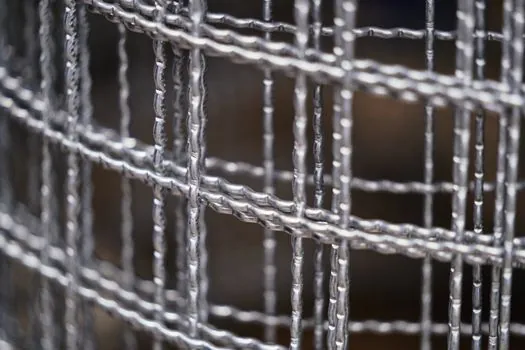
W1.4xW1.4 is not a structural reinforcement; it is crack-control steel, and ACI 318 and WRI both limit its use to temperature and shrinkage reinforcement in slabs-on-ground, not to resist calculated flexural moments [S3][S5]. Specifying W2.9xW2.9 in lieu of rebar mat for a true structural slab requires an engineered evaluation of yield strength, development length, and splice details, and WRI explicitly cautions that WWR's "structural application" growth relies on proper specification against ACI and AASHTO equivalents [S3]. WWR buried in the subgrade does "little value" regardless of style, so the middle-third placement rule has to be enforced on site, not just on the structural drawing [S5]. For welded wire sizes larger than the common residential styles (above W4.0 or wire diameters over 1/2 inch), mill lead times extend and the unit price premium is no longer nominal, so engineers tend to switch to rebar or headed shear studs at that point [S1][S3].
Track two signals for the next 6 to 12 months: any ASTM A1064 revision that changes the W-number cross-section table or the weld-shear test methodology, and any distributor stocking shift that moves 6x6 W2.9xW2.9 out of standard sheet inventory into mill order, since W1.4xW1.4 vs W2.9xW2.9 is fundamentally a stock-item-vs-stock-item comparison and lead time will swing bids before price does [S1][S2][S3].