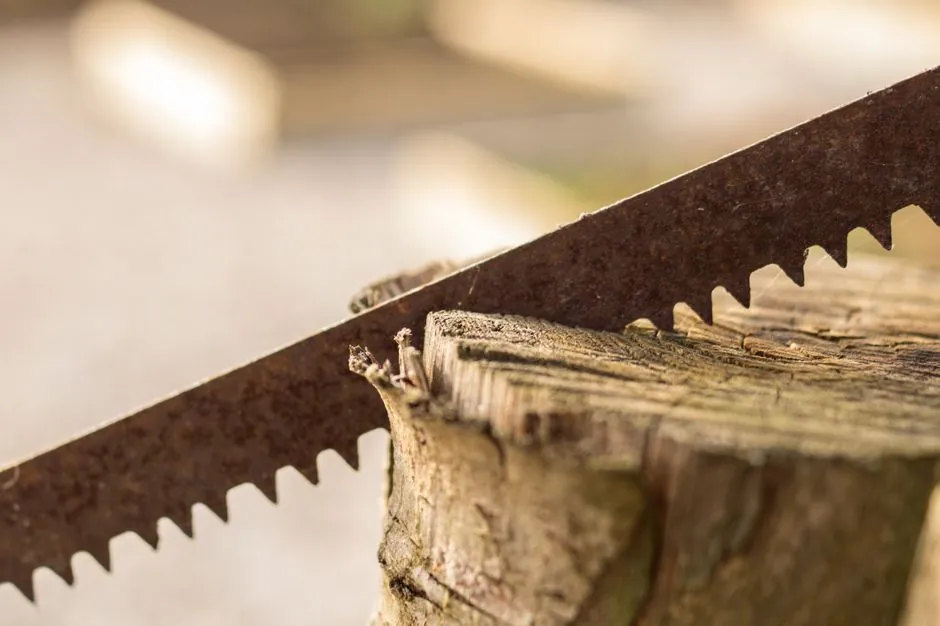
An 8-1/4-inch circular saw blade provides roughly 3 inches of cutting depth, about 5/8 inch more than a 7-1/4-inch blade at its nominal maximum.
The larger diameter suits deeper cuts in thick lumber and timber, but the saw, arbor, blade, and maximum depth setting must all be checked before making the change.
Cutting Depth and Diameter Compared
The published depth data place a 7-1/4-inch blade at about 2-1/2 inches, 2-3/8 inches, or 2-1/2 inches depending on the equipment and source, while an 8-1/4-inch blade reaches about 2-3/4 inches to 3 inches [S1][S2][S4].
One saw-size guide converts 7-1/4 inches to 184 mm and 8-1/4 inches to 210 mm. It lists maximum depths of about 65 mm and 76 mm, respectively, and gives a general rule of thumb that cutting depth is approximately one-third of blade diameter [S4].
That ratio is a sizing guide, not a compatibility rule. Maximum depth also depends on the saw housing, baseplate, depth-adjustment mechanism, blade geometry, and manufacturer limits. The saw manual controls where the cut stops, and fitting a larger blade to a smaller saw can expose the blade or prevent proper operation.
Which Diameter Fits the Work
A 7-1/4-inch blade is the standard handheld circular-saw size, while 6-1/2-inch blades are common on cordless saws and 10-inch or larger blades are associated more often with table and miter saws [S3]. The practical distinction is capacity: 7-1/4-inch equipment is commonly selected for standard framing lumber, and 8-1/4-inch equipment adds useful capacity for thicker stock [S1].
Choose 7-1/4 inches for portable work where the stock is within about 2-1/2 inches and a 5/8-inch arbor is required. Choose 8-1/4 inches when the cut must approach 3 inches, when stock is thicker than the 7-1/4-inch saw can pass through, or when a dedicated saw platform offers suitable depth and stability.
For frame carpentry, the 7-1/4-inch saw is the lighter, more conventional choice. For heavy timber, laminated components, and cuts near 3 inches, the 8-1/4-inch saw offers the stronger fit, provided its power, baseplate, and guard are designed for that load. The choice should follow material dimensions rather than blade diameter alone.
Compatibility, Arbor, and Depth Limits
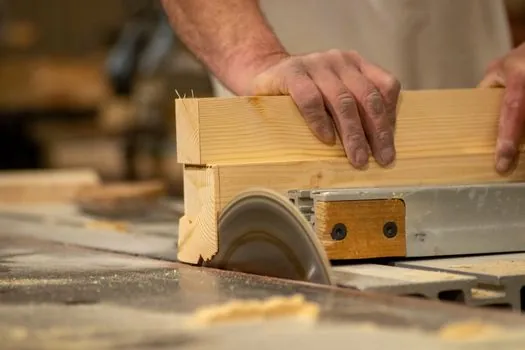
Diameter and arbor must both match. Most handheld circular saws use a 5/8-inch arbor, while larger table-saw applications may use a 1-inch arbor [S3][S4]. An adapter is not a substitute for checking the saw manufacturer’s permitted blade range, maximum RPM, and maximum cutting depth.
Do not assume that a 7-1/4-inch saw can accept an 8-1/4-inch blade. A timber-framing discussion specifically notes that a 7-1/4-inch saw was limited to about 2-3/8 inches without modification and warns against fitting the larger blade [S2]. Such a conversion is not a normal interchange and may create a hazard if the blade projects beyond the guard or baseplate.
For correct setup, set the blade so the teeth extend only about 1/4 inch below the material, as recommended in the blade-sizing guide [S4]. This minimizes the depth of cut and reduces the load imposed on the motor, blade, and work piece.
Blade Construction and Cut Quality
Tooth count changes the operating result. A 24-tooth flat-top-grind blade is intended for fast rips through framing lumber, a 40-tooth combination blade balances general-purpose cutting, and a 60-tooth blade favors cleaner plywood, cabinet, and trim work [S3]. A 40-tooth blade is a practical general-purpose choice, while 60-tooth or 80-tooth blades reduce tear-out in sheet material.
Carbide-tipped teeth provide a balance of edge retention and durability for routine wood and composite cutting, while high-speed steel is better suited to light, intermittent work [S3]. Kerf also affects tool loading: a thin kerf below 1/8 inch reduces resistance, while a full kerf of about 1/8 inch favors stability in high-power tools and thicker material [S3].
An 8-1/4-inch saw with a 40-tooth blade offers greater depth than a 7-1/4-inch saw, but tooth count does not change that relationship. Diameter governs maximum geometric reach, while tooth geometry governs speed, finish, and load.
Use Cases and Failure Modes
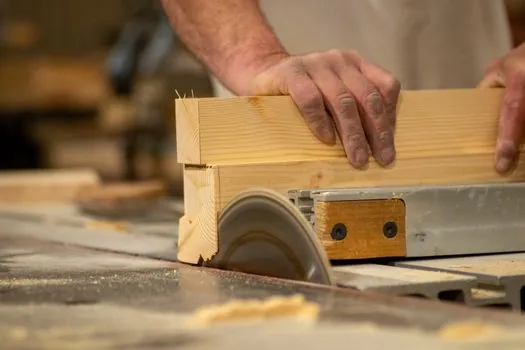
The 7-1/4-inch format is suitable for typical dimensional lumber, general carpentry, and repeat site cuts where portability and the standard arbor arrangement matter. A published saw-size guide identifies it as a common standard circular-saw size, while a separate guide associates it with a maximum depth of about 2-1/2 inches [S3][S4].
The 8-1/4-inch format is the better match for beams, heavy timber, and components requiring close to 3 inches of vertical capacity. One published guide describes an 8-1/4-inch blade as cutting about 2-3/4 inches deep and handling thick beams and engineered lumber [S1]. A timber-framing example also identifies 3-inch capacity as the requirement for cutting 2-inch tenons in 8-inch timber [S2].
The principal failure mode is a mismatched blade. Excessive depth can cause burning, wandering cuts, overload, and kickback, while an oversized blade that projects beyond the saw guard or baseplate can create a direct contact hazard [S3][S4]. A dull blade, resin buildup, or unsuitable tooth count adds heat and reduces cut quality independently of diameter.
Decision Criteria for 7-1/4 vs 8-1/4 Inches
Compare the formats on four criteria: cutting capacity, portability, compatibility, and application fit. The 7-1/4-inch option provides about 2-3/8 to 2-1/2 inches of depth, standard 5/8-inch arbor availability, and broad suitability for conventional framing [S2][S3][S4].
The 8-1/4-inch option provides about 2-3/4 to 3 inches of depth, making it the stronger choice for thick beams and near-3-inch crosscuts [S1][S2][S4]. Its disadvantage is that it is not automatically interchangeable with a 7-1/4-inch saw, and larger saws can be less convenient for overhead or confined-space work.
For a cutting depth of 2 inches, select 7-1/4 inches because the extra 3/8 to 5/8 inch from an 8-1/4-inch blade adds little. For a 2-1/2-inch target, both formats can work only if the 8-1/4-inch saw is a designed platform, not an improvised blade swap. For 3 inches, specify an 8-1/4-inch saw or larger and verify the manufacturer-rated maximum depth.
Before purchasing, record the saw model, required blade diameter, arbor diameter, maximum RPM, and full-depth rating. Also check that the power source, motor, baseplate, guard, and bevel mechanism are rated for the intended cut. A larger blade does not automatically create a more capable saw.
For related operating adjustments, Circular Saw Bevel Range and Angle Setup covers the geometry that changes effective depth and cut geometry. The decisive specification remains the saw manual: use 7-1/4 inches for standard handheld work within roughly 2-1/2 inches, and use a manufacturer-approved 8-1/4-inch platform when the cut requires approximately 3 inches.