Pick 8620 when the spec calls for a hard, shallow case over a tough, machinable, weldable core, and pick quenched-and-tempered 4140 when the part needs high uniform strength through the section. The two are not drop-in substitutes: 8620 chemistry centers on roughly 0.2% C with nickel-chromium-molybdenum additions that support carburizing, while 4140 chemistry centers on 0.38-0.43% C with 0.80-1.10% Cr [S3][S4].
On real shop floors the case-hardening route is generally reserved for low-carbon steels because diffusion-based processes need the surface to absorb carbon, then quench to a hard shell, with the low-carbon core staying ductile. 4140 already sits at roughly 0.40% C, so its surface is normally hardened by heating and quenching the whole cross-section, not by carburizing [S1][S4].
Composition and why it drives the process route
8620 nominally runs about 0.20% C, 0.40-0.70% Mn, 0.40-0.70% Cr, 0.15-0.25% Mo, plus roughly 0.40-0.70% Ni, with iron as the balance. 4140 runs 0.380-0.430% C, 0.75-1.00% Mn, 0.80-1.10% Cr, 0.15-0.25% Mo, with sulfur and phosphorus capped at 0.040% and 0.035% respectively [S3][S4]. The extra carbon in 4140 is what gives it a higher as-quenched hardness potential, while the 8620 leaner carbon content is what lets it soak carbon into the surface during carburizing without forming brittle grain-boundary networks.
Chromium content is the other decisive difference. 4140's 0.80-1.10% Cr forms stable carbides that do not respond well to traditional carburizing case hardening, which is why shops that want a hard surface on 4140 typically switch to nitriding (a diffusion process that uses nitrogen rather than carbon) rather than fight the chromium [S2]. For deeper reading on how alloying drives behavior, the alloy steel reference page covers the metallurgical framework behind these trade-offs.
Mechanical properties and achievable hardness
In the rolled or annealed reference condition, 4140 datasheet values include a tensile strength of about 655 MPa (95,000 psi), yield strength of 415 MPa (60,200 psi), 25.7% elongation in 50 mm, Brinell hardness of 197, density 7.85 g/cm³, melting point 1416°C, and elastic modulus 190-210 GPa [S4]. Machinability in the annealed state is rated at 65 relative to AISI 1212 (=100), which is why 4140 is widely chosen for parts that need heavy stock removal before heat treat [S4].
4140 responds to oil quenching from the austenitizing range and can reach approximately 55 HRC in small sections when heat treated [S1]. 8620, once carburized, quenched, and optionally tempered, can reach a case hardness on the order of 60 HRC at a case depth of roughly 0.015 in on sprocket-style components, with the low-carbon core remaining tough and impact-resistant [S1][S3]. Where 8620 is used in the as-supplied annealed state for further machining, machinists consistently rate its machinability as easier than 4140 in the same condition [S5].
Case hardening vs through hardening: the process difference

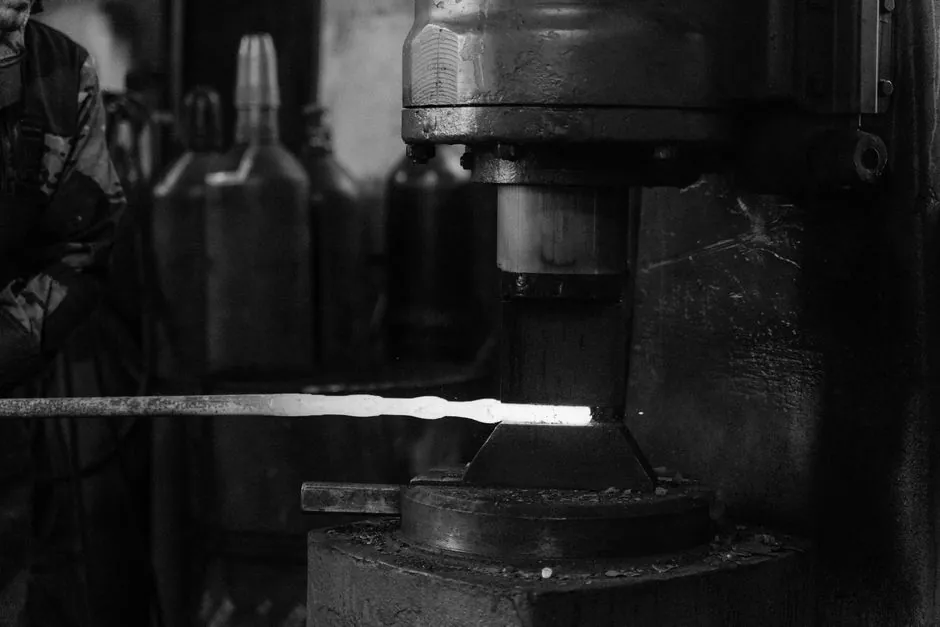
Case hardening on 8620 is a two-stage problem: a diffusion step (gas, pack, or liquid carburizing) that pushes carbon into the surface at roughly 850-925°C, then a quench that hardens that carbon-rich skin while the lean core transforms to a softer, tougher structure. Through hardening on 4140 austenitizes the entire cross-section (typically around 845-870°C) and quenches it, so hardness is roughly uniform end-to-end in sections thin enough to fully harden [S3][S4].
The practical consequence is that you cannot buy a uniform 60 HRC through a 1 in diameter 8620 section by carburizing alone, and you cannot buy a 60 HRC skin over a 25-30 HRC core in 4140 by quenching alone. If the engineering requirement is a hard, wear-resistant skin for spline teeth, gear teeth, or chain-sprocket teeth with a tough root, 8620 + case hardening is the natural fit; if the requirement is a uniform high-strength shaft or spindle, 4140 + quench and temper is the natural fit [S1][S2][S3].
Decision matrix: pick by 4 criteria
Carbon content and process route: 8620 at ~0.20% C is built for carburizing case hardening; 4140 at 0.38-0.43% C is built for through hardening or nitriding. Choose 8620 when you need a defined case depth over a softer core; choose 4140 when you need uniform hardness or temper back to a target strength level [S2][S3][S4].
Weldability and machining: 8620 is widely described as the more readily weldable grade because its lower carbon content reduces hard-zone cracking risk in the HAZ; 4140 in the hardened condition is generally considered weldable only with preheat and PWHT, while in the annealed condition it machines well at the 65-machinability rating [S3][S4]. Choose 8620 for fabrications that need significant welding; choose 4140 for heavy machining in the annealed state followed by through hardening.
Hardness ceiling and case depth: case-hardened 8620 routinely reaches the ~60 HRC / 0.015 in case depth zone on chain-sprocket and gear work; through-hardened 4140 commonly hits ~55 HRC, with deeper case but no soft core [S1]. Choose 8620 for thin, hard, fatigue-resistant skin; choose 4140 for high section strength.
Cost and availability: 8620 is often the more affordable option in some procurement channels, but actual pricing is mill- and size-dependent; both grades are stocked in flat bar, round bar, and plate form by service centers [S3].
Real use cases and shop-floor evidence
Chain sprockets, spline shafts, and pinion gears that need hard wear surfaces on the teeth with a tough root are the classic 8620 case-hardened pattern, and 4140HT followed by post-machining hardening is the classic through-hardened gear pattern [S1][S3]. Bushings that originally would have been specified for case hardening have been shifted to nitrided 4140 on production lines where the chromium content of 4140 actually helps nitriding performance, even though the same chromium resists carburizing [S2].
One practical shop scenario: a print calls out 4140 case hardened to 60 HRC at 0.015 in. Machinist feedback is consistent that the carburizing step on 4140 will underperform because of the chromium carbides, so the realistic options are to either (a) substitute 8620 at the drawing stage and run a standard carburize-and-quench cycle, or (b) keep 4140 and change the surface process to nitriding, accepting the different case hardness profile that nitriding produces [S1][S2].
Limits, failure modes, and rework risk
Quench-cracking and distortion rise sharply with carbon content and section size, which is one reason the case-hardening approach keeps the bulk of a 8620 part soft: less volume change, less residual stress. If a part is already supplied as 4140HT and then sent back through a carburize-and-quench cycle, expect measurable dimensional movement; for non-precision chain-sprocket and spline work this movement is usually tolerable, but for tight-pitch gears it is not [S1].
Case depth variance on 8620 is governed by carburizing time and temperature, and at the ~0.015 in target the cycle is short enough to keep grain growth in check on properly annealed stock. On 4140, attempting to push a deep case by extended carburizing tends to produce retained carbides and a less ductile case, again driving the industry preference to use nitriding for surface hardening instead [S2]. For projects that sit adjacent to this material choice, like conveyor frame and track decisions, the steel vs aluminum enclosed track comparison is a useful parallel for spec-driven structural picks.
Standards, sourcing, and how to specify
Both grades sit under the AISI-SAE four-digit alloy steel system: 8620 (UNS G86200) and 4140 (UNS G41400). Datasheet chemistry and the 4140 mechanical-property baseline (tensile 655 MPa, yield 415 MPa, density 7.85 g/cm³, melting 1416°C) are consistent across published supplier data and the AZoM datasheet [S4]. For procurement, normalize the callout to the form (bar, billet, plate), condition (annealed, normalized, pre-hardened HT), and target case depth or hardness profile, and let the heat treater pick the cycle. Pre-hardened 4140HT is commonly stocked at 28-32 HRC for machinists who will finish-machine only, with post-machining case hardening left to 8620 where needed [S1][S4].
Trackable signals to watch: distributor price deltas between 8620 and 4140 bar stock in your region, and any update to the 4140 datasheet revision history, which was last refreshed on 18 December 2019 per the AZoM entry [S4].
For the relevant spec sheets and selection criteria, see case packing machine, and aluminum alloy.