For seawater service to roughly 30-40 °C, both 6Mo super austenitic (254 SMO type, PREN ~42-43) and super duplex (UNS S32750 / S32760, PREN ≥40-41) survive provided crevices are controlled; the choice then turns on strength, fabrication, and alloy cost, not on raw pitting index [S1][S2].
Both families sit well above the seawater screening threshold of PREN ≥40 used by standards such as NORSOK for stainless components in marine service, and both have documented field histories exceeding three decades in piping, heat-exchanger tubing, and firewater systems [S1][S3].
Chemistry and PREN: why both clear the seawater bar
PREN = %Cr + 3.3·%Mo + 16·%N, and 6Mo austenitic grades such as 254 SMO land at PREN ~42-43 (20Cr-6Mo-N) while super duplex UNS S32750 (25Cr-4Mo-0.27N) sits at PREN 42-43 and UNS S32760 (25Cr-3.5Mo-0.7W-0.7Cu-0.25N) at PREN ≥40 [S1][S2][S5].
316L with PREN ~25 and standard 2205 duplex at PREN ~34-35 are below the seawater screening line and are not interchangeable with either of the two high-PREN families in raw seawater service [S1].
Super duplex S32760 adds 0.5-1.0% tungsten and copper on top of the S32750 base, a composition that boosts resistance to reducing acids and is preferred in chemical service rather than in pure seawater, where S32750 already meets the corrosion requirement [S2][S5].
Mechanical properties and wall-thickness leverage
Super duplex S32750/S32760 specifies 0.2% proof strength ≥550 MPa and tensile strength ≥795 MPa, versus 450 MPa proof / 620 MPa tensile for standard duplex S32205, and roughly 220-240 MPa proof for 316L austenitic [S2].
Yield strength of ~550 MPa, roughly double that of 316L, allows wall-thickness reductions in pipework, valve bodies, and pressure vessel shells specified for seawater duty, partially offsetting higher alloy cost per kilogram [S2][S4].
Elongation drops to ≥15% for super duplex versus ≥25% for standard duplex, and hardness caps at 310 HBW, so forming, cold-rolling, and field bending are workable but less forgiving than 316L [S2].
Corrosion behaviour in chlorinated and aerated seawater
Field data compiled by R. Francis shows super duplex Zeron 100 (UNS S32760) tolerating a wide range of marine service environments since 1986 (castings) and 1990 (wrought product) with limited localised corrosion when design and water chemistry are controlled [S3][S5].
Chlorinated seawater at 0.5-1.0 mg/L residual shifts stainless potentials upward and elevates crevice-corrosion risk; under those conditions laboratory and service data indicate that both Z100 super duplex and 6%Mo austenitic alloys resist crevice corrosion, while lower-alloyed grades fail [S5].
Crevice geometry, deposit control, weld quality, and avoidance of sigma-phase embrittlement all outweigh the small PREN gap (40 vs 43) in real plant performance, a point emphasised in a 2021 review cited by the AZoM comparison [S1].
Selection criteria: 6Mo austenitic vs super duplex
For welded plate heat-exchanger shells, thin-wall instrument piping, and components requiring severe cold forming, 6Mo super austenitic is the lower-risk choice because its single-phase FCC structure tolerates higher ferrite-free weld procedures and delivers better low-temperature toughness than super duplex [S1][S6].
For thick-walled pipe spools, industrial valve bodies, firewater ring mains, and structural components where 550 MPa proof strength enables thinner walls, super duplex S32750 wins on a lifecycle-cost basis despite roughly 1.5-2x the alloy surcharge per kilogram [S2][S4].
Where chlorination is intermittent rather than continuous, where biofouling is controlled mechanically rather than chemically, and where maximum service temperature stays below ~30 °C, either family is acceptable; the deciding factors become weld-procedure qualification, NACE MR0175 / ISO 15156 sour-service rating (S32750 and S32760 both qualify for limited sour use), and supply availability rather than raw PREN [S1][S2].
Welding, fabrication, and inspection constraints
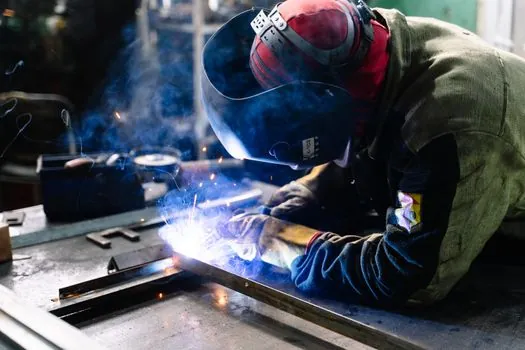
Super duplex requires controlled heat input (typically 0.5-2.0 kJ/mm), interpass temperatures below ~150-200 °C, and avoidance of prolonged exposure in the 600-950 °C range where sigma and chi phases cut both corrosion resistance and impact toughness; 6Mo austenitic tolerates a much wider thermal envelope and is friendlier to field repairs [S2][S6].
Weld filler selection differs: super duplex welds are typically matched (e.g. 2507/P100 filler) or over-matched with nickel-rich fillers, while 6Mo super austenitic uses higher-Mo nickel-base fillers such as alloy 625 or C-276 for dissimilar joints, which raises filler cost and flow-meter orifice-plate weld-overlay complexity [S1][S2].
Post-weld pickling and passivation with nitric plus hydrofluoric acid mixtures, followed by thorough rinsing, is mandatory for both families in seawater service; surface contamination, heat tint, and iron embedding will initiate pitting long before the bulk PREN would predict failure [S1][S6].
Cost, availability, and standards
Plate, bar, and tube in S32750 / S32760 are stocked by major stainless distributors in ASME SA-240 / SA-479 / SA-789 product forms; 6Mo grades (UNS N08367, N08926, S31254) are also widely stocked but command a higher nickel-driven price per kilogram because nickel content sits at 17-25% versus 6-8% in super duplex [S1][S2].
Standards relevant to seawater service include NORSOK M-001 (PREN ≥40 for marine stainless), NACE MR0175 / ISO 15156 for sour environments, ASTM A240 / A789 for plate and tube, and ASME B16.34 for industrial valve body ratings, with EN 1.4410 / 1.4501 designations used in EU specifications [S1][S2][S5].
For pure seawater without chlorination and with tight temperature control below 30 °C, 254 SMO type 6Mo is often the lower-total-cost option; once continuous chlorination, elevated temperature (above ~40 °C), or structural loading enter the picture, super duplex's strength, higher critical crevice temperature, and lower nickel dependence make it the default specification [S1][S2][S4].
Track the following before finalising the spec: confirm the residual chlorine envelope (intermittent vs continuous, mg/L range), confirm the maximum design temperature including upset cases, verify the availability of ASME-qualified weld procedures for the chosen family, and check that the selected grade is listed in the project NACE MR0175 / ISO 15156 sour envelope if H2S is present.
Background reading: XPS Grades for Under-Slab and Inverted Roofs: A Spec-Driven Selection.