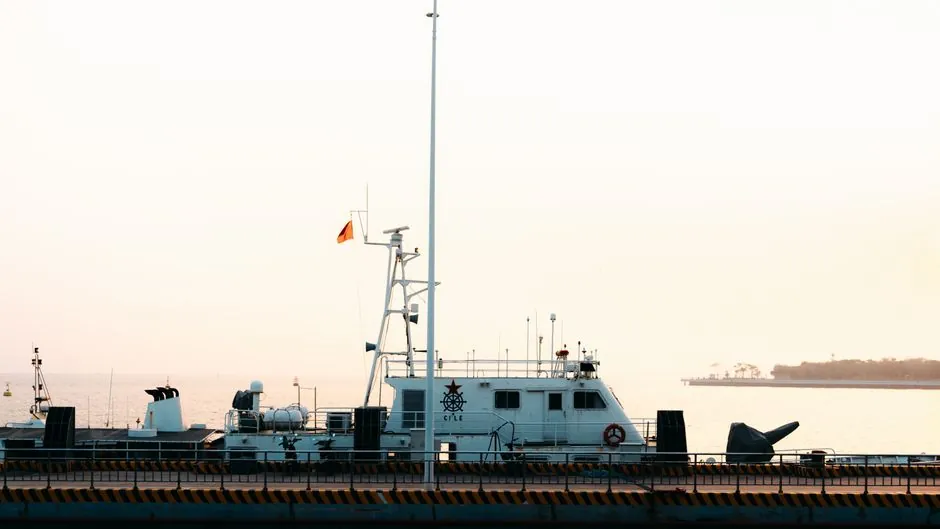
5083-H116 and 5083-H321 are the two strain-hardened tempers of aluminum-magnesium 5083 plate most commonly called out for marine service, with identical ASTM B928 minimum mechanical limits of 305 MPa tensile, 215 MPa yield and 10% elongation across the 3.00-50.00 mm thickness band [S4][S5]. The real engineering choice between them is not strength; it is the processing route and the corrosion-stability behaviour of the magnesium-rich microstructure over decades of seawater exposure.
This matters because 5083 contains 4.0-4.9% Mg, and at sustained service temperatures above roughly 65-70 °C the supersaturated Mg can precipitate at grain boundaries as Al3Mg2 (β phase), a phenomenon classically called sensitization, which makes the alloy susceptible to intergranular corrosion and stress-corrosion cracking [S5]. H116 and H321 are both designed to keep that risk in check, but they get there through different mill routes, and procurement specs, class rules and welding procedures will dictate which one is acceptable on a given drawing.
What the temper designations actually mean
5083-H116 is a strain-hardened temper of high-magnesium 5xxx wrought product with defined limits on mechanical properties and on resistance to exfoliation corrosion, applied to the as-rolled plate without a separate stabilization thermal cycle [S1]. 5083-H321 is also strain-hardened but is then given a low-temperature stabilization treatment that brings mechanical properties to a more stable point on the strain-hardening curve and reduces the tendency to age-soften or distort during further fabrication and service [S2][S5]. The alloy chemistry (Mg 4.0-4.9%, Mn 0.40-1.0%, Cr 0.05-0.25%, Fe ≤ 0.40%, Si ≤ 0.40%, Cu ≤ 0.10%, Zn ≤ 0.25%, balance Al) is identical for both tempers, so any difference in corrosion or stability behaviour comes from the thermo-mechanical history, not from composition [S5].
Both tempers are accepted under ASTM B928 for high-magnesium marine plate and shipbuilders also see them cross-referenced to EN 485, ASTM B209, AMS-QQ-A-250/6 and ISO 12215-5:2019 for small-craft scantling work, with class society coverage typically including CCS, DNV, NK, ABS, BV, LR and KR [S4]. Suppliers carry the common marine plate range of 3-50 mm thickness, 1000-2650 mm width and 2000-12000 mm length in both tempers, with H116 dominating thinner hull plate and H321 dominating heavier structural plate [S4].
Sensitization: why the 65-70 °C envelope is the real limit
Because 5083 cannot be strengthened by heat treatment, all of its strength comes from magnesium in solid solution plus cold work, and that same magnesium is what makes the alloy vulnerable if it is held at elevated temperature long enough to nucleate β-phase (Al3Mg2) on grain boundaries [S5]. This sensitization window is the reason hull, topside and pressure-vessel designers cap sustained operating temperature for 5xxx-series plate, and it is also why ASTM B928 requires both H116 and H321 to pass an exfoliation-corrosion test (per ASTM G66) plus an intergranular corrosion test in which the maximum attack depth is held to grade 3 or better [S4][S5]. For plate designated as "long-term direct contact with seawater" or for "sea-going hull shell", the requirement tightens further: no class E exfoliation and no PB (pronounced pitting/exfoliation) appearance after the GB/T 22639 exfoliation test [S4].
H321's stabilization step is specifically intended to pull the microstructure closer to a low-temperature equilibrium so that the natural tendency to precipitate β-phase during decades of warm service is reduced, and so that the as-delivered mechanical properties are more stable during shipyard forming and welding [S2][S5]. H116, by contrast, is qualified to the same corrosion tests but is delivered without that extra thermal soak, so for any service profile that involves extended exposure above the sensitization envelope (process piping near engines, exhaust plenums, deck plating over heated tanks, LNG regasifier skids) H321 is the more conservative call [S1][S2].
Mechanical properties: same floor, different shape of envelope
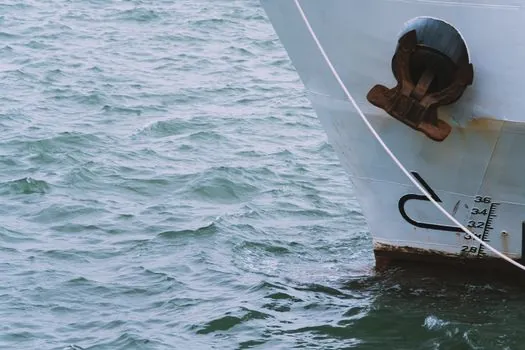
Both tempers share a minimum tensile strength of 305 MPa, a minimum 0.2% yield of 215 MPa and a minimum elongation of 10% over 3.00-50.00 mm plate under ASTM B928, and both must clear the same G66 exfoliation and intergranular corrosion acceptance criteria [S4][S5]. H321, however, is normally delivered with a tighter tensile-strength ceiling of 305-385 MPa and a slightly higher minimum elongation of 12%, reflecting the more controlled strain-hardening plus stabilization route [S4]. H112, the third temper often seen on mill test certificates, drops to 275 MPa tensile / 125 MPa yield minimum over 6.00-50.00 mm and is generally reserved for less critical applications, not for underwater hull plating [S4].
Because the minimums are identical, the wrong engineering reflex is to assume H321 is "stronger" than H116. It is not automatically harder, stronger or more corrosion resistant: every H321 plate must be evaluated against the thickness-specific mechanical values and the corrosion-test acceptance in the actual purchase specification, and H116 can in some thicknesses and product forms show equal or higher strength depending on the amount of cold work retained [S1]. The selection should track the approved drawing, the classification-society rule, the welding-procedure qualification and the governing material standard rather than the temper letter alone.
Weldability, formability and fabrication behaviour
Weldability is the other axis where the two tempers diverge in practice. 5083 as an alloy has good welding crack resistance and the welded joint loses little performance compared with the parent plate, which is why it dominates marine structural fabrication, but the HAZ will always be a partially sensitized zone in any 5xxx-series weld [S3]. H321's stabilized starting microstructure is generally more forgiving in heavy multi-pass weldments because it is already closer to a low-temperature equilibrium, so additional HAZ sensitization is smaller; H116 retains more cold-work energy and is therefore more sensitive to distortion and to post-weld softening if subsequent forming or hot work is required [S2][S3].
Formability for spun or deep-drawn marine fittings is a similar trade: H116 in thinner gauges is the more common choice for hull shell and superstructure panels where the as-rolled strength is acceptable, while H321 in 6-50 mm plate is preferred for decks, bulkheads, engine bearers and pressure-vessel shells where the as-welded dimensional stability and the smoother strength scatter band simplify fit-up [S2][S5]. For projects designed to ISO 12215-5:2019 small-craft rules or to DNV/ABS/LR/RINA hull rules, the class rule typically dictates which temper is permitted for each structural application, and substitution of H116 for H321 (or vice versa) should only be done after re-checking the specified mechanical values, corrosion tests, dimensional tolerances, inspection documents and welding qualification against the design approval [S1][S4].
Specification checklist when ordering marine plate
Procurement documents should fix, at minimum, the alloy (5083), the temper (H116 or H321), the product form (plate/sheet), the thickness range, the width and length, the dimensional tolerance class, the governing material standard (commonly ASTM B928, EN 485 or ASTM B209), the class society and edition, the welding-procedure reference, and the inspection document type (e.g. EN 10204 3.1 or 3.2) [S1][S4]. The exfoliation and intergranular corrosion test results, plus a temperature-of-exposure note for any service above ~65-70 °C, should be requested on the mill test certificate so that the metallurgical risk of sensitization is auditable for the life of the vessel [S4][S5]. The mill size tables in active commercial use cover H116 from 1/8" up to 2" and H321 from 1/4" up to 6" in 96"x240" or 60"x120" plate under ASTM B928, which lines up with the typical hull (thin to medium) and structural (medium to heavy) split between the two tempers [S4].
Decision matrix: which temper for which job
Use H116 when the approved drawing or class rule calls for it, typically on hull shell plating, bottom plate, side shell above and below the waterline, workboat and patrol-vessel plating, offshore platform panels, and storage tanks in direct splash or immersion service, where the priority is proven exfoliation and intergranular corrosion resistance under long-term chloride exposure [S2][S3][S5]. Use H321 when the priority is dimensional and mechanical stability over time, specifically for welded decks, bulkheads, engine-room structures, pressure vessels, LNG and chemical-tank shells, and any plating that will see sustained elevated-temperature service, where the stabilization step reduces the long-term risk of sensitization-driven cracking [S2][S4][S5].
A common engineering shortcut on multimillion-dollar ship packages is to dual-list H116 and H321 on the same drawing note and let the mill supply whichever temper is in stock for the requested thickness, because both clear the same ASTM B928 minimum mechanicals and the same G66 corrosion tests [S5]. That shortcut is only valid when the class rule and the welding procedure both accept either temper; for high-temperature service, for sour-service pressure equipment, or for any application where a class surveyor will sign off only on a specifically named temper, the substitution must be re-justified with documented test data before the order is released [S1][S2].
Track the next technical signal in 5083 plate procurement: revisions to ASTM B928's corrosion-test acceptance criteria and any 2026-2027 updates to DNV, ABS and LR rules on sensitization testing of 5xxx-series hull plate, both of which will tighten how mills qualify H116 versus H321 for warmer operating profiles such as those seen in dual-fuel and methanol-fuelled newbuilds.
Component reference pages worth checking: marine hvac, marine valve, and steel plate.
Background reading: NEMA 17 vs 23 vs 34 stepper: holding torque range and sizing decision.