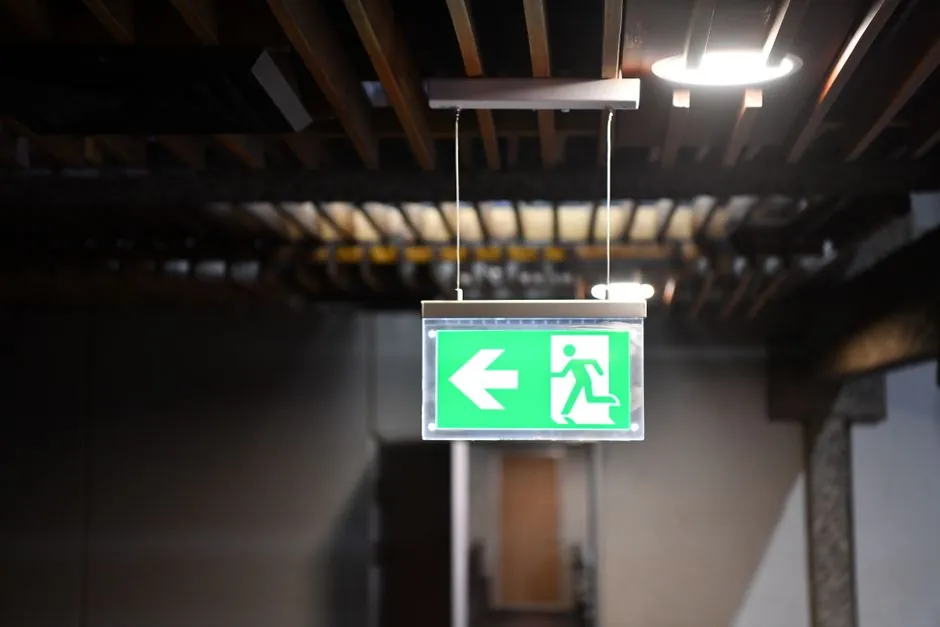
Under NFPA 101 §7.9.2.1 the U.S. baseline is 1.5 hours (90 minutes) of automatic illumination when normal power fails, and that 90 minutes applies whether the source is a battery, a generator, or any other approved emergency power system [S5][S9].
Under BS 5266 in the UK, the same luminaire may have to run for 3 hours (180 minutes) in sleeping-risk and high-occupancy premises, and contractors report luminaires sold as "3-hour" units that fall 1 to 2 minutes short of 180 minutes failing inspection outright [S4][S2].
Where each duration is written into code
NFPA 101 §7.9.2.1 sets the 90-minute minimum and §7.9.2.1.1 requires an initial 1 ft-candle average / 0.1 ft-candle minimum at floor level along the path of egress, with §7.9.2.1.2 allowing decay to 0.6 ft-candle average and 0.06 ft-candle minimum at the end of the 1.5-hour window; §7.9.2.1.3 caps the max-to-min ratio at 40:1 to prevent overly bright or dark spots [S5]. The 90-minute clock starts on automatic loss of normal lighting, not on manual initiation, per §7.9.2.3 [S5].
BS 5266 takes a building-risk approach: a simple office or warehouse may only need a 1-hour or 60-minute rating because evacuation is fast, while a care home, cinema, restaurant, or sleeping-accommodation block generally requires 2 to 3 hours (120 to 180 minutes) [S4]. A "3-hour" fixture is therefore not a marketing upgrade; it is a code-mandated rating for specific occupancy classes, and a fixture that delivers 179 minutes of usable light is treated as a failure, not a near-miss, during periodic inspection [S2][S4].
Selection criteria: matching the rating to the room, not the room to the rating
Five inputs drive the right duration: occupancy class (sleeping vs awake), familiarity of occupants with the layout, evacuation time, time-to-restore-power after a fault, and the photometric minimum at the end of the discharge, not at minute one [S1][S2][S4]. A lumen package that looks generous at minute 0 but crashes below 0.06 ft-candle at minute 90 is not code-compliant under NFPA 101 §7.9.2.1.2, even if the lamp is still on [S5][S8].
For U.S. non-sleeping, non-high-hazard occupancies the 90-minute rating is the de facto floor, and over-specifying to 180 minutes adds battery cost and recharge time for no compliance benefit. For UK sleeping-accommodation, healthcare, or public-assembly venues, the 3-hour rating is the legal minimum and the AHJ will reject shorter ratings on the day of commissioning [S2][S4]. Specifiers should also confirm the listed rating matches the test method: a 3-hour mark means 180 minutes of code-minimum illumination under the manufacturer's discharge curve, not 180 minutes of any light at all [S8].
Decision matrix: 90-minute vs 180-minute vs longer

On a four-criterion comparison, the 90-minute rating wins on battery cost, recharge time, and unit price; the 180-minute rating wins on UK code coverage, sleeping-accommodation compliance, and resilience during extended outages. A "longer than 3-hour" rating (rare, typically 4 to 8 hours) is only justified in high-amber-risk process plants, remote sites, or refuges where re-entry or rescue is staged over many hours; it carries a 3 to 4x cost penalty in battery capacity and a longer recharge cycle that can leave the luminaire off-complying for the next 24 hours after a deep discharge [S1][S2][S8].
The middle option (120 minutes / 2 hours) exists mainly for intermediate-risk UK premises and some transit occupancies, and it should not be silently substituted for 180 minutes in sleeping-risk buildings; inspectors reading BS 5266 will look for the exact 3-hour rating on the luminaire label and the test certificate [S4][S2]. In U.S. jurisdictions the 120-minute rating has no formal status under NFPA 101 §7.9.2.1 and is generally considered over-spec for ordinary occupancies [S5][S9].
Test method: why a 179-minute run is a failure
Self-contained emergency luminaires are tested by simulating a mains failure and recording the elapsed time until the lamp output falls below the manufacturer's declared minimum (commonly 0.06 ft-candle at the floor for U.S. code work), and the duration is rounded down to the last full minute the threshold was met [S8]. One UK supplier's field data shows luminaires sold as "3-hour" units regularly test at 150 to 178 minutes, which is treated as a fail under BS 5266 because the 180-minute threshold was not achieved at the photometric minimum, not because a clock ran out a minute early [S4].
In practice, contractors do not sit with a stopwatch for the full discharge; they use timed test rigs, battery cyclers, and recent test certificates from the installer of record, and they re-test annually as a minimum, with a deeper 3-hour full-discharge test on a percentage of the installed base each year [S3][S4]. For a complete reference on the test and inspection workflow, see the emergency light and emergency rescue encyclopedia entries, and for the underlying luminaire categories, the lighting equipment and electric lamps overview.
Failure modes that quietly shorten rated duration
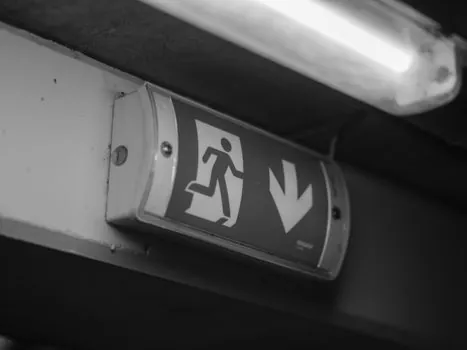
Four mechanisms drive field units below their rated minutes: battery capacity loss from high-temperature operation, reduced hold-up time as cells age past their service date, undersized cells fitted to chase a cheaper BOM, and self-discharge in the charger circuit between outages [S4][S8]. A NiCd or LiFePO4 pack past its 4 to 5-year service life can show 70 to 80 percent of nameplate capacity and therefore run for only 110 to 140 minutes of a "180-minute" label, which is enough to pass a 90-minute U.S. test but enough to fail a 180-minute UK test.
Temperature is the second silent killer: every 10 °C rise above the cell's rated ambient roughly halves battery life, so a luminaire in an unventilated stairwell or above a hot ceiling void can lose 30 to 50 percent of its rated runtime within 2 to 3 years of service [S1][S2]. Specifiers should therefore treat the duration rating as a day-one value, not a 10-year value, and budget battery replacement at the manufacturer's stated interval, not at the fixture's cosmetic end of life. For the broader illumination and photometric context that drives these minimum thresholds, the measurement test and emergency stop encyclopedia pages cover the related safety-instrumentation terminology used in commissioning reports.
Sourcing and standards to put on the spec sheet
For U.S. projects, cite NFPA 101 §7.9.2.1, §7.9.2.1.1, §7.9.2.1.2, §7.9.2.1.3, and §7.9.2.3 in the luminaire schedule, and require UL 924 listed emergency LED drivers with battery backup that automatically switch over on loss of normal power [S5][S9]. For UK projects, cite BS 5266-1 and the relevant BS 5266-7 risk category, require a 3-hour rated self-contained luminaire for sleeping-risk occupancies, and demand a test certificate showing the 180-minute photometric minimum was met on the as-installed unit, not on a lab sample [S2][S4].
Trackable signals to watch over the next 12 months: a steady increase in field reports of 150 to 178-minute "3-hour" failures from UK suppliers, an NFPA 101 cycle that may revisit the 90-minute floor for high-amber-risk occupancies, and a market shift from NiCd to LiFePO4 cells in self-contained units, with longer service life but stricter thermal management in the luminaire housing [S3][S4][S8]. For a related decision-grade spec comparison on adjacent industrial safety hardware, see the 2.5 Gallon Pressurized Water Extinguisher, 2-A Rating: Use Cases and Limits reference.