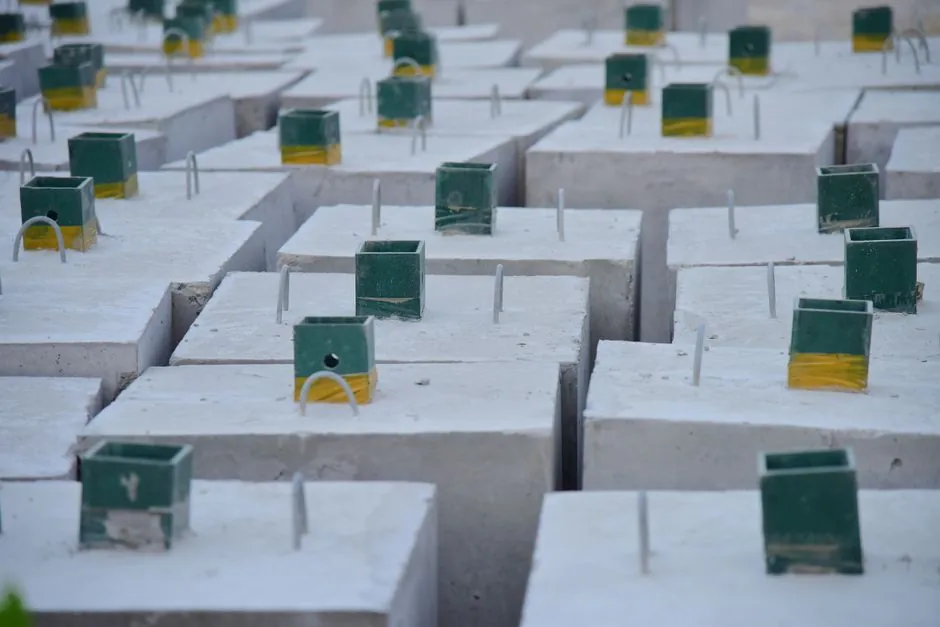
Oven-dry density for commercial-grade AAC blocks sits in a 550 to 650 kg/m³ band per IS 2185 (Part 3) references in current Indian manufacturer literature, and the European declared density per EN 771-4 covers a similar 300 to 600 kg/m³ commercial range, extending down to about 250 kg/m³ for the newer low-thermal-conductivity grades [S1][S2][S3].
The number stamped on a manufacturer datasheet is almost never the number a contractor weighs at site: a freshly autoclaved and cooled block will absorb and adsorb water during yard storage, monsoon handling, and transport, and the resulting as-delivered density routinely runs 25 to 35 percent above the declared oven-dry value, a gap that quietly inflates dead-load calcs, crane picks, and even truck payload limits if the procurement spec is not pinned to a defined moisture condition [S4][S5].
Why declared density and delivered density diverge
AAC's cellular pore structure is the same feature that makes it a 0.07 to 0.13 W/mK insulator at 300 to 600 kg/m³, and it is also the reason the material behaves like a hard sponge: the autoclave cures the mix into a stable calcium silicate hydrate matrix with millions of interconnected micro-pores, and those pores re-fill with water whenever relative humidity is high or rain is present [S1][S3]. The declared density on a datasheet is the oven-dry value per EN 771-4 in Europe, and per IS 2185 (Part 3) in India, measured after the sample is dried to constant mass in a lab oven [S2][S4]. Real blocks on a truck or a yard pallet are almost never in that condition.
Lab and field practice in India caps acceptable air-dry moisture content at 35 percent by mass for AAC delivery per IS 2185 acceptance guidance, which is the formal mechanism the standard uses to control the dry-vs-wet gap, and it is the single most important acceptance number on a purchase order that procurement teams routinely leave blank [S5]. Above 35 percent moisture, the unit is technically out of spec, and the structural designer should not be using the declared 600 kg/m³ figure to compute dead load.
Converting the two densities for design and logistics
For a 600 kg/m³ declared AAC block at 30 percent moisture by mass, the as-supplied density works out to 600 ÷ (1 minus 0.30) ≈ 857 kg/m³ of bulk wet material, a 43 percent uplift in block weight per cubic metre before any surface water is added; a more typical 25 percent moisture content still pushes the figure to 600 ÷ 0.75 = 800 kg/m³, a 33 percent increase [S5]. On a project where 200 mm AAC walls cover, say, 8,000 m² of elevation, that gap can shift the masonry dead load on the structural frame by several tonnes per floor, and it changes the number of blocks per truck from a planning assumption into a payload constraint that logistics managers ignore at their peril.
The conversion is mechanical, not mysterious: ρ_delivered = ρ_oven-dry ÷ (1 minus m), where m is the moisture fraction (0.25 to 0.35 typical). The thermal-conductivity numbers on the datasheet, 0.07 to 0.13 W/mK at 300 to 600 kg/m³, are dry values; a wet block conducts more heat because water (≈ 0.6 W/mK) replaces air (≈ 0.025 W/mK) in the pore structure, and field U-values measured on construction sites routinely run higher than the lab-declared λ than designers predict when the moisture condition is uncontrolled [S1].
Procurement spec: what to pin on the purchase order
The minimum effective purchase-order language for an AAC buy references oven-dry density to EN 771-4 in Europe or IS 2185 (Part 3) in India, with a declared band of 550 to 650 kg/m³ for the structural grade, and it ties the batch test certificate to a delivered moisture cap of 35 percent air-dry, the acceptance limit that Global Lab India and similar NABL-accredited facilities run as a routine parameter [S2][S5]. Anything looser than that and the contractor is buying a material whose as-delivered mass is undefined.
Two practical additions raise the spec from "acceptable" to "defensible." First, require batch-tested oven-dry density per EN 771-4 / IS 2185 (Part 3) at a stated sampling frequency, not a one-shot factory certificate. Second, add a weighbridge check at site receipt: weigh a sample of five blocks, oven-dry them per the lab method, and back-calculate moisture; reject lots above 35 percent, or apply a price adjustment. This is the only reliable way to convert a vendor's declared 600 kg/m³ into the number that actually loads the structural frame and the truck.
Where the 25 to 35 percent uplift really hurts
Dead-load on frames and foundations is the headline problem: a designer who used 650 kg/m³ for AAC infill and ends up with 850 kg/m³ wet units has added 30 percent to that line item, and on a 20-storey tower with extensive AAC infill the cumulative penalty runs into hundreds of kilograms per square metre of floor plate when multiplied across all walls, partitions, and the AAC block masonry on every level. Crane picks and hoist sizing need to be re-rated for the heavier block; manual handling risk assessments need to assume the heavier block; truck payloads need to be re-planned. [S2]
Thermal performance is the second-order effect that often gets missed: a wet AAC wall has a higher effective λ than its dry declared value, and the in-service U-value drifts upward as moisture equilibrates, so an energy model calibrated to 0.10 W/mK dry may be 15 to 20 percent off once the wall is in a humid climate or has been wetted by monsoon storage. The standard response is to keep blocks tarped on site, allow drying time before enclosure, and to use the declared dry λ in energy calcs with a moisture safety factor, but the underlying point is that the dry λ on the datasheet is not the in-service value.
Comparison: declared dry vs as-delivered wet vs design value
Three numbers matter in any AAC block conversation, and they are not interchangeable. Declared oven-dry density, 550 to 650 kg/m³ per IS 2185 (Part 3) and 300 to 600 kg/m³ per EN 771-4, is the lab value used for thermal-conductivity declarations and is the basis for any comparison with manufacturer datasheets [S1][S2][S3]. As-delivered density, 800 to 880 kg/m³ for a 25 to 35 percent moisture content on a 600 kg/m³ base, is what the weighbridge sees and what the crane actually lifts [S5]. Design value for structural dead load should sit between these, using a project-specific moisture assumption but never below the declared dry figure; the conservative move is to use the declared dry value for thermal calcs and a wet-adjusted value (declared × 1.25 to 1.35) for dead-load calcs unless site moisture data justifies otherwise.
The decision rule is simple: if the procurement spec has not pinned a delivered moisture cap of 35 percent per IS 2185 acceptance practice, and if batch test certificates are not tied to that cap, then the structural and thermal calcs are based on a number the contractor cannot verify on site. Pin the moisture cap, run the weighbridge check, and the declared dry density becomes a usable input instead of a marketing figure.
Limits, failure modes, and what the standards do not cover
IS 2185 (Part 3) and EN 771-4 both define the oven-dry test condition for declared density, but neither standard prescribes a maximum as-delivered moisture for every climate; the 35 percent air-dry cap cited by Indian test labs is an acceptance guidance, not a universal regulatory value, and it is the buyer's job to write it into the contract [S5]. Monsoon storage in coastal Indian sites, or winter thaws in northern European sites, can push surface moisture well above the 35 percent number even when the bulk material is in spec, and the only mitigation is covered storage and a documented drying period before enclosure.
Two failure modes recur. First, partition walls built with wet AAC shrink and crack at the joints as the block dries toward equilibrium moisture content, so any finishing or tiling done before the wall has stabilised will crack. Second, AAC specified for dry-mortar thin-bed adhesive systems can fail at the adhesive interface if the block surface is too wet, because excess moisture disrupts the cement hydration in the adhesive layer; manufacturers of thin-bed mortars cap substrate moisture at a defined level, and AAC at 35 percent moisture content can exceed that cap.
Tracking signals to watch: tighter declared-density bands (e.g. 580 to 620 kg/m³ instead of 550 to 650) from European Tier 1 producers, and IS 2185 (Part 3) revisions tightening the as-delivered moisture definition, would both materially improve the dry-vs-wet gap problem. In the meantime, the weighbridge-plus-oven-dry check on a 5-block sample per lot is the cheapest and most defensible mitigation a contractor can deploy.
Component reference pages worth checking: dry block temperature calibrator.
Related analysis: 14-bit raw radiometric vs 8-bit AGC video: when radiometry wins over display-ready output.