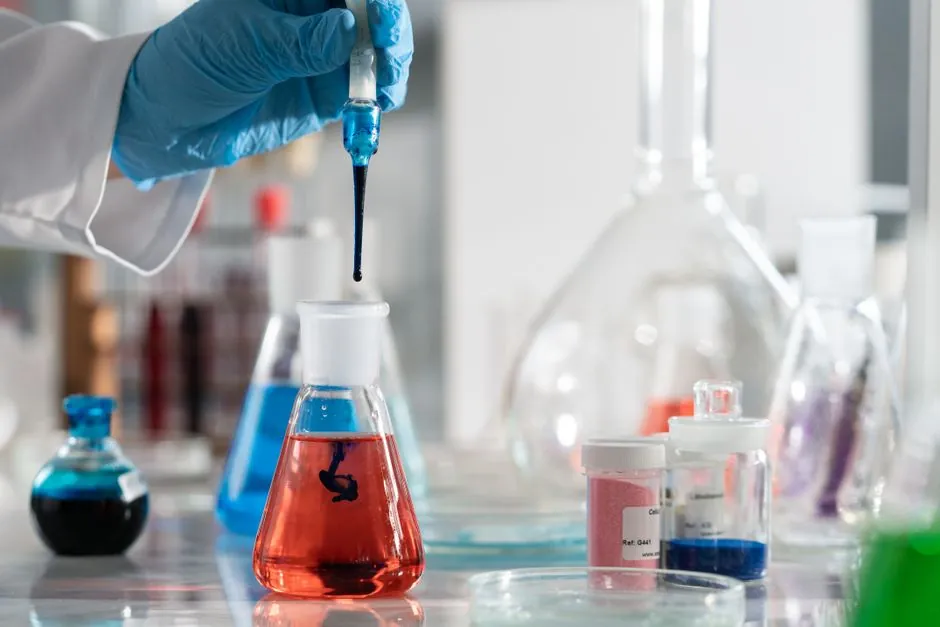
ACS reagent grade chemicals must exceed 95% purity and conform to the American Chemical Society's Reagent Chemicals monograph tests for individual impurities, while technical grade carries no defined purity threshold and is sold for industrial manufacturing use [S1][S2][S4].
The two grades target fundamentally different applications: ACS grade supports analytical work, pharmaceutical formulations, and food contact, whereas technical grade handles bulk processes such as metal degreasing, pH adjustment, and concrete cleaning where trace impurities do not affect the outcome [S1][S3][S4].
Purity Thresholds and What the Numbers Actually Mean
ACS grade and ACS reagent grade both require a minimum purity above 95% under the Reagent Chemicals specifications published by the American Chemical Society, with each chemical carrying a defined ceiling on specific impurities such as heavy metals, non-volatile residue, water content, and related organics [S1][S2][S4]. Reagent grade is generally regarded as equivalent to ACS grade, though ACS-grade solvents are explicitly tested against the additional assay requirements in the ACS monograph, including residual solvents and trace metal limits that generic reagent grade may not enumerate on the Certificate of Analysis [S2][S5][S6].
Technical grade sits at the bottom of the published hierarchy and has no compendial purity minimum: it is "high enough quality to use industrially, except when a higher purity grade is specified" and is "not generally suitable for use in applications requiring much lower levels of impurities" [S3]. Practical guides describe technical grade as the lowest purity tier in routine commerce, with no standardized monograph test panel behind it [S4][S7].
Testing Protocols: Monographs vs No Monograph
Every ACS-grade chemical is verified against a monograph: the publication defines appearance, solubility, molecular weight, safety, and purity, then lists specific assays and acceptable result ranges the manufacturer must run [S1][S5]. The ACS demo monograph for Acetic Anhydride, for example, lists a general description, a fixed specification table, and explicit quality-check references to the Reagent Chemicals specification book [S5]. A separate compliance statement notes that "ACS grade solvents must be tested to ensure that" specified impurity limits are met, and this testing obligation is what separates ACS from a generic reagent label [S6].
Technical grade chemicals are not tested to any specific compendial standard. Pure grade and practical grade, which sit just above technical grade in the hierarchy, are also "not tested to any specific set of standards" and serve general manufacturing or educational applications only [S3]. The result is a documented CoA for ACS shipments and a much thinner paperwork trail for technical drum lots, which is the actual operational difference procurement notices on the receiving dock.
Cost, CoA Documentation, and Traceability

ACS-grade chemicals carry a price premium because of the monograph testing and the tighter impurity ceilings, with industry references describing ACS as "more expensive" and noting that "lab, technical or ungraded chemicals are often much less expensive than high-grade chemicals that meet ACS, NF or USP-grade standards" [S1][S4]. The benefit side of that premium is reproducible analytical data, more consistent manufacturing batches, and a CoA that can be filed against FDA or USP audits; the cost side shows up on every line item where a higher-purity drum was specified for a process that did not actually need it [S1][S4].
For decision-makers, the practical question is whether the application needs a documented assay trail. Pharmaceutical manufacturing, food additives, and clinical or research laboratories do; bulk solvent blending, large-scale pH adjustment with mineral acids, and industrial cleaning typically do not [S1][S3][S4]. Hydrochloric Acid 31% Technical Grade (CAS 7647-01-0) at a 108°C boiling point is a standard pickling and pH-adjustment choice precisely because trace metals and non-volatile residue are not on the specification for that use case [S1].
Decision Matrix: When to Specify Each Grade
The selection rule of thumb, distilled from the available guidance, is to match the highest applicable standard to the binding regulatory or analytical requirement, then step down. ACS grade is the right call for analytical method development, HPLC and chromatography mobile phases, pharmaceutical API synthesis, and any application whose CoA will be reviewed by a regulator or external auditor [S1][S2][S4][S6]. USP grade takes over where the use case is human-consumption drug formulation, where USP monographs define the test panel instead of ACS ones, and the two are not interchangeable for regulated submissions [S1][S3][S4].
Technical grade is the right call for bulk solvent duty (degreasing, resin thinning), industrial pH adjustment, steel pickling, and large-scale synthesis intermediates where downstream purification steps will remove the trace impurities that technical grade permits [S1][S3][S7]. Laboratory grade slots between them as an upper-intermediate tier for educational labs and routine non-critical work, while pure/practical grade covers general manufacturing when no specific standard is binding [S3]. Buying ACS grade for shop-floor degreasing is the canonical example of over-specification; buying technical grade for an HPLC mobile phase is the canonical example of under-specification [S1].
Use Cases Mapped to Grade

Acetone Technical Grade at 100% concentration (CAS 67-64-1) with a 56°C boiling point and a -20°C flash point is the standard industrial degreaser and resin thinner; the trace impurities do not affect solvency, so paying for ACS purity in this duty is waste [S1]. Propylene Glycol Technical Grade (CAS 57-55-6), 188°C boiling point, 104°C flash point, is the typical heat-transfer and antifreeze choice in the same cost tier [S1]. For solvent comparison duty in a related decision, acetone vs MEK selection walks through the evaporation-rate and solvency trade-offs that drive which bulk grade a formulator actually orders.
For analytical and pharmaceutical work, ACS or USP grade is non-negotiable. Glycerin USP at a 290°C boiling point and Citric Acid USP at 99.5% purity are typical pharmaceutical-formulation picks where the monograph tests, not just the headline assay number, are what the FDA review covers [S1]. Hexane ACS at 98.5% and IPA ACS at 99.9% are the matching ACS-grade references for laboratory extraction and cleanroom use, where the 1-2% gap to technical hexane is the difference between a passing and a failing chromatogram [S1].
Limitations and Common Substitution Errors
The single most common substitution error is treating "reagent grade" and "ACS grade" as identical without checking the monograph. Reagent grade is generally equal to ACS grade and is usually ≥95% pure, but the labeling difference reflects whether the specific ACS monograph assays were run and reported; for regulated work this distinction is not cosmetic [S2][S5][S6]. The reverse error is paying ACS prices for a process step whose downstream purification will strip the impurities anyway, which doubles or triples chemical cost without changing the in-spec yield.
Two further constraints matter at the receiving dock: technical grade cannot be used in food, pharmaceutical, or clinical applications because the impurity profile is undefined, and laboratory grade should not be assumed equivalent to ACS even though both are "high purity" [S3][S4]. For users handling the chemical on a plant floor, the relevant chemical reagent classification governs both PPE selection and the audit trail; a parallel chemical material review covers the bulk-handling side, and any chemical anchor used in process piping must be specified against the same purity assumptions that were used to write the corrosion tables.
Trackable signals for the next procurement cycle: confirm whether any drum currently labelled "reagent grade" carries an actual ACS monograph test panel on its CoA, and reclassify any technical-grade chemical that has migrated into a food, pharmaceutical, or analytical workflow since the last audit.