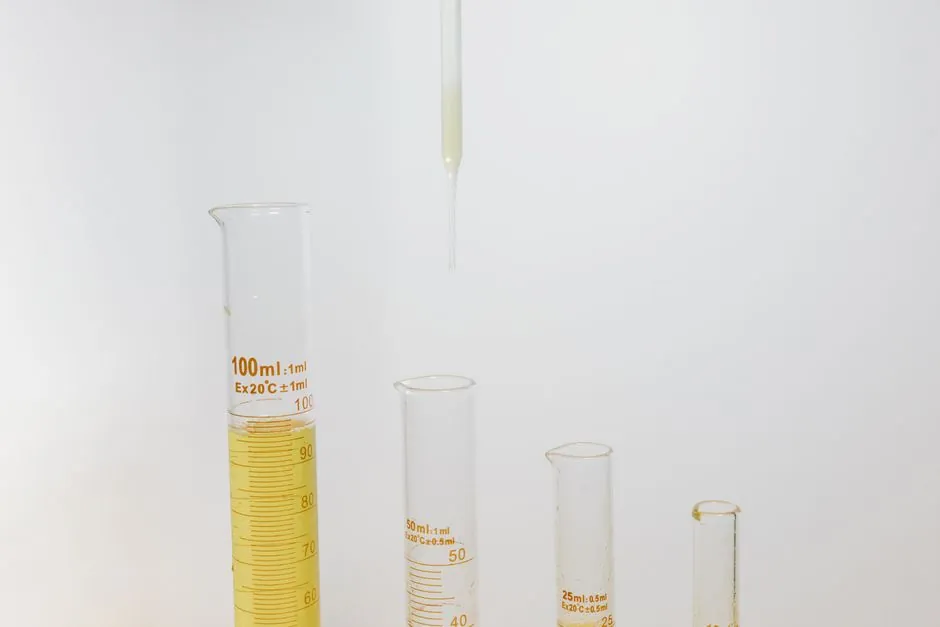
Acetonitrile (ACN, methyl cyanide, CAS 75-05-8) is recovered as a byproduct of the Sohio ammoxidation process for acrylonitrile (ACN-acrylo, C3H3N), where the stoichiometric yield is only about 2 to 4 percent on mass, meaning every 100 tonnes of acrylonitrile produced yields 2 to 4 tonnes of recoverable acetonitrile [S1][S5].
There is no dedicated on-purpose commercial route at scale: acetonitrile supply is therefore a derived function of acrylonitrile operating rates, which themselves respond to acrylic fibre demand, ABS resin demand, and feedstock propylene and ammonia costs, not to pharmaceutical solvent demand [S2][S3][S8].
Yield Geometry: How the 2 to 4 Percent Becomes the Market
The Sohio process (propene + ammonia + oxygen over a bismuth-molybdate or antimony-iron fluidised-bed catalyst at roughly 400 to 510 °C and 1 to 3 bar) generates acrylonitrile as the main product, with acetonitrile, hydrogen cyanide, and acrylonitrile-derived heavies as co-products [S1]. Industry analysis cited by chromatographyonline places the acetonitrile cut at 2 to 4 percent of process mass, and Dataintelo's 2025 to 2034 outlook reaffirms that this byproduct structure is the single binding constraint on merchant availability [S1][S3].
For perspective, ISPE Pharmaceutical Engineering (November-December 2025 issue) noted that 1,000 tonnes per year of ultra-dry acetonitrile is required to support a single 1-tonne-per-year oligonucleotide therapeutic, equivalent to roughly 0.5 percent of global acetonitrile flow, which means a single late-stage API ramp can move several percent of merchant demand against a fixed byproduct ceiling [S3]. When a major acrylonitrile line idles, that 2 to 4 percent sliver shrinks by the same percentage, with no slack to backfill it.
Capacity Moves Defining the 2026 to 2030 Window
Three concrete projects re-shape the supply curve within the 2026 to 2030 planning horizon. First, Asahi Kasei has signalled shutdown of its 200,000-tonne-per-year Mizushima acrylonitrile line around 2030, removing feedstock from the Asian merchant acetonitrile pool [S3]. Second, Ascend Performance Materials started its Chocolate Bayou acetonitrile recovery unit in February 2026, adding downstream purification capacity tied to its acrylonitrile output [S3]. Third, INEOS is adding 15,000 tonnes per year of acetonitrile capacity at Köln, a step that addresses European merchant demand rather than the underlying acrylonitrile yield [S3].
Dataintelo's 2025 base-year data put the global acetonitrile market at USD 800 million, with a forecast of USD 1,295.3 million by 2034 (5.5 percent CAGR) and Asia Pacific holding 45 percent of 2025 value at the fastest regional growth rate of 6.8 percent per year [S3]. HPLC grade led the grade mix at 47 percent of value, while DNA synthesis and anhydrous grade was the fastest-growing slice at 9.5 percent per year, the same segment that competes with oligonucleotide therapeutic scale-up for the ultra-dry cut [S3].
Procurement Criteria: Why Acrylonitrile, Not Demand, Sets the Price
For buyers, the practical implication is that acetonitrile price discovery should track acrylonitrile operating rates, propylene and ammonia spreads, and Asian plant turnaround schedules, not the published pharma or HPLC solvent demand curve [S8]. A useful comparison set for solvent selection against three decision criteria (UV cutoff, water miscibility, viscosity for low-pressure-drop HPLC) is acetonitrile versus methanol versus ethanol, where acetonitrile's 192 nm UV cutoff and low viscosity still set the benchmark for reversed-phase and HILIC methods even when supply is tight [S1].
The two main options for managing exposure are: (1) demand-side substitution, swapping methanol or ethanol into flushing, cleaning, and less sensitive preparative steps while keeping acetonitrile in the UV-critical HPLC and oligonucleotide-coupling positions, and (2) supply-side hardening, with on-site or vendor-located solvent recovery, dual-region qualification, and inventory policies measured against the 2 to 4 percent byproduct ceiling rather than against on-time delivery of generic solvents [S1][S5]. Consequential LCA's constrained-market case study framed this trade-off as the "Great Acetonitrile Shortage" pattern, where marginal consumers (analytical labs and pharma) substitute methanol in non-critical cleaning while critical chromatographic use stays on acetonitrile [S5].
What Recurring Tightness Looks Like in Practice
Historical precedent matters here: the 2008 to 2009 episode was triggered by the 2008 Beijing Olympics shutdown of Chinese acrylonitrile and acetonitrile producers (air-pollution controls kept some plants off-line after the Games) compounded by Hurricane Ike's September 2008 hit on the Texas Gulf Coast, which idled a major US acrylonitrile and acetonitrile producer that was already scheduled for a January 2009 expansion shutdown [S1]. That sequence, an environmental policy event in Asia plus a weather event in North America, is the prototype for modern tightness: acetonitrile has been through multiple shortfalls over roughly 25 years, and the consistent driver is acrylonitrile operating-rate volatility, not acetonitrile demand spikes [S7].
Procurement teams should treat the 2008 to 2009 episode as a template rather than an outlier, and run rolling 12 to 18 month acrylonitrile operating-rate and turnaround calendars as a leading indicator for acetonitrile tightness [S1][S8]. The 2026 to 2030 window is no exception: with the Mizushima line slated for retirement around 2030 and new recovery capacity at Chocolate Bayou and Köln adding downstream (not feedstock) tonnage, the structural answer is tighter, not looser, until on-purpose or bio-acrylonitrile routes reach commercial scale.
For Whom This Matters, and For Whom It Does Not
For analytical labs, oligonucleotide API manufacturers, and peptide synthesis operations running reversed-phase HPLC, HILIC, or solid-phase oligonucleotide DNA synthesis, acetonitrile supply is a primary constraint on throughput, and contract structures with take-or-pay clauses or indexed pricing to acrylonitrile are the right hedge [S1][S2][S3]. For bulk chemical formulators using acetonitrile as a process solvent in non-UV-critical steps (reactor cleaning, line flushing, certain crystallisations), methanol and ethanol substitution is technically viable and is the standard marginal response during tightness [S1][S5].
For procurement at firms with low acetonitrile intensity (under roughly 5 percent of total solvent spend) and no oligonucleotide or HPLC critical path, the 2026 to 2030 supply picture argues for short-cycle contracts and dual-vendor qualification rather than long-dated fixed-price exposure, since the structural ceiling is feedstock, not merchant solvent [S8].
Limits, Failure Modes, and the Sourcing Trail
The single biggest failure mode in acetonitrile supply planning is modelling it as a demand-driven solvent market, which systematically understates the probability of shortfall because the 2 to 4 percent byproduct sliver has no elasticity to price in the short term [S1][S3][S5]. A second failure mode is single-region qualification: with Asia Pacific at 45 percent of 2025 value and the Mizushima 200,000-tonne acrylonitrile retirement around 2030, regional shocks in Northeast Asia propagate directly into global merchant acetonitrile availability [S3]. A third is treating on-site solvent recovery as a strategic rather than tactical lever, since recycle loops in oligonucleotide synthesis can substantially cut virgin ACN demand per kilogram of API, but require capital, distillation capacity, and water-content controls that not every site has [S2].
For process engineers and procurement leads who want a comparable constrained-supply case, the related coverage of process equipment lead times stretching to 128 to 144 weeks against a pre-shortage baseline shows the same pattern: a derived supply curve (transformers from electrical steel and copper; acetonitrile from acrylonitrile) is harder to flex than a direct demand curve, and the procurement response, dual-sourcing, indexed pricing, and inventory buffers, is structurally similar. Related solvent-side guidance is in acetone vs MEK on solvent strength and evaporation rate for engineers weighing the broader flammable-solvent substitution set under NFPA 30 and the anti-static bonding rules covered in OSHA and NFPA drum-transfer bonding.
Trackable signals to watch through 2027: (1) Asahi Kasei's pre-shutdown operating-rate disclosure for Mizushima, since any earlier-than-2030 ramp-down tightens Asian supply immediately; (2) Ascend Chocolate Bayou and INEOS Köln actual nameplate versus start-up reliability, because recovery and downstream capacity only add to merchant availability if they run at design rates; and (3) Chinese acrylonitrile turnaround and environmental-policy calendars, which have been the single most reliable leading indicator of acetonitrile tightness since the 2008 Olympics episode [S1][S3][S8].
For the relevant spec sheets and selection criteria, see power supply, dc power supply, and switching power supply.