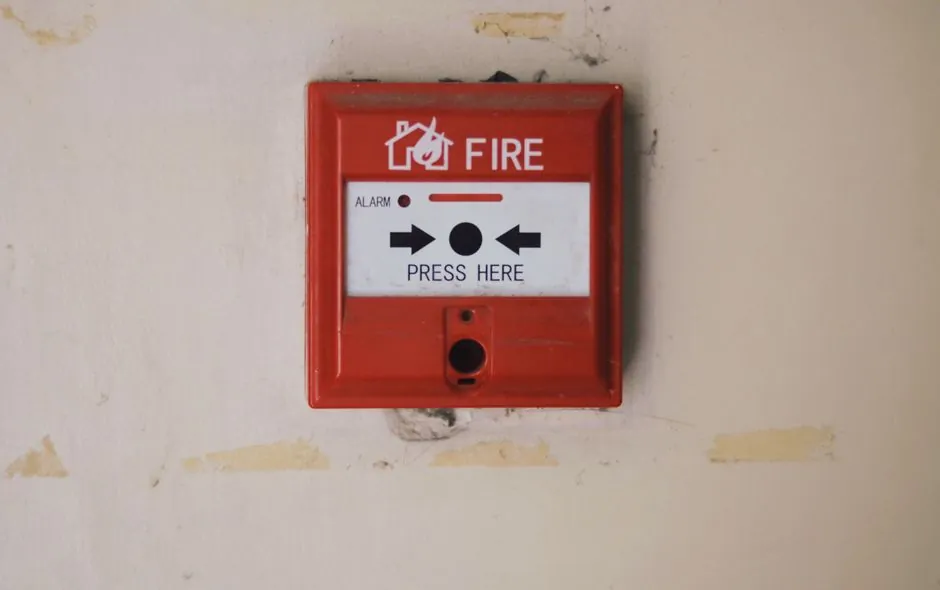
An addressable smoke detector reports an exact device location (room number and detector ID) on a single 2-wire signaling line circuit (SLC) loop, while a conventional detector only reports the zone on a separate radial home-run cable back to the FACP [S2][S3]. The two architectures differ in topology, fault tolerance, and the amount of copper required for the same building footprint, which is the decision point for any specifier or estimator.
For any building under roughly 25,000 sq ft with simple search access, conventional zone wiring still wins on installed cost. Beyond that threshold, or wherever NFPA 72 mandates pinpoint identification, the SLC loop's device density, self-diagnostics, and survivable single-fault wiring make addressable the lower total-cost-of-ownership path [S3][S7].
Wiring topology: radial zone circuits vs a single SLC loop
A conventional system divides the building into detection zones, each on its own dedicated home-run cable from the FACP, with detectors and call points wired in parallel along that radial run [S2][S8]. When a device activates, the panel sees a zone-level current change; it cannot see the device. The simplest practical split is roughly 20 to 30 initiating devices per zone, which keeps end-of-line resistor supervision stable and keeps troubleshooting walks short.
An addressable system runs a single 2-wire SLC loop from the FACP out and back, with up to 99 device addresses (older protocol) or 159 addresses (modern CLIP/SLC Enhanced) per loop on most North American panels [S3]. Each detector, module, and pull station carries a unique DIP-switch or soft address and reports its own state. Compared to a 10-zone conventional building that pulls 10 home-runs, the addressable install typically pulls one loop in plus one out, cutting conduit and homerun conductor count substantially on anything larger than a small retail strip [S2][S7].
Device count, cable count, and conductor requirements
For a 200-detector, 5-story office, the conventional approach tends to land at 8 to 10 zones, each with its own 2-conductor (or 4-conductor with isolators) jacketed fire cable homerun to the FACP, and a separate sounder circuit per floor [S2]. That is 9 to 11 dedicated cables just for detection and notification before you add the dedicated riser for the FACP-to-FACP network.
The addressable version of the same building runs one SLC loop, one notification appliance circuit (NAC) loop, and a few short isolator stubs, with a typical FACP supporting 1 to 2 loops of up to 159 points each [S3][S4]. A useful rule of thumb cited by integrators: for every 10,000 sq ft above 25,000, addressable SLC saves roughly 1 to 2 miles of homerun cable versus equivalent conventional zoning [S2]. This is also why a smoke detector specified for an addressable loop carries a base with an integral short-circuit isolator, while a conventional detector base does not need one.
Fault tolerance: single-cable behavior after a break
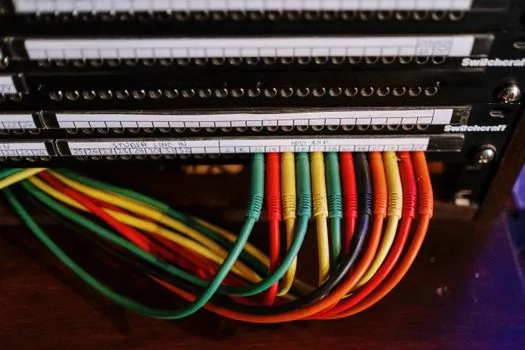
On a conventional radial zone, a single cable cut or detached detector base kills every device downstream of the break on that circuit; the FACP logs a trouble and that whole zone goes blind [S3][S8]. A break inside a zone cannot be rerouted, so the entire downstream run needs physical repair before supervision clears.
On a Class B SLC loop, a single break also drops the devices between the break and the loop end from supervision, so a Class B addressable loop is not actually more fault-tolerant than a conventional zone on that point. The step change happens at Class A (or Class X) wiring, where the loop returns to a second pair of terminals on the FACP. With a Class A return path present, one break anywhere on the loop still leaves every device addressable from either direction, which is the survivability argument that drives most code-mandated addressable retrofits [S3][S7]. Isolator bases segment the loop further so a single short takes out a small group of devices, not the whole building.
Information density: zone text vs device label
A conventional FACP annunciates a zone label, e.g. "Zone 2 - 2nd Floor East", and a first responder walks the zone to find the activated smoke detector or pull station [S3][S4]. In a 30-device zone, that walk is the difference between a 2-minute and a 12-minute locate, which translates directly to incident command decisions on whether to commit interior crews.
An addressable FACP annunciates a 40-character custom label, e.g. "DET-47 / Room 312 / 3rd Flr North", and first responders know the exact room before entry [S3][S4]. Each device also returns analog values: obscuration percentage for an optical smoke chamber, drift-compensation percentage, chamber contamination flag, and "near end of life" pre-alarm, which conventional devices cannot transmit at all. That telemetry is the lever that pulls addressable into the spec for hospitals, schools, and high-rise offices where the AHJ expects device-level maintenance records, not annual zone-based walk tests.
Commissioning, expansion, and lifecycle cost
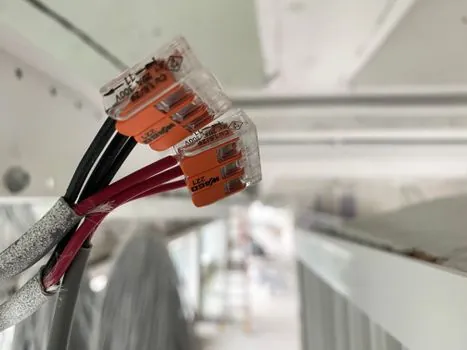
Conventional systems take minutes to commission because each zone is a hardwired pair, and there is no device programming beyond a label [S2][S5]. Addressable systems require a laptop or keypad-driven device-address assignment loop, a custom-label database, and per-device cause-and-effect programming for any output logic (door holders, smoke control, elevator recall), which can stretch first-time commissioning by a full day on a mid-size install [S2][S3].
Expansion is where the ledger flips. Adding a conventional device to a saturated zone means running a new home-run or re-zoning; adding an addressable device means dropping it on the existing SLC loop (within the 159-point budget) and typing one new label into the FACP database [S3][S4][S7]. Over a 20-year service life, a building that has had two tenant fit-outs and one addition recovers the addressable cost premium in avoided conduit and ceiling rework, which is the central TCO argument systems integrators make to facility owners. The same logic shows up in adjacent building-system decisions, for example the NEMA Size 1 vs 32 A IEC contactor cross-walk, where a higher-spec device costs more upfront but reduces panel rework across motor changes.
Where conventional wiring still wins, and where addressable is required
Conventional wiring is the right call for small shops, standalone offices under 2,000 sq ft, single-story warehouses with clear sightlines, dedicated releasing-service panels (like a pre-action or clean-agent system for a server room), and elevator recall-only subpanels that need a few Normally Closed inputs [S2][S5]. It is also the right call when the owner has no plan to integrate with HVAC, access control, or a building management system, because the zone-only information model cannot feed those systems without an addressable module bridging it.
Addressable wiring is the right call, and often code-required, for buildings above the 25,000 sq ft threshold, healthcare occupancies under NFPA 99, new educational occupancies, high-rise buildings per NFPA 92, and any site with smoke-control sequences under NFPA 92B [S3][S4]. A useful pre-spec checklist: count the number of smoke-control dampers, the number of elevator shafts, the number of floors with phased evacuation, and the number of devices the AHJ will want on a 5-year recertification report. If the answer to any of those is greater than one, the addressable SLC loop pays for itself in design hours alone. Pairing the fire panel with addressable gas detector modules in a parking-garage or boiler-room application extends the same loop, so the wiring premium becomes marginal.
Selection matrix: decision criteria lined up
For a working comparison an estimator can put on one page, conventional zone wiring and addressable SLC wiring line up against four criteria from the research. On information granularity, conventional returns a zone label and addressable returns a custom 40-character device label [S2][S3]. On fault tolerance, a conventional radial circuit drops every downstream device on a single break, while an addressable Class A loop keeps every device online through one break via the return path [S3][S7]. On typical device count, conventional zoning settles at 20 to 30 devices per zone, and addressable loops support 99 to 159 devices per SLC [S2][S3]. On lifecycle cost, conventional has the lower upfront material and commissioning labor, addressable has the lower TCO over a 20-year horizon with two or more tenant fit-outs [S4][S7]. Pick the column that matches the building, not the marketing brochure.
Trackable signals for the next planning cycle: NFPA 72 cycle revisions on Class A vs Class B SLC mandates for mid-rise residential, the AHJ push toward device-level inspection records instead of zone-level logs, and the falling unit cost of addressable detector bases with integral isolators, all of which keep narrowing the conventional addressable cost gap. For adjacent building-system specs that follow a similar loop-vs-radial decision pattern, the Hard-Coded Credentials in Industrial Devices vs Default Passwords procurement guide applies the same per-device addressability logic to network security.
Spec-level background on the components involved: wiring duct.