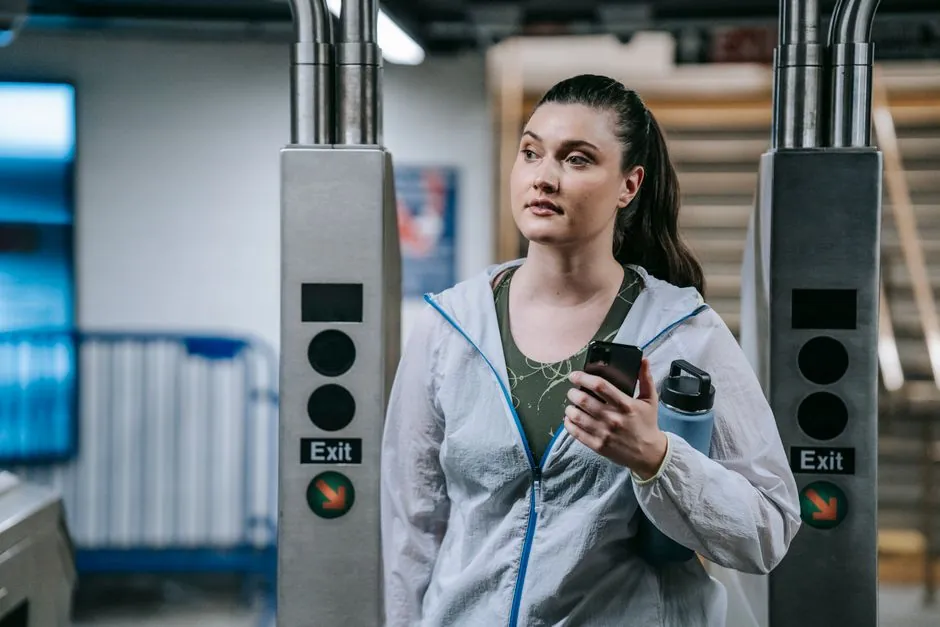
Pedestrian access control turnstiles deliver widely different throughput figures by category: full height mechanical units sit at roughly 10 people per minute (ppm), full height ADA gates and waist-high motorized gates around 6 ppm, optical speed gates with swing barriers at about 20 ppm, and barrier-free optical speed gates at 30 ppm [S3]. Tandem configurations stack lanes side by side, so a tandem full height unit reaches 20 ppm and a tandem optical swing barrier reaches 40 ppm under engineering test data [S3].
Speed gate turnstiles, the optical or flap-barrier style used in corporate lobbies, typically run 30-40 ppm per lane, with selected high-throughput models reaching up to 60 ppm [S5][S9]. Waist-high tripod or barrier-arm units, the most common type in transit and general commercial access, deliver 20-25 ppm [S6]. Practical throughput is almost always lower than nameplate, because the slowest part of the cycle is usually the user, not the reader or the gate [S3].
Type-by-Type Throughput Comparison
Real-world throughput figures cluster into a small number of bands. Full height turnstiles (rotating arm or "tornado" style) deliver approximately 10 ppm per lane because the user has to physically push through three or four arms [S3]. Full height man-trap configurations are the slowest at roughly 3 ppm, since only one occupant is admitted per cycle [S3]. Optical speed gates with swing or retractable glass barriers are the fastest conventional design at 20 ppm barrier and 30 ppm barrier-free per lane, with tandem optical units reaching 40 ppm [S3][S6]. A general design rule is 1-2 seconds per person for optical and waist-high units and 3-4 seconds per person for full height units, assuming proximity cards and a 250 ms access system response [S4].
Speed gate turnstiles in 2026 product lines are commonly rated 30-40 ppm, with operating temperature windows of -20°C to +75°C and biometric-ready controllers [S9]. One published BOM benchmark puts selected high-throughput speed gates at up to 40-60 ppm, achieved by stacking credential reads in the controller so the next user can present while the previous user is still walking through [S4][S9]. Heavy-duty tripod turnstiles, including models such as the BLS-T302, are rated for more than 5 million operating cycles, a useful proxy for service life in stadium or transit service [S5].
Free Access vs. Controlled Access
Every throughput number above assumes controlled access, where the user must present a credential, the control cabinet verifies it, and a signal unlocks the turnstile [S1]. Free access, used almost exclusively for the exit side, leaves the lane constantly unlocked or auto-cycles on a presence sensor, and therefore moves faster than controlled access under identical hardware [S1][S4]. This is why designers always pair a controlled entry lane with a free-exit lane or a separate exit turnstile, rather than trying to reverse the same lane in shifts.
The access system response time is the hidden ceiling. Even a turnstile mechanically capable of 30 ppm will only deliver that figure if the credential reader, the controller, and the door-release relay all respond inside the 1-2 second window [S1][S4]. A swipe card reader, a PIN-pad proximity reader, or a slow biometric matcher will all drop effective throughput versus a hands-free long-range proximity reader, which lets the user keep the card in a wallet or bag [S1][S4].
Sizing Formula: Patrons, Time, and Lanes
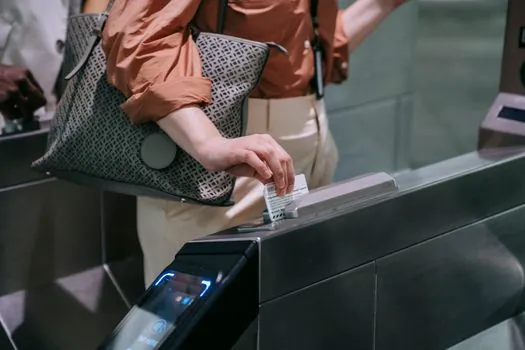
The standard sizing formula in the access-control industry is (Number of Patrons / time allotted) / rate of throughput = number of turnstiles required [S4]. Worked example: 4000 patrons admitted in 30 minutes, at 30 ppm per turnstile, requires (4000/30)/30 = 4.44, so 5 lanes [S4]. The same 4000 patrons through 10 ppm full height units would need 14 lanes inside the same 30-minute window.
Designers always pad the math because real users do not arrive in formation. Misplaced cards, socializing at the lane, badge re-issuance at visitor desks, and slow-walking accessibility users all eat into the theoretical rate [S2]. A common professional practice is to add 20-30% to the calculated lane count, and to make sure the lobby queueing area can hold at least one minute of peak patron volume without spilling into adjacent corridors [S2]. Property-management buildings tend to optimize for customer experience, while corporate HQs accept slightly slower lanes in exchange for higher security, so the throughput target is a policy decision as much as an arithmetic one [S2].
Selection Criteria by Use Case
For stadiums, transit hubs, and high-throughput lobbies, optical speed gates with swing or retractable barriers are the default choice, with 20-40 ppm per lane and the ability to stack reads for up to 60 ppm in premium models [S3][S9]. Biometric-ready speed gates with -20°C to +75°C operating range and IP54-IP65+ enclosures are appropriate for outdoor or semi-outdoor installations, with 316 stainless steel specified for coastal sites and 304 stainless steel for standard outdoor duty [S5].
For industrial sites, warehouses, and construction perimeters, full height mechanical turnstiles remain the workhorse: cheaper than speed gates, harder to tailgate, and rated for millions of cycles, but capped at roughly 10 ppm per lane [S3][S5][S6]. For office lobbies with mixed visitor and employee traffic, waist-high motorized gates at 6 ppm handle ADA-compliant throughput for wheelchair users, paired with separate optical speed gates for badge-holding staff at 20-30 ppm [S3]. Tripod turnstiles (a waist-high variant) are widely deployed in transit and general commercial access at 20-25 ppm, and represent a middle ground between cost and throughput [S6].
Failure Modes and Sizing Constraints

The three practical constraints that break the throughput math are: (1) credential transaction time, especially with PIN-pad or match-on-card biometric readers [S1][S4]; (2) ADA tailgate and piggyback detection, where optical sensors force a single-occupant cycle and drop effective rate versus nameplate [S3]; and (3) controller-stacked reads that vendors advertise as "up to 60 ppm," which only hold when the next user is pre-staged and the credential database responds in under 250 ms [S4][S9].
For a sense of how this connects to per-door economics across credential types, see the card vs biometric cost comparison benchmark. Mechanical reliability is the other limit: heavy-duty tripod units are rated above 5 million cycles, but a 10,000-patron-per-day stadium will eat that budget inside 18-24 months if the lane is not on a preventive maintenance plan, and the rated cycle count should be read as a design guideline, not a warranty period [S5].
Standards, Sourcing, and Trackable Signals
Turnstile throughput is not a regulated number, so it lives in manufacturer datasheets and integrator field data rather than in IEC or ISO standards. Useful sources to cross-check are the manufacturer passthrough rate tables (TURNSTILES.us compiled set at 3-30 ppm by type) [S3], OEM pages listing speed gate throughput in the 30-40 ppm range with -20°C to +75°C envelopes [S9], and independent integrator guidance giving the (patrons / time) / ppm formula with a 2-second baseline for optical and waist-high units [S4]. Material selection for outdoor lanes is the one place standards do bite: 316 stainless for coastal or salt-air sites, 304 stainless for standard outdoor, and IP54 minimum, IP65 preferred for heavy-rain or dusty industrial locations [S5].
Track the next 6 months for: (1) speed-gate product lines pushing nameplate throughput past 60 ppm by stacking reads and using AI-assisted anti-tailgate, and (2) the first wave of biometric-default access control rollouts that will drop effective throughput on legacy lanes and force re-sizing of existing corporate lobbies. For outdoor stainless selection, the 201 vs 304 vs 316 banding comparison is a useful cross-reference on which grade survives which environment.
Component reference pages worth checking: access scaffold.