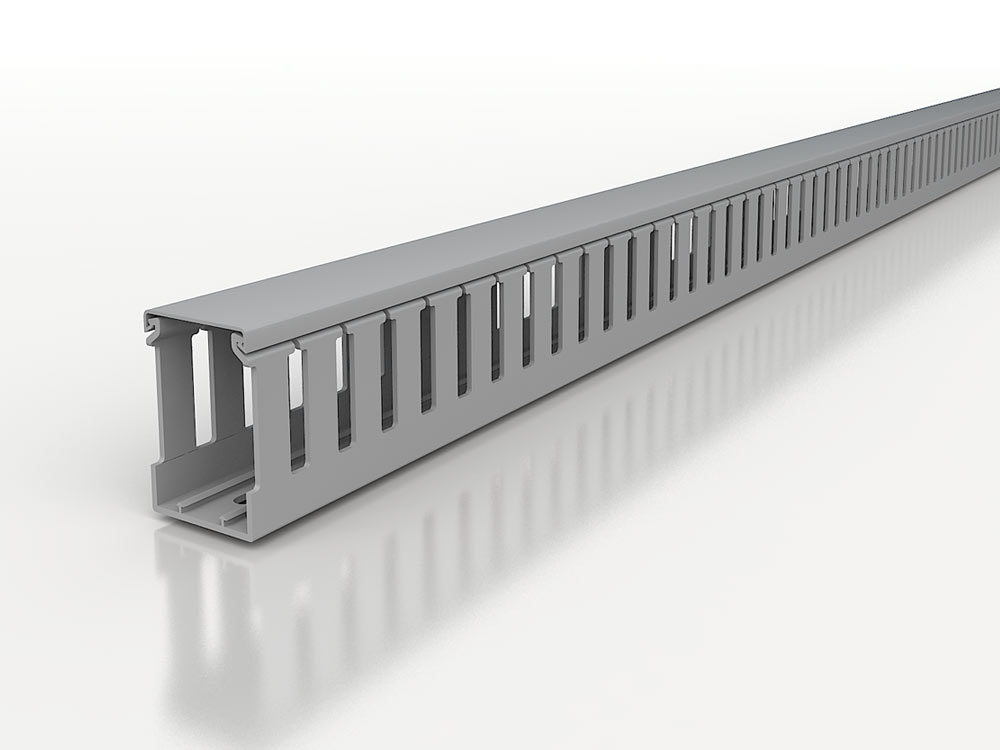
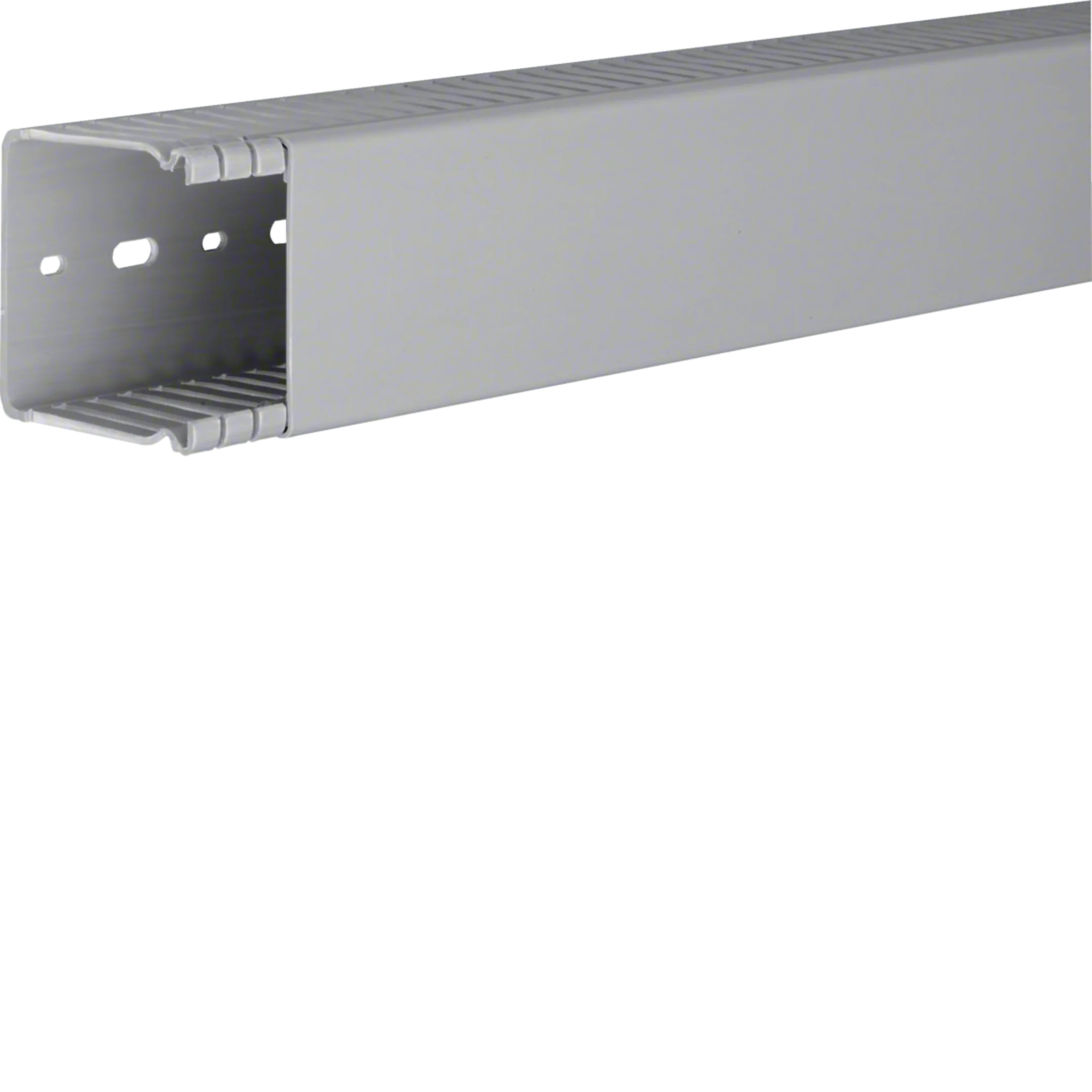
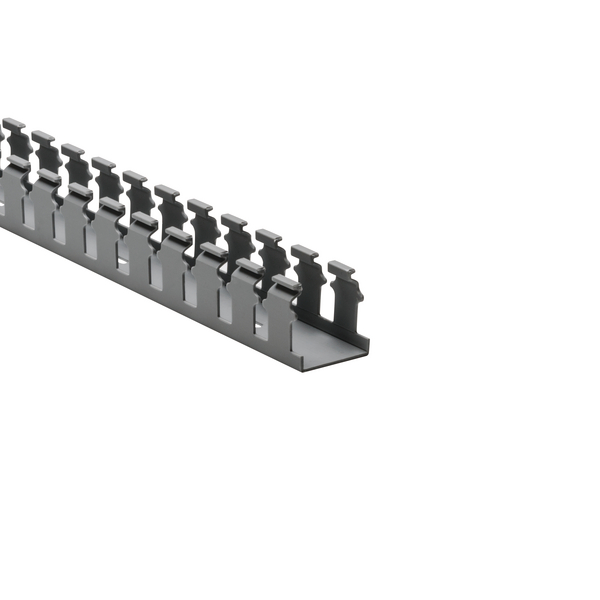
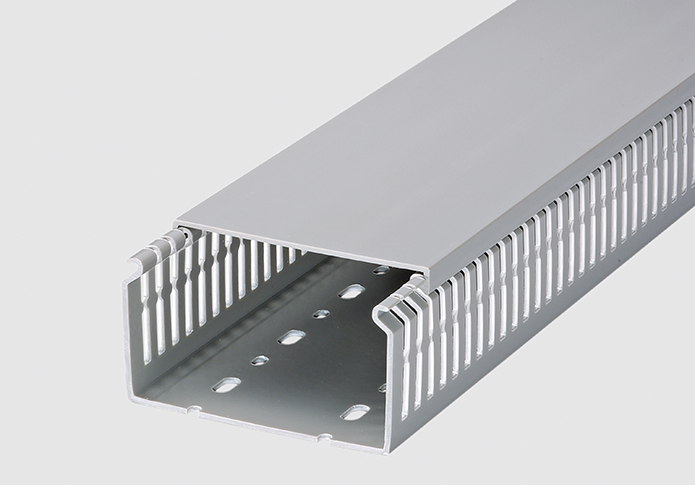
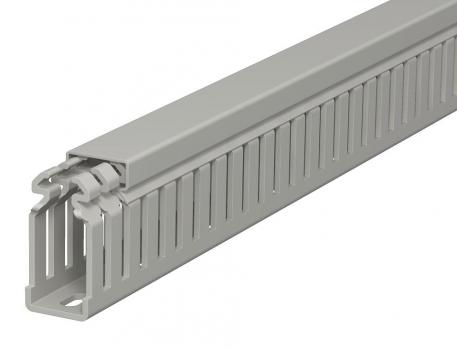
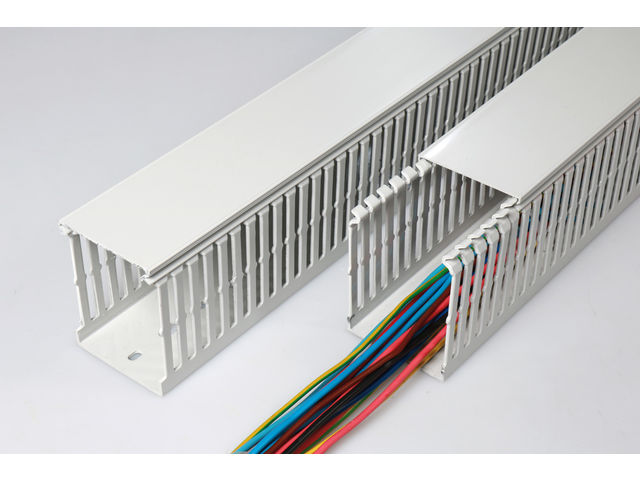
Wiring duct, also called wire duct or slotted cable trunking, is the enclosed plastic channel that routes control and signal wiring inside electrical panels, control cabinets, and machine enclosures. A slotted base mounts to the back panel, wires exit toward terminals through openings in the side walls, and a snap-on cover hides and protects the bundle. It is one of the most ubiquitous components in panel building, yet selection mistakes around slot style, material grade, and fill ratio are common and costly to rework.
This page treats wiring duct as a specified engineering product rather than a commodity. It maps the slot styles to terminal density, separates PVC from halogen-free materials, decodes the part-number sizing logic, and lists the UL and EN standards a buyer should see on a datasheet before issuing a purchase order.
This guide is aimed at industrial purchasing engineers and panel-build design engineers. It covers 6 chapters from what wiring duct is, through slot styles, materials, sizing and fill ratio, spec-sheet decoding, to selection decisions, with 7 selection FAQs and manufacturer references. All parameters reference public standards including UL 1565, UL 62275, EN 50085-2-3, EN 50085-1, IEC 61084, NFPA 79, UL 508A, and UL 94.
Chapter 1 / 06
What is a Wiring Duct
A wiring duct is an enclosed channel, almost always a rigid extruded thermoplastic, that organizes and protects insulated conductors inside control panels and cabinets. The standard form is two parts: a slotted base that fastens to the mounting plate, and a removable cover that snaps over the top. Wires enter the channel, travel along the bus of the panel, and exit through openings in the side walls toward terminal blocks, relays, contactors, and field-wiring terminals. The result is a panel where every wire follows a defined path, the harness is hidden, and a technician can open a cover to add or trace a conductor years later.
Wiring duct belongs to a broader family that international standards call cable trunking systems. EN 50085-1 defines a cable trunking system as a closed enclosure, comprising a base with a removable cover, intended for the accommodation of insulated conductors, cables, and possibly other electrical equipment. The slotted variant intended specifically for installation inside cabinets is the subject of EN 50085-2-3, mirrored internationally by the IEC 61084 series. These systems are rated for installations up to 1,000 V a.c. and 1,500 V d.c., which covers essentially all low-voltage panel wiring.
It is important to distinguish wiring duct from adjacent products that share a similar appearance. A conduit is a round, fully enclosed raceway with no side openings, used to carry conductors through walls and outdoor runs. A cable tray is an open or perforated support structure for building-scale power and data distribution, carrying load over long spans rather than enclosing wires in a cabinet. A surface raceway is a decorative on-wall channel for offices. Wiring duct is the panel-interior product: it lives behind the door of a control cabinet, its defining feature is the slotted side wall that lets wires break out at any point toward nearby terminals.
The function is humble but the engineering consequences are real. Tidy wire routing through duct keeps power and signal conductors physically separated, which reduces electromagnetic coupling and crosstalk. The enclosed channel and cover protect insulation from abrasion and from contact during service. Defined wire paths shorten fault-finding time and make a panel maintainable across its 15 to 25 year service life. A panel wired without duct, with conductors bundled by zip ties or laid loose, may pass a power-on test, but it fails the audits, the EMC expectations, and the serviceability that industrial buyers actually pay for.
Three engineering choices dominate a wiring duct decision: slot style, which must match terminal density and wire size; material and fire grade, which must match the installation environment and applicable fire code; and size with fill ratio, which must accommodate the final conductor count with margin. The chapters below address each in turn, then assemble them into a selection sequence.
Chapter 2 / 06
Slot Styles and Types
The single most distinguishing feature of a wiring duct is the geometry of its side walls, which determines how and where conductors break out toward terminals. Manufacturers organize their catalogs around a handful of named slot styles. Using Panduit Panduct nomenclature as a widely recognized reference, the principal types are narrow slot (Type F), wide slot (Type G), solid wall (Type FS), round hole (Type D), and metric and hinged-cover variants built on the same families. The table below compares the core styles and their best-fit use.
Slot style
Typical slot width
Side-wall geometry
Best fit
Narrow slot (Type F)
~6.0 mm (0.24 in)
Fine fingers, close pitch
High-density terminal blocks, small control wires
Wide slot (Type G / H)
~7.9 mm (0.31 in)
Wide fingers, large openings
Larger bundles, thicker cables, power wiring
Solid wall (Type FS)
0 mm (no slots)
Closed sides
Full enclosure, EMC separation, no side egress
Round hole (Type D)
Defined holes
Discrete circular exits
Fixed exit points, individual conductors
Hinged cover
Per base style
Cover hinged to base
Frequent access, captive cover
Narrow slot duct uses fine fingers at a close pitch, with a slot opening around 6 mm and finger width near 6.5 mm on typical halogen-free profiles. The narrow opening keeps small-diameter control conductors captive inside the channel and aligns the breakout pitch with the spacing of modern high-density terminal blocks and I/O modules. Narrow slot is the default for control and signal wiring in densely packed cabinets, where each wire must exit at a precise position and the cover should not bulge under a tightly managed harness.
Wide slot duct presents larger openings, around 7.9 mm, between broader fingers. The wide slot is intended for routing larger quantities and diameters of cable, where bundles need to enter and leave at varied points and the extra opening eases the bend radius of thicker conductors. Wide slot is common where power and control mix, or where a single duct run feeds widely spaced equipment.
Solid wall duct has no side openings at all. It is chosen where conductors must remain fully enclosed for the entire run: for clean separation of sensitive signal cabling from power, for runs that pass through areas with no terminals to feed, or where a fully closed channel is preferred for appearance and protection. Round hole duct provides discrete circular exits and suits applications that need conductors to leave at specific, repeatable points. Hinged-cover variants keep the cover captive to the base, which speeds repeated access and prevents lost covers in panels that are serviced often.
The fingers of most slotted duct are pre-notched at snap-off points, so an installer can remove a finger to widen an opening where a large bundle must break out. This field-adjustability is a practical advantage of slotted duct over fixed-aperture products. When selecting, match the slot pitch to the terminal spacing of the components the duct will feed, and confirm the slot width comfortably clears the largest single conductor that will exit at any point.
Chapter 3 / 06
Materials and Fire Performance
The polymer a wiring duct is made from determines its fire behavior, temperature range, weight, cost, and suitability for a given installation code. Three material families cover almost all industrial duct: rigid PVC, heat-resistant PVC, and halogen-free compounds such as PC/ABS or modified PPO. Fire performance is the property that most often forces a material choice, because it is governed by the application standard rather than left to preference. The table below summarizes the families.
Material
Flammability
Continuous temperature
Relative cost
Typical use
Rigid PVC
UL 94 V-0
~50 to 60 °C
Low
General industrial panels
Heat-resistant PVC
UL 94 V-0
~85 °C
Low to medium
Warm panels, near heat sources
Halogen-free PC/ABS
UL 94 V-0
-25 to +90 °C
Medium to high
Rail, tunnels, ships, public buildings
Halogen-free PPO
UL 94 V-0
up to +105 °C
High
High-temperature halogen-free duty
Rigid PVC is the workhorse material for the great majority of control panels. It is inexpensive, extrudes cleanly into precise profiles, and is formulated to self-extinguish at the UL 94 V-0 level, the most demanding of the common UL 94 classifications. Some standard PVC product lines carry a UL recognized continuous-use temperature near 50 degrees Celsius. The drawback of PVC is its chlorine content: when it burns it releases hydrogen chloride, a corrosive and toxic gas, and dense smoke. In an enclosed cabinet that an electrician opens, this matters less than in a tunnel full of people, which is why code, not preference, drives the upgrade away from PVC.
Heat-resistant PVC grades push the continuous-use temperature to roughly 85 degrees Celsius while keeping the V-0 rating and the low cost. They are the right choice for panels that run warm, sit near drives and transformers, or operate in hot ambient environments, where standard PVC could soften or distort over time. Buyers should confirm the rated continuous temperature on the datasheet, because the term heat-resistant is used loosely across catalogs.
Halogen-free duct, often labeled LSZH for low smoke zero halogen, is specified where a fire would create a life-safety hazard in a confined or crowded space. Typical compounds are PC/ABS alloys and modified PPO. When these burn they do not release corrosive halogen gases or dense toxic smoke, which protects both people and adjacent equipment. Halogen-free PC/ABS duct from established makers commonly spans -25 to +90 degrees Celsius and carries UL 94 V-0 plus, for transport, EN 45545-2 rail fire and smoke compliance. Halogen-free material is roughly 20 percent lighter than PVC but costs more, so it is applied where the standard requires it: rail rolling stock, metro and road tunnels, ships, data centers, hospitals, and densely occupied public buildings.
Two cautions on fire ratings. First, the UL 94 flammability class and the continuous-use temperature are independent properties: a V-0 duct can still soften above its rated temperature, so both numbers must be checked. Second, for installations that reference glow-wire testing (common in IEC-region enclosures), verify the glow-wire performance, not just the V-0 mark, because they assess different ignition scenarios. RoHS compliance, restricting hazardous substances in the polymer, is now standard across reputable manufacturers and should appear on the documentation.
Chapter 4 / 06
Sizing, Fill Ratio, and Standards
Sizing a wiring duct means choosing a cross-section large enough to carry the final conductor count with room to spare, then confirming that the chosen profile is available in the right material and slot style. Catalog sizing follows a straightforward width-by-height logic, usually expressed in the part number itself. The table below shows the common size range using representative imperial and metric profiles.
Profile (W x H)
Metric equivalent
Standard length
Typical use
0.5 x 1 in
~12 x 25 mm
6 ft (1.83 m)
Light control wiring, tight panels
1 x 2 in
~25 x 50 mm
6 ft (1.83 m)
General control panels
2 x 3 in
~50 x 75 mm
6 ft (1.83 m)
Mixed power and control runs
3 x 3 in
~75 x 75 mm
6 ft (1.83 m)
High-count main wireways
4 x 4 in
~100 x 100 mm
6 ft (1.83 m)
Large distribution panels
Metric 25 x 25
25 x 25 mm
2 m
IEC-region control cabinets
Metric 40 x 60
40 x 60 mm
2 m
IEC-region mixed wiring
Two supply conventions matter when ordering. In imperial markets the standard section length is 6 feet (1.83 m), and the duct is sold as a slotted base plus a separate snap-on cover that must be ordered to match. In metric markets the common section length is 2 m, frequently packaged in multi-section cartons, for example 25 sections totalling 50 m. The dominant interior color is light gray in the RAL 7035 family, chosen to match control panel interiors, with white, black, and blue also widely stocked. Read the part number carefully: makers encode width, height, color, and length into the code, so a value like G.5X1LG6 decodes to a Type G wide slot base, 0.5 inch by 1 inch, light gray, 6 foot.
Fill ratio is the discipline that separates a clean, serviceable panel from one that fails inspection. Wiring duct is not bound by a single mandatory fill code the way conduit is governed by the National Electrical Code, but the industry borrows the same logic. NEC Chapter 9, Table 1 limits conductor fill in conduit to 40 percent of internal cross-sectional area when three or more conductors are present, reserving the remaining 60 percent for heat dissipation and for pulling without abrading insulation. Applied to wiring duct, experienced panel builders design to a 30 to 40 percent fill so the cover seats flat without bowing, wires lift out cleanly for service, heat is not trapped against conductors in a way that derates their ampacity, and there is headroom for future circuit additions.
Overfilling is one of the most common defects in field-built panels. A duct packed beyond its cover capacity will push the cover off, exposing wires and defeating the protection the duct exists to provide. A tightly packed channel traps heat, which can force a derating of the conductors it carries. And a full duct makes the panel difficult and slow to modify, raising the labor cost of every future change. The remedy is to size the duct to the final conductor count plus a deliberate spare margin, not merely to the wires installed on the first day.
On the standards side, buyers should look for specific marks rather than generic claims. In North America the relevant references are UL 1565 for positioning devices and wiring duct, UL 62275 for cable management systems as the harmonized successor reference, and CSA C22.2 No. 18.5 in Canada. At the panel level, NFPA 79 governs the electrical wiring of industrial machinery and UL 508A governs the construction of industrial control panels, both of which dictate how duct is used. In Europe and IEC regions the controlling documents are EN 50085-2-3 for slotted cable trunking installed in cabinets, applied with the general requirements of EN 50085-1, mirrored by the IEC 61084 series. A wiring duct datasheet that cites these standards, plus UL 94 for flammability and RoHS for substances, gives a buyer the traceability to defend the selection.
Chapter 5 / 06
Key Specification Parameters
Reading a wiring duct datasheet is straightforward once the eight decision-driving parameters are separated from the marketing copy. The same product line may list a dozen dimensions and features, but selection hinges on slot style, internal cross-section, slot and finger dimensions, material, flammability rating, continuous-use temperature, color and length, and the standards cited. Each is explained below.
Slot style and pitch is the first parameter, because it must align with the terminal density the duct will feed. Narrow slot for high-density control, wide slot for larger bundles, solid wall for full enclosure, round hole for discrete exits. The slot pitch (the spacing between openings) should match or evenly divide the terminal-block pitch so wires exit opposite their landing points without crossing.
Internal cross-section determines how many conductors the duct carries at the target fill ratio. Catalog dimensions are usually external width by height, so subtract the wall thickness, or use the manufacturer wire-capacity table, which states how many conductors of a given gauge fit at a recommended fill. Sizing to internal area at 30 to 40 percent fill is the reliable method.
Slot width and finger width set the largest single conductor that can break out and how securely small wires are retained. Representative halogen-free narrow profiles run a 6.0 mm slot with 6.5 mm fingers; wide slot profiles open to roughly 7.9 mm. Confirm the slot clears your largest exiting conductor, including its insulation and any ferrule.
Material drives fire behavior, temperature, weight, and cost, as detailed in Chapter 3. The datasheet should state the polymer explicitly: rigid PVC, heat-resistant PVC, PC/ABS, or PPO, and whether it is halogen-free or LSZH.
Flammability rating is most often UL 94 V-0, the self-extinguishing class required for panel-interior plastics. For IEC enclosures, also check glow-wire performance, and for transport check EN 45545-2. The V-0 mark alone does not describe high-temperature behavior.
Continuous-use temperature is an independent property from flammability. Standard PVC may be rated near 50 to 60 degrees Celsius, heat-resistant PVC to about 85 degrees Celsius, and halogen-free PC/ABS across -25 to +90 degrees Celsius, with some PPO grades to +105 degrees Celsius. Match this to the panel hot spot, not the room ambient.
Color and standard length affect both appearance and bill-of-materials accuracy. Light gray (RAL 7035 family) dominates, with white, black, and blue available. Standard sections are 6 ft (1.83 m) in imperial markets and 2 m in metric markets, and the cover is frequently a separate line item from the base.
Cited standards close the loop on traceability. Look for the relevant subset of UL 1565, UL 62275, CSA C22.2 No. 18.5, EN 50085-2-3, EN 50085-1, IEC 61084, NFPA 79, UL 508A, UL 94, and RoHS. A datasheet that names the standards it meets is far easier to defend in an audit than one that asserts compliance in general terms.
Chapter 6 / 06
Selection Decision Factors
To turn the knowledge above into a specific order, follow the decision sequence below. Most selection mistakes come not from a single wrong value but from deciding size before slot style, or material before checking the applicable fire code. These eight steps double as a fixed RFQ checklist for a panel-build bill of materials.
Application and fire code first: Identify the installation, general industrial cabinet, rail vehicle, tunnel, ship, data center, or public building, and the fire standard it imposes. This decides PVC versus halogen-free before any dimension is chosen, because the code is not optional.
Slot style to terminal density: Choose narrow slot for high-density control wiring, wide slot for larger bundles and power, solid wall for full enclosure or EMC separation, round hole for discrete exits. Match the slot pitch to your terminal-block spacing.
Size to final fill, not day-one count: Select the internal cross-section so the final conductor count plus a spare margin sits at 30 to 40 percent fill. Use the maker wire-capacity table where available, and round up rather than down.
Material and temperature: Confirm the polymer (rigid PVC, heat-resistant PVC, PC/ABS, PPO) and its continuous-use temperature against the panel hot spot. Verify UL 94 V-0 and, where required, glow-wire and EN 45545-2.
Slot and finger clearance: Verify the slot width clears your largest single exiting conductor including insulation and ferrule, and that finger width retains your smallest wires.
Standards and certification: Require the datasheet to cite the relevant marks for your region: UL 1565 / UL 62275 / CSA C22.2 No. 18.5 in North America, EN 50085-2-3 / EN 50085-1 / IEC 61084 in Europe and IEC regions, plus NFPA 79 or UL 508A at the panel level and RoHS for substances.
Color, length, and cover: Confirm color (light gray RAL 7035 family is standard), section length (6 ft imperial or 2 m metric), and that the matching cover and any couplers are on the bill of materials as separate line items.
Accessories and total install cost: Account for covers, dividers, end caps, mounting hardware, and adhesive-back versus screw-mount bases. The duct itself is cheap; the labor to size, cut, mount, and re-cover it dominates the installed cost, so a clean fill plan pays back in build and service time.
One frequently overlooked dimension is serviceability over the panel lifetime: whether covers stay captive or get lost, whether the slot pitch leaves room to add wires later, and whether the material survives the cabinet thermal cycle for 15 to 25 years without becoming brittle. Panduit, ABB Installation Products (formerly Thomas & Betts, TyDuct), HellermannTyton, and Legrand all maintain broad standardized ranges with documented certifications and stable supply, which lowers the long-term risk of a discontinued profile leaving a panel design unsupportable.
FAQ
What is the difference between a wiring duct and a cable tray?
A wiring duct (also called a wire duct or slotted cable trunking) is an enclosed channel with a removable cover and slotted side walls, mounted inside control panels and cabinets to route low-voltage control and signal wiring tidily between components. A cable tray is an open or perforated support structure used for building-scale power and data distribution along walls and ceilings. Wiring duct is governed by panel-building standards such as UL 1565, UL 62275, and EN 50085-2-3 for slotted trunking in cabinets, while cable tray follows NEMA VE 1 and IEC 61537. Wiring duct prioritizes wire egress through side slots and a removable cover; cable tray prioritizes load-bearing span and ventilation.
What does the slot style of a wiring duct mean, and how do I choose it?
Slot style refers to the geometry of the openings in the side walls through which wires exit toward terminals. Narrow slot (typically a 6 mm slot with about 6.5 mm fingers, such as Panduit Type F) closely matches high-density terminal blocks and keeps small-diameter control wires captive. Wide slot (about 7.9 mm slot, such as Panduit Type G) eases routing of larger bundles and thicker cables. Solid wall (Type FS) has no slots and is used where wires must stay fully enclosed for EMC separation or where no side egress is needed. Round hole (Type D) suits applications needing specific exit points. Match the slot pitch to your terminal spacing and the slot width to your largest single conductor.
Should I use PVC or halogen-free wiring duct?
Standard rigid PVC is the default for general industrial panels: it is inexpensive, self-extinguishing to UL 94 V-0, and rated for continuous use around 50 to 85 degrees Celsius depending on grade. Halogen-free (LSZH) duct, typically made of PC/ABS or modified PPO, is specified where fire generates a life-safety risk in confined or public spaces: rail vehicles (EN 45545-2), tunnels, ships, data centers, and crowded buildings. When halogen-free duct burns it does not release corrosive hydrogen chloride or dense toxic smoke. Halogen-free grades also tend to carry a wider temperature range, for example -25 to +90 degrees Celsius, and weigh roughly 20 percent less than PVC, at a higher unit price.
How full can I fill a wiring duct?
Wiring duct is not covered by a single mandatory fill code the way conduit is, but industry practice borrows the NEC conduit logic: keep wires below about 40 percent of the duct cross-sectional area for normal runs. Many panel builders design to 30 to 40 percent so the cover seats without bowing, wires pull freely, heat dissipates, and there is room for future additions. Overfilling causes covers to pop off, traps heat that derates conductor ampacity, and makes service rework difficult. Size the duct to the final wire count plus a spare margin, not just the day-one bundle.
What temperature can wiring duct withstand?
It depends on the polymer. Common rigid PVC wiring duct carries a UL recognized continuous-use temperature of roughly 50 degrees Celsius for some product lines, while heat-resistant PVC grades are rated to about 85 degrees Celsius. Halogen-free PC/ABS or PPO ducts commonly span -25 to +90 degrees Celsius, and some industrial grades reach +105 degrees Celsius. The flammability rating (UL 94 V-0 self-extinguishing) is a separate property from the continuous-use temperature. For panels near heat sources, verify both the upper continuous temperature and the glow-wire performance, not just the V-0 mark.
Which standards govern wiring duct?
In North America the relevant marks are UL 1565 (positioning devices and wiring duct), UL 62275 (cable management systems, the harmonized successor reference), and CSA C22.2 No. 18.5. Panel-level installation references NFPA 79 (industrial machinery) and UL 508A (industrial control panels). In Europe and IEC regions, slotted cable trunking for installation in cabinets is covered by EN 50085-2-3, used with the general requirements of EN 50085-1, mirrored internationally by the IEC 61084 series. Flammability is classified by UL 94, environmental compliance by RoHS, and rail applications add EN 45545-2 fire and smoke requirements.
Which manufacturers make industrial wiring duct?
Panduit (Panduct Type F narrow slot, Type G wide slot, Type FS solid wall, Type D round hole, plus metric and hinged lines) and ABB Installation Products (formerly Thomas & Betts, TyDuct) lead the North American market. HellermannTyton (HelaDuct, including HTWD-HF halogen-free PC/ABS lines) and Legrand are strong in Europe and IEC regions. Other established suppliers include Iboco, RS PRO and Pro Power for general industrial use. Verify the specific slot style, material grade, UL or EN certification, and continuous-temperature rating on the datasheet rather than relying on a series name alone, because each maker offers many variants under one family.
Wiring Duct Manufacturers
Source-backed product routes. Open a company dossier for procurement scope and cited evidence.