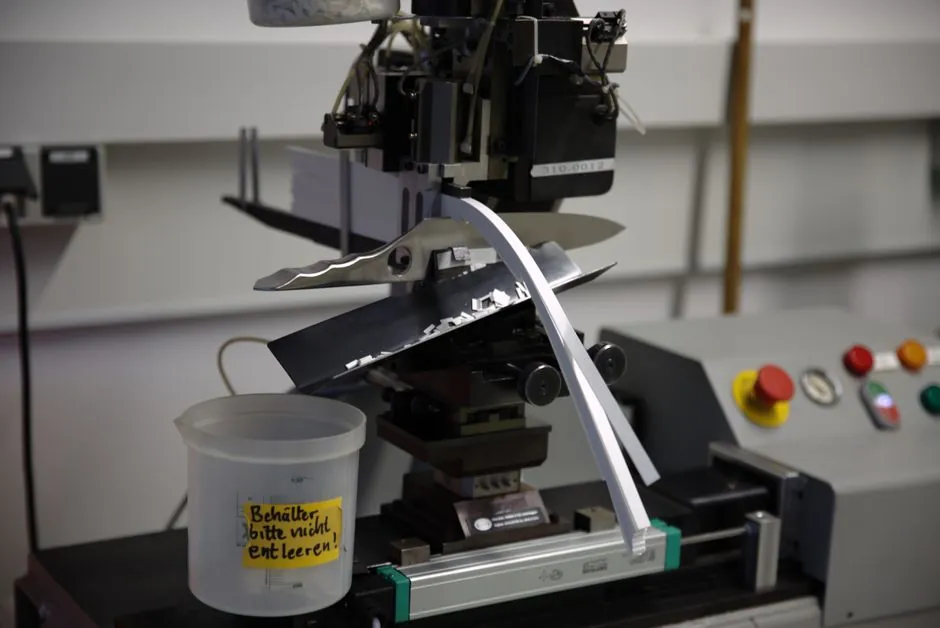
Vibration loading degrades adhesively bonded single-lap joints faster than equivalent quasi-static cyclic loading at the same peak force, with measurable drops in modal stiffness and back-face strain visible by mid-life [S2].
For structural epoxy and modified epoxy bonds, fatigue failure typically initiates at 20–40 percent of the static single-lap shear strength once cycles exceed the 10⁴–10⁵ range, and the Paris-law exponent B for adhesive FCGR commonly falls between 2 and 6 depending on mode-mixity and bondline thickness [S2][S4].
Why vibration fatigue is harsher than quasi-static cyclic
Vibration input at the bonded-joint natural frequency concentrates cyclic strain at the bondline overlap ends, where the peel stress peaks, so the same peak force that a quasi-static test survives will drive earlier delamination when applied dynamically [S2]. The Du et al. modal-property study showed that first natural-frequency shifts and damping-factor changes track fatigue damage in single-lap joints, giving an in-situ NDT signal for life consumption [S2]. In LS-DYNA simulations of automotive single-lap and stepped-lap specimens, the Paris-law formulation d a/dN = D(ΔG)^B combined with a cohesive zone model reproduced measured S-N curves within the typical engineering band of ±15 percent when the exponent B was fitted per adhesive [S4]. For parts mounted near engines or other vibration-dense zones, the practical rule is to derate the static allowables by 2.5–4× rather than apply a single generic knockdown, because the dynamic-to-static ratio is geometry-dependent [S4].
Core variables that move the S-N curve
Adhesive bondline thickness, mode-mixity, R-ratio, and loading frequency each shift the S-N curve independently, so a single curve should never be carried across geometries without re-checking [S4][S7]. The Pederbelli et al. bi-material study quantified loading-frequency effects on fatigue response, showing that viscoelastic adhesives shift their hysteresis loop area and mean-stress relaxation with frequency, which alone can change cycles-to-failure by a factor of 2–3 across the 1–100 Hz band typical of structural vibration [S7]. Bondline thickness below roughly 0.1 mm increases peel stress concentration and lowers fatigue life, while thickness above about 0.5 mm introduces more compliant shear and can either help or hurt depending on substrate stiffness [S4]. Mode-mixity is the dominant driver: pure mode-I (peel) FCGR exponents run 1.5–2× higher than pure mode-II (shear) for most structural epoxies, so a joint loaded in apparent shear but with a small peel component due to eccentricity can fail well below the mode-II S-N line [S2]. R-ratio (min/max load) matters because compressive cycles arrest crack growth, meaning a fully reversed R = −1 spectrum is more damaging than a tension-tension R = 0.1 spectrum at the same peak [S4].
Numerical prediction: Paris law + cohesive zone model
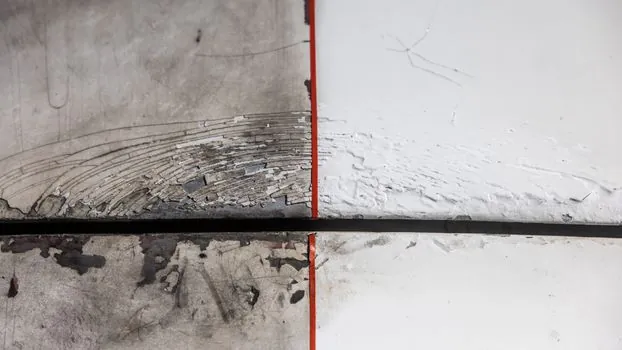
Combining Paris-law fatigue crack growth rate (FCGR) with cohesive zone modeling (CZM) is the dominant numerical approach for adhesive joint fatigue, implemented in LS-DYNA, ABAQUS, and ANSYS via user-defined cohesive elements [S4]. The damage evolution law proposed by Roe degrades the cohesive strength as a function of accumulated damage, and integrating dD/dN over the loading history yields the residual strength at any cycle count [S4]. Tabiei and Zhang's 2018 LS-DYNA paper verified this against single-lap and stepped-lap automotive specimens, with the predicted S-N curve fitting the experimental data across 10³ to 10⁶ cycles [S4]. The historical limitation was computational cost for high-cycle problems, since the damage integration requires deformation-rate history at every cohesive element; cycle-jump techniques and the energy-release-rate form of Paris law (d a/dN = D(ΔG)^B, where ΔG is the strain energy release rate range) reduce this cost substantially [S4]. Compliance-based beam methods for DCB and SLB specimens are now preferred over classical crack-monitoring schemes for extracting ΔG as a function of crack length, per Fernández et al. as cited in Du et al. [S2].
Material modifications that extend fatigue life
Adding particulate fillers to the adhesive layer, including natural waste-derived fillers like coconut shell powder, can extend service life under cyclic loading when the filler-matrix interface is properly wetted [S1]. Hrabě's 2022 study on coconut shell-filled epoxy bonds tested 1000-cycle quasi-static loading at two intensities: 5–30 percent (157–940 N) and 5–50 percent (157–1567 N) of maximum force [S1]. At the 5–50 percent intensity, the unfilled AB0 reference bonds did not survive the 1000-cycle target, while filled variants AB10, AB20, AB30 (10–30 percent filler loading) completed the cycle count with reduced strength loss [S1]. SEM analysis revealed that poor wetting and delamination at the filler-matrix interface were the main residual failure initiators, meaning filler modification helps but does not eliminate the need for surface preparation [S1]. This is consistent with broader findings on adhesive bonded joint creep at elevated temperature, where interface quality dominates long-term performance whether the driver is thermal or mechanical cycling. For vibration-specific applications, the industrial adhesive selection should prioritize high-toughness, high-elongation formulations over high-modulus rigid epoxies, because the latter concentrate peel stress at overlap ends and accelerate FCGR.
Real structural applications and the welding-replacement question

Adhesive bonding is being evaluated as a replacement for welding in load-bearing automotive structures, where cyclic vibration fatigue governs the design allowables rather than static strength [S5]. Antelo et al. tested adhesively bonded joints in a real structural configuration and concluded that bonding can serve as a suitable replacement for welding in fatigue-critical applications, provided the joint is designed for the actual vibration spectrum rather than the static collapse load [S5]. The 2023 encyclopedia review on enhancing fatigue strength in adhesively bonded joints notes that the majority of industrial applications, including automotive, wind turbine blade root, and rail vehicle body shell joints, see high cyclic fatigue loading over their designed service life, which is why the static strength is a poor proxy for the working allowables [S6]. The 2010 NRC fracture study on typical structural adhesive joints confirmed that fatigue damage initiates at relatively low load levels compared to quasi-static fracture forces, with room-temperature tests on standard joint geometries showing crack onset around 20–30 percent of static fracture load once cycles exceed 10⁴ [S8]. For vehicle window bonding vs mechanical retention, the same principle applies: dynamic fatigue governs long-term durability, not the single-event pull strength. The Pang et al. work on CVP (constant-velocity-amplitude periodic) loading showed that adhesive layer stress redistributes as damage accumulates, which means a joint's stress field is not constant over life and a single FE snapshot underestimates the late-life peak stress [S3][S9].
Limitations, failure modes, and what the data still cannot tell you
Most published S-N curves on adhesive joints are run at a single R-ratio, single frequency, and room temperature, so extrapolation outside those bounds carries a 2–4× uncertainty on predicted cycles-to-failure [S7][S10]. Environmental aging, thermal cycling, moisture absorption, and UV exposure all shift the S-N curve further, and very few papers couple these effects into the Paris-law framework [S10]. The Ellsworth white paper notes that adhesive shear strength values can depreciate by 30 percent or more under sustained cyclic loading, but the rate depends heavily on joint geometry, so handbook values should be treated as a starting point rather than a design allowables [S10]. Vibration sensor data from the installed structure, when available, should drive the lab test spectrum rather than a generic ASTM-style block, because real-world PSDs contain resonant dwells that lab sine-sweep tests miss. The 2013 Du et al. modal-property paper specifically called out that "much less research effort" had been invested in vibration-fatigue effects on modal properties compared to quasi-static cyclic testing, and the gap has only partially closed since [S2]. The reliable trackable signals for the next design cycle are: (1) expansion of R-ratio × frequency × mode-mixity matrices in published test data, and (2) validation of cycle-jump Paris-law implementations against full-life S-N curves beyond 10⁶ cycles for wind and rail applications.
The underlying component specifications are covered under expansion joint.