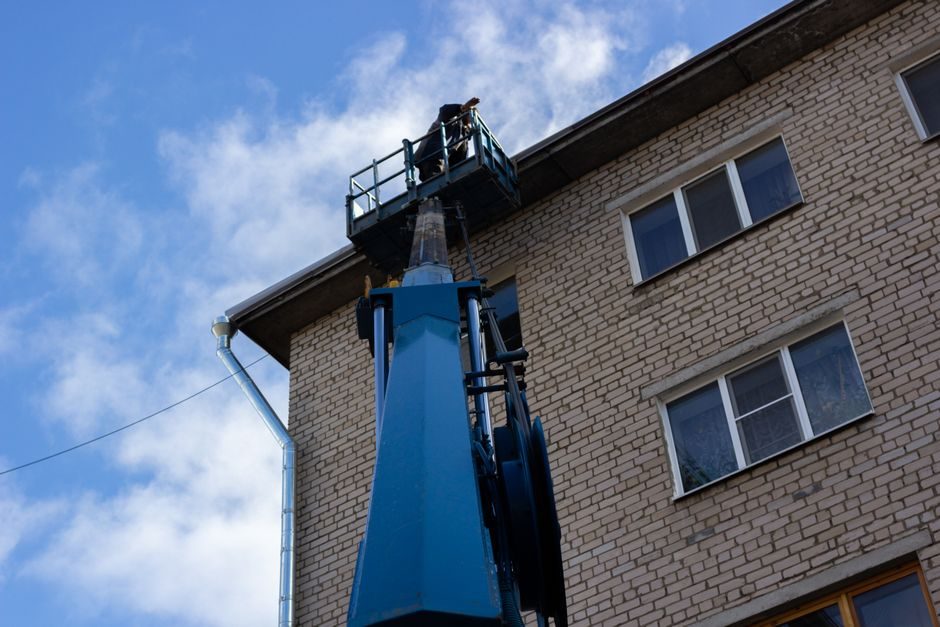
An aerial work platform is a personnel-carrying chassis with a telescopic, articulated or scissor lift structure, normally rated 0.1–0.5 t of platform payload, while a crawler crane is a lattice- or telescopic-boom hoist running on steel or rubber tracks, with lifting duties typically starting around 30 t and going past 600 t.
Engineers usually need a single question answered first: are you putting a worker with tools into the air, or are you swinging steel, formwork or a generator? That single decision sets the chassis, the certification route (EN 280 for platforms, EN 13000 for crawler cranes) and the site footprint.
Working envelope and rated duty
Self-propelled boom lifts routinely work to 12–38 m platform height, with the diesel-electric 38 m class now common on wind and infrastructure jobs; tracked spider platforms extend that envelope while keeping the ground pressure low enough for finished floors [S2]. Crawler cranes with telescopic booms cover 30–90 m hook height at radii up to 70 m, while lattice-boom crawler cranes (the Manitowoc 14000, Liebherr LR-series class) push past 200 m of main boom when configured with a luffing jib.
Payload tells the same story: a typical 16 m articulating platform carries 230 kg, a 26 m straight boom 454 kg, and a 38 m straight boom 340 kg, per current OEM data sheets; crawler crane pick capacities are quoted on a load-radius chart, with a 250 t class unit picking 80–120 t at a 12 m radius before falling off into the chart's mid-range.
Chassis, mobility and ground pressure
Most aerial work platforms ride on 4 rubber wheels with rough-terrain axles, or on compact rubber tracks for the "spider" / aerial work platform crawler form factor — the 7 manufacturers listed on DirectIndustry for tracked platform-basket models all offer widths under 1.2 m for doorway access [S2]. Tractor-mounted platforms such as the Safi SCJ20 truck-mounted electro-hydraulic unit marry the lift to an agricultural tractor driveline, cutting capital cost on farm and orchard work [S1].
Crawler cranes use dedicated steel or rubber track frames sized to spread the lifted load; even a 50 t class unit lands around 80–100 kPa of ground bearing pressure, and that figure doubles as the load grows, which is why site matting, pile caps or hard standing are non-negotiable beneath a working crane. By contrast, a 14 m scissor lift exerts less than 12 kPa on each tyre, so it can work on a suspended slab or a mezzanine rated for light traffic.
Power source and on-site energy
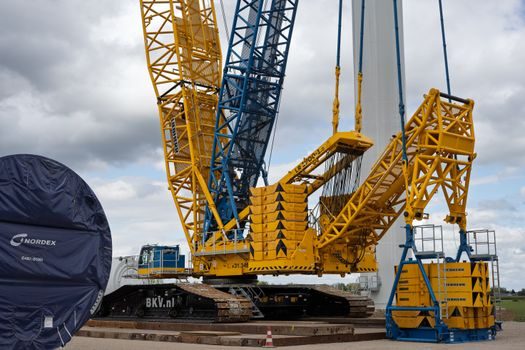
Diesel is still the default for both, but the duty cycle is different. Boom lifts are increasingly ordered as diesel-electric hybrids (Stage V / Tier 4f engines driving a generator and electric drive motors), and the indoor-rated subclasses are pure electric with lithium battery packs sized for a full shift — 8 h under typical duty. Crawler cranes stay diesel-hydraulic at the top end, with the main hoist, auxiliary hoist and swing all running off variable-displacement hydraulic pumps; electrification is creeping into the smaller 8–30 t class for indoor and emissions-restricted sites. [S1]
For specification, the key parameters are engine power per tonne of machine, hydraulic flow per function, and battery kWh for the electric SKUs. Tractor-mounted platforms draw hydraulic flow and 12/24 VDC from the tractor, which is why suppliers like Safi publish them as "tractor-mounted electro-hydraulic" rather than self-contained diesel packages [S1].
Standards, certification and operator rules
Aerial work platforms sold in the EU fall under EN 280 for the machine and EN ISO 3691-3 for the industrial truck chassis, with CE marking via the Machinery Directive; in the US, ANSI A92.20 covers the design and A92.22 covers the operator qualification. Crawler cranes follow EN 13000 for design, with operator certification under CPCS A02 in the UK, NCCCO in the US, and the equivalent national licence in each market. [S2]
Both are "intermittent duty" machines — the standard cycle assumes a high number of starts and stops rather than a continuous load — and both require a thorough examination (LOLER in the UK, OSHA crane standards in the US) on a six- to twelve-month cycle depending on the duty environment. The paperwork burden is heavier on the crane side because the operator, the rigger, the signaler and the appointed person are all named roles.
Where the two are interchangeable — and where they are not
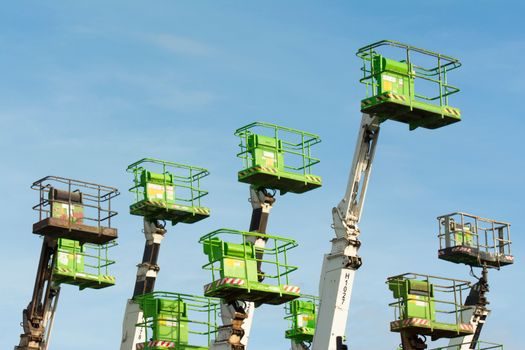
Overlap is narrow. A small telescopic crawler crane of 8–16 t capacity can occasionally substitute for a large boom lift when the load is a 1–2 t piece of glazing or a steel beam that has to be lifted over an obstruction, and a heavy-duty articulating platform on tracks (the 32 m Hinowa Lightlift or 40 m Teupen LEO class) can sometimes substitute for a taxi-crane on a 0.5–1 t lift over a short radius. Outside that band, the wrong machine is unsafe or uneconomic. [S3]
Pick the platform when the load is the worker plus tools, when the job moves around the site daily, and when the working height is below ~30 m. Pick the crawler crane when the load is steel, concrete, plant modules or generators weighing more than 1 t, when the radius is more than 15 m, or when the same pick will be repeated for a programme of lifts — a job profile that matches a typical truck crane buying brief for fixed-position work.
Cost, sourcing and total-cost levers
A new 26 m articulating boom lift from a major OEM lists in the $90,000–$140,000 range ex-works; a 38 m straight boom runs $180,000–$260,000. New 50 t class crawler cranes in the Chinese export channel (Jining, Xuzhou, Zhengzhou manufacturing cluster) commonly land at $180,000–$320,000, with 80–150 t units in the $450,000–$900,000 bracket and lattice-boom heavy crawlers above $1.5M [S4]. Used 2018–2022 units from Komatsu, Kobelco, Liebherr and XCMG discount 25–45% off list and dominate the rental channel.
Total cost of ownership depends on the duty cycle. For an aerial work platform, the engine hours drive most of the maintenance cost; for a crawler crane, the structural inspections, the hoist rope replacement (every 1,500–2,500 hours on the main hoist) and the undercarriage shoe wear drive it. A 100 t class crawler working 1,500 hours a year will spend 6–9% of its acquisition cost annually on wear parts, against 3–5% for a 38 m boom lift on the same hours. For buyers sizing a fleet against a multi-year program, the forklift 2026 price and cost guide framework translates cleanly: machine class, power source, attachment set and residual value, in that order.
Selection criteria in one comparison

Four criteria decide the choice. Working height: platforms max out near 58 m on a straight boom, crawler cranes with a luffing jib reach 200+ m. Rated lift: platforms are sub-1 t, crawler cranes start at ~8 t and go to 3,500 t. Ground pressure: platforms are friendly on slabs (under 12 kPa), crawler cranes need matting (60–120 kPa). Mobilisation: a boom lift drives onto a low-loader and rides at 80 km/h on tracked units, a 200 t crawler crane needs 8–12 trailer loads, an escort vehicle and often a night-time road closure permit. [S4]
Use that matrix and the answer is usually binary. If the brief is "send two men with a drill to 22 m on the side of a warehouse," the platform wins and the crane is the wrong tool. If the brief is "lift 60 t of structural steel to 35 m radius on a power-station build," the crawler crane wins and a platform cannot legally do the lift under any standard.
Track three signals going into the second half of 2026: the next revision of EN 280 (the 2022 amendment is the current working basis for most EU OEMs); the spread of all-electric 20–30 t class crawler cranes from Chinese suppliers; and the lithium-battery retrofit kits now reaching the 16–26 m scissor-lift aftermarket — each one tightens the case for hybrid or electric platforms on urban and indoor work, and pushes the diesel-hydraulic crawler crane further into the heavy civil and wind-farm niche.
For component-level specifications, see aerial work truck.