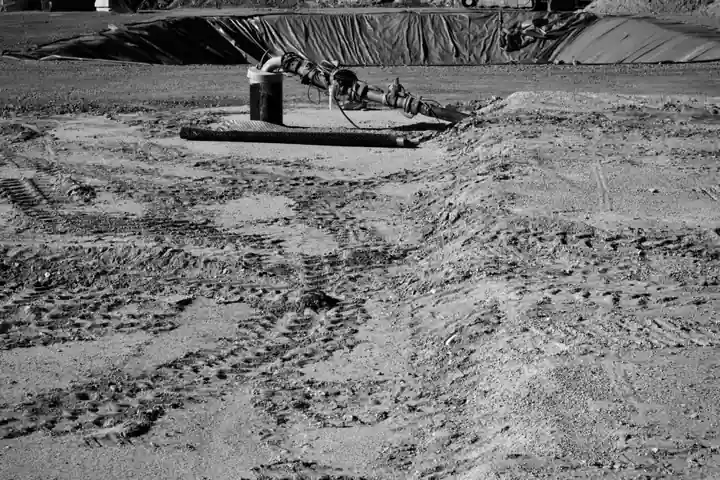
A pipeline right-of-way rarely presents a flat warehouse floor, so the default lift truck for greenfield spread work is a 4WD rough-terrain forklift in the 2,500-3,500 kg rated load class, with a 3.0 m two-stage mast and a 110-130 kW Tier 4 final diesel or Stage V engine [S3]. Pipe strings, sacked concrete, palletized fittings, and rig mats all clear the same truck, which is why fleets try to standardize on one rated class per spread rather than mix two.
The duty split on a typical 48-inch gas spread in 2026 looks like: 35-40% of lift-truck hours on stringing, 20-25% on yard stocking, 15-20% on lowering-in cradles, and the remainder on fuel/tool/culvert re-supply to the right-of-way [S2]. That mix pushes the spec toward short wheelbase, high ground clearance (typically 300 mm or more), and a tight 4.0-4.5 m turning radius so the unit can U-turn inside a 6 m weld cell.
Duty-cycle gates: what "pipeline-rated" really means
The first gate is rated capacity at the load center, not at the fork face. A 3.0 t pipeline-rated truck on the rough terrain forklift platform lifts 3,000 kg at the standard 500 mm load center, but the same chassis with a side-shift carriage drops roughly 5-8% of that figure once the center moves to 600 mm, which is closer to a real pipe-handling cradle geometry [S3]. Engineers should always read the truck's load chart at the actual pipe-handling load center, not the fork face.
The second gate is mast tilt and free lift. Pipe stringing on uneven ground needs at least 10 degrees of forward mast tilt and 6 degrees of backward tilt so a 12 m stick can be picked without gouging the cradle; full free lift of 1,500-1,800 mm keeps the lift cylinder out of the dirt when picking from low berms [S3]. The third gate is approach and departure angle, typically 35-45 degrees front and 25-30 degrees rear, which separates a true rough-terrain chassis from a warehouse chassis on construction tires.
Powertrain: Tier 4 final diesel vs. Stage V vs. electric vs. hydrogen
Electric sit-down forklifts in the 2.5-3.5 t class are now standard for indoor pipe-coating yards and marshalling yards where Tier 4 cannot run, with 80 V lithium-iron-phosphate (LiFePO4 or LFP) batteries in the 200-300 Ah range giving 6-8 hours of realistic duty [S3]. Hydrogen fuel-cell units from manufacturers including Heli, Manitou, and select niche OEMs are entering trials on Tier 1 spreads in 2026, with 10-15 minute refuel times being the headline gain over LFP charging windows; commercial availability remains limited [S3].
The right powertrain for a given spread is set by three answers: (1) Is the unit indoors or under canopy? (2) Does the spread allow overnight grid charging? (3) Does the right-of-way permit diesel exhaust in the work zone? For indoor coating and double-jointing yards, electric wins. For open right-of-way stringing, diesel or Stage V still wins. Hydrogen sits in the middle, with operators waiting to see 2026-2027 service data before committing [S3].
Ergonomics, safety, and operator survivability on long shifts
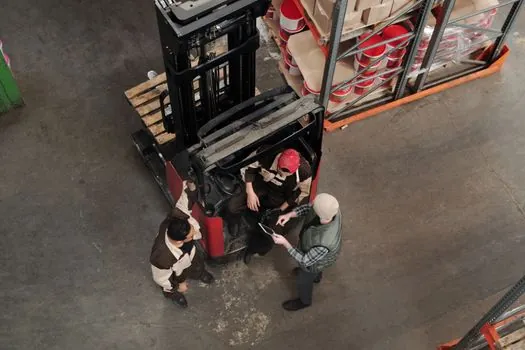
Operator seats, not horsepower, are the single most common spec differentiator on a pipeline bid in 2026. A 12-hour shift on a rough-terrain chassis without suspension and without an ergonomic seat is a 50-week back-injury claim, and fleets have learned this the hard way [S1]. The minimum seat spec is a mechanical suspension seat with 80-100 mm vertical travel, 60 mm fore/aft adjustment, and a documented vibration transmissibility figure (typical SVE value 0.5-0.8 under ISO 2631, with the lower end preferred) [S1].
ROPS/FOPS structures are mandatory on rough-terrain units under most North American and European right-of-way rules, and a falling-object protective structure (FOPS) rated to at least 8.5 kN peak load has become a practical floor for pipe-handling work [S3]. A reversing camera, a forward object-detection radar, and a blue LED spot lamp that casts a 3-4 m pedestrian exclusion zone behind the truck are now standard bid line items, not options, on most 2026 spreads [S3].
Cab filtration is a separate spec: pipe yards handling coated pipe produce fine particulate, and an enclosed cab with a MERV 8 or better filter, plus positive pressure, is increasingly common [S1]. When comparing two otherwise identical trucks, fleets should weight the operator package as roughly 20-25% of the total evaluation score; the cheapest cab option is rarely the cheapest total cost of ownership over a 5-year life.
Selection criteria comparison: warehouse vs. rough-terrain vs. electric yard vs. fuel-cell
The four realistic platforms line up on the four spec gates as follows. Rated capacity at 500 mm load center: warehouse sit-down 2.0-3.5 t, rough-terrain 2.5-3.5 t, electric yard 2.5-3.5 t, fuel-cell prototype 2.5-3.0 t. Ground clearance: warehouse 100-150 mm, rough-terrain 250-350 mm, electric yard 150-200 mm, fuel-cell 200-300 mm. Typical daily duty: warehouse 6-8 h indoor, rough-terrain 10-12 h outdoor, electric yard 6-8 h indoor/outdoor with charger access, fuel-cell 10-12 h outdoor with H2 access [S3].
Powertrain technology also drives the spec by climate: an electric LFP truck derates roughly 10-20% in ambient temperatures below -10 degrees C, which is the working temperature for many winter spreads, while a Tier 4 diesel runs cold-soak down to -30 degrees C with the correct block heater and synthetic oils [S3]. Operators on winter Canadian or Russian winter spreads therefore keep at least one diesel rough-terrain unit per spread even when the rest of the fleet is electric, and the same pattern repeats in desert summer work where battery thermal management pushes operating cost up.
Standards, sourcing, and what to write into the bid
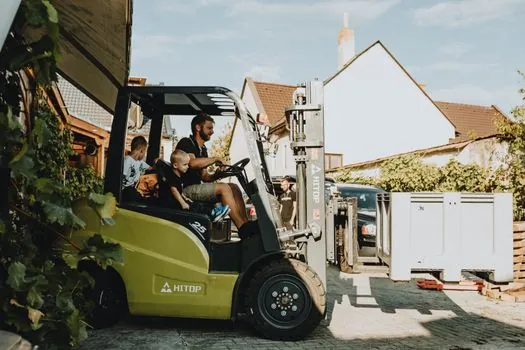
The standards to anchor a forklift bid in 2026 are: ANSI/ITSDF B56.1 (Safety Standard for Low-Lift and High-Lift Trucks) for the North American base, ISO 3691-1 (Industrial trucks, safety requirements) for the European/ISO base, and the engine emissions tier set by EPA Tier 4 final / EU Stage V [S3]. For pipeline-specific operator training, the practical reference is OSHA 1910.178(l) for industrial truck operator training in the US, and a parallel national rule in most other jurisdictions; rough-terrain telehandler variants (a common substitute on a spread) also sit under ANSI B30.5 or ISO 12100-derived national rules [S3].
Sourcing discipline matters. The 2026 dealer survey pulled from public Forklift Finder coverage on Construction Equipment news shows that lead time for a 2.5-3.5 t rough-terrain diesel unit is now 4-6 months ex-factory for major brands, and 6-9 months for hydrogen fuel-cell units, while off-brand LFP electric units are available in 1-3 months but carry a 2-year parts support risk in North America [S3]. Fleets should write spares, service intervals, and a documented mean-time-to-repair commitment into the purchase contract, not as a verbal assurance, before signing.
Failure modes and constraints to flag before signing
Three failure modes bite pipeline fleets repeatedly. First, the "warehouse truck on a construction site" mistake: a 2.0 t electric sit-down without ground clearance gets stuck in a soft right-of-way shoulder and burns out its drive motor within weeks, and no warranty covers that duty. Second, the undersized mast: pipe stringing at 12 m requires a 3-stage mast with full free lift, not a 2-stage warehouse mast that lifts to 4.5 m, so the spread ends up renting a telehandler at three to four times the hourly cost. Third, the non-ROPS cab: any rough-terrain unit without a certified ROPS/FOPS structure should be ruled out at the spec stage, regardless of price [S3].
For operators running a mixed fleet, material-handling bearing selection is a downstream spec the maintenance team usually inherits from the chassis maker, and it matters for hot-climate spreads where grease intervals halve and unsealed bearings fail early.
Trackable signals to watch in the second half of 2026: (1) EPA Tier 5 proposal timing, which would tighten NOx and PM further on rough-terrain diesels, and (2) the first commercial fleet deployment of 3.0 t hydrogen fuel-cell rough-terrain units in North America beyond the current pilot stage [S3]. Either signal will move 2027 bid specs, so fleet planners should hold the line on selecting a current Tier 4 / Stage V chassis with documented service support rather than waiting for the next regulatory cycle.
The underlying component specifications are covered under pipeline pump.