Aggregate bin compartments on concrete batching plants are steel sectioned storage units, most commonly built with 3 or 4 compartments, though configurations from 2 up to 8 are in service, and total storage spans roughly 60-800 tons depending on plant class and recipe mix [S1][S2].
Each compartment isolates one aggregate fraction (washed sand, crushed stone, pea gravel, recycled aggregate) so the batcher can dose the recipe accurately; mixing fractions inside a single bin is the classic root cause of off-spec concrete, and compartment count is therefore a process decision before it is a structural one [S2][S3].
Compartment Count and Standard Configurations
Most stationary plants in the 60-180 m³/h band ship with 3-4 aggregate compartments, and standard commercial offerings from major OEMs cover that range with documented bin geometry [S1][S4]. The MEKA MB-100D and MB-200D dry-batch plants, both rated 100-200 m³/h (130-260 yd³/h), use 4-compartment bins as standard, with central compartments of 3200 × 4200 mm (10.5' × 13.5') and outer compartments of 2900 × 4200 mm (9.5' × 13.5') at the top level with extensions [S4].
Lighter commercial bins used by small and mid-sized US producers start at the 2-compartment, 60-ton end and stretch to 4 compartments at 200 tons for overhead storage configurations [S5]. For plants that must dose six or more fractions, such as those running lightweight aggregate plus two sand grades plus three coarse sizes for specialty mixes, OEM bins are built to eight compartments, with a 60-800 ton overall capacity envelope covering the bulk of the market [S1].
Total Storage Capacity by Plant Class
Aggregate storage capacity is not one number; it is sized to match the mixer's nominal batch and the plant's hourly output, with a 3 × 10 m³ bin arrangement (three 10 m³ compartments) commonly paired with a 1000 L nominal mixer in mid-range commercial builds [S3]. The MEKA MB-100D, at 100 m³/h output, carries 100 m³ (130 yd³) of aggregate storage and weighs up to 9 m³ (12 yd³) per batch, illustrating the 1:1 batch-to-storage logic that drives bin sizing [S4].
On smaller portable plants, decumulative aggregate bins start at 20 tons and are expandable to 30 or 40 tons at purchase or with field retrofit, with optional clam-gate, slide-gate, or custom discharge and field-upgradeable load cells [S5]. At the upper end of the standard commercial range, 60-200 ton overhead bins with 2-4 compartments are the common large-plant configuration, and the broader 60-800 ton envelope across the catalog covers everything from a small ready-mix yard to a high-output dam or highway project [S1][S5].
Compartment Geometry, Discharge Gates, and Vibrators
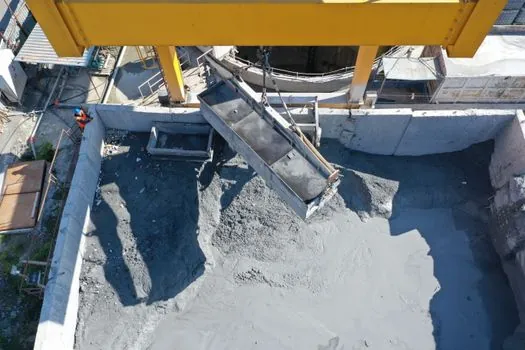
Bin compartment geometry is rectangular at the top, tapering toward discharge, with width-to-length ratios set by the loader's bucket reach and the feed conveyor layout; on the MEKA MB-100D/200D, outer compartments are 2900 mm wide while central compartments widen to 3200 mm, all 4200 mm long, giving roughly 12.2 m² and 13.4 m² top footprints respectively [S4]. Each compartment discharges through its own gate, and the 4-compartment MEKA bin uses 8 amortized pneumatic cylinders driving 100 mm (4") diameter gates with a 250 mm (10") stroke for quick discharge, plus 2+2 vibrators rated 200 kg (440 lb) mounted between the discharge gates at the first sand compartment to break bridged material [S4].
On US-built JEL bins distributed by FESCO Direct, wear surfaces are specified as A/R (abrasion-resistant) steel in high-wear zones, and bins ship with load cells for live weighing; standard 12-yard (≈9.2 m³) capacity batchers are the common matched weighing hopper for the small-to-mid plant class [S5]. For aggregate handling upstream of the bin, the concrete batching plant is typically fed by a wheel loader or a radial stacker, and bin vibrators are sized so that even damp 3/8" pea gravel will free-flow without manual intervention.
Selection Criteria: Matching Compartments to Plant Output
Selection starts with the number of aggregate fractions in the mix design: a basic C30 ready-mix plant running one sand plus two coarse sizes needs three compartments, while a plant also batching lightweight or recycled aggregate pushes to four or more [S2][S7]. Required storage volume is set next, with a common rule-of-thumb that each compartment should hold at least 3-5 batch equivalents so the loader does not starve the weighing hopper during a peak pour; on the MEKA MB-100D, the 9 m³ batch versus 100 m³ total storage gives roughly 11 batch equivalents of buffer [S4].
Feed method (skip hoist, belt conveyor, or loader-direct), gate and actuator arrangement, and material moisture all change the bin spec, and structural plus site constraints (bin height clearance, ground-bearing pressure, foundation settlement tolerance) frequently cap the practical bin size more tightly than the OEM catalog does [S2][S6]. On small concrete plants, choosing the right aggregate bin also depends on the matching weighing hopper and aggregate silo geometry, since undersized hoppers force the bin to act as the surge volume and that disturbs weigh accuracy [S7]. The weighing bin and hopper foundations must be erected on firm ground; settlement directly degrades load-cell accuracy, so a 100 m³ bin is not just a bigger bin, it is a foundation engineering job [S6].
Concrete Batching Plant Comparison: Bin Configuration by Class

Small portable (20-80 m³/h): 2-3 compartments, 20-60 ton total storage, decumulative bin, optional slide-gate discharge, no overhead structure; suited to short-term, scattered, or rural projects [S3][S5]. Mid-range stationary (60-120 m³/h): 3-4 compartments, 60-200 ton total storage, 4 pneumatic discharge gates per bin, 2-4 vibrators, in-line aggregate discharge onto transfer belt conveyor; the workhorse configuration for ready-mix yards [S4][S5].
Large stationary (120-200+ m³/h): 4-8 compartments, 200-800 ton total storage, hot-dip galvanized structure for overseas container shipping, optional 2-3 × 100 ton cement silos, and centralized automated recipe control; used for dams, industrial parks, and high-rise developments [S1][S3][S4]. Across all three classes, compartment count scales with recipe complexity rather than plant output: a 60 m³/h mobile plant running four fractions still needs four compartments, while a 200 m³/h plant running only two fractions can stay at two if the mix design allows.
Failure Modes and Operational Constraints
Aggregate bridging in the first sand compartment is the most common operational failure, and is the reason OEMs mount vibrators specifically between the sand compartment gates rather than evenly across the bin [S4]. Moisture in fine aggregate is the dominant trigger, and on plants handling washed sand or operating in humid climates, vibrator runtime per cycle typically rises from a few seconds to 15-30 seconds; this is normal, not a vibrator sizing fault.
Settlement of the weighing bin foundation is a quiet accuracy killer, and the standard practice is to set bin and hopper supports on engineered foundations rather than compacted fill, with regular re-calibration of load cells if any settlement is observed [S6]. A/R steel liners in high-wear zones extend bin life where abrasive crushed stone or recycled concrete aggregate is handled, and polyurethane liners are an option for sticky sand fractions that would otherwise build up on bin walls [S5]. Used bins in the secondary market are common, but buyers should verify compartment count, gate actuator type, and load-cell calibration before commissioning; a 4-compartment 100-ton bin is not interchangeable with a 4-compartment 200-ton bin even if the geometry looks similar [S5].
Standards and Sourcing Notes

Aggregate bin design is governed primarily by structural steel codes and the plant's own weighing-system accuracy class; in the US, bin foundations and structural steel typically follow AISC Steel Construction Manual provisions, while weighing-system performance is commonly verified against NIST Handbook 44 (used as the underlying reference for concrete plant scales) and the local DOT's plant certification procedure (for example, the MnDOT concrete manual on batching and mixing) [S6]. Material specifications on the wear side reference A/R (abrasion-resistant) steel plate grades such as AR400 in standard US builds, and polyurethane liners for sticky-fraction service [S5].
Compartment-level selection criteria documented across OEM and integrator sources consistently list: number of aggregate fractions, required storage volume, feed method, weighing system, gate and actuator arrangement, material moisture and flow characteristics, and structural and site requirements [S2]. Buyers specifying a new plant should pin all seven on the datasheet before quoting; changing the compartment count or total volume after the foundation is poured is the most expensive change in the build.
Track the bin-to-batch volume ratio on the next plant quote (it should sit in the 8-15 batch equivalents range for a smooth 8-hour shift) and confirm whether the gate actuators are pneumatic or electric, since pneumatic systems need a compressor sized for simultaneous gate cycling while electric actuators draw from the plant UPS. For matched upstream equipment, the concrete mixer truck class is selected off the mixer's nominal batch size, which is itself set by the bin and weighing hopper geometry.