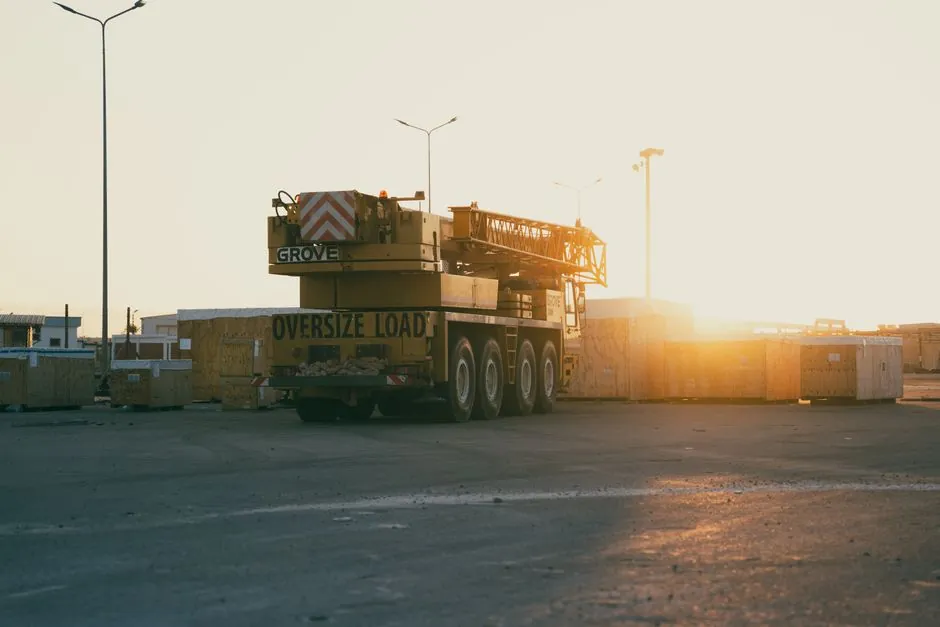
An automated guided vehicle (AGV) is classified primarily by how it acquires, supports, and releases a load, and that classification sets its payload range, facility footprint, and battery duty cycle. The load-handling taxonomy in current OEM and integrator documentation splits the market into six functional families: tow/tugger, unit load carrier, forklift AGV, heavy direct-load, automated cart, and lift/rotate assembly AGVs [S1][S2][S5].
Payloads span roughly 500 lb for light cart AGVs up to 15,000 lb for direct-load heavy chassis carriers, with tow AGVs typically rated to 5,000–5,500 lb and lift AGVs to 6,000 lb [S1][S4]. Picking the wrong handling class is the single most common cause of failed AGV pilots, because the vehicle geometry, mast height, and end-effector are fixed at specification time and rarely retrofittable later.
Tow Tractor / Tugger AGVs: Pull-Based Handling
Tow tractors, also called tugger AGVs, transfer loads by pulling a train of passive trailers rather than carrying them on the vehicle itself, which keeps the AGV itself light and the per-trip payload effectively unlimited [S1]. The Linde P-MATIC autonomous electric tow tractor with stand platform moves towing loads of up to 5,000 kg and is specified for production-hall supply, waste removal, and long-haul line-side delivery [S1].
Typical tugger use cases: cart trains to assembly lines, cab-line parts delivery, and waste-bottle haul-out in automotive plants. RedViking cites a tugger tow capacity of up to 5,500 lb (≈2,495 kg) for its line of cart-pulling AGVs, with each trailer adding capacity in a non-powered pass-through configuration [S4]. Tow AGVs require the longest aisle length because the train turning radius scales with the longest trailer, not with the AGV wheelbase. For a deeper spec-by-spec pull, see the Tugger vs Unit-Load vs Forklift AGV breakdown.
Unit Load Carriers: Deck- or Fork-Mounted Single-Pallet Handling
Unit load AGVs transport a single pallet or container at a time, either by driving underneath a load (deck-style, often called a “turtle” AGV) or by carrying a fork mechanism similar to a manual pallet jack [S8]. Solving’s AGV reference lists unit load carriers, unit load deck AGVs, and turtle AGVs as the three sub-variants within this handling family [S6][S7].
Unit load AGVs are the workhorse of pallet-in/pallet-out warehouses because the load surface is flat, lift heights are typically ≤1 m, and the vehicle can dock at conveyor or floor-level stands without a mast. They are most efficient at repetitive A-to-B moves where the pallet SKU and pick face are stable, and where floor flatness allows the under-pallet fork to engage without shimming. Compared to forklift AGVs, unit loaders have no reach, mast, or counterweight, so they trade vertical flexibility for a tighter turning radius and lower battery draw per cycle.
Forklift AGVs: Mast-Mounted Lift and Reach Handling
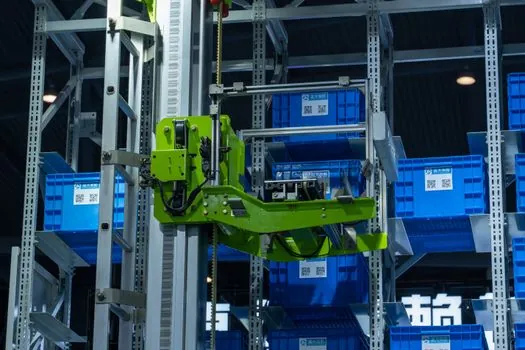
Forklift AGVs replicate the geometry of a counterbalanced forklift, reach truck, or very narrow aisle (VNA) truck, adding automated control to the mast, fork carriage, and travel paths [S1]. Linde’s MATIC range covers the full forklift spectrum: pallet stackers, counterbalanced forklift trucks, reach trucks, and VNA trucks, all available as driverless AGVs with natural-feature or track-guided navigation [S1].
Forklift AGVs are the only class that can both transport a pallet and place it at a second-tier rack elevation, which is why they dominate mixed-SKU distribution centers where pallet storage heights reach 6–10 m. The trade-off is footprint: a counterbalanced AGV needs a wider aisle for mast tilt and load pivot, and VNA variants require wire- or rail-guided racking because free navigation cannot reliably clear the mast sway tolerances at full lift. Forklift AGVs also carry the highest safety-stated risk envelope (load falling from mast height) and usually require ISO 3691-4 / ANSI B56.5-compliant zone control around the lift envelope; operators must verify the local safety standard applies before deployment.
Heavy Direct-Load AGVs: Oversized-Payload Assembly Handling
Direct load AGVs are designed for single-piece loads that cannot be broken into pallets, typically in automotive final assembly, heavy machinery, and chassis framing lines [S4]. RedViking specifies direct load AGVs at payloads up to 15,000 lb (≈6,800 kg), the upper end of the AGV capacity spectrum and well above any forklift or tow configuration [S4].
Direct load AGVs almost always use a rotating top deck (turntable, lift table, or 360° rotate function) so the assembly can be presented to the operator at ergonomic height and orientation, eliminating manual repositioning [S4]. They are specified as fixed-path vehicles (wire, magnetic tape, or natural-feature) because the load mass and stop-distance demand deterministic control, not free-path AMR behavior. Common pairing: a heavy AGV in a body-in-white or chassis marriage cell, with a higher-level fleet manager scheduling the vehicle against a paced conveyor.
Automated Carts and Light-Load Handlers

Cart AGVs are the smallest, lowest-cost handling class: a flat or shelf-equipped deck, typically ≤1,000 lb payload, used for tote, bin, and small-pallet moves in light manufacturing or healthcare logistics [S5]. Qviro’s taxonomy lists cart AGVs, mobile picking robots, and AMRs in the same low-mass class, distinguished by load surface and picking interface rather than by drive train [S5].
Cart AGVs usually operate on a fixed virtual or magnetic path and interface with roller conveyors, pick-to-light stations, or mobile shelving. Because the deck sits low and the load is light, cart AGVs can use differential or omnidirectional drives, which lets them rotate in place, an advantage in 2 m aisles where a forklift AGV could not turn. For a broader material-handling context beyond AGVs, the material handling overview maps these vehicle classes against conveyors, AS/RS, and robotic picking.
Comparison Table: Selecting by Handling Method
The four most common decision criteria for choosing between AGV handling classes are maximum payload, lift capability, aisle width, and typical duty environment. The table below lines up the main classes against those criteria using the published OEM data [S1][S4][S5][S8].
Capacity bands: tow/tugger AGVs are limited by AGV itself (≈5,000 kg / 11,000 lb) but trailer count extends effective load [S1]; unit load AGVs typically handle one standard pallet at 1,000–3,000 lb [S8]; forklift AGVs match their manual equivalents (1,500–5,000 lb at up to 10 m lift) [S1]; direct load AGVs reach 15,000 lb with no mast lift [S4]; cart AGVs sit below 1,000 lb [S5]. Aisle width follows the mast and turning geometry: cart and turtle AGVs work in 1.5–2.5 m aisles, counterbalanced forklift AGVs need 3.0–3.6 m, and VNA forklift AGVs require wire-guided racking inside ≈1.8 m aisles. Duty environment splits indoor-only (cart, unit load, forklift, most direct load) from outdoor-rated (Linde P-MATIC platform and other yard tractors designed for paved yard duty, not on-road use) [S1][S5].
Limitations, Failure Modes, and Standards to Watch

AGV load-handling selection has three recurring failure modes: mis-rated payload (vehicle structurally rated for 1,500 lb but loaded to 1,800 lb on uneven floors), mast instability above the rated lift height on forklift AGVs, and trailer-jackknife on tugger trains in tight corners [S4]. The heavy direct-load class adds rotating-deck backlash if the turntable encoder is mis-calibrated, which shows up as assembly misalignment downstream. For guidance and navigation, both track-guided (wire, magnetic tape) and natural-feature (laser, SLAM) paths are used; the former is cheaper up front but expensive to re-route, the latter is flexible but requires mapping at commissioning [S1].
Safety compliance centers on the applicable mobile-robot standard for the deployment region; engineers should confirm the governing edition against the latest local adoption before specifying. Capacity claims in vendor literature are typically rated at flat-floor, level-surface, center-of-gravity conditions; de-rating for slope, off-center load, and dynamic braking is the integrator’s responsibility, not the OEM’s. Trackable signals for the next planning cycle: whether new VNA-truck AGV releases extend lift height past 12 m, and whether any major OEM publishes a standardised tow-train turning radius formula, both of which would shift fleet sizing in brownfield warehouses.
Component reference pages worth checking: agv robot, and storage handling.