
A tugger, unit-load, and forklift AGV are not three sizes of the same machine; they are three different load interfaces, three different control problems, and three different price bands, with 2026 hardware quotes running roughly $50,000–$85,000 for a tugger, $40,000–$70,000 for a unit-load, and $75,000–$200,000+ for a forklift AGV [S3].
ANSI/RIA R15.08-1-2020 (R15.08) defines an AGV as a vehicle that follows predefined guide paths (virtual or physical) and uses collision avoidance, stopping and waiting on blockage, which is the behavioural baseline shared by all three types covered here [S2]. The decision between them comes down to whether the load rides, hangs from a hitch, or needs to be lifted into racking.
Tugger AGV: pull-based interface for cart trains
A tugger AGV hitches to non-powered trailers or carts and pulls the whole train as a single move, with towing capacities reported up to several tons and throughput gained from moving several carts at once rather than one heavy unit [S2]. A reference use case is parts-to-line delivery in assembly operations, where the tugger runs a fixed loop and drops carts at build stations [S2].
MasterMover, Kivnon, Toyota Material Handling, and other suppliers split their tugger product lines by load class: compact to ~6,600 lbs, performance to 154,000 lbs, and ultra to 660,000 lbs, with stainless steel (316 grade) and IP55-rated builds available for food and pharmaceutical cells [S1]. The 2026 hardware band for a production tugger is $50,000–$85,000, with retrofits and low-capacity variants falling below that range [S3].
Tuggers are a poor fit when loads are single SKUs that need racking access, and the right pick when you have a fixed milk-run route, a train of standard carts, and want one vehicle to replace several manual cart moves per shift.
Unit-Load AGV: deck- or conveyor-mounted payload carrier
Unit-load AGVs carry the payload on top of the vehicle, either on a fixed deck, a lift table, or a roller/conveyor deck, and are the workhorse for repetitive point-to-point pallet or tote moves in structured environments [S2][S3]. Capacity tracks vehicle size: 2026 industrial models with sensors and free-navigation stack at 1,000–2,000 lb payloads in the $40,000–$70,000 band, while basic tape-guided AGCs sit at $15,000–$25,000 [S3].
Payload range scales from light goods and totes up to 25-ton steel coils on custom heavy-duty unit-load decks built by suppliers such as DTA [S2]. Newer builds layer RFID pallet identification onto the lift table so the vehicle confirms it picked the right load, not just any load at the pickup station [S4]. The reference AGV robot class covers these deck- and conveyor-top vehicles alongside forklifts and tuggers.
Specify a unit-load AGV when the move is pallet-in / pallet-out at floor level, aisles are wide enough for the vehicle footprint, and you do not need to place the pallet into rack beams.
Forklift AGV: mast-based lift for rack and variable-height handling
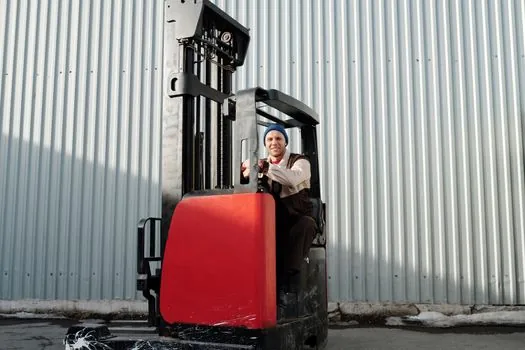
Forklift AGVs replicate a manual forklift with a mast, forks, and onboard lift, and the 2026 price reflects that extra mechanism: $75,000 for an automated pallet jack, climbing to $150,000–$200,000+ for very narrow aisle (VNA) or reach-truck builds with SLAM or hybrid vision navigation [S3]. High-precision encoders and inertial units are used to keep the load stable at different lift heights, which is the spec gap that separates a forklift AGV from a unit-load AGV with a lift platform [S4].
Driverless forklift AGVs are the most direct safety play in a facility that already runs manual forklifts, because they keep the truck and the pedestrian in the same aisle at different times rather than at the same time [S5]. For uneven ground or outdoor yards, a rough terrain forklift derivative is a separate platform; standard forklift AGVs are designed for finished, level warehouse floors.
Pick a forklift AGV when the destination is a rack beam at 3–11 m, load geometry varies, or you are trying to remove manned forklifts from pedestrian zones. Avoid it when the move is purely floor-to-floor with no lift required, because the mast and lift hardware are paying for capability you will not use.
Decision matrix: which AGV type matches which job
Lining the three types up against the four criteria that actually drive a buy decision: typical 2026 hardware cost for unit-load sits at $40,000–$70,000, tugger at $50,000–$85,000, and forklift AGV at $75,000–$200,000+; load interface is deck/conveyor for unit-load, hitch-and-pull for tugger, mast-and-fork for forklift; racking compatibility is none for unit-load (floor only), none for tugger (carts only), and full VNA/rack for forklift; and best-fit layout is wide structured aisles for unit-load, fixed loop with cart train for tugger, and variable-height racking for forklift [S3][S5].
Use the matrix like this: if your bottleneck is a manual operator pushing a cart train between two cells, the answer is a tugger; if the bottleneck is one operator walking a single pallet from a wrapper to a staging lane, the answer is a unit-load; if the bottleneck is a licensed driver racking pallets in narrow aisles, the answer is a forklift AGV [S2][S3].
Navigation, safety, and integration constraints common to all three
All three AGV types rely on the same baseline guidance stack, including magnetic tape/wire, laser triangulation against reflective targets, LiDAR with SLAM, or hybrid vision, with laser-guided units typically reporting millimeter-class position accuracy when triangulated against fixed reflectors [S4]. Safety stacks are also shared: redundant sensors, E-stop, and the R15.08 stop-and-wait collision-avoidance model that distinguishes an AGV from an AMR, the latter being obstacle-avoidance rather than path-bound [S2][S4].
Integration scope is where budgets diverge from the headline unit price, because software, mapping, WMS or MES coupling, and facility prep typically add to the hardware line; the 2026 framing from integrators is that AGVs are not plug-and-play consumer robots but programmable industrial tools configured per site [S3][S5]. Cyclic loading is also real: heavy-duty tugger trains on long loops stress battery sizing, and lithium-ion packs with high storage capacity are now the default for tow tractor work rather than legacy lead-acid [S4].
What disqualifies each type
A tugger AGV is the wrong pick when the load is a single pallet per move, because the cart-train interface adds complexity without raising throughput [S2]. A unit-load AGV is the wrong pick when the destination is a rack beam, because it cannot lift the pallet to the storage position and the operator either leaves it on the floor or hand-stacks it, breaking the cycle [S3]. A forklift AGV is the wrong pick when aisle width and floor flatness are outside its tolerance, or when payloads are below ~1,000 lbs and the mast cost is dead weight in the budget [S3][S4].
Across all three, the most common failure mode in the field is a facility that is not AGV-ready, with uneven floors blocking laser navigation, mixed pedestrian traffic that overwhelms the stop-and-wait model, and WMS hooks that were never built for machine-driven task dispatch rather than human-driven pick lists [S2][S5].
Sourcing and standards to anchor the spec
For any of the three types, anchor the spec to ANSI/RIA R15.08-1-2020 (R15.08) for the AGV/AMR safety and behaviour definitions, and to your integrator's site survey for navigation choice, because magnetic-tape, LiDAR-SLAM, and laser-triangulation each carry different floor-prep cost and different behaviour under blockage [S2][S4]. Vendor pricing bands in this article reflect January 2026 U.S. market data from MESH Automation: unit-load $40,000–$70,000, tugger $50,000–$85,000, forklift AGV $75,000–$200,000+, with custom engineered builds above $200,000 [S3].
Track the next decision node by validating three numbers before issuing an RFQ: the verified peak payload (not nominal), the longest single-bay aisle width where the vehicle will turn, and the destination lift height for any forklift AGV install. A useful sanity check on integration scope is the PNP vs NPN proximity sensor logic breakdown, because sensor output type is one of the small details that quietly drives whether an AGV drops cleanly into an existing conveyor or PLC line.