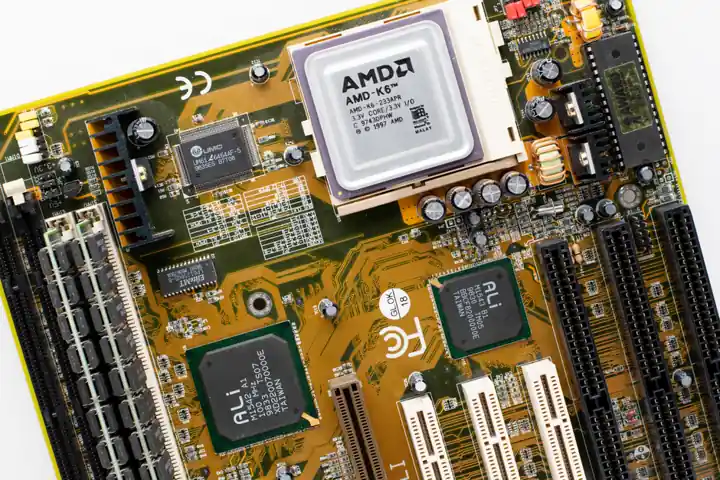
Generative-AI and AI-accelerator chips approach US$500 billion in 2026, equal to roughly half of all global semiconductor sales, on Deloitte's February 2026 outlook [S1].
That dollar concentration coexists with a near-zero unit share: Crisp Idea's March 2026 breakdown puts AI-chip unit volume below 0.2% of the ~1.15 trillion chips forecast to ship in 2026 [S2]. The mismatch between revenue weight and shipment count is the defining structural fact of the 2026 market.
2026 Revenue Sizing: $1 Trillion or $1.6 Trillion, Both With AI Near 50%
Forecasters disagree on the total market size but converge on AI's share. TechPowerUp's January 2026 piece cites the first-ever US$1 trillion semiconductor year, propelled by AI demand [S3]. Gartner's August 24, 2026 release sizes the market at US$1.6 trillion in 2026, with AI data-center revenue climbing from a 36.5% share in 2026 to 53% by 2030 [S4].
The headline number an engineer should track is the share, not the absolute. Deloitte's "roughly half" [S1] and Gartner's 36.5% data-center share [S4] describe overlapping but non-identical baskets: Deloitte's "generative AI chips" front-end frames accelerators and adjacent logic, while Gartner isolates the data-center slice of total revenue. Both are defensible, and the gap between them is mostly definitional, not directional.
Unit vs. Dollar: Why 50% of Revenue Comes From 0.2% of Units
Crisp Idea's data table puts 2026 global chip unit volume at ~1.15 trillion against US$975 billion in revenue, an average selling price of about US$0.85 per chip [S2]. An HBM-stack-equipped accelerator or data-center GPU ships for thousands of dollars per unit, so a few million high-end AI parts swing the dollar aggregate while barely moving the unit count.
Memory reinforces the same asymmetry. Crisp Idea projects 2026 memory revenue at US$200 billion, or 25% of the total market, with HBM and DDR5 in chronic shortage [S2]. HBM is sold in units roughly comparable to DRAM, but the die-stacked, advanced-packaging variant carries pricing multiples above commodity DDR5. The "memory supercycle" therefore lifts dollar share faster than unit share, exactly like the AI accelerator story. The relevant industry background sits in the HBM revenue share article, which quantifies the supplier split inside that bottleneck.
Vendor-Level Evidence: Broadcom Up 143%, Nvidia Calling 14% Growth
Broadcom's AI semiconductor revenue reached US$10.8 billion in Q2 fiscal 2026, up 143% year-over-year, and the entire semiconductor solutions segment scaled with it [S6]. Nvidia, in SemiWiki's March 2026 write-up, projects AI will drive 14% of its own revenue growth in the cycle, with four other tracked companies expecting 2% to 11% gains off a recovering industrial base [S5].
The vendor dispersion matters. A 143% year-over-year print at Broadcom is a tail event; a 14% growth call at Nvidia is now considered the baseline. The signal is that AI dollars are concentrating in companies that own the custom-ASIC and accelerator-IP stack, while the rest of the market recovers off cyclical lows rather than AI tailwinds.
What's Outside the AI Bucket: Automotive, Industrial, Memory Cyclicality
Non-AI demand is broader than the headline implies. Crisp Idea identifies automotive architecture shifts (distributed ECU to centralized/zonal compute), grid modernization, industrial automation, and pre-6G RF as the parallel growth lanes in 2026 [S2]. SemiWiki corroborates the industrial side: four companies project 2% to 11% revenue gains anchored in industrial recovery rather than AI [S5].
For purchasing and component teams, the practical implication is that AI share is volatile, while automotive and industrial share is slow-moving but durable. A bill-of-materials that depends on analog, power, and microcontroller lead times is exposed to a different supply curve than one built around accelerator substrates, and conflating the two produces forecast errors.
Limitations, Failure Modes, and Forecast Risk
Three failure modes are visible in the source set. First, definitional drift: "AI chips" ranges from accelerators only [S4] to all logic serving generative-AI workloads [S1], so the 50% figure is not directly comparable across houses. Second, the cyclical memory bet assumes HBM and DDR5 stay in structural shortage; if either segment normalizes, the 25% memory share [S2] re-rates quickly. Third, the "US$1.6 trillion" Gartner total [S4] and the "~US$975 billion" Crisp Idea projection [S2] cannot both be right, and the gap is a forecasting-risk surface, not a rounding difference.
Trackable signals for the next node are: (1) Gartner's and Deloitte's Q4 2026 update to the 36.5% data-center share [S4], (2) any HBM ASP data point that breaks the US$0.85 ASP assumption in the Crisp Idea table [S2], and (3) Broadcom's next two AI-revenue prints relative to the US$10.8 billion Q2 fiscal 2026 base [S6].