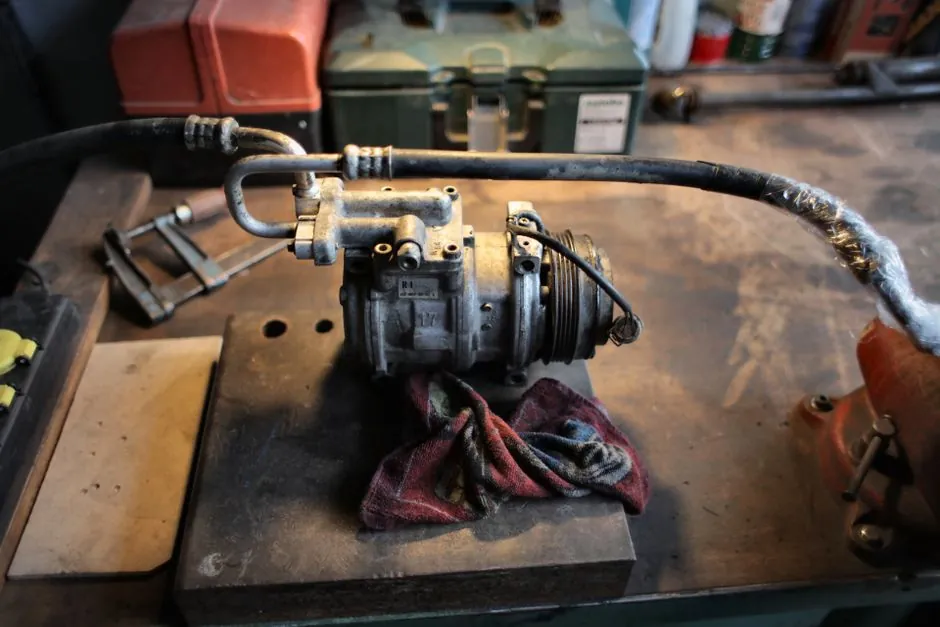
An industrial air compressor in 2026 is best specified as the heart of a compressed air system: air generation, receiver tank, dryer, filtration, distribution piping, and pressure control treated as one engineered package rather than a standalone machine [S3]. Because compressed air frequently makes direct or indirect contact with the manufactured product, it is treated in pharmaceutical and food plants as the "fourth utility" alongside electricity, water, and natural gas [S3][S2].
Manufacturing facilities that apply best energy management practices and purchase energy-efficient compressed air equipment consistently see significant energy savings across the lifecycle of the system [S1]. Selecting the right machine and matching it to the duty cycle, peak demand, and air-quality class is now the central engineering task, not picking a brand off a catalog page [S7].
Compressor Type vs. Application Fit
Positive-displacement and dynamic designs serve different load profiles, and matching type to duty cycle is the first selection decision [S6]. Reciprocating (piston) compressors are common in small shops and intermittent duty; rotary screw compressors dominate continuous-duty industrial loads because of their steady output and lower vibration; centrifugal compressors are used for very high CFM baseloads above roughly 500–1000 HP equivalents; oil-free screw and water-lubricated screw units are mandatory where the air stream contacts product [S3][S2][S6]. Variable Speed Drive (VSD) screw compressors modulate motor speed to match real-time CFM, trimming the part-load energy penalty that fixed-speed units pay during unloaded running [S3]. For pharmaceutical lines, oil-free water-lubricated screw technology paired with twin-tower desiccant drying at −40 °C pressure dew point and 0.01 µm terminal sterile filtration on 304SS/316L piping is the standard architecture cited in 2026 GMP audit guidance [S2].
Sizing by CFM, PSI, and Duty Cycle
Correct sizing starts from the full demand profile: total airflow across all tools and equipment, whether demand is steady or fluctuating, peak demand windows, shift schedule, and future expansion headroom, not a single average CFM number [S5]. Most industrial applications operate within a relatively standard pressure range, but actual system requirements depend on the tools, machinery, and automation equipment being fed, and pressure drop across piping, filters, dryers, and fittings must be budgeted in or downstream equipment will not see design pressure at peak [S5].
A common sizing error is selecting a unit by maximum pressure rating instead of by the actual PSI the process needs, which inflates energy cost across the asset's life [S5]. Receiver tank volume should be sized to buffer peak demand spikes so the compressor does not short-cycle, and for VSD units the modulation band should be wide enough to follow the real load curve rather than spend most of its time at 50–70% speed [S3][S5].
Air Quality Class and Pharmaceutical Qualification

Compressed air in direct or indirect product contact must achieve ISO 8573-1 Class 0 purity, with total oil content strictly below the instrumental detection limit, and the entire system, not just the compressor, must clear a full URS, DQ, IQ, OQ, PQ qualification framework to pass EU GMP Annex 1 and FDA 21 CFR Part 211 audits [S2]. Class 0 is defined under ISO 8573-1:2010, which sets the purity classifications for oil, water, and particulate on compressed air streams used in regulated production [S2]. A 0.01 µm terminal sterile filter and a desiccant dryer set to −40 °C pressure dew point are the typical finishing elements for sterile fill-finish lines, paired with 304SS or 316L stainless distribution piping to prevent rust particulate from entering the airstream [S2].
Three failure modes recur in 2026 GMP audit findings: invalid quality certificates that rely on an outdated "oil-free" claim rather than an active third-party ISO 8573-1 Class 0 certificate, incomplete qualification of the dryer, receiver tanks, and distribution piping (not just the compressor), and proprietary OEM controllers that block site engineers from executing documented Change Control on alarm setpoints [S2]. Open-architecture controllers on Siemens or Schneider platforms are increasingly specified so that setpoint changes and alarm history can be tracked inside the site's quality system [S2].
Energy Efficiency and Lifecycle Cost
Compressed air systems routinely account for a large share of plant electricity use, so lifecycle cost, not purchase price, is the correct comparison axis [S1]. VSD screw compressors, leak-tight distribution (which includes properly sized piping and minimized fittings), heat-of-compression recovery, and lower pressure setpoints are the four levers most consistently cited in 2026 efficiency guidance [S3][S1]. Operating the system at the lowest pressure the application actually needs, rather than the compressor's maximum, supports energy reduction, so pressure-drop budgeting and receiver sizing feed back into energy efficiency, not just reliability [S5][S3].
For a deeper look at how compressed air subsystems, actuators, valves, and FRLs get specified on a modern line, see this pneumatic system production line design spec map, and for the smart sensor and IIoT integration side of the same air circuit, the smart pneumatic components under Industry 4.0 spec snapshot is a useful complement.
Operator-Side Maintenance and Oil Basics

Operator discipline is a spec factor because poor maintenance routinely degrades air quality class regardless of the compressor's nameplate. Before every use, operators should inspect hoses, fittings, and pressure settings and confirm they match the tool or task [S4]. Compressor lubricant selection, whether mineral, synthetic, or food-grade, must follow the OEM's specific recommendation, since using the wrong viscosity or additive package can shorten bearing and rotor life, and on oil-injected units it directly affects downstream oil carryover into the air stream [S8].
A practical trackable signal: monitor specific power (kW per 100 CFM) at a fixed discharge pressure and compare monthly; a 5–10% drift without a load change usually points to filter loading, dryer desiccant exhaustion, or developing leakage in the distribution network rather than to the compressor itself [S1][S3]. Two more signals worth logging are ΔP across the intake filter (replace at manufacturer-recommended ΔP, not on a calendar) and the receiver-tank condensate drain cycle, because a drain that sticks open is a quiet, continuous energy leak [S1].
For the relevant spec sheets and selection criteria, see additive manufacturing material, linear guide, and crossed roller guide.