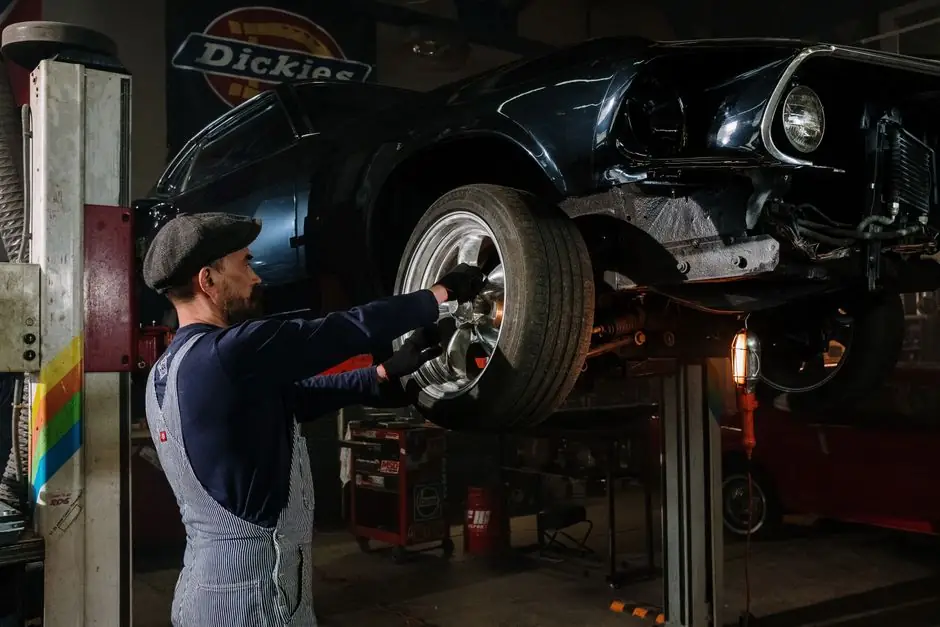
Air impact wrenches expose operators to triaxial hand-arm vibration strong enough to drive Hand-Arm Vibration Syndrome (HAVS), with NIOSH/CDC field measurements reporting ISO-weighted root-mean-square accelerations of 6.26 ± 2.08 m/s² at the tool handle, 7.49 ± 2.54 m/s² at the wrist, and 4.05 ± 1.32 m/s² at the elbow across 450 trials on 15 tools [S2].
Tool design has overtaken PPE as the primary mitigation lever, with modern air wrenches integrating twin-hammer mechanisms, polymer-isolated handles, internal counterweights, and tunable power settings to cut vibration at the source rather than rely solely on anti-vibration gloves or shift reduction [S3][S4][S5].
Quantified Vibration Exposure at Handle, Wrist, and Elbow
Six experienced male operators running 15 different impact wrenches on a simulated workstation produced 450 individual trials, and the resulting ISO-weighted accelerations showed a resonant transmissibility peak near 31.5 Hz at the wrist that the standard ISO frequency weighting does not capture, meaning current ISO 5349 single-axis sums likely understate vascular and neurological risk on real pneumatic tools [S2].
The vibration power absorption (VPA) weighting derived from palm anatomy tracks that 31.5 Hz resonance far more closely than ISO weighting does, which is one reason tool designers now quote triaxial values rather than a single ahv number when comparing wrenches [S2]. A 2026 biomechanical model from ter Braack et al. treats the impact wrench as a coupled dynamic system so that design changes to the hammer mass, anvil, and grip interface can be simulated before the tool is ever built, with the explicit goal of cutting operator dose [S7].
Mechanism Choices: Twin Hammer vs Single Hammer vs Jumbo Hammer
Twin-hammer impact mechanisms deliver maximum power with minimal vibration by striking the anvil from two opposed hammers per cycle, which balances the percussive reaction force and lets the motor run at lower peak RPM for a given torque output [S5].
Jumbo-hammer mechanisms, by contrast, move a single large mass with longer stroke and produce higher BPM and a louder, harsher sound spectrum, which raises both hand-arm vibration dose and noise exposure; for duty cycles dominated by suspension and structural bolts, the trade-off is documented in side-by-side benchmark data [S3][S5]. For tight-quarters automotive work, a compact twin-hammer tool like the BETA 1928XM still posts 1,600 Nm of maximum torque while keeping the hammer reaction mass low enough to keep handle buzz manageable [S4].
Grip Materials, Insulation, and Anti-Vibration Handle Architecture

Premium air impact wrenches wrap the entire handle zone, including under the grip areas, in engineered polymer compounds that block vibrational energy transfer before it reaches the palm, which a shop-floor test reveals immediately: a well-insulated model "exhibits a slight mechanical vibration but almost no detectable buzz in the handle itself, even under full power" [S5].
Designers stack four distinct dampers in series: internal counterweights offset hammer reaction, rubber mounts or springs isolate the handle from the motor housing, viscoelastic or elastomer grip sleeves add a tuned damping layer at the palm, and a tungsten hammer pin reduces metal-on-metal striking noise that would otherwise be re-radiated as high-frequency vibration [S3][S5]. Soft high-friction rubber overmold on the handle also improves grip security, which lets the operator push less hard and reduces feed-force coupling into the wrist, a secondary but real source of HAVS dose [S3][S6].
Exhaust Path, Trigger Profile, and Weight Balance
Rear exhaust on standard wrenches blows vaporized lubricant back into the operator's face and over the work area, so higher-end designs redirect the airflow at a 45–60° angle through a rear diverter, which both reduces contamination and lets the operator adopt a more neutral wrist posture without shielding the face [S5].
Trigger geometry matters more than most buyers realize: a curved single-finger lever concentrates force on one flexor tendon, while a profiled multi-finger trigger distributes the pull across the index, middle, and ring fingers and lets the hand stay in a neutral position, reducing fatigue that compounds vibration dose over a shift [S5][S6]. Tool balance and total mass also feed into operator exposure, since a front-heavy wrench forces a stronger grip and push force, both of which raise vibration transmissibility into the hand-arm system [S6]. A 3/8" palm-style air impact wrench takes the same logic further by shortening the lever arm and centering mass close to the palm, with a hidden muffler dropping the radiated sound pressure that otherwise reaches the operator's ear [S9].
Decision Matrix: Selecting a Low-Vibration Air Impact Wrench
Four criteria dominate the choice, and a side-by-side comparison makes the trade-offs explicit for buyers: (1) Mechanism, where twin-hammer beats single/jumbo on vibration and noise but jumbo-hammer still wins for very high-torque structural bolts; (2) Grip insulation, where full-coverage polymer wrap plus an internal isolator outperforms bare metal or thin rubber sleeves; (3) Power adjustability, where three or more forward/reverse power settings let the operator drop the hammer energy on soft joints, cutting both vibration and fastener damage; (4) Exhaust and trigger, where a 45–60° rear diverter and a profiled multi-finger trigger reduce secondary stressors (oil mist, tendon load) that add to perceived fatigue [S4][S5].
For an air impact wrench buyer in automotive or light-industrial service, the practical default is a compact twin-hammer tool with three power settings, a fully overmolded grip, and a rear exhaust diverter; for heavy structural bolting, a larger twin-hammer or carefully specced jumbo-hammer with aggressive counterweights is the right trade, and a palm-style 3/8" wrench is the right pick when access is tight and cycle count is high [S4][S5][S9]. Anti-vibration gloves and wrist supports remain useful as a second line of defense when the tool itself cannot be changed, but material and design changes at the wrench are the lever that actually moves the ISO-weighted acceleration number [S3].
Standards, Measurement Methods, and Open Gaps
Vibration emission testing for handheld power tools is governed by ISO 5349 (frequency-weighted hand-arm vibration) and ISO 28927, the latter covering hand-held portable power tools specifically, and a basic engineering takeaway from the CDC dataset is that triaxial ISO-weighted acceleration is the right metric to demand on a wrench datasheet, not a single-axis ahv [S2].
The 31.5 Hz wrist resonance that the CDC transmissibility data exposes is not reflected in ISO frequency weighting, and the VPA weighting derived from palm anatomy matches the operator response curve much more closely, which suggests the next revision of guidance, or at least a buyer-side internal standard, should weight that band more heavily when ranking wrenches [S2]. For shops that already run a structured tool program, the right next step is to require triaxial vibration data and an ergonomic grip spec sheet at procurement, then validate with a vibration meter survey on a representative sample of daily work, and to revisit the socket-retention interface, since a loose socket slaps the anvil and adds dose that the wrench itself never produced, as detailed in this socket retention comparison and this twin-hammer vs jumbo-hammer benchmark [S2][S3].
For the relevant spec sheets and selection criteria, see impact drill.