
Air quality monitors in 2026 fall into two distinct product families: laser-particle counters priced from $199.99 to $475.00 (Dylos DC1100, DC1100 PRO, DC1700, DC1700-PM [S2]) and multi-parameter IAQ stations such as the Awair Element at $299 and the Awair Omni for business deployments [S4].
The first family measures only particulate counts, while the second adds CO2, VOC, temperature, and humidity sensing. Buyers should pick a variant by matching sensor count, output type (standalone display vs. cloud dashboard), and the particle size window the application actually requires.
PM-only Particle Counters vs. Multi-Parameter IAQ Stations
Laser particle counters such as the Dylos DC1100 family report particle counts in two size bins (small/large) and start at $199.99 for the base DC1100 unit [S2]. The DC1100 PRO at $260.99 adds logging and a PC interface, while the DC1700-PM ($475.00) is the PM2.5/PM10-specific variant with a regulated gravimetric-style mass readout [S2].
Multi-parameter IAQ stations instead read 5 to 7 environmental factors: the Awair Element ($299, 5 factors) targets home and small office, whereas the Awair Omni (business tier) tracks 7 factors across tenant, employee, and student deployments [S4]. Awair's published footprint is 6,000+ business subscriptions, 85,000+ app downloads, and 750M+ data points collected per day [S4].
Sensor Channels and What Each One Buys You
Particle-only counters in this segment use a laser scattering principle and report counts per volume, not mass concentration, on the base DC1100. Step up to the DC1700-PM if your application needs PM2.5 and PM10 mass values directly in µg/m³ [S2].
Multi-parameter IAQ stations layer NDIR CO2, metal-oxide VOC, and combined temperature/humidity sensors on top of a PM module. The Element covers 5 factors (CO2, VOC, PM, temp, humidity); the Omni adds 2 more channels aimed at commercial spaces where CO2 trend tracking matters for ventilation verification [S4].
Selection Criteria: Match Sensor Set to Duty
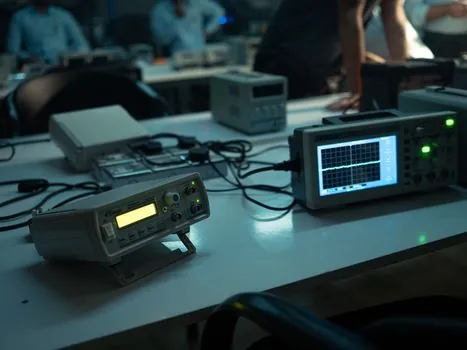
For residential allergen and dust complaints, a DC1100 PRO at $260.99 with PC logging covers what 90% of home users actually need; published customer feedback cites dust and particle allergies as the primary purchase driver [S2].
For commercial offices, schools, and retail, a 7-factor Omni-class station gives CO2 trend data that an HVAC controls contractor can act on; the Awair business model is subscription-based, so total cost of ownership extends well past the unit price [S4].
For industrial shops, woodworking, and craft environments with visible dust, the DC1700 battery-operated ($425.00) removes cord constraints and survives portable surveys where mains power is unavailable [S2].
Data Output, Connectivity, and Logging
Base DC1100 units are standalone with on-device display. The DC1100 PRO at $289.99 with PC interface is the entry point for spreadsheet logging; the new DC1100 PRO with MASK TEST function ($260.99) is positioned for fit-test workflows rather than continuous monitoring [S2].
IAQ stations in the Awair line ship with companion apps (iOS and Android), a web dashboard, and the AwairNet gateway for multi-site rollups. The Omni tier is designed for property managers and was originally scoped to track 6,000+ business subscriptions with 750M+ daily data points [S4].
Who Should Not Buy the Mainstream Option
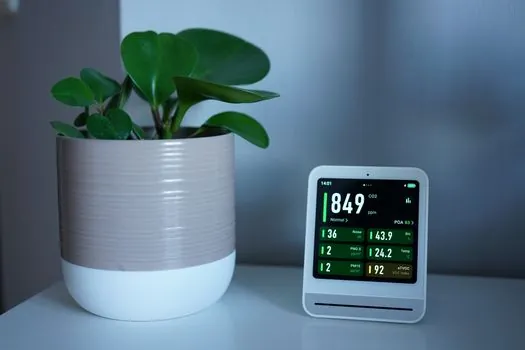
Do not spec a 5-factor consumer IAQ station for regulated environments: these units are not gas-detector-certification bearing, have no ATEX/IECEx marking, and cannot substitute for a fixed gas detection system in chemical or refinery service.
Do not buy a particle-only counter if your hazard is gaseous (CO, NO2, formaldehyde, ozone). A DC1100 reads only particulate; VOC, CO2, and gas-phase contaminants stay invisible to the sensor, regardless of price tier [S2].
Cost Stack and TCO Logic
Hardware-only, the cheapest credible laser particle counter sits at $199.99 (DC1100), mid-range PC-logging units at $260.99 to $289.99 (DC1100 PRO family), and PM2.5/PM10 specific units at $475.00 (DC1700-PM) [S2].
Multi-parameter IAQ stations add subscription fees: the Element at $299 is a one-time hardware buy, while business-tier Omni deployments carry recurring software costs that materially shift the 3-year TCO calculation. For context on TCO framing used in industrial sensor selection, see the online water quality analyzer spec-first map.
Application Pairings and Cross-Reference

Particle counters pair naturally with shop dust control and HVAC filter verification; multi-parameter IAQ stations pair with BMS integration and tenant-comfort reporting. For adjacent measurement categories in the same spec-first family, see the temperature recorder cost guide and the pressure transmitter TCO breakdown. [S2]
Buyers building a complete indoor environment monitoring stack should cross-check sensor data sheets against the air quality monitor reference page and confirm the temperature monitor channel range before integrating into a building management system.
Trackable Signals Worth Watching
Watch two product signals: (1) battery-operated PM counter refreshes, since the DC1700 platform at $425.00 is the most recent portable variant listed and (2) subscription-tier changes for IAQ business deployments, which directly alter multi-year TCO [S2][S4].
Spec-level background on the components involved: linear guide.