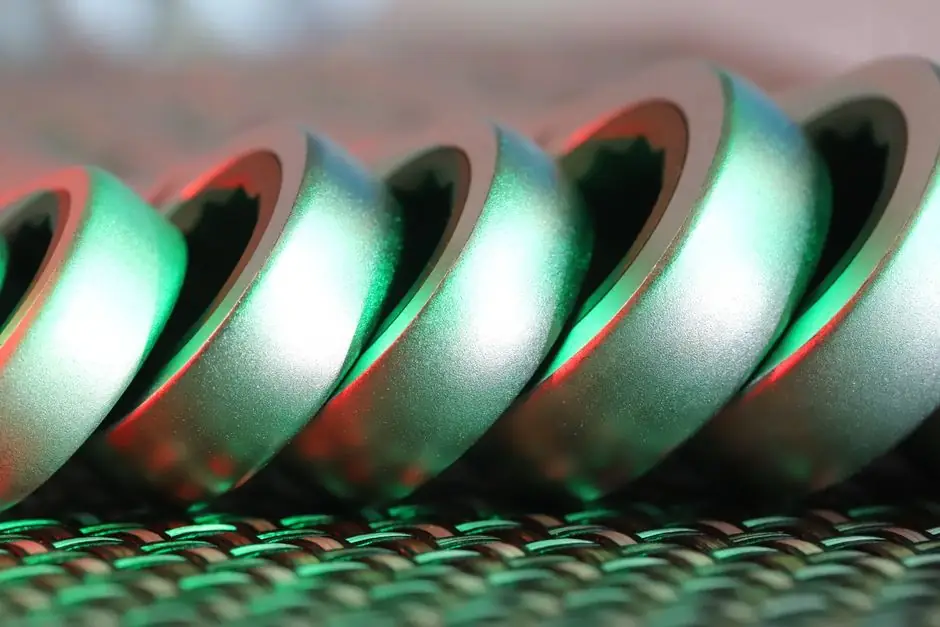
Through-hardened AISI 52100 chrome steel, with 0.95-1.10% C and 1.30-1.65% Cr, is the dominant race material for standard-duty tapered roller bearings, delivering 60-64 HRC surface hardness and continuous service up to 120 deg C [S2][S4].
Case-hardened low-alloy carburizing steels (e.g. AISI 4320, 8620, 9310 families) take over when the race section is thick, the impact load is high, or the operating temperature demands a tougher core, and the same NASA TM-2012-217445 explicitly lists this family as the primary alloy class for tapered roller bearing races [S1].
Why 52100 Chrome Steel Dominates Standard Tapered Races
AISI 52100 has been the ball-bearing industry's reference steel since 1920, and the same composition is used for inner rings, outer rings (cups), and tapered rollers in most catalog tapered roller bearings [S4]. The alloy's 1.30-1.65% chromium content gives through-hardening response in moderate cross-sections, and a controlled-atmosphere through-hardening heat treat produces a uniform 60-64 HRC throughout the race section [S2].
Hardenability is the governing selection criterion: the race must reach full martensitic hardness at the OD of the cup and the ID of the cone, and 52100 is balanced to do that in the typical 6-25 mm section sizes used in commercial automotive and industrial bearings. For context, the international equivalents carry the same nominal chemistry: 100Cr6 (DIN), SUJ2 (JIS), and GCR15 (GB), each with C in the 0.95-1.10% band and Cr in the 1.30-1.65% band [S2]. The same chrome-steel chemistry also extends to standard roller bearings for non-tapered geometries where through-hardening is feasible [S2].
Case-Hardened Alloy Steels for Heavy-Section Tapered Races
For large bore sizes, heavy wall sections, or high-impact applications, the race is made from low-alloy carburizing steel and then case-hardened: a hard, wear-resistant surface case (typically 58-62 HRC) backed by a tough, lower-carbon core (roughly 25-40 HRC) [S1]. NASA TM-2012-217445 identifies these low-alloy carburizing steels as the primary class used in tapered roller bearings where the case-hardened approach outperforms through-hardening [S1].
Common AISI/SAE grades in this family include 4320, 4620, 4720, 4820, 8620, 9310, and 52100 variant modifications; the nickel-bearing grades (4320, 9310) are favored for the largest sections because nickel raises core toughness without sacrificing case hardness [S1]. A typical tapered race in this class is carburized at 900-925 deg C, quenched in oil, then tempered at 150-200 deg C to stabilize retained austenite while preserving surface hardness.
Comparison: 52100 Through-Hardened vs Low-Alloy Case-Hardened for Tapered Races
The two alloy families solve different problems, and the spec choice is driven by four criteria. The 52100 chrome-steel route wins on cost, dimensional stability, and hardness uniformity in small-to-medium sections (roughly 6-25 mm effective case depth); the case-hardened low-alloy route wins on core toughness, impact resistance, and suitability for thick sections (above ~25 mm) or elevated-temperature service [S1][S2].
On maximum continuous temperature, standard 52100 is rated to 120 deg C, with a stabilized temper variant reaching 220 deg C at the cost of hardness and load capacity [S2]. On corrosion resistance, neither family performs well, so a rust-preventive oil or coating is mandatory for storage and shipping [S2]. On manufacturing, 52100 races are cheaper to grind because the section is uniformly hard, while case-hardened races require controlled-case grinding to hold the case depth within roughly 1.0-2.0 mm depending on bearing size.
Stainless and Specialty Alloys for Tapered Races
440C is hardenable to roughly 58-60 HRC and tolerates wet or mildly corrosive environments, but its hot-hardness ceiling is lower than 52100, so it is not a drop-in for high-load gearboxes [S1].
For food-grade or washdown environments, AISI 304 or 316 races are occasionally used, but these austenitic grades cannot be hardened by conventional heat treatment, so the load rating is severely limited and they are reserved for slow-speed, lightly loaded service [S2]. Silicon nitride (Si3N4) ceramic rollers paired with 52100 or case-hardened steel races are a hybrid, not a full-ceramic race, and are typically justified only for high-speed or electrically insulated applications.
Heat Treatment, Hardness Targets, and Operating Limits
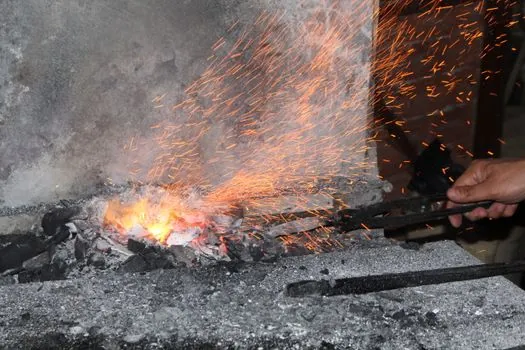
Standard 52100 races are through-hardened in a controlled-atmosphere furnace to 60-64 HRC, with austenitizing around 845-870 deg C, oil or martempering quench, and a temper at 150-200 deg C [S2]. Case-hardened low-alloy races are carburized at 900-925 deg C to a case depth of roughly 1.0-2.5 mm, oil-quenched, then tempered, giving a surface of 58-62 HRC over a 25-40 HRC core [S1].
Stabilized 52100 (sometimes called 52100 high-temp or "S" variant) trades surface hardness for thermal stability: roughly 58-60 HRC at 220 deg C, versus 60-64 HRC for the standard grade [S2]. Bearing-rings 1010-2010: published data on 52100 manufacturing routes explicitly names 52100 as the "bearing quality chrome steel" most often used for races, valued for mechanical strength, high hardness, and wear resistance [S8].
Standards, Specifications, and Sourcing Signals
The applicable material standards are ASTM A295 for 52100 high-carbon bearing steel and ASTM A534 for case-hardened bearing steels, with ISO 683-17 covering the equivalent international grades; these documents control inclusion rating, hardenability, and microstructure requirements for bearing races. For end-of-life traceability, OEM spec sheets for tapered roller bearings typically list both the alloy family and the case-depth or hardness range, which is the single fastest way to confirm which class a given part belongs to [S1].
Two practical signals to track on a purchase order or incoming inspection report: the specified surface hardness in HRC and the alloy designation (e.g. 52100 vs 8620), because these two values together pin down the heat-treat route and the operating-temperature ceiling without ambiguity [S1][S2]. A related internal reference on stainless high-temperature selection, 321 vs 347 stainless steel, applies the same alloy-decision logic when 440C is not enough and the service temperature moves into the 500-800 deg C band.
Spec-level background on the components involved: road roller.