
For die and mold work, tool steel is the right pick for any surface that cuts, forms, ejects, or wears; alloy steel is the right pick for the structural frame around it, because it costs less and machines faster at the same section size [S1][S4].
Tool steel as a class typically runs 0.5–1.5% carbon with deliberate carbide formers (Cr, W, Mo, V) added to push hardness and hot strength, while low-alloy steels sit below 5% total alloy content and are tuned for toughness, weldability, and through-thickness strength rather than edge retention [S1][S2][S3][S5]. That is why the same project routinely specs P20 or H13 for cavities and cores but 4140 or A36-grade low-alloy plate for the mold base clamping it shut.
Composition, Carbon Range, and Hardenability
Tool steel grades generally carry 0.5–1.5% C in the popular reference range, with SSAB quoting a tighter 0.7–1.5% C band, and the four carbide-forming alloying elements (tungsten, chromium, vanadium, molybdenum) doing the heavy lifting on wear and hot hardness [S2][S3][S5]. Low-alloy steels by contrast are defined at under 5% combined alloy content, with carbon usually 0.2–0.5%, and rely on nickel, chromium, and molybdenum for through-hardening rather than carbide volume [S1].
The consequence is a wide hardness gap. AISI W-group water-hardening grades can hit above 66 HRC but are brittle; AISI D2 cold-work tool steel (about 12% Cr) is the wear benchmark; H13 hot-work tool steel is specified at 50–62 HRC after heat treatment and keeps properties to roughly 540°C (1000°F) [S2][S3][S5]. A quenched-and-tempered low-alloy 4140 plate is sitting closer to 28–32 HRC in the same mold-base thickness, so it machines far easier but will not hold a cavity detail.
Where Alloy Steel Still Wins: Frames, Bolsters, and Base Plates
Low-alloy steel is the right call for the parts of a casting mold or stamping die that never see the cut: clamp plates, ejector housings, bolster faces, and the mold base itself [S1][S4]. These parts need tensile strength, fatigue life, and dimensional stability over a 1.5–3 m footprint, not 60 HRC.
For higher-temperature die-casting frames where the structure is near the cavity, the same base is often upgraded to a low-alloy Cr-Mo-V plate, but the spec rationale (strength plus weldability plus thermal conductivity control) is still alloy-steel logic, not tool-steel logic.
Tool Steel for Cavities, Cores, and Wear Inserts
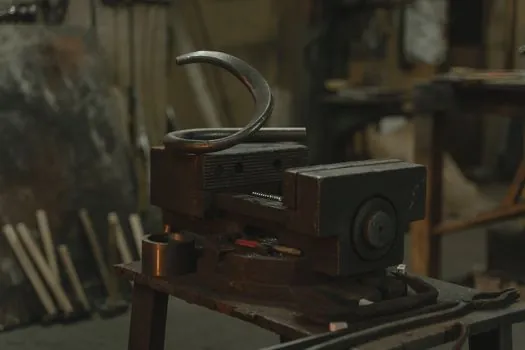
Cavity and core duty is where tool steel dominates, because the requirement is hardness plus wear resistance plus a surface that can be polished to SPI mirror grades, not raw structural strength [S3][S4][S5]. AISI P20 (about 0.35% C, 1.7% Cr, 0.4% Mo) ships pre-hardened to roughly 30–36 HRC, machines at 65–75% of 160 BHN B1112 reference, and needs no further heat treat, which is why it is the default for medium-volume plastic injection mold cavities on polypropylene and polyethylene [S4].
When cycle count climbs into the hundreds of thousands or the resin is glass-filled PEEK at 720°F, P20 wears out and the spec steps up to H13: 0.32–0.45% C, around 5% Cr, 1.5% Mo, 1% V, typical 50–62 HRC after heat treat, good polishability, and thermal-fatigue resistance through repeated heating and cooling [S4][S5]. D2 (1.5% C, 12% Cr, 1% Mo, 1% V) is the cold-work choice for blanking, punching, and forming dies where abrasive wear is the failure mode rather than thermal cycling, and S7 (0.5% C, 3.25% Cr, 1.4% Mo) is the shock choice for punches and chisels taking repeated impact [S3][S5]. High-speed grades (M2, T1) are reserved for cutting tools, not mold cavities.
Selection Criteria and Side-by-Side Comparison
Four criteria separate alloy steel from tool steel on any die or mold drawing: hardness/HRC, hot-strength limit, machinability rating, and cost per kg, and the gap is large enough to drive a clean split between structural and tooling functions [S1][S3][S4][S5].
Typical 4140 low-alloy plate in Q&T condition: about 28–32 HRC, no useful hot strength above 300°C, roughly 70–75% of B1112 reference machinability, and the lowest cost per kg. Typical P20 pre-hardened mold steel: 30–36 HRC, no useful hot strength above 300°C, 65–75% machinability rating, and roughly 2–3× the cost of 4140. Typical H13 hot-work tool steel: 50–62 HRC after heat treat, useful properties to about 540°C, only about 45% of B1112 machinability, and 3–5× the cost of 4140. Typical D2 cold-work tool steel: 58–62 HRC, useful properties to about 400°C, machinability around 35–45% of B1112, and 4–6× the cost of 4140 [S1][S3][S4][S5]. The takeaway is direct: pick by the hardest working surface in the assembly, then back-fit the rest as alloy steel.
Heat Treatment, Distortion, and Machining Reality
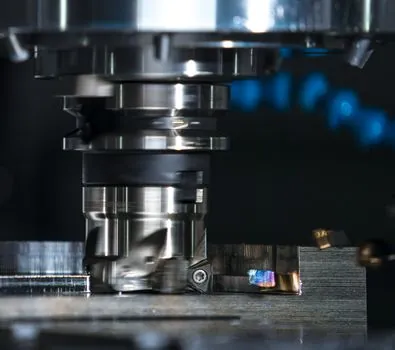
Heat treatment is where these two material families diverge operationally. Water-hardening W-grades are the cheapest tool steel but warp and crack during quench, which is one reason they have been displaced by oil-hardening (O-series, e.g. O1) and air-hardening (A-series, e.g. A2) grades for precision die work [S2][S3]. Air-hardening A2 and AISI D2 give the best dimensional stability of the common cold-work tool steels, which is why they are specified for blanking and forming dies with tight punch-to-die clearance.
P20 sidesteps the heat-treat step entirely by shipping pre-hardened to 30–36 HRC, which is the single biggest reason it dominates medium-volume plastic mold builds, and H13 is normally supplied annealed (around 200 HB) for machining, then vacuum-hardened and double- or triple-tempered to 50–62 HRC to hit the 540°C hot-strength target [S3][S4][S5]. Low-alloy 4140 and similar grades are quenched and tempered for tensile strength in the 850–1100 MPa band, with much wider process windows and no need for the surface protection that H13 demands.
Standards, Designation, and Sourcing Notes
Tool steel grades are identified on the AISI-SAE scale (W, O, A, D, S, H, M, T) with individual alloys (A2, O1, D2, H13, P20, S7, M2) carrying the property reputation, while low-alloy steels follow the AISI 4-digit SAE system (4140, 4340, 8620) keyed to chemistry rather than heat-treat response [S2][S3]. The choice between grades within each system is driven by cost, working temperature, required surface hardness, strength, shock resistance, and toughness, with the rule that more severe service conditions (higher temperature, more abrasion, more corrosion) push selection toward higher alloy and higher carbide content [S2].
Buyers should pin the spec to a named AISI grade plus hardness range in HRC or HB, plus a heat-treat certificate for tool-steel components, and to a chemistry plus Q&T tensile-strength range for the alloy-steel structural parts. For more on how tensile ranges translate to working load on the structural side, see quenched and tempered alloy steel tensile strength: ranges, limits, and how to read them. For shops that need to know how long a die or mold assembly takes to ship and install, the VLM section delivery and on-site installation time piece is the practical companion to this material selection.
For the relevant spec sheets and selection criteria, see tool die steel.