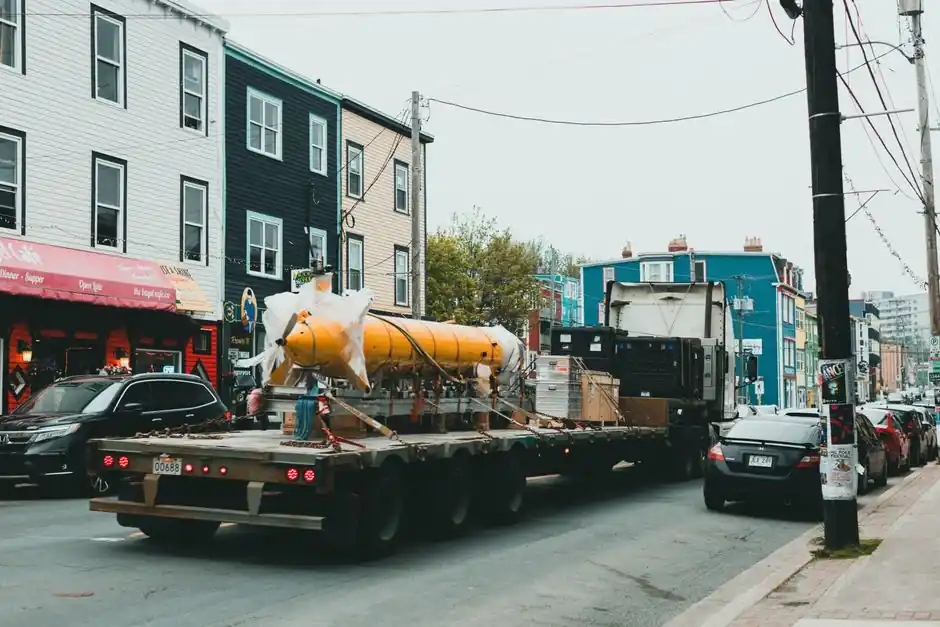
A vertical lift module (VLM) generally arrives at the customer site in 4 to 6 freight sections per unit, with on-site assembly, elevator calibration, and commissioning absorbing 2 to 5 working days once the floor and ceiling envelope are confirmed [S1][S2].
Section count, crane day count, and integrator labour scale with VLM height (configurations up to ~50 to 52 ft are common, and storage heights around 40 ft appear in standard offerings) and with the number of machines installed in the same outage window [S2].
How a VLM is actually split for shipping
Most VLMs are broken into structural column sections, the roof/cap, the extractor carriage, base frame, and the access bay panels, because the assembled cabinet is too tall and too heavy to move on a standard lowboy. White Systems' product family, for example, lists single- and dual-tray configurations with rack-and-pinion drive and unit heights up to ~40 ft in standard form, with extended configurations reaching 50 to 52 ft on Compact Lift and PC3 lines [S2]. Each section arrives on its own skid, with the extractor shipped separately and often crated indoors if the site allows.
Section count is not fixed across vendors: shorter units (under ~20 ft) can sometimes ship as 2 or 3 sections, while a 40+ ft unit more commonly splits into 5 to 6 sections plus the elevator. Site survey findings published by Bradford Systems in September 2026 stress that "a machine may fit on a drawing, but every facility has" column, ceiling, and door-opening constraints that decide whether the unit must be broken into more pieces or craned through a removed wall section [S3].
What the on-site crew actually does, day by day
Once sections are on the floor, Prestige's installation sequence describes the core workflow: physical assembly of the two column structures around the central extractor, mechanical alignment of the elevator track, electrical drop and control panel termination, software load and ERP/WMS handshake, then operator-side acceptance testing [S1]. White Systems' installation FAQ frames the same scope as a function of model, height, site conditions, and unit count, and explicitly does not publish a one-size number, because rigging access, floor flatness, and available crane time all swing the schedule [S2].
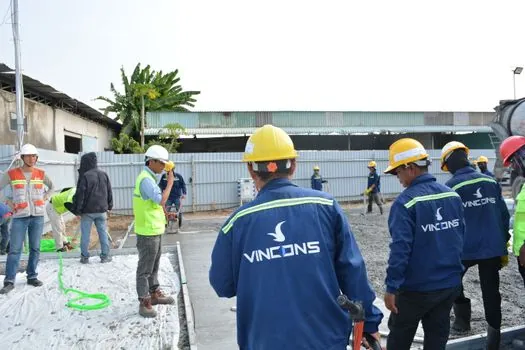
For a single standard-height VLM on a prepared slab, two working days for mechanical assembly and one day for commissioning is a realistic lower bound. A 40 ft+ unit on a tight site, or a multi-unit install done in a single weekend outage, more commonly consumes 4 to 5 days, with crew size scaling from a 2-person install team to a 4- to 6-person team when sections must be lifted into a second-floor mezzanine. The construction machinery and equipment used on the day (forklift, telehandler, or mobile crane) is dictated by section weight, not by VLM model.
Acceptance criteria: when the install is "done"
Acceptance is not a handshake, it is a measured set of checks. Pick speed verification is the headline test: White Systems rates its VLM line at up to 120 tray cycles per hour and a picking accuracy of 99%+ on standard configurations, both of which the commissioning team has to demonstrate before sign-off [S2]. Independent manufacturing-focused reporting cites up to 300 lines per hour for higher-throughput VLM deployments, which reflects goods-to-person picking rate rather than raw tray cycles and depends heavily on the host WMS/ERP integration [S4].
Beyond throughput, the integrator must prove tray-to-access-opening repeatability, ERP/WMS transaction round-trip, emergency-stop and light-curtain response, and power-quality behaviour under full elevator load. The 85% floor-space reclamation figure White Systems publishes is a design-stage target, not a measured acceptance number; it should be verified against the customer's actual picking aisles, not taken from a brochure [S2].
Where the schedule breaks: site-survey red flags
The Bradford Systems post from September 2026 is blunt on the most common install delays, and they are almost always site-survey failures, not machine problems: insufficient floor flatness (a VLM base needs a level tolerance tighter than a typical warehouse slab), ceiling clearances that ignore fire-spray or conduit drops, and door openings too narrow for upright section delivery [S3]. When any of these is missed, the install day turns into a rework day, and the customer eats the cost. Their guidance is to lock the site survey as the gating milestone before shipment, not after.
Two other delays are chronic and worth budgeting for: (1) the host-system integration test, which only finishes when the customer's WMS or ERP is reachable from the VLM controller, and (2) operator training, which is often scheduled as a half-day but slips to a full day when pick-to-light or batch-pick workflows are introduced for the first time. Buyers should plan for these as separate line items on the integrator's quote, not as bundled into the install day count.
Comparison: VLM install drivers at a glance

Three variables dominate the install-day count and should be compared side by side: (a) unit height, where sub-20 ft installs are typically a 1 to 2 day job and 40+ ft installs are a 3 to 5 day job; (b) number of units in the same outage, where adding a second unit in the same crew visit is roughly +1 to +2 days because the elevator commissioning and host integration repeat; (c) section delivery format, where factory pre-assembly on a wheeled base can cut rigging time on tight sites but extends the freight footprint, while fully knocked-down sections need more on-site build hours but slip through standard 8 ft doorways [S1][S2][S3].
Pre-install checklist for buyers
Lock these before signing the PO: confirmed finished floor levelness at the install footprint, verified ceiling clear height minus any fire-spray, HVAC, or conduit intrusions, a measured door/envelope path for the tallest rigid section, a host-system API or file-drop spec for ERP/WMS integration, and a written acceptance test that quotes specific numbers (tray cycles per hour, pick accuracy, ERP round-trip latency) rather than adjectives. The VLM vs Vertical Carousel: Spec-Driven Selection for AS/RS Buyers piece walks through how these same spec numbers should be written into the RFQ so they survive procurement review, and the 25 mm storage pitch and automatic height scanning in VLM tray storage note covers the tray-level geometric limits that a careless site survey will miss. [S2]
Trackable signals to watch over the next planning cycle: integrators publishing named day-count SLAs by model and height band, more vendors quoting factory pre-assembly on wheeled bases for brownfield sites, and WMS vendors shipping pre-built VLM connectors that shorten the host-integration day from a full shift to a half-shift.
Component reference pages worth checking: time relay, and checking and testing apparatus.