
Anaerobic threadlockers cure in the absence of air and metal ions, flowing into every thread groove and polymerising into a solid mass that fills 100% of the microscopic gap between mating threads, compared with roughly 15% metal-to-metal contact in a typical nut-and-bolt joint [S5][S2].
Lock washers, including split, star, and modern wedge-lock designs such as the Nord-Lock system, rely on friction, spring tension, or inclined ramps to keep the fastener from turning [S1]. The two technologies solve the same problem (prevention of self-loosening from vibration and thermal cycling) by completely different mechanisms, and that is why assembly engineers keep arguing about which one wins [S1][S2].
How each method actually holds the joint
A standard lock washer works by biting into the mating surface, increasing friction, or, in the case of wedge-lock washers, creating a tension couple across inclined cam faces that can only be released by rotation in the tightening direction [S1]. A split spring washer adds a small axial spring load that has to be overcome before the nut can back off; the contact area on the surface is small, and once the washer loses a fraction of a millimetre of bite the joint can unwind [S3].
Threadlockers are single-component anaerobic resins introduced commercially by Loctite Corporation in the 1960s; they stay liquid in the bottle, cure to a tough solid when confined between active metal surfaces, and the cured polymer keys into the surface roughness of both male and female threads, effectively bonding the assembly [S5]. Most formulations reach functional strength in 10 to 30 minutes, reach full cure in 24 hours, and fill gaps efficiently in the 0.025 to 0.50 mm range, which covers the vast majority of standard UNC/UNF and metric threads [S2].
Strength grades, colour codes, and temperature windows
Anaerobic threadlockers are sold in low, medium, and high strength grades that map to specific colour codes so a maintenance tech can identify the product in the field without a datasheet [S2][S4]. Purple (low strength, e.g. Loctite 222) is specified for screws that must be removed repeatedly, including small electronic and instrumentation fasteners; blue (medium strength, e.g. Loctite 243 / Bondrite A2243) is removable with standard hand tools and is the default choice for general-purpose nut-and-bolt joints; red (high strength, e.g. Loctite 270 / Bondrite A2270) is the studlock grade used on pump and motor housings where heat plus power tools are expected for disassembly [S4]. Green wicking grades (e.g. Loctite 290) are formulated to penetrate pre-assembled fasteners and cure inside the joint by capillary action [S2][S3].
Standard threadlocker formulations cover roughly -54 to +150 degrees C for general-purpose use, with specialty high-temperature grades rated to 175 degrees C and above, and certain hydraulic / chemical-resistant grades (e.g. Bondrite A2542 brown) tuned for fluid compatibility rather than peak temperature [S2][S4]. Bondrite's A2577 yellow is rated for an instant low-pressure seal up to 10,000 psi, useful for pneumatic and hydraulic fittings that also need thread locking [S4]. Above the chemical envelope, a wedge-lock or spring washer in high-grade steel keeps its mechanical lock; the chemical bond softens and the joint loses preload [S1][S2].
Vibration, sealing, and disassembly: head-to-head criteria
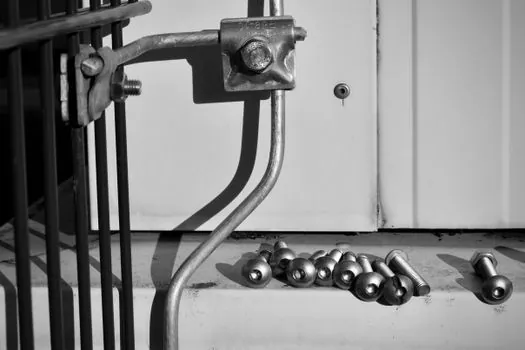
On continuous severe vibration, anaerobic threadlockers outperform the common split-lock washer because the polymerised bond stops the microscopic lateral slip that initiates self-loosening, whereas a split washer depends on a small amount of surface bite that deteriorates once the joint moves [S2][S3]. This is the same reason Mercedes-Benz, Harley-Davidson, and aerospace assembly lines default to threadlocker or specialty mechanical systems such as Hi-Lok pins rather than generic lock washers [S3].
On sealing, only the threadlocker provides a hermetic fill of the thread helix, blocking moisture, gases, and industrial fluids from wicking down the threads and causing crevice corrosion or galvanic attack; a lock washer has no sealing function at all [S1][S2][S5]. Where the joint also carries fluid (hydraulic fittings, pump studs, pneumatic manifolds), the threadlocker does two jobs (locking plus sealing) in one step.
On disassembly, the lock washer wins on speed: no cleaning, no re-application, and a wedge-lock or split washer can be removed and reinstalled many times with no loss of holding power [S1]. A medium-grade blue threadlocker comes off with standard hand tools; a red high-strength grade requires localised heat (typically 150 to 170 degrees C for Loctite 271-class products) plus hand tools, after which the threads must be cleaned of cured residue before re-application [S2][S4]. A reusable lock nut or a wedge-lock washer pair is faster on a maintenance-heavy asset, but every reusable mechanical joint is a separable joint that can eventually work loose, which is the failure mode the chemical bond is designed to prevent.
Selection matrix by application
Use anaerobic threadlocker when the joint sees continuous vibration, must be sealed against fluid or moisture, is a small fastener where a washer is hard to place, or is on a tapped hole with no nut (the classic drilled-and-tapped case where a washer has nothing to bear against) [S3][S5]. Choose a purple low-strength grade for instrument screws (M2 to M6, frequent calibration), blue medium grade as the default for chassis, pump, and gearbox hardware, red high strength for studs in motor or pump housings, and a green wicking grade for retrofit of pre-assembled fasteners [S2][S4].
Use a lock washer or wedge-lock washer when service temperature exceeds 200 degrees C, the joint must be taken apart repeatedly on a short maintenance cycle, the threads are too contaminated or too oily to bond reliably, or the assembly is on a non-active metal (anodised aluminium, stainless, plated surfaces) where the cure speed of the adhesive is uneconomically slow [S1][S2]. In high-temperature or rapid-maintenance service, the sealing-washer categories (bonded EPDM, fibre) become the alternative sealing choice when thread sealing is also required. For an industry-agnostic primer on the industrial-adhesive family that includes anaerobics, epoxies, and cyanoacrylates, the bonding decision tree is largely driven by substrate, gap, and cure mechanism.
Limitations, failure modes, and contamination sensitivity

Threadlockers are unforgiving of three conditions: surface contamination, inactive metals, and very large gaps. Oil, cutting fluid, or anti-corrosion residues on the threads will slow or stop the cure because the anaerobic resin needs direct metal-ion contact to polymerise; many modern grades tolerate minor industrial-oil films but the tolerance is formulation-specific and the safest practice is a clean, dry thread [S2][S4]. Passive metals (stainless steel, anodised aluminium, zinc-plated steel, titanium) need an activator primer to start the cure within a workable time, otherwise the joint can take hours to set or never fully cure at room temperature [S2].
Gaps above about 0.50 mm push the application out of the threadlocker's efficient range; for large clearance fits a retaining compound (e.g. Bondrite A2638 / Loctite 638 green) is the correct chemistry, designed for cylindrical bond gaps approaching 0.25 mm on bearings, sleeves, and pins [S4]. Exceeding the chemical temperature envelope softens the polymer and the joint loses preload; this is the textbook reason chemical lockers are rarely specified alone on turbocharger studs, exhaust manifolds, or any joint near a continuous heat source above 200 degrees C without a high-temperature grade and a washer backup.
Lock washers have their own failure mode: once the joint moves enough to lift the bite, the washer loses all of its holding power in a single event, with no progressive warning, and the joint can then unwind completely [S3]. Spring washers in particular are sensitive to over-compression; flatten the spring and you have a plain washer. For low-torque joints in soft materials (aluminium, cast iron, plastic) a split spring washer can also dig in enough to damage the seating surface, which is a documented reason to avoid them on soft substrates [S3].
Standards, sourcing, and what to verify before you specify
There is no single international standard that forces a choice between an anaerobic threadlocker and a lock washer; the relevant industrial norms (e.g. ISO 16047 for fastener torque-tension testing, ISO 898-1 for bolt mechanical properties, MIL-S-46163 and MIL-S-22473 for anaerobic adhesives historically used in US defence) define test methods and performance classes, not selection between methods [S2]. The decision is engineering judgement driven by the duty cycle: vibration severity, thermal exposure, maintenance interval, and the need for a sealed joint.
When you buy, verify three things on the technical data sheet: the strength grade (low/medium/high), the active-substrate cure time on your actual bolt material (active steel versus stainless versus plated), and the rated temperature window for both continuous service and peak excursion [S2][S4]. Independent laboratory data, such as the IntechOpen study showing liquid threadlocking adhesives retain clamping force better than unfilled mechanical joints under cyclic load, supports the chemical-bond case in vibration-heavy assemblies [S6].
The pragmatic engineering default, used across automotive and heavy-equipment OEM lines, is a blue medium-strength threadlocker on general nut-and-bolt hardware, a red high-strength studlock on permanent studs, and a wedge-lock washer pair on high-temperature and high-maintenance joints. That split spec covers the bulk of new-assembly work without forcing a one-size-fits-all answer. Track the next move when: ASTM and ISO committees publish updated anaerobic-adhesive qualification protocols, and when OEMs publish quantified vibration-test comparisons between wedge-lock washer pairs and red-grade threadlocker on the same joint geometry; either will shift the duty-cycle thresholds above.
Background reading: AGV charging: opportunity charging vs battery swap stations, a 2026 spec-driven comparison.