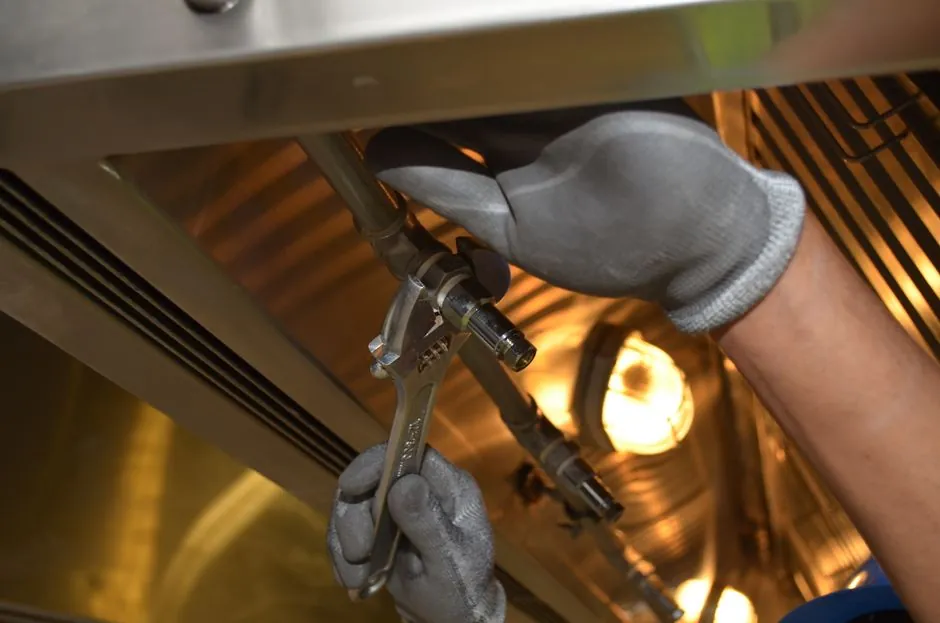
An angle-head pneumatic impact wrench with a 90° head and 1/2 in. square drive delivers 407 Nm (300 ft-lb) of maximum torque in a 1.4 kg package, sized to slip into engine bays and wheel wells where a standard pistol-grip tool will not fit [S2].
Pistol-grip air impact wrenches remain the default on automotive and production lines because the inline handle puts the operator's wrist directly behind the torque axis, but the body length is the price of access: a typical pistol grip is straight and rigid, so it cannot fold around obstacles the way an angle-head tool can [S3].
Geometry and Access: What the Two Bodies Actually Buy You
An angle-head impact wrench moves the anvil perpendicular to the motor axis (typically 90°), which collapses the access footprint in the direction the bolt head sits, so a tool that would otherwise need 250-300 mm of inline clearance can work in roughly the head height plus handle thickness, a practical difference of 100 mm or more in engine-bay work [S2].
Pistol-grip wrenches keep the anvil inline with the motor and the operator's forearm, which puts the reaction torque straight back into the wrist, the most controllable configuration for free-run on a wheel-nut pattern but the worst case for reaching down behind a subframe bracket [S3]. A flex-head variant sits between the two: the head pivots on a locking hinge from 0° to 90° or more, so the tool can run straight when desired and angle only where access demands it, without a separate universal-joint adapter stacked on the anvil [S1].
Torque, Speed, and Mass: Numbers From Real Catalogues
The compact 1/2 in. right-angle class sits around 300-910 ft-lb of maximum torque, with weights of 1.4-3.63 kg and free speeds of 7,500 rpm; the lighter 1.4 kg, 407 Nm (300 ft-lb), gearless direct-drive units target assembly and maintenance, while the 3.63 kg, 910 ft-lb twin-hammer units target underbody and suspension work [S2][S4].
A standard pistol-grip 1/2 in. air impact in the same workshop class commonly runs higher peak torque than the compact angle units but at the cost of overall length and a centred handle that the operator must swing into position. A stubby pistol-grip is the third option: it is a short-body inline tool, not an angle tool, designed for tight spaces where a full-size pistol will not fit; it is the right call when access clearance is marginal but the bolt still lines up with a straight approach [S6].
Side-by-Side Decision Matrix

Use the four criteria below to pick the body style. The numbers come from the source material and standard industrial practice for the 1/2 in. pneumatic class. [S1]
Access in tight spaces: angle-head and flex-head win because the drive axis folds away from the motor; pistol-grip and stubby are limited to fasteners that line up with a straight approach, and stubby only narrows the length, not the direction [S1][S2][S6]. Peak torque delivery: pistol-grip 1/2 in. units typically lead at the top of the class, with the heavy right-angle twin-hammer (910 ft-lb) closing most of the gap at 3.63 kg; the compact right-angle (300 ft-lb) trades top-end torque for a 1.4 kg package [S2][S3][S4]. Operator fatigue and balance: the 1.4 kg compact angle tool and stubby pistol are the lightest; a flex-head lets the operator keep the inline balance for most of the job and angle only where needed [S1][S2]. Cost of ownership over service life: angle tools use a gearless direct-drive or right-angle gear pack that adds a wear surface; rebuild economics for the 1/2 in. pneumatic class are covered in the air impact wrench rebuild vs replacement decision guide.
Where Each Body Style Fits and Where It Fails
Angle-head pneumatic impact wrenches fit: exhaust manifold studs, suspension bolts inside the wheel well, engine-bay bracket fasteners on trucks, and HVAC/plumbing service where the line of approach is perpendicular to the operator's stance; they fail where the operator needs to swing the tool across a wide arc, where a right-angle head blocks sight of the socket, or where the joint is exposed to abrasive dust without sealing [S1][S2][S3].
Pistol-grip wrenches fit: wheel-nut patterns, open underbody work, production-line fastening with a fixture, and any job where the operator benefits from sighting along the anvil; they fail in narrow engine bays, behind frame rails, and on fasteners whose access axis is not inline with the operator's wrist [S3][S6]. Flex-head wrenches fit: technicians who run both open and confined work in a day and want one tool on the cart; they fail when the pivot joint is not locked (drift under load) and on the heaviest M24+ suspension fasteners where a full straight tool transfers torque more directly [S1].
Air Supply, Hose, and Trigger Considerations
Pneumatic angle-head wrenches in the 300-910 ft-lb class are tuned for shop air at 90 psi (6.2 bar) and need a hose bore large enough to hold CFM under load; a 3/8 in. hose over 25 ft will starve a 1/2 in. twin-hammer angle tool and the tool will deliver less than its rated torque. The same pressure-drop rule that governs framing nailers applies, and the bore-and-run tradeoffs for pneumatic tool hose are covered in the air hose length vs pressure drop for framing nailers breakdown, which translates directly to the impact-wrench case at the same 90 psi supply [S2][S4].
Trigger ergonomics differ: a pistol-grip trigger sits where the index finger naturally falls, while an angle-head trigger is typically a thumb- or lever-style throttle on the head housing so the operator can keep a straight wrist at 90°. Both are valid; the lever style reduces kickback into the wrist on a stalled bolt because the right-angle impact mechanism absorbs reaction force internally rather than passing it down the handle axis [S2].
Selection Checklist Before You Buy
Confirm the fastener access axis: if the bolt is perpendicular to your natural approach, pick angle or flex-head; if it is inline, a pistol-grip or stubby is simpler. Confirm the torque class: 300 ft-lb covers most M10-M16 automotive work, 600-910 ft-lb is the suspension and driveline range, and anything beyond that is a heavy-duty 3/4 in. or 1 in. drive class that the angle-head 1/2 in. units in this guide do not cover [S2][S3][S4].
Confirm the air supply: 90 psi (6.2 bar) at the tool, a 3/8 in. minimum hose for short runs and 1/2 in. for runs over 7-8 m, and an in-line lubricator to protect the right-angle gear pack on a gearless direct-drive tool [S2]. Finally, confirm the handle style against the air impact wrench family reference and decide whether a stubby inline body would solve the access problem without the cost and torque penalty of a right-angle head [S6].
Verbatim Practitioner Note
A working mechanic on a public forum put it directly: "I have 2 pneumatic right angle impacts, and use them both in tight areas," contrasted with a second user who bought a 3/8 in. cordless right-angle and "literally never use it, maybe twice just to say that I used it" [S5]. The split tracks the body of this guide: pneumatic right-angle tools earn their place in the cart on underbody and engine-bay work where the air supply is already plumbed, while a cordless right-angle used only for occasional access can be replaced by a stubby pistol-grip at lower cost.
Track these signals over the next procurement cycle: (1) any new 1/2 in. angle-head model crossing 500 ft-lb under 2 kg, which would close the torque gap to pistol-grip; (2) wider availability of locking flex-head pneumatic units in the 1/2 in. class, which would shift the decision matrix toward a single-tool cart; (3) shop-air infrastructure upgrades (1/2 in. drop hoses at every bench) that change the answer to the hose-bore question above [S1][S2].
The underlying component specifications are covered under angle grinder, and impact drill.
