An air impact wrench rebuild typically costs $80-$110 in parts and labor versus $40-$150 for a bare replacement, with a 30-year-old Craftsman/CP734H rebuild quoted at $100 and a new equivalent at $115.11 (2019-11) [S1]. For industrial users, the break-even shifts when downtime, lost labor, and tool-tracking write-offs are priced in.
A 1/2" drive tune-up kit such as the aftermarket MG725/MG725A repair kit lists replacement vanes, O-rings, and hammer pins for restoring common pneumatic impact platforms [S6]. A bare air impact tool at the entry level runs $40-$150, while a comparable cordless impact wrench without battery starts at $150-$400 (2026-07) [S2].
Rebuild Kit vs New Tool: Direct Cost Comparison
A rebuild kit alone costs about $40 for a CP734H-class 1/2" drive, with $50 of overhaul labor layered on top for a $100 total refurbish cost; the new replacement was $115.11 (2019-11) [S1]. For 1" drive Ingersoll Rand impact wrenches, the OEM markets dedicated tune-up kits covering vanes, hammer mechanism parts, and seals to "maintain peak performance" rather than replace the whole tool [S4]. On the cheapest end, an owner-rebuild on a NAPA 30-year-old gun was logged at $30 for parts plus a few hours of bench time (2020-04) [S5].
Under the threshold where new-tool price is within roughly 1.15x the rebuild price, the math collapses onto a warranty question, not a dollars question. The CP734H case showed a $15 gap that the CP service tech resolved by recommending a new unit [S1]. When the gap widens to 2x or more (a $40 rebuild kit against a $115 new unit is only 0.35x), rebuild becomes the rational call for shops that already stock kits and have a technician on hand.
Decision Criteria: When Rebuild Wins, When Replacement Wins
Rebuild is the right move when the tool has documented OEM parts support, a known failure mode (worn vanes, gummed oil passages, seized O-rings), and a service technician who can turn it in under 2 hours. Industrial users running 1" drive Ingersoll Rand impacts have OEM-backed tune-up kits specifically designed to extend service life in production environments [S4]. Authorized Ingersoll Rand and Chicago Pneumatic service centers rebuild tools "to factory specifications or better" as a stated service line, not a side offering (2026) [S3].
Replacement is the right move when the rebuild labor quote approaches the new-tool price, when the original tool is past 20-30 years with no parts traceability, or when the failure mode is internal-housing damage rather than wearable consumables. Multiple owner reports note that rebuilt air impacts "never run the same as new" and that a $250 Snap-on MG725 used-rebuilt gun outperformed home-rebuilt IR units on break-away torque (2019-11; 2020-04) [S1][S5]. For cordless crossover buyers weighing total platform cost, a bare cordless impact at $150-$400 plus batteries and chargers can exceed the entire air-tool replacement, making a $40-$150 air replacement the lower-cost entry point (2026-07) [S2].
Failure Modes That Decide the Outcome
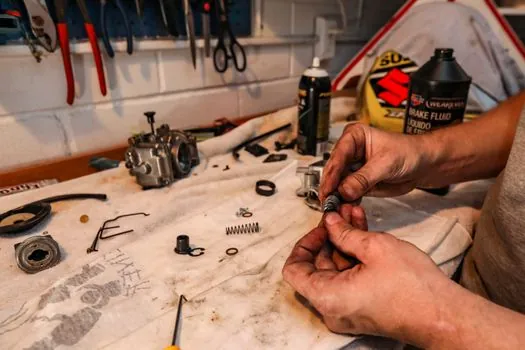
Vanes gummed by incorrect oil, dried-up hammer grease, and a seized air-inlet screen are the three highest-frequency field failures on consumer-grade air impacts, and all three are inside a $30-$50 rebuild kit [S5]. Hammer-pin breakage is the most common mechanical failure on the Ingersoll Rand 231-class 1/2" drive impacts and is "cheap to repair" with the OEM service-parts channel (2020-04) [S5].
Failed housings, cracked anvils, scored cylinder bores, and stripped hammer-cam grooves are the failures that sink rebuild economics, since the part cost alone approaches a bare new tool. If the failure is unknown, the Garage Journal consensus on a 30-year-old NAPA gun was to "take it apart, see what's wrong with it... then go buy a new one" (2020-04) [S5]. Diagnostic disassembly takes under 30 minutes on most 1/2" drive impacts and converts an unknown failure into a parts-list decision.
Air Tool Maintenance Economics Inside a 2026 Shop
Air impacts require daily oiling and produce high noise, with "high system cost, low tool cost" as the documented ownership profile versus cordless (2026-07) [S2]. That profile means the compressor, hose, FRL, and oiler are sunk capital, so saving the $40-$110 tool via a $30-$50 kit is pure margin recovery. A 1/2" drive aftermarket MG725/MG725A tune-up kit is sold as a standalone replacement-parts set specifically to "ensure smooth operation and long-lasting performance" on that platform [S6].
Industrial buyers running pneumatic tool fleets should treat rebuild kits as planned-maintenance inventory, not emergency purchases. Stocking $30-$50 kits per platform, paired with a 1-2 year scheduled overhaul cycle on high-use impacts, recovers the OEM "peak performance" window without paying full replacement cost [S4]. The repair-vs-replace conversation converges on fleet age: tools under 10 years with available parts get rebuilt; tools over 20 years with undocumented service history get replaced. For a deeper lifecycle-cost framework applied to rotating equipment, the same purchase-vs-total-cost logic is documented in mechanical seal TCO analysis.
Sources, Standards, and Service-Channel Validation
OEM service channels (Ingersoll Rand, Chicago Pneumatic, ARO) operate authorized repair and warranty centers that rebuild to factory specifications using genuine parts kits, with documented coverage for impact wrenches, nutrunners, ratchet wrenches, grinders, and the full air-tool line (2026) [S3]. No external standard governs the rebuild decision itself; the cited cost numbers are owner-reported and dealer-quoted rather than drawn from an industry-association reference.
Cross-referenced decision data points: $40 rebuild kit and $50 labor for a CP734H-class 1/2" drive, $115.11 new replacement (2019-11) [S1]; $30 owner-rebuild on a 30-year NAPA 1/2" drive (2020-04) [S5]; $40-$150 bare air-tool replacement versus $150-$400 bare cordless replacement (2026-07) [S2]; OEM 1" drive tune-up kits marketed for peak-performance maintenance on Ingersoll Rand platforms (2026) [S4]; aftermarket MG725/MG725A repair kit as a generic-platform consumable set (2026) [S6]. Encyclopedia anchors for the underlying tool class are at air impact wrench and impact drill, with the broader maintenance workflow covered in air pick. For shops deciding whether to standardise on pneumatic, cordless, or corded platforms, the 2026 comparison in cordless vs air vs corded impact wrenches gives the full feature matrix (2026-07) [S2].
Trackable next signal: monitor OEM quarterly updates to tune-up kit part numbers for 1/2" and 1" drive Ingersoll Rand and Chicago Pneumatic impacts, since part-number supersession is the leading indicator that a platform's rebuild support window is closing. A second signal is the spread between bare cordless and bare air tool entry prices, which closed modestly in the 2026-07 data set and will determine whether cordless crossover keeps eating into the pneumatic rebuild economics [S2].