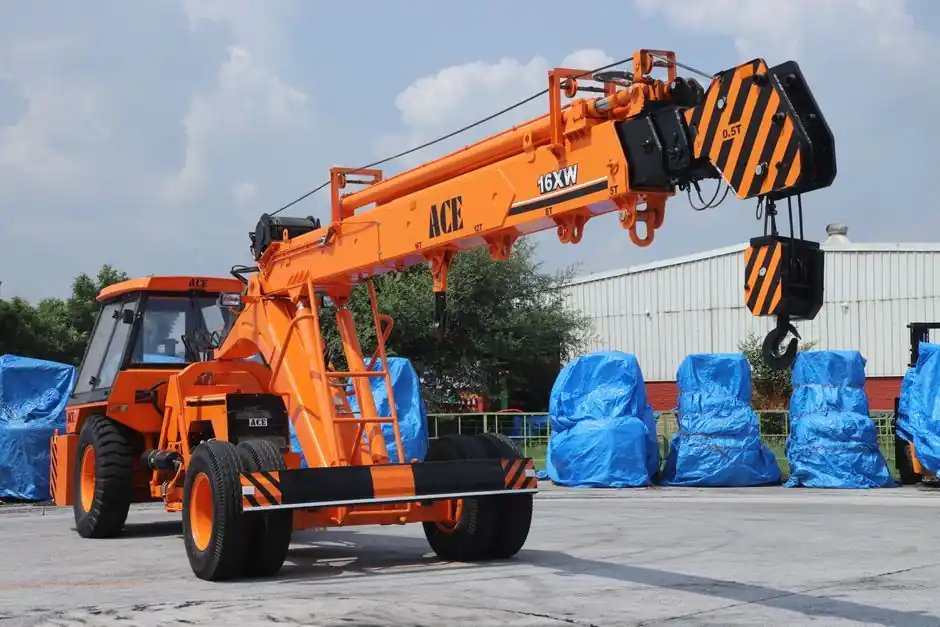
Material handling gear, including conveyors, hoists, and crane slewing rings, depends on angular contact bearings that carry combined radial and axial loads, with the duplex back-to-back (DB) arrangement being the default for reversing or bidirectional thrust service [S1].
NTN's 7314BDB duplex angular contact ball bearing, drawn as a back-to-back matched pair on the manufacturer's Bearing Finder tool, typifies the 70 mm bore class commonly used in palletizer heads, crane sheaves, and heavy-duty material handling drivetrains [S1].
Load Case and Contact Angle Geometry
A 40 degree contact angle on a 7314-series bearing raises axial load capacity by roughly 50 percent relative to a 25 degree version of the same bore, at the cost of lower limiting speed; the 25 degree variant is the typical choice for conveyor idler and gearbox input shafts, while 40 degree is reserved for crane slew and hoist drum service [S1].
Back-to-back (DB) mounting widens the effective load triangle between the two lines of action and resists tilting moment, which is the dominant failure mode in chain-drive live-shaft conveyors; face-to-face (DF) mounting narrows the load triangle and tolerates misalignment, so it is used where shaft deflection is expected and where axial clamping is delivered by the housing shoulder rather than the inner ring [S1].
Tolerance, Clearance, and ISO 15 Class
Angular contact ball bearings in material handling are commonly built to ISO tolerance class 5 (ABEC-5) for general conveyor and hoist service, with ISO class 4 reserved for high-speed gearbox stages above 3,600 rpm and ISO class 2 used in machine-tool spindles; tighter classes raise friction-generated heat and are not justified for the 200 to 1,800 rpm operating band of most storage handling equipment [S1].
Internal clearance must be specified in matched sets: a C3 clearance is the standard recommendation for 7314BDB applications in steel-mill overhead conveyors where the inner ring operates 20 to 40 K hotter than the housing; C4 is reserved for cases where the temperature differential exceeds 50 K [S1].
Cage, Lubrication, and Grease Service Life
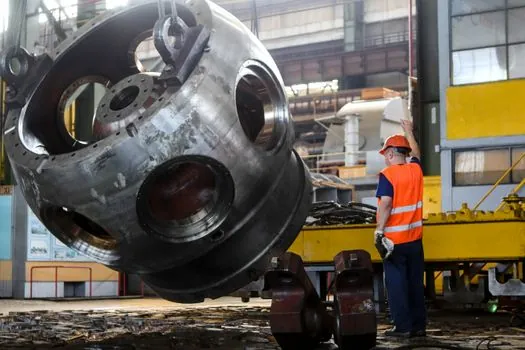
Pressed-steel cages (suffix J) suit general material handling at temperatures up to 120 degrees C, while brass cages (suffix M or Y) are specified for shock-loaded hoist service above 150 degrees C, with phenolic resin cages limited to 120 degrees C continuous and banned from any application where lubricant starvation is a credible failure mode [S1].
For 20,000 hour L10 grease life in a 7314BDB at 1,500 rpm and a 70 mm bore, the target fill is 25 to 35 percent of the free volume with NLGI grade 2 lithium-thickened mineral oil grease of base oil viscosity 100 to 200 mm^2/s at 40 degrees C; conveyor idlers commonly use grease-impregnated shielded 2RS variants with no relubrication provision [S1].
Comparing Duplex, Single Row, and Double Row Options
Single-row angular contact bearings require a second opposed bearing to locate the shaft axially, adding assembly complexity; the duplex back-to-back pair (DB) integrates this into one matched unit and is the default for reversing service, while the double-row type fills a similar role in a single-ring package at the cost of higher friction and lower speed [S1].
On four decision criteria, the duplex back-to-back type rates: (1) axial load capacity, where DB rates 5 of 5 and single row rates 3 of 5 because it shares load with an opposed bearing whose alignment is not guaranteed; (2) reversing service, where DB rates 5 of 5 versus double row at 4 of 5 because each row of a double row is loaded in only one direction at a time; (3) limiting speed, where single row rates 5 of 5 and DB rates 4 of 5 due to the additional contact zone generating heat; (4) misalignment tolerance, where double row rates 3 of 5 and DB rates 2 of 5 because the wider effective span magnifies the moment from any shaft deflection [S1].
Material Selection for Corrosive and Hygienic Service
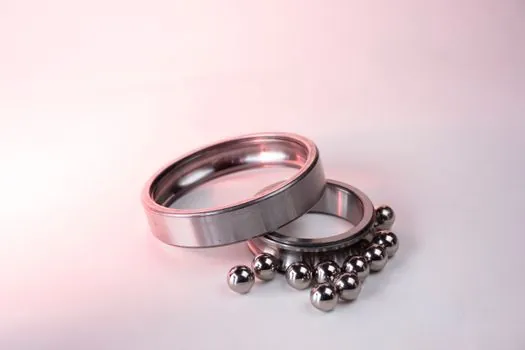
Standard 7314BDB components use through-hardened chromium steel with stamped steel or brass cages, which is sufficient for dry, indoor conveyor service but inadequate for washdown or chemically aggressive environments common in food-grade or fertilizer-handling plants [S1].
For these cases, a ceramic bearing hybrid (steel rings with silicon nitride rolling elements) upgrades corrosion resistance, tolerates lubricant starvation far better than all-steel, and reduces centrifugal load at high speed; the trade-off is roughly three to four times unit cost and a requirement for controlled mounting force to avoid race damage from the harder balls [S1].
Mounting, Shaft Fit, and Field Failure Modes
For 7314BDB on a 70 mm shaft, the standard fit recommendation is a tight interference fit on the inner ring (shaft tolerance k6 for solid steel shafts, m6 for hollow shafts) and a loose fit on the outer ring (housing tolerance H7 or J7) so thermal expansion of the shaft does not preload the bearing beyond its intended clearance band [S1].
Adjacent Applications and Cross-Reference
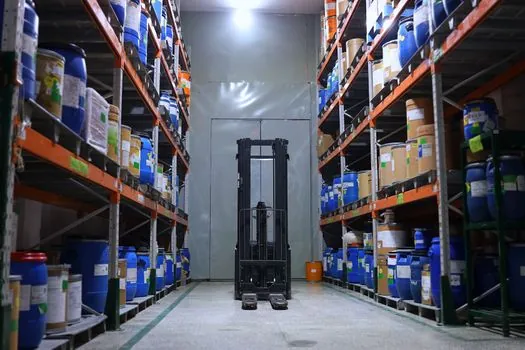
For packaging lines, where 30 to 40 percent of bearings now run on stainless or hybrid constructions and the spec map centers on 30 mm to 50 mm bores, the parallel article on angular contact bearing selection for packaging lines covers the lubrication and cleaning-rail changes specific to washdown service. [S1]
For ball bearing applications where combined loading is not a concern, deep-groove types suffice and at lower cost; for linear slides on gantry crane bridges, the linear bearing family takes over and the selection logic is entirely different, driven by stroke length, moment loading, and lubrication interval.
The next signal to track is the 2026 update of ISO 15:2017, which sets the tolerance class envelope for all single-row and duplex angular contact bearings and is the governing reference when an engineering drawing cites a 7314BDB on a material handling specification; for procurement, the verified next node is the NTN Bearing Finder CAD download for 7314BDB, which carries the sealed dimensions, fits, and permissible speed values needed to lock the drawing release [S1].