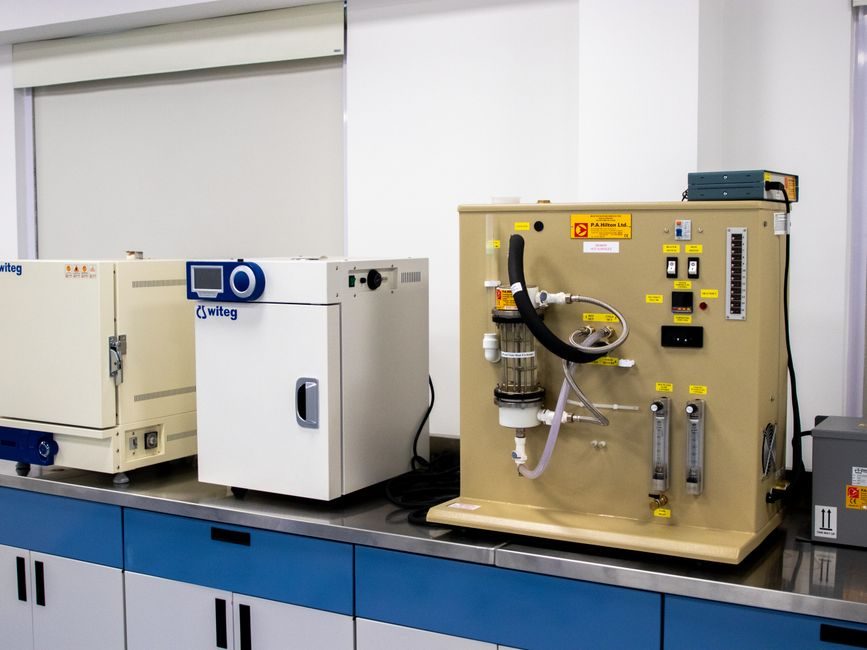
Anti-static equipment pricing in 2026 is best read as a five-band stack, with handheld static-elimination test units on Made-in-China listed at US$78.00-108.00 per piece at a 5-piece MOQ from Dongguan City Keyuan Anti-Static Equipment Co., Ltd [S3], while capital equipment such as Simco-Ion-class power-supply controllers sits in the several-hundred to low-thousand USD bracket per workstation [S1].
The product family covers ionizer bars and controllers, wrist straps and heel grounders, anti-static safety shoes, ESD-safe curtains, and bench-top static testers; a complete anti-static equipment selection map sits in our spec encyclopedia, and the cost basis is essentially a hardware BOM plus a compliance-certificate adder (IEC 61340-5-1, ANSI/ESD S20.20) that buyers should price in rather than discover on a rejected PO.
Five Product Bands and Where the Money Goes
The cheapest tier on the open 2026 market is China-sourced bench-top static-elimination test devices, listed at US$78.00-108.00 per piece for a 5-piece MOQ, with no published certification language beyond the manufacturer's own datasheet [S3]; these are typically purchased for QA bench use or low-volume electronics assembly, not for line-critical ionization.
The second band covers consumables and personal grounding: wrist straps, heel grounders, ESD mats and common-point grounding hardware, stocked at ULINE-class North American distributors with same-week shipping and per-unit prices typically in the single-digit to low-double-digit USD range [S2].
The third band covers consumable garments and apparel: anti-static safety shoes, oil/water-resistant leather ESD boots, and anti-static curtains for window shielding, both commonly sourced on Made-in-China and Okorder at price points governed by material and MOQ; anti-static PVC/Venetian-style window blinds are listed on Okorder at a 10 m² MOQ, with paper-box/PVC/PET packaging and a 45 mm headrail-style accessory stack [S6].
The fourth band covers ionizer bars, overhead ionizing blowers, and bench-top ionizers with their power-supply controllers; Simco-Ion's product family is the canonical reference for this tier, with a controller-class "A Unit" power supply documented on DirectIndustry as the integrating backbone for a multi-bar workstation [S1].
The fifth band covers engineered turnkey ESD-protected areas (EPAs) and cleanroom-grade ionizers, where the price step is driven by certification documentation, ion-balance trim (typically ±35 V or tighter), and cleanroom-compatible low-VOC materials rather than raw electronics.
Decision Criteria: What Drives the 3-10x Price Step
Ionizer bar and controller pricing is dominated by three variables: discharge technology (AC corona versus pulsed-DC, with pulsed-DC commanding roughly a 20-40% premium for faster decay times), balance tolerance, and cleanroom-rated enclosure materials [S1].
Personal-grounding consumables are price-stable across 2026 because the bill of materials is essentially a 1 MΩ resistor, a coil cord, and a molded plug; ULINE-class channel pricing [S2] suggests year-on-year movement in the low single-digit percent range, well below industrial-instrument inflation. Anti-static safety shoes, by contrast, track leather and rubber commodity pricing on the 6-12 month lag, so a 2025-2026 move in oil/water-resistant leather ESD boot offers will reflect upstream hide and oil-resistant outsole cost [S5].
For engineering buyers, the comparison question is rarely "which ionizer" but rather "where on the controller-stack price curve to enter" — a static pressure molding machine cell, an anti-static equipment workstation, and an ESD-test bench share the same instrumentation-grade power-supply cost logic, and the controller is usually the largest single line item after the ionizer hardware itself [S1].
Comparison: Equipment Class vs Typical 2026 Price vs Best-Fit Use

Static-elimination test meters (Dongguan Keyuan-class): US$78-108 per piece at 5-piece MOQ; best fit is incoming-inspection QA and field service on smaller electronics lines [S3].
Personal grounding consumables (ULINE Grp 131): typically sub-US$20 per item with same-week North American fulfillment; best fit is any EPA where ANSI/ESD S20.20 common-point grounding is required [S2].
Anti-static safety shoes and boots: 2026 offers from Made-in-China cluster around the mid-teens to low-hundreds USD per pair depending on outsole spec, leather grade, and toe-cap rating [S5].
Anti-static window curtains: priced per square meter on Okorder with a 10 m² MOQ, with paper-box/PVC/PET packaging and motorized or manual tilt options [S6].
Ionizer bars with Simco-Ion-class controllers: industrial capital equipment in the multi-hundred to low-thousand USD per workstation; best fit is SMT, back-end semiconductor, and cleanroom assembly [S1].
Who This Guide Is For, and Who It Is Not
For a sourcing engineer building a new EPA on a fixed capex, the controller-and-bar pair is the line item to negotiate; for a facilities manager refreshing wrist straps across 200 benches, the consumable tier from a ULINE-class distributor is the correct channel [S2]. The guide is less useful for cleanroom-class semiconductor fabs, where ionizer specification is tied to a tool-set qualification and pricing is non-catalog, or for hazardous-area sites where the relevant cross-reference is insulated tools for live electrical work rather than ESD control.
Limitations, Failure Modes and Reading the 2026 List Prices
List prices on Made-in-China and Okorder exclude certification paperwork, tooling NRE for OEM-branded enclosures, and the cost of a cleanroom-compatible particulate-shedding audit [S3][S6]; a buyer who treats US$78-108 as a turnkey landed cost for an EPA will under-budget by a factor of 5-10 once documentation, calibration, and installation are added.
Ionizer balance drift is the most common field failure mode: an uncalibrated bar can swing ±100 V and still pass a basic on/off functional test, which is why specifying a calibrated balance (typically ±35 V or tighter for SMT-class work) and a re-calibration interval is cheaper than discovering the problem at first-article inspection [S1].
Sourcing Channels, MOQ Logic and Standards Anchors
Three channels carry the bulk of 2026 anti-static equipment procurement: China-direct platforms (Made-in-China, Okorder, Alibaba) for lowest unit cost and widest SKU spread at the consumable and garment tiers [S3][S5][S6]; North American industrial distributors (ULINE, Grainger-equivalent) for same-week fulfillment on personal-grounding and mat hardware [S2]; and OEM-direct (Simco-Ion-class) for capital ionizer bars and controllers with full IEC 61340-5-1 and ANSI/ESD S20.20 traceability [S1].
MOQ economics differ sharply by channel: 5 pieces for a static-elimination tester on Made-in-China [S3], 10 m² for anti-static curtains on Okorder [S6], and 1-piece catalog orders for consumables on ULINE [S2] — meaning the cost-per-square-meter of an EPA drops non-linearly as order size rises past the break-even for ocean freight from South China.
On the linear guide and crossed-roller guide side of a motion-plus-ESD workstation, the controllers share a similar industrial-power-supply BOM, and that is why a Simco-Ion-class A Unit sits in the same budget conversation as motion-axis power electronics [S1]. For buyers comparing ionizer controllers to other industrial power-electronics line items, the power semiconductor pricing 2026 thread covers the IGBT/SiC wafer pass-through that also drives controller-board cost.
Two trackable signals into late 2026: the spread between Made-in-China static-tester list and ULINE consumable list has held within roughly 10-15% across 2025-2026 and is the single best leading indicator of whether the 2026 anti-static equipment price band will hold; a move above 20% would mark the first sign of tariff or freight pass-through into the entry tier. The second is whether Simco-Ion-class OEM direct quotes re-quote above the 2025-12 reference listed in [S1] when the next 2026-Q3 RFQ cycle opens.