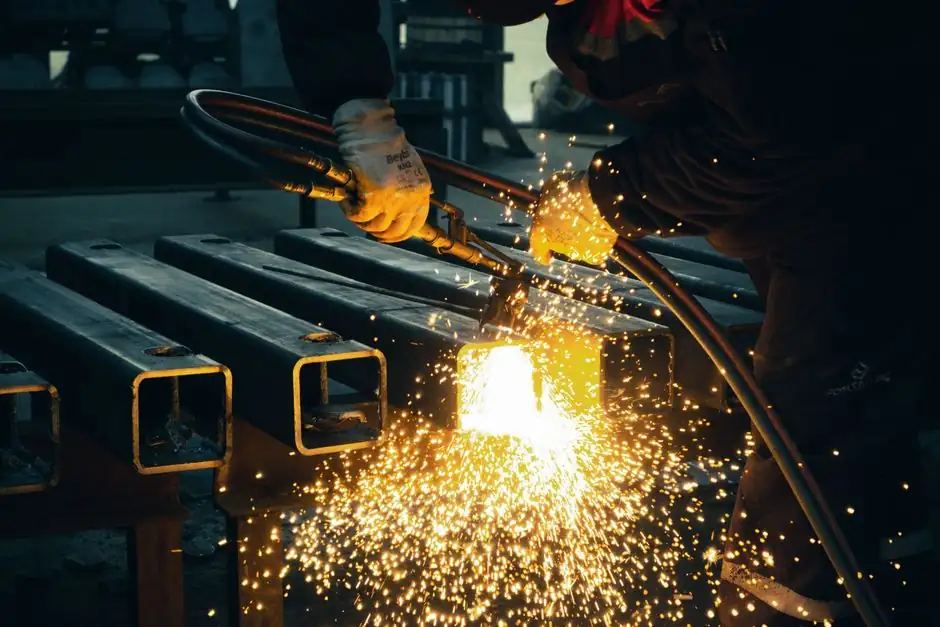
AR400 and AR500 are the two most specified abrasion-resistant steel plate grades, separated mainly by a nominal 100-point Brinell hardness step: AR400 measures 360-440 BHN, AR500 measures 460-550 BHN per multiple mill and distributor datasheets [S2][S4].
The "AR" number is the nominal Brinell Hardness Number, not a guaranteed minimum: AR400 is not a certified 400 BHN plate, and AR500 is not a certified 500 BHN plate. Each grade carries a tolerance band, and several industry write-ups note that commodity AR plate is not covered by a single governing standard [S6]. Engineers should spec against the published BHN range and chemistry limits, not the nominal number.
Hardness and Chemistry: What the Brinell Number Actually Means
Brinell hardness for AR plate is measured with a 10 mm hardened steel ball under a 3,000 kgf load, and the indentation size is read with a calibrated scope to produce the BHN value [S2]. The 360-440 BHN window for AR400 and the 460-550 BHN window for AR500 are widely cited across mill pages, service centers, and reference data, with one Wikipedia compilation placing the AR500 ceiling at 544 BHN [S2][S3][S4][S7].
AR500 is chemically similar to AR400, but carries higher carbon and manganese content to push surface hardness up through the quench-and-temper heat treatment [S2]. As the carbon-manganese-silicon content rises, BHN climbs, but ductility, formability, weldability, and impact resistance all fall: a tradeoff flagged explicitly in the Tricon guide and in distributor technical bulletins [S3]. Once the hard surface layer of a commodity AR400 plate wears through, the softer core behaves like mild steel, so plate selection on hardness alone can mislead buyers who skip the through-thickness check [S6].
Impact Resistance vs Abrasion Resistance: The Real Selection Axis
The defining operational split between AR400 and AR500 is not hardness, it is the impact-to-abrasion ratio of the service environment. AR400 absorbs more energy before cracking, which is why it is the default for dump truck beds, where falling rock delivers repeated high-energy impacts [S1][S2][S4]. AR500 absorbs less impact energy and is more prone to cracking under dynamic loading, but its harder surface resists sliding abrasion far better, which is why it dominates chute liners, target plates, and ballistic panels [S1][S2][S4].
The Clifton Steel quarry example makes the split concrete: a dump-truck bed that catches falling rock needs AR400 to survive impact without shattering, while a downstream chute where the same rock slides out of the crusher needs AR500 to outlast AR400 under sliding wear [S2]. The same material, the same quarry, two different liners, two different grades: that is the selection logic in one paragraph.
Decision Matrix: AR400 vs AR500 on Five Criteria
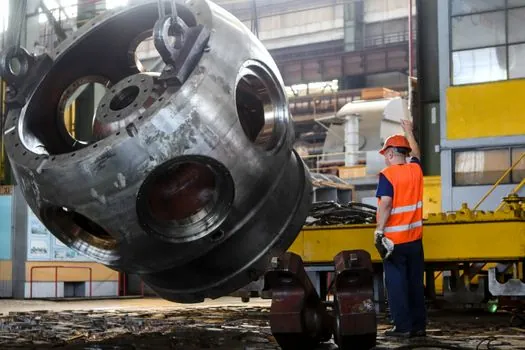
Hardness: AR400 = 360-440 BHN, AR500 = 460-550 BHN. The AR500 surface is harder and therefore more abrasion-resistant under sliding contact [S2][S3][S4].
Impact toughness: AR400 is the tougher of the two, with higher ductility and a lower crack risk under repeated impact. AR500 is more brittle and more likely to crack from impact or during forming [S1][S2][S4].
Weldability and formability: AR400 is easier to weld and cold-form. AR500 is more difficult to weld, more likely to crack during welding or cold forming, and more sensitive to cold-weather fabrication [S3][S4]. Preheating and low-hydrogen consumables are commonly required for AR500, while AR400 is routinely welded in the field with standard procedures [S3][S4].
Sliding-abrasion life: AR500 lasts longer than AR400 in pure sliding or scraping service, which is the use case for which it was developed [S1][S5].
Application fit: AR400 fits dump truck beds, crusher liners, bulldozer blades, hoppers, chutes that see impact, and wear strips where forming is required. AR500 fits ballistic armor and shooting targets, mining and aggregate equipment liners, and chute or conveyor sections where the load slides rather than drops [S1][S2][S4][S5].
Forming, Welding, and Fabrication Constraints
AR400 can be cut, formed, and welded with standard shop practice, though its high carbon content still demands preheat and low-hydrogen consumables on thicker sections. AR500 is more demanding: the same higher carbon and manganese that push hardness to 470-525 BHN also raise the crack risk during welding, cold forming, and field installation in cold weather, so fabricators should plan for tighter procedures, more preheat, and stricter interpass control [S3].
Through-thickness hardness is a second-order risk that gets ignored. The Brinell test is a surface test, so it does not capture the hardness gradient from the hardened skin to the softer core; once the surface wears through on a thin or cheap AR400 plate, wear life can collapse to mild-steel levels [S3][S6]. For severe service, request through-thickness hardness surveys or specify an alloyed AR product (for example, a chrome-moly-boron Tri-Braze-type plate) rather than a commodity AR400 [S3].
Where AR500 Earns Its Premium and Where It Is the Wrong Pick
AR500 earns its higher per-pound price in sliding-abrasion service: target plates, armor, aggregate chutes, conveyor skirts, and bucket liners where the rock slides or scrapes rather than falls [S1][S5]. It is the wrong pick for dump bodies, crusher jaws, or any liner that takes repeated high-energy impact, where AR400 will outlast AR500 by absorbing the energy instead of cracking [S2][S4].
AR500 is also the wrong pick when the design depends on cold forming or heavy field welding, because the same hardness that delivers wear life makes the plate crack-prone during fabrication [S3]. For mixed-mode service, where a chute sees both sliding abrasion and occasional large-rock impact, the practical answer is often a hard-facing overlay on an AR400 backing plate rather than a monolithic AR500 liner.
Standards Gap and Buyer Caveats
AR400 and AR500 are not defined by a single ASTM or ISO specification the way A36 or A514 are. They are trade-grade designations, and the actual chemistry, hardness band, and impact guarantees vary by mill, which is why published BHN ranges from different sources can drift by 10-20 points at the edges [S6]. Treat the AR number as a hardness target, then validate the actual chemistry, hardness band, through-thickness profile, and impact guarantee on the mill test report before signing a PO.
For ballistic or armor-critical AR500 use, do not assume that commodity AR500 meets a specific threat rating. NIJ or MIL-SPEC compliance is a separate certification chain layered on top of the AR500 base material, and not every distributor stocks armor-certified plate. For general mining and aggregate service, the mill test report plus a documented BHN survey on the lot is usually enough.
For engineers mapping SPC flooring wear-layer thickness against material hardness as a procurement analogy, the pencil hardness test standard for PVDF coated aluminum panels reference frames a different but parallel hardness-spec discussion worth scanning before locking the AR plate spec. The closer-watched next node is the ASTM work on through-thickness hardness for quenched-and-tempered abrasion-resistant plate, which would close the surface-only BHN test gap that currently forces buyers to rely on mill reputation. Track any movement on a unified AR plate standard through SAE J1392 and ASTM A01 committee outputs over the next two reporting cycles.