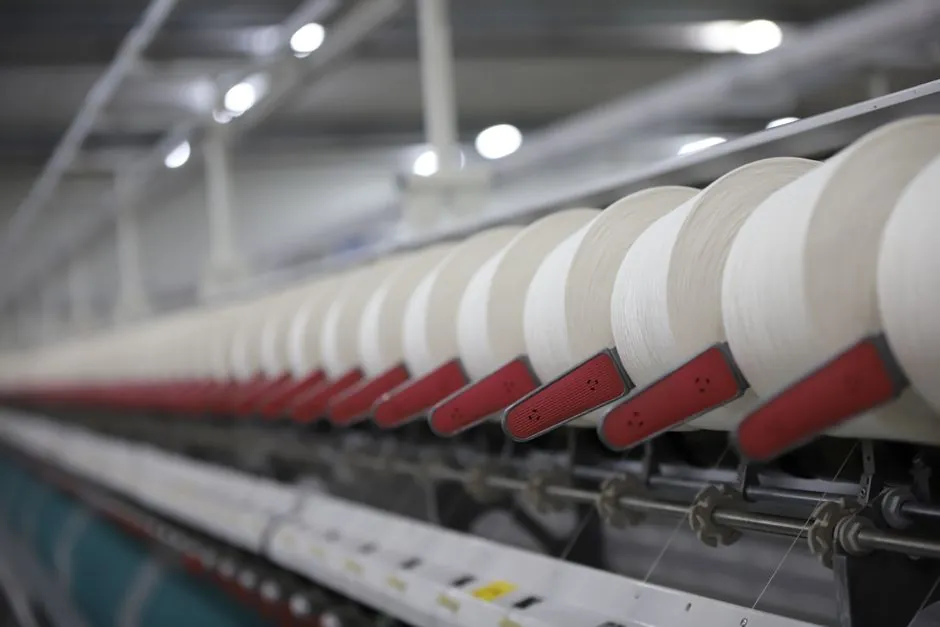
Procurement teams that still treat aramid as a single SKU lose money twice: once on the wrong fiber family, once on the wrong supply region. The defensible move in 2026 is to separate the decision into three layers: which aramid chemistry, which conversion form (yarn, fabric, webbing, cord), and which origin-policy tier the contract requires.
The first gate is chemistry. Para-aramid (Kevlar, Twaron) and meta-aramid (Nomex) sit on the same aromatic-polyamide backbone but behave very differently under heat and load, and they are priced and supplied through different global channels [S1]. Skipping that distinction is the most common error in first-time aramid RFPs.
Para-Aramid vs Meta-Aramid: What the Spec Sheet Actually Shows
Para-aramid (Kevlar-class) holds continuous service temperatures up to 250C, with an inherent Limiting Oxygen Index of 29 and EN 388 cut ratings in the C–E band; meta-aramid (Nomex-class) tops out near 220C continuous, LOI 28, with EN 388 cut ratings in the A–B band [S1]. Both self-extinguish in atmospheric oxygen without chemical flame-retardant finishes, so the wash-out failure mode common to treated FR cotton does not apply to genuine aramid [S2].
For drives and mechanical reinforcement, para-aramid yarn is the practical choice. In PU timing belts it gives low weight, clean bending around small pulleys, and stable tensile strength where the drive path is dynamic, while steel-cord reinforcement remains the better pick for long linear axes where stretch control dominates over flexibility [S4]. Translating that into procurement language: specify para-aramid cord for compact, high-cyclic drives; reserve steel-cord belts for long-travel, high-tension axes where the buyer accepts the stiffness trade-off.
Compliance and Standards: The Non-Skip Gates
Procurement officers sourcing high-temperature aramid fabrics must verify compliance with the relevant international safety standard for the end use: NFPA 1971 or EN 469 for structural firefighting turnout gear, ISO 11612 for industrial heat-and-flame clothing, and EN 407 for thermal-risk gloves [S2]. For ballistic end uses, the [S1] reference to aramid netting and [S5] guidance point toward NIJ CPL listing as the operative gate rather than any specific country-of-origin rule.
For safety netting specifically, the binding standards are EN 1263-1 for construction safety nets, NFPA 1983 for fire-service life-safety rope, and ANSI/ASSE A10.11 for construction nets, with material traceability backed by ISO 9001:2015 certification and lot-level mill certificates [S1]. Asking for the certificate number per shipment, not just a generic "ISO certified" claim, is the cheapest due-diligence upgrade a buying team can make.
Origin Policy: Domestic vs Imported, and the Berry Misconception

For US law-enforcement and most non-DoD buyers, domestic-vs-imported is a preference, not a legal requirement; the Berry Amendment (10 USC §2533a) applies to the US Department of Defense, with federal, state, municipal, and corrections agencies outside its scope unless a specific grant program imposes its own content rule [S5]. This matters because RFP language that mimics Berry wording can illegally narrow the bidder pool without delivering any compliance benefit.
Imported aramid and UHMWPE fibers typically run 10–20% below US-produced equivalents on bulk procurement, and NIJ CPL verification applies equally to Twaron, Alkex, and imported Dyneema products as to US-made equivalents [S5]. Supply-chain risk remains a legitimate counter-argument: a single foreign plant outage (Teijin Twaron at Arnhem, Korean Alkex lines) can stall fielded armor deliveries for months, which is why some agencies write a soft domestic preference into the scoring matrix rather than a hard domestic requirement [S5]. For a related industrial-fibre perspective, see the Sourcing Glass Fiber from China: Spec Gates, Cluster Map, and Verification breakdown of cluster-based buying.
Forms and Converted Products: What to Put on the PO
Aramid is bought by the buying organization in very different physical forms, and the form dictates both the spec sheet and the price. Common procurement line-items include aramid webbing (10–50mm width, 1.0–3.0mm thickness) for net edge binding and anchor straps, aramid rope (3–16mm diameter, twisted or braided) for net grid lines and perimeter cables, aramid tape (15–100mm width, tubular or flat) for reinforcement strips, and aramid sleeve (6–50mm diameter, expandable) for cable protection and thermal insulation [S1].
Woven and knitted aramid fabrics cover a separate set of part numbers. Engineered aramid-nylon hybrids blend high-tenacity para-aramid with high-wear nylon to push scuff and tear resistance, and are commonly used as knee and elbow reinforcement on turnout gear, tactical uniforms, and heavy motorcycle jackets; knitted aramid gloves and woven insulation blankets address contact heat, molten-metal splash, and welding-spark exposure [S2]. When the application runs hot and dynamic, a para-aramid fibre core combined with a carbon-aramid hybrid fabric face can deliver stiffness and thermal performance in one laminate.
Inspection, Service Life, and Failure Modes
Aramid netting should be inspected before each use and replaced if cut, abraded, or heat-exposed, with a typical service life of 3–5 years under normal industrial conditions [S1]. The two predictable failure modes are UV degradation on outdoor installations (mitigated by UV-resistant sheath or coating) and knot-induced strength loss in knotted nets, where knotless construction retains a higher percentage of original tensile strength and is the right call for fall-arrast applications [S1].
For drive belts, the equivalent failure mode is stretch creep and tooth-engagement drift when the reinforcement is mismatched to load: para-aramid cords tolerate smaller pulleys and faster start-stop cycles, while steel-cord PU belts hold length better on long linear axes but punish tight bending paths [S4]. In both cases the buyer should key the line-item to the application, not to a generic "aramid" label. A linear guide running with an aramid-reinforced belt behaves very differently from a crossed-roller guide drive on the same shaft, and the procurement record should reflect that.
Decision Matrix: Which Aramid, Which Standard, Which Origin Policy
A clean RFP response maps end use to chemistry, standard, and origin in one line. Para-aramid fabric or yarn to NFPA 1971 / EN 469 with domestic-preferred scoring for US fire-service turnout gear; para-aramid UD or woven panel to NIJ CPL for hard armor, with imported fiber permitted under a 10–20% cost-differentiation scoring rule; meta-aramid fabric to ISO 11612 for industrial plant PPE where continuous temperatures sit between 200C and 250C; aramid webbing or rope to EN 1263-1 or NFPA 1983 for safety-net and life-safety rope assemblies [S1][S2][S5]. For lightweight industrial drives, para-aramid PU timing belt to the original equipment's pitch and width spec, not a generic "aramid belt" substitution [S4].
The single largest variable in landed cost is the fiber family, not the origin country, so the next auditable signal to watch is para-aramid versus meta-aramid price spread in Q4 2026 contracts, plus any NIJ CPL or NFPA-certified mill expansion announcements from Asian producers that would shift the domestic-premium band. Procurement teams that lock the chemistry and standard first, and treat origin as a separate scoring line, will avoid both the Berry-mimicry trap and the wrong-fiber-family retrofit.